
APT-130 · Lesson 8 of 12 · 25 min
Returns, exchanges and core charges
▶ Video coming soon A video version of this lesson is on the way.
On Friday, October 30, three returns came to the front counter in an hour. A customer brought back an unopened air filter he no longer needed. Another brought back an ignition coil she had bought the week before; the box was open and she said it "didn't fix it." A third returned an old starter as the core for the remanufactured one he had bought, but the old starter's housing was cracked. Talia handled the filter easily, called Imani for the coil, and was not sure what to do about the starter. "Every return is a little different," Imani said. "That's why we have a policy, and why we read it to the customer before the sale, not after."
Returns are part of every parts business. Customers buy the wrong part, buy two to be safe, change their plans, or find that a part was not the cause of their problem. Remanufactured parts bring back cores. Handling returns fairly and consistently keeps customers coming back and protects the department from losses. This lesson explains return policies, restocking fees, parts that cannot be returned, exchanges, and core charges and inspection.
Why return policies matter
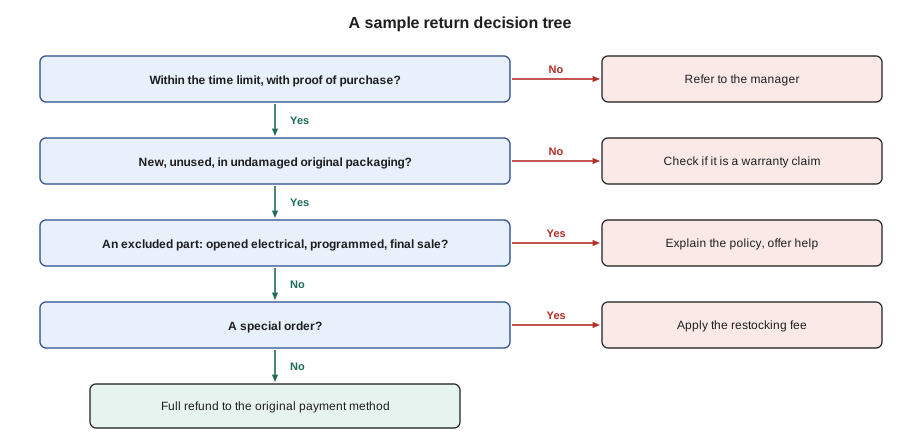
A return policy sets out which parts can be returned, for how long, in what condition, with what proof of purchase, and for what kind of refund. It protects the customer, who knows the rules before buying, and the department, which cannot afford to take back parts it cannot resell or return to its own supplier.
The law sets the baseline. In Ohio, as in most states, there is no general law requiring a store to accept returns for a change of mind; the store's own posted policy decides, while products that are defective or misrepresented are covered by warranty and consumer protection law. Because the policy is the department's own, it must be clear, applied the same way to every customer, and shown before the sale: on signs at the counter, on the receipt, and on the online store.
A typical dealership parts return policy includes these terms, though every department sets its own:
- Time limit: returns within a set number of days, often 30, from the purchase date.
- Proof of purchase: the receipt or invoice number, which the DMS uses to find the sale and the price paid.
- Condition: new, unused and uninstalled, in the original undamaged packaging with all pieces.
- Refund method: to the original payment method, or a credit to the account.
- Exclusions: parts that cannot be returned, listed below.
- Restocking fee: a charge on some returns, especially special-order parts.
Parts that usually cannot be returned
Some parts are not returnable once sold, and the reasons are practical. Most departments list them on their policy and tell the customer before the sale:
- Electrical and electronic parts that have been installed or whose packaging is opened, such as sensors, modules, coils and switches. Once installed, they cannot be sold as new, and a static discharge or a wiring fault can damage them in ways that cannot be seen. Many suppliers will not accept them back, so the department cannot either.
- Special-order parts that the supplier will not take back, or will take back only with its own restocking fee.
- Parts that have been installed or show signs of installation, such as tool marks, grease or scratches.
- Fluids, chemicals and opened supplies, for safety and quality reasons.
- Programmed or coded parts, such as keys and modules matched to a VIN.
- Clearance or final-sale items, when marked as such.
A part that was installed but did not fix the problem is the most common difficult return. The customer is often frustrated, and they may be right that the part was the wrong diagnosis. But the part was not defective, and the department cannot resell it. The fair answer is to explain the policy kindly, check whether the part is actually defective (lesson 9), and suggest a diagnosis by a technician. This is the case Imani handled with the ignition coil: it was tested, found to work, and could not be refunded, but Imani booked the customer a diagnostic appointment and the customer left calmer than she arrived.
Restocking fees
A restocking fee is a charge deducted from the refund to cover the cost of handling a return: checking the part, repackaging it, returning it to stock or to the supplier, and any fee the supplier charges the department. Restocking fees are common on special-order parts and on returns of stocked parts outside the normal policy, and a typical fee is 15 to 25 in 100 of the price. The fee must be stated in the policy and, for special orders, in the quote (lesson 4).
Worked problem
A special-order return
A customer special-ordered a door mirror assembly for 312.00 dollars before tax, then sold the car before installing it. The part is new and in its box, returned within 30 days. The department's policy charges a restocking fee of 20 in 100 on special-order returns. What is the refund before tax?
Show solution
- Restocking fee:
- \[312.00 \times 0.20 = 62.40\ \text{dollars}\]
- Refund before tax:
- \[312.00 - 62.40 = 249.60\ \text{dollars}\]
Answer: The customer receives 249.60 dollars, plus the sales tax that was charged on that part of the price; the DMS calculates the tax on the refund. The price and fee are sample values.
When a return is accepted, the refund goes back to the original payment method where possible, or as a credit to the customer's account. Cash refunds for card purchases are usually not allowed, because they are a common route for fraud.
Exchanges
An exchange replaces one part with another, usually because the first was the wrong part. Exchanges are simpler than refunds: the wrong part is checked and returned to stock, and the right part is sold, with any price difference charged or refunded. A customer who bought the wrong part because of a counter error, such as a wrong lookup, should always be exchanged without any fee and with an apology. Lesson 2 showed why most of those errors come from listening, and why asking for the VIN prevents them.
Core charges
APT-110 and APT-120 introduced cores: the used units that remanufacturers rebuild. A remanufactured part is sold with a core charge, refunded when the customer returns the old unit in rebuildable condition. Core charges also apply to some new parts, such as batteries, which are recycled.
At the counter, the core process has three moments:
- At the sale, the parts technician explains the core charge, what condition the core must be in, and how long the customer has to return it. The invoice shows the core charge as a separate line.
- At the return, the parts technician inspects the core, matches it to the original sale, and refunds the core charge if it is acceptable.
- After the return, the core is tagged, stored and sent back to the remanufacturer, which inspects it again and credits the department.
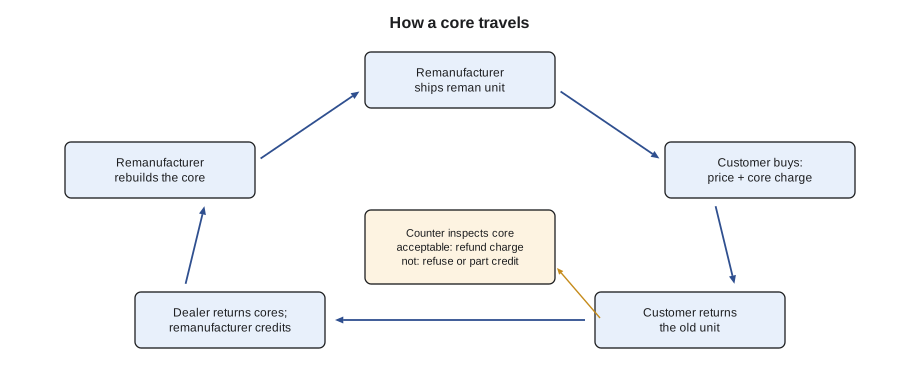
Core inspection follows the remanufacturer's rules, which the department keeps at the counter. A core is usually acceptable if it is the same part type and fits the same application, is complete, and is not broken, cracked, burnt, disassembled or badly corroded. A cracked housing, as on the starter that came back on October 30, usually makes the core unacceptable, because the remanufacturer cannot rebuild it.
| Core condition | Usually acceptable? | Why |
|---|---|---|
| Complete, same type, normal wear | Yes | It can be rebuilt |
| Dirty or oily but undamaged | Yes | Cleaning is part of remanufacturing |
| Cracked or broken housing | No | The main casting cannot be rebuilt |
| Disassembled or missing parts | No, or partial credit | The core is incomplete |
| Burnt, seized from overheating, or badly corroded | Often no | Damage may be too severe to rebuild |
| Different part number or application | No | It does not match the unit sold |
Worked problem
Core credit on a starter
The customer paid 226.00 dollars for a reman starter plus an 80.00 dollar core charge. His core has a cracked housing. The remanufacturer's rules say a cracked housing earns no credit. What does the customer end up paying for the starter, before tax, and what would he have paid with an acceptable core?
Show solution
- Paid at the sale:
- \[226.00 + 80.00 = 306.00\ \text{dollars}\]
- Core refund for a cracked housing:
- \[0\ \text{dollars}\]
- Net cost with this core:
- \[306.00\ \text{dollars}\]
- Net cost with an acceptable core:
- \[306.00 - 80.00 = 226.00\ \text{dollars}\]
Answer: With the cracked core, the customer keeps paying the full 306.00 dollars. Talia explained the rule, showed him the crack, and noted that a different, undamaged core of the same part type would be accepted if he had one. The prices are sample values.
Explaining the core rules at the sale prevents most disputes at the return. A customer who knew that a cracked or disassembled core would not be refunded is far less likely to argue than one who hears it for the first time.
Recording returns
Every return and core credit is recorded in the DMS against the original sale, so the refund, the stock and the supplier return all match. The parts technician notes the reason for the return, such as wrong part ordered, customer changed mind, counter error or defective (a warranty claim). These reasons help the manager find patterns: a part that is often returned as the wrong fit may have a catalog error that should be reported, as APT-120 explained.
Returns to suppliers
A customer return is only half the process. Once a returned part is back on the shelf, it is stock again. But parts that cannot be resold, such as a part ordered specially for one customer, a part with damaged packaging, or a failed part under warranty, usually go back to the supplier or manufacturer. Suppliers have their own return rules: time limits, condition requirements, return authorisation numbers and sometimes their own restocking fees.
The counter's job is to make that second return possible. That means checking the condition of every returned part, keeping the original packaging, labeling the part with the reason it came back, and putting it in the right place: back in its bin if it can be sold, on the supplier return shelf if it must go back, or in the warranty area if it is a failed part. APT-210 covers supplier returns and stock adjustments in detail.
Timing matters. A special-order part returned by a customer within the department's return period may still be returnable to the supplier, but only if it is sent back quickly. The longer it sits on the shelf, the more likely it is that the supplier's window closes and the department is left with a part nobody wants.
Exchanges for the right part
Most counter returns are really exchanges: the customer bought the wrong part and needs the right one. These are the easiest returns to handle well. Process the return and the new sale together, so the customer pays or receives only the difference, and confirm the right part from the VIN before handing it over. An exchange is also a moment to find out why the first part was wrong, so the error can be prevented next time.
Worked problem
An exchange with a price difference
A customer returns an unopened ignition coil bought at 68.40 dollars and needs the correct coil for his engine, which is 81.90 dollars. The return is within the period and no restocking fee applies. What does the customer pay, before tax?
Show solution
- Difference:
- \[81.90 - 68.40 = 13.50\ \text{dollars}\]
Answer: The customer pays 13.50 dollars before tax. If the new part were cheaper, the department would refund the difference instead. The prices are sample values.
Talia found that most customers returning a wrong part were embarrassed rather than angry. "They think they've wasted our time," she said. "When we sort it out quickly and without any fuss, they relax."
Returns are also information. A part that comes back often, for the same reason, points to a problem worth fixing: a catalog note that customers misread, a display label in the wrong place, or a supplier whose parts do not fit as well as they should. Imani kept a simple tally of return reasons each month and shared it with Rolf, who used it to fix the causes.
Common mistakes
MistakeExplaining the return policy only when the customer brings the part back.
InsteadExplain the policy, exclusions and core rules at the sale.
MistakeRefunding an installed electrical part because the customer is upset.
InsteadApply the policy kindly, test for a defect, and suggest a diagnosis.
MistakeCharging a restocking fee for a counter error.
InsteadExchange the part without a fee and apologize.
MistakeRefunding a core charge without inspecting the core.
InsteadInspect it against the remanufacturer's rules first.
MistakeGiving a cash refund for a card purchase.
InsteadRefund to the original payment method.
Summary and key terms
- A return policy states the time limit, proof of purchase, condition, refund method, exclusions and fees, and is shown before the sale.
- Most change-of-mind returns are governed by the store's own policy rather than by law.
- Opened or installed electrical parts, special orders, installed parts, fluids, programmed parts and final-sale items are usually not returnable.
- Restocking fees, often 15 to 25 in 100, cover handling and supplier charges and must be stated in advance.
- Exchanges for counter errors are made without fees.
- Core charges are refunded when the core is complete, the same type and not broken, burnt or disassembled.
- Return policy
- A store's rules for which parts may be returned, when and for what refund.
- Restocking fee
- A charge deducted from a refund to cover the cost of handling a return.
- Exchange
- Replacing one part with another, with any price difference charged or refunded.
- Core
- A used unit returned for remanufacturing or recycling.
- Core charge
- An amount added to a part's price and refunded when an acceptable core is returned.
- Final sale
- A sale marked as not returnable, such as a clearance item.
Practice problems
Work each problem on paper first, then reveal the answer to check.
A special order of 180 dollars is returned with a 20 in 100 restocking fee. What is the refund before tax?
Show answer
180 − 36 = 144 dollars.
Why are installed electrical parts usually not returnable?
Show answer
They cannot be sold as new and may have unseen damage; suppliers will not take them back.
A core has a disassembled housing and missing bolts. Is it usually acceptable?
Show answer
No, or only for partial credit, because it is incomplete.
A customer got the wrong part because of a lookup error at the counter. What should happen?
Show answer
Exchange it without any fee, and apologize.
Where does a refund for a card purchase usually go?
Show answer
Back to the original card.
Lesson quiz · 5 questions
Score 60% or more to complete this lesson.
Create a free account to save your progress, take quizzes and earn a certificate.