
APT-130 · Lesson 2 of 12 · 23 min
Listening and asking the right questions
▶ Video coming soon A video version of this lesson is on the way.
On Thursday, September 24, a retail customer named Petra Dunleavy came to the front counter holding a photo on her phone. "I need the thing that holds the hood up," she said. Talia started to type "hood strut" into the catalog, then stopped, remembering what Imani had told her on Monday: listen first, then look up. She asked what the car was, whether the hood had a gas strut on each side or a single prop rod, and whether she had the car outside. Petra's 2019 Arden had two struts, only the left one was weak, and the photo showed a part number on its label. Five minutes later Petra left with a pair of struts and a tip from Talia to replace both at once. "You found that out by asking," Imani said. "The catalog only answers the questions you give it."
Most wrong parts at the counter are not lookup errors. They are listening errors: the parts technician heard "brakes" and looked up pads when the customer needed a caliper, or heard "the 2.0" and assumed the wrong engine. This lesson is about the conversation before the lookup: how to listen, which questions to ask, how to confirm the vehicle and the need, and how to turn a customer's description into the information the catalog needs.
Listening before looking
Active listening means giving the customer your full attention, letting them finish, and checking that you understood before you act. At a parts counter it has a practical purpose: the customer often knows things about the problem that are not in any catalog, such as the noise it makes, what the last shop said, or which side is damaged. Those details narrow the search.
Active listening has a few simple habits:
- Stop typing while the customer explains. Looking at the screen while they talk tells them you have already decided.
- Let them finish before asking questions. Interrupting often cuts off the detail that matters.
- Take notes of anything specific: numbers, sides, symptoms, dates.
- Repeat back what you heard in your own words: "So the left hood strut on a 2019 Arden is weak, and you want to replace it yourself."
- Ask before assuming. If a word could mean two things, ask which.
Customers do not always use the catalog's words. A "shock" on the hood is a gas strut, a "sensor" could be any of dozens, and "the belt" might be a serpentine belt, a timing belt or a seat belt. Part of the parts technician's skill is translating everyday words into catalog words, without making the customer feel foolish for not knowing the term.
Open and closed questions
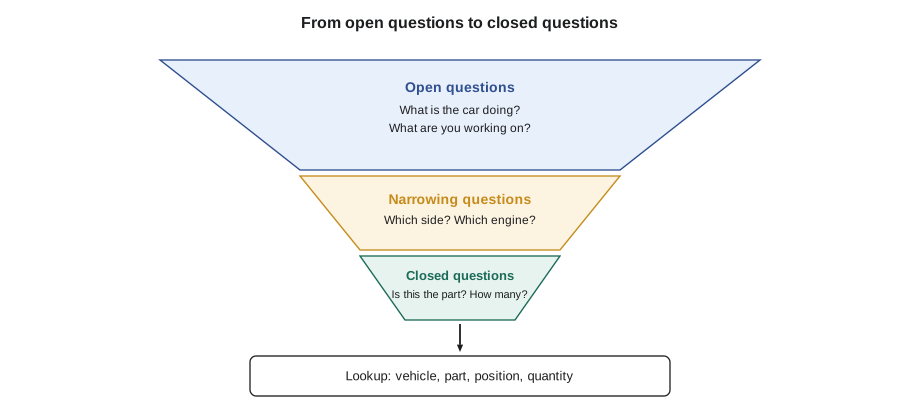
Questions come in two broad kinds. Open questions invite the customer to explain in their own words: "What's the car doing?" "What happened to it?" "What are you planning to replace?" They are best at the start of a conversation, when you do not yet know what the customer needs.
Closed questions have a short answer, often yes or no or a single fact: "Is it the left side or the right?" "Is it the 2.0 liter or the 1.5?" "Do you have the old part with you?" They are best once you know roughly what the customer needs and want to pin down the details.
A good counter conversation moves from open to closed, like a funnel. It starts wide, to understand the job, and narrows to the facts the catalog needs: vehicle, part, position and quantity. Starting with closed questions too early can lead the customer: asking "Is it the front pads?" may get a yes from a customer who does not know, when the problem is the rear.
| Stage | Kind of question | Example |
|---|---|---|
| Understand the job | Open | "What are you working on today?" |
| Understand the problem | Open | "What is it doing, and when did it start?" |
| Narrow the part | Closed | "Is it the front or the rear?" |
| Confirm the vehicle | Closed | "Can I see the VIN, or the registration?" |
| Confirm the sale | Closed | "So two front struts and the mounting hardware, is that right?" |
Confirming the vehicle
APT-120 showed that the VIN is the only reliable way to identify a vehicle for a parts lookup. At the counter, getting it is part of the conversation. Year, make and model are a start, but two vehicles with the same model year and model name can need different parts because of engine, transmission, trim level or production date.
The best sources of the VIN, in order, are the vehicle itself (if it is in the lot), the registration or insurance card, a photo of the VIN plate or certification label, and the service department's records for that customer. Many DMS systems also decode the VIN and fill in the vehicle details automatically, which saves typing and avoids errors.
When a customer has no VIN, the parts technician asks the questions that substitute for it: the engine size, the transmission type, the trim name, the drive type (front, rear or all-wheel drive), and sometimes the production month from the door label. A sale made without a VIN should be noted on the invoice, so that if the part does not fit, everyone knows why.
Worked problem
How much a VIN check saves
Imani kept a tally for one week of retail counter lookups. Of 60 sales made with a VIN, 1 part was returned for wrong fit. Of 20 sales made from year, make and model only, 3 were returned for wrong fit. What was the wrong-fit return rate in each case?
Show solution
- With a VIN:
- \[1 \div 60 \approx 0.017,\ \text{about 2 in 100}\]
- Without a VIN:
- \[3 \div 20 = 0.15,\ \text{or 15 in 100}\]
Answer: The sales made without a VIN were returned for wrong fit about nine times as often. A wrong-fit return costs the customer a second trip and costs the department handling time, so asking for the VIN is worth the few seconds it takes. The tally is a sample for this course.
Confirming the need
Knowing the vehicle is half the lookup; knowing exactly what the customer needs is the other half. The questions that confirm the need depend on the part, but some come up again and again:
- Position: left or right, front or rear, upper or lower, inner or outer. APT-120 explained that left and right are seen from the driver's seat.
- Quantity: one or a pair? Some parts, such as brake pads, are sold as an axle set; others, such as struts, are often replaced in pairs for even handling.
- Related parts: does the job also need gaskets, seals, bolts, clips or fluid? Lesson 3 covers related sales.
- The old part: has the customer brought it, and does it have a part number or a tag?
- The installer: who will do the work? A home mechanic may need advice that a professional technician does not.
Some customers arrive with a diagnosis from another shop or from the internet. The parts technician respects it but does not diagnose the vehicle. If a customer asks "Will this fix my noise?", the honest answer is that the part matches the vehicle and the description, and that a technician can confirm the cause if they are unsure. Diagnosis belongs to licensed technicians in the service department.
Using the old part
The old part is often the best evidence on the counter. It shows the shape, the connectors, the mounting points and sometimes a part number or a supplier mark. APT-120 showed how to compare a new part with the old one side by side before the customer leaves. At the counter, the old part also answers questions the customer cannot: which side it came from, how many pins its connector has, and whether it is the original or an earlier replacement.
Old parts are also dirty, heavy and sometimes leaking. Talia learned to put a mat or a sheet of cardboard on the counter before a customer set down an old brake caliper, and to keep gloves within reach. An old battery or a part with fluid in it goes in a tray, not on the counter top.
Phone conversations
Callers are harder to serve than walk-in customers because the parts technician cannot see the part or the vehicle. Listening matters even more on the phone, and the closed questions need to be sharper. Imani's phone routine was: greet and give your name; ask for the vehicle details or VIN; let the caller explain; repeat back the part, position and quantity; give the price and availability; and, for anything uncertain, offer to call back rather than guess while the caller waits. Lesson 5 covers phone and online orders in detail.
When the customer is unsure
Some customers do not know what they need. They know the car makes a noise, or a light is on, or a part is broken but they cannot name it. The parts technician can help with questions, diagrams and the exploded views from the catalog, turning the screen so the customer can point to the part. If the customer still cannot identify it, the right answer may be to bring the vehicle in, send a photo, or book a diagnosis with the service department. Selling a guess helps nobody.
Listening for what the customer does not say
Customers often leave out the details that matter most, not because they are hiding anything but because they do not know which details matter. A customer who asks for "a battery" may not mention that the car has a start-stop system, which usually needs a particular battery type. A customer asking for spark plugs may not mention that the engine has been misfiring, which could point to a coil or an injector. Good listening includes noticing these gaps and asking about them.
A few signals deserve a follow-up question:
- A part asked for twice in a short time. A second alternator in a month suggests another fault, such as a battery or wiring problem, that a technician should check.
- A description that does not match the part. "It squeals when I turn" might be a belt, a power steering problem or a suspension part, not the brake pads the customer asked for.
- Recent work by someone else. A vehicle that has just been repaired elsewhere may have non-original parts fitted.
- Uncertainty in the customer's voice. "I think it's the front" is a reason to confirm, not to guess.
The parts technician does not diagnose vehicles; that is the technician's job. But a well-placed question can save a customer a wasted purchase, and suggesting a diagnosis when the symptoms do not fit the part is part of honest service.
Taking notes
Notes help listening. Writing down the vehicle, the part and the customer's own words keeps the details straight while the lookup is running, and lets the parts technician read the request back accurately. Notes also matter when a sale goes wrong. If Petra's struts had not fitted, a note saying "customer confirmed: original struts, no aftermarket changes" would have shown what was asked and answered. Many departments use the DMS's comment field for this, so the note stays with the sale.
Worked problem
Confirmation time and its pay-off
Confirming the vehicle and part with three extra questions adds about 45 seconds to each sale. On a day with 60 counter sales, how much time does that add, and how does it compare with one wrong-part return, which takes about 20 minutes of staff time plus the customer's second trip?
Show solution
- Extra time for 60 sales:
- \[60 \times 45 = 2700\ \text{s} = 45\ \text{min}\]
- Wrong-part returns that would equal this time:
- \[45 \div 20 = 2.25\]
Answer: The extra questions cost about the same staff time as two or three wrong-part returns, and they prevent far more than that on a typical day, as well as saving customers' second trips. The times are sample values.
Talia kept a small notebook for the first few weeks, then switched to the DMS comment field once she was faster with the system. "Writing it down made me listen better," she said. "If I couldn't write the customer's answer down, I hadn't really heard it."
Common mistakes
MistakeTyping a part name before the customer has finished explaining.
InsteadListen first, then look up.
MistakeAsking a leading closed question, such as "It's the front pads, right?"
InsteadStart with an open question and let the customer describe the problem.
MistakeAccepting year, make and model when the VIN is available.
InsteadAsk for the VIN from the vehicle, the registration or a photo of the label.
MistakeForgetting to confirm left or right, front or rear.
InsteadConfirm position and quantity before quoting.
MistakeTelling a customer a part will fix their problem.
InsteadConfirm the part matches the vehicle; leave diagnosis to a technician.
Summary and key terms
- Most wrong parts come from listening errors, not lookup errors.
- Active listening means full attention, letting the customer finish, notes, and repeating back what you heard.
- Open questions explain the job; closed questions confirm the details. A good conversation moves from open to closed.
- The VIN is the reliable way to confirm the vehicle; note any sale made without one.
- Confirm position, quantity, related parts, the old part and who will install it.
- The parts technician matches parts to the vehicle and description but does not diagnose the vehicle.
- Active listening
- Giving the customer full attention, letting them finish, and checking understanding before acting.
- Open question
- A question that invites an explanation in the customer's own words.
- Closed question
- A question with a short, specific answer, often yes or no or a single fact.
- Leading question
- A question that suggests its own answer and can push an unsure customer into agreeing.
- Repeating back
- Restating what the customer said in your own words to confirm you understood.
Practice problems
Work each problem on paper first, then reveal the answer to check.
Give an example of an open question to start a counter conversation.
Show answer
"What are you working on today?" or "What is the car doing?"
Why is "It's the front pads, right?" a poor first question?
Show answer
It is leading; an unsure customer may agree when the problem is elsewhere.
Name three places to find a vehicle's VIN at the counter.
Show answer
The vehicle itself, the registration or insurance card, a photo of the VIN plate or label, or service records.
Of 25 sales made without a VIN, 2 were wrong-fit returns. What is the rate?
Show answer
2 ÷ 25 = 0.08, or 8 in 100.
A customer asks whether a sensor will fix their warning light. What do you say?
Show answer
That it matches the vehicle and description, and a technician can confirm the cause.
Lesson quiz · 5 questions
Score 60% or more to complete this lesson.
Create a free account to save your progress, take quizzes and earn a certificate.