
APT-130 · Lesson 11 of 12 · 28 min
Payment, credit and invoicing
▶ Video coming soon A video version of this lesson is on the way.
On Tuesday, November 10, Talia closed out the front counter's cash drawer for the first time on her own. The DMS said the drawer should hold 1,486.35 dollars in cash and checks; she counted 1,476.35 dollars. Ten dollars short. She counted again, then checked the day's cash sales one by one, and found it: at 2:40 p.m. she had given a customer a 10 dollar cash refund for an unopened pack of clips, but had not entered the return in the DMS. The cash was right; the record was not. Ruth Brennagh from accounting looked at the correction and nodded. "Short by ten, found in ten minutes, entered properly. That's a good first close."
Every sale at the counter ends with payment, either at the counter or on an account. This lesson covers the ways customers pay, taking payments accurately and securely, deposits on special orders, credit card fees, the parts of an invoice and how taxes and fees appear on it, correcting invoices, and balancing the cash drawer at the end of the day. Account credit and terms were covered in lesson 7; this lesson focuses on the counter's part of the payment process.
Ways customers pay
Parts departments accept several kinds of payment:
- Cash, counted carefully and kept in a locked drawer.
- Debit cards, which take the money directly from the customer's bank account.
- Credit cards, which the card company pays and the customer repays later; the department pays a processing fee on each sale.
- Contactless payments by card, phone or watch, processed like the card behind them.
- Charge accounts for approved businesses and some individuals, billed on a monthly statement (lesson 7).
- Checks, now rare at the counter and often accepted only from account customers.
- Online payments through the online store or a secure payment link (lesson 5).
The parts technician follows the department's policy for each, and checks the payment before handing over the part: a card approval on the terminal, cash counted, or an account confirmed as active and not on credit hold (lesson 7).
Taking payment accurately
Cash handling follows a simple routine that prevents most errors. Say the amount due, take the customer's cash and say how much was given ("Out of fifty"), leave it on the counter or the drawer ledge until the change is counted, count the change back to the customer, and only then put the cash in the drawer. The DMS records the amount received, so keying the wrong amount leaves a sale record that does not match the drawer even when the change was right.
Worked problem
Counting change back
A sale comes to 37.85 dollars. The customer pays with a 50 dollar note. What change is due, and how could it be counted back?
Show solution
- Change due:
- \[50.00 - 37.85 = 12.15\ \text{dollars}\]
- Count up from the sale amount:
- 37.85, then 0.15 to make 38.00, then 2.00 to make 40.00, then 10.00 to make 50.00
- Check:
- \[0.15 + 2.00 + 10.00 = 12.15\ \text{dollars}\]
Answer: Counting up from the sale amount to the amount paid lets both people check the change. In the United States, cash change is usually given to the exact cent. The sale amount is a sample value.
Card payments are processed on the terminal with the card in the customer's hands where possible: they insert, tap or swipe the card and enter their PIN or confirm. Counter staff never take a customer's card out of sight, never write card numbers down, and never key a card number into the terminal from a phone call unless the department's policy allows it and the terminal is set up for it (lesson 5). These rules come from the Payment Card Industry Data Security Standard and protect both the customer and the department.
Deposits on special orders
When a retail customer orders a part that is not in stock, especially an expensive or non-returnable one, many departments ask for a deposit or full payment in advance. The deposit protects the department if the customer never collects the part, and it confirms that the customer is serious. A common policy is a deposit for special orders over a set amount, and full payment for non-returnable electrical parts or parts that the supplier will not take back.
The deposit is recorded in the DMS against the special order, and the customer receives a receipt that states the amount, the part, the expected arrival date and what happens to the deposit if they cancel. At pickup, the deposit is applied to the invoice and the customer pays the balance.
Worked problem
Applying a deposit
A customer special-orders a headlamp assembly at 486.00 dollars, before tax, and pays a deposit of 150.00 dollars. When the part arrives, the invoice total including tax at a sample rate of 13 in 100 is calculated. What does the customer owe at pickup?
Show solution
- Tax:
- \[486.00 \times 0.13 = 63.18\ \text{dollars}\]
- Invoice total:
- \[486.00 + 63.18 = 549.18\ \text{dollars}\]
- Balance after the deposit:
- \[549.18 - 150.00 = 399.18\ \text{dollars}\]
Answer: The customer pays 399.18 dollars at pickup. The deposit is applied to the total, including tax, not to the price before tax. The price, deposit and tax rate are sample values; the actual rate depends on the state and county.
Card fees and surcharges
Credit card processing costs the department a fee on each sale, usually a small fraction of the sale amount. Some businesses add a surcharge to credit card payments to recover this fee. In the United States, most states allow merchants to add a surcharge to credit card payments within limits set by the card networks, if they disclose it before the customer pays; surcharges are not allowed on debit card payments, and a few states restrict surcharging. Whether a department surcharges is a management decision; the counter follows the policy and makes sure any surcharge is clearly disclosed before the customer pays.
Anatomy of an invoice
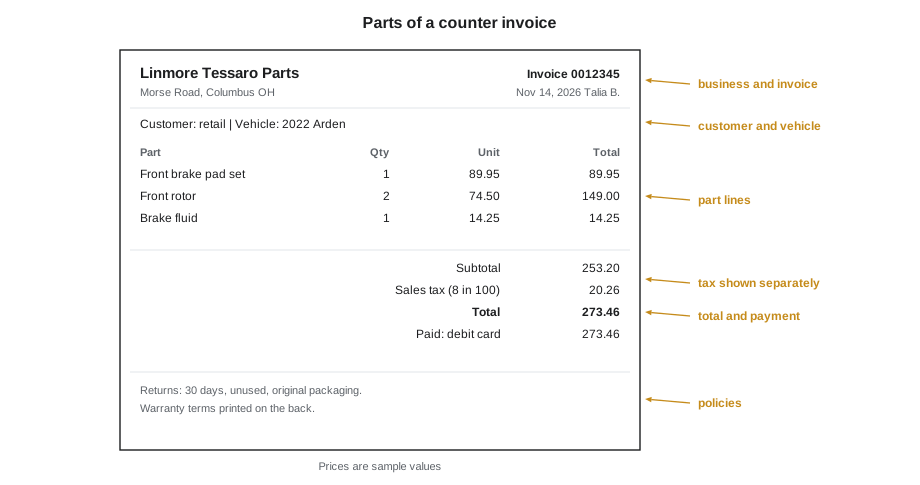
An invoice is the department's record of the sale and the customer's record of what they bought and paid. A complete counter invoice includes:
- The business name and address, and the business's contact details.
- The invoice number and date, and the salesperson.
- The customer: name, account number if any, and the vehicle VIN or description where the department records it.
- Each line: part number, description, quantity, unit price and line total.
- Core charges on separate lines, so the customer knows what is refundable (lesson 8).
- Fees: environmental or tire fees, shown as the rules require.
- Tax, as a separate line or lines.
- The total, the payment method and any balance due, with the terms for account sales.
- Policies: the return, warranty and core terms, or a reference to where the customer can read them.
Environmental and tire fees have their own disclosure rules. In Ohio, a fee of one dollar per new tire is collected when new tires are sold in Ohio and is usually shown on the invoice, and some other items, such as batteries, may carry recycling fees or core charges under the seller's own policy. The DMS adds these fees automatically to the right parts; the parts technician checks that they appear and can explain them.
Worked problem
Totaling an invoice
A retail invoice has front brake pads at 89.95 dollars, two rotors at 74.50 dollars each, and a bottle of brake fluid at 14.25 dollars. Tax applies to all lines at a sample rate of 8 in 100. What are the subtotal, tax and total?
Show solution
- Rotors:
- \[2 \times 74.50 = 149.00\ \text{dollars}\]
- Subtotal:
- \[89.95 + 149.00 + 14.25 = 253.20\ \text{dollars}\]
- Tax:
- \[253.20 \times 0.08 = 20.256 \approx 20.26\ \text{dollars}\]
- Total:
- \[253.20 + 20.26 = 273.46\ \text{dollars}\]
Answer: The invoice totals 273.46 dollars. 8 in 100 is the combined sales tax rate in Franklin County, Ohio, which includes Columbus; the prices are sample values.
Correcting invoices
Mistakes on invoices happen: a wrong quantity, a missed core charge, a part charged to the wrong account. The rule is that a completed invoice is never deleted or edited to hide the error. Instead, the department issues a credit memo (or credit note) that reverses the wrong invoice or line, and a new invoice for the correct sale. Both stay in the records with a reason. This keeps the inventory, the customer's account and the tax records accurate, and it shows an auditor exactly what happened.
A void is used only before a sale is completed and paid, or as the DMS allows on the same day. Most departments limit voids and credits to staff with the right permission, and the manager reviews them regularly. Talia's correction on November 10 was to enter the missing return with a note explaining the late entry, not to change any earlier sale.
Balancing the drawer
At the end of each shift or day, the counter balances the cash drawer: the cash, checks and card totals are counted and compared with what the DMS says should be there. The starting float, the cash kept in the drawer to make change, is counted separately and kept for the next day.
Worked problem
A drawer count
The drawer started the day with a float of 200.00 dollars. The DMS shows cash sales of 1,186.35 dollars and checks of 100.00 dollars, with no cash refunds recorded. At closing, the drawer holds 1,376.35 dollars in cash and one check of 100.00 dollars. Is the drawer balanced?
Show solution
- Expected cash:
- \[200.00 + 1186.35 = 1386.35\ \text{dollars}\]
- Expected cash and checks:
- \[1386.35 + 100.00 = 1486.35\ \text{dollars}\]
- Counted cash and checks:
- \[1376.35 + 100.00 = 1476.35\ \text{dollars}\]
- Difference:
- \[1476.35 - 1486.35 = -10.00\ \text{dollars}\]
Answer: The drawer is 10.00 dollars short, the amount Talia found on November 10. A small difference is investigated by checking the day's cash sales and refunds, and the result is recorded, whether or not the cause is found. The amounts are sample values.
Card totals are balanced against the terminal's daily report, which the processor settles to the department's bank account. Account sales do not involve money at the counter; they are reviewed by accounting, who sends statements and follows up on overdue accounts (lesson 7). Records of sales, payments and corrections are kept for the period tax law requires, and the DMS stores most of them.
Protecting against fraud
Counters handle money and valuable parts, so they attract occasional fraud. The most common forms at a parts counter are:
- Counterfeit notes, usually of higher values. Staff check the security features of large notes, following the department's training.
- Stolen or misused cards, sometimes with a customer who is in a hurry and buying expensive, easily resold parts such as catalytic converters, electronics or lamps.
- Fake account orders, where someone claims to be from an account business to charge parts to it. This is why account orders are checked against the list of authorised buyers (lesson 7).
- Return fraud, such as returning a used part in a new part's box, or a stolen part for a refund. Checking part numbers, condition and the original sale prevents most of it.
The parts technician does not accuse anyone. If something seems wrong, they follow the policy, which usually means asking for the manager, delaying the sale until it can be checked, or refusing a payment method politely. Staff should never put themselves at risk to stop a fraud; the safety rules of lesson 10 apply.
Customer information on invoices
Invoices hold personal information: names, phone numbers, addresses and vehicle details. They are handled with the same care as other customer records (lesson 1). Printed copies are handed only to the customer or the account, never left on the counter, and old paper copies are shredded according to the department's records policy. When a customer asks for a copy of an old invoice, the parts technician checks that the person asking is the customer or authorised by the account before printing or emailing it.
Worked problem
Splitting a payment
A customer's invoice totals 286.12 dollars. She pays 100.00 dollars in cash and the rest by debit card. How much goes on the debit card, and what does the cash drawer gain?
Show solution
- Debit amount:
- \[286.12 - 100.00 = 186.12\ \text{dollars}\]
- Cash to the drawer:
- 100.00 dollars
Answer: The DMS records both payments against the one invoice, so the drawer count and the terminal report each show their part. The amounts are sample values.
Common mistakes
MistakePutting the customer's cash in the drawer before counting the change.
InsteadLeave it on the ledge until the change is counted back.
MistakeKeying the wrong amount received.
InsteadCheck the amount on the screen before completing the sale.
MistakeWriting down a card number.
InsteadNever record card numbers; follow the payment policy.
MistakeDeleting or editing a completed invoice to fix a mistake.
InsteadIssue a credit memo and a new invoice with a reason.
MistakeApplying a deposit to the price before tax.
InsteadApply the deposit to the invoice total.
Summary and key terms
- Customers pay by cash, debit, credit, contactless, account, check or online; check each payment before handing over the part.
- Count change back and key the amount received accurately.
- Card rules protect customers: keep cards in sight and never record card numbers.
- Deposits on special orders are recorded and applied to the invoice total.
- Any credit card surcharge must follow card network limits and be disclosed before payment.
- A complete invoice shows lines, cores, fees, tax, total and terms; fees follow their own disclosure rules.
- Correct invoices with credit memos, not by deleting them, and balance the drawer every day.
- Invoice
- The record of a sale, showing what was bought, the prices, taxes and payment.
- Deposit
- A payment made in advance on a special order, applied to the invoice at pickup.
- Surcharge
- An extra charge added to a credit card payment to recover the processing fee.
- Credit memo
- A document that reverses all or part of an invoice.
- Float
- The cash kept in the drawer at the start of the day to make change.
- Balancing
- Comparing the counted cash, checks and card totals with what the DMS expects.
Practice problems
Work each problem on paper first, then reveal the answer to check.
A sale is 23.60 dollars and the customer pays with a 40 dollar note. What change is due?
Show answer
16.40 dollars.
A part costs 300 dollars before tax at a sample tax rate of 13 in 100, and the deposit was 100 dollars. What is the balance?
Show answer
300 × 1.13 = 339; 339 − 100 = 239 dollars.
How do you fix a completed invoice with the wrong quantity?
Show answer
Issue a credit memo for the wrong invoice or line and a new invoice for the correct sale.
The float is 200 dollars and cash sales are 650 dollars. How much cash should be in the drawer?
Show answer
850 dollars.
Can a surcharge be added to a debit card payment?
Show answer
No.
Lesson quiz · 5 questions
Score 60% or more to complete this lesson.
Create a free account to save your progress, take quizzes and earn a certificate.