
APT-130 · Lesson 5 of 12 · 23 min
Phone and online orders
▶ Video coming soon A video version of this lesson is on the way.
On Friday, October 23, an online order arrived overnight from a customer named Lena Ilsley: a cabin air filter and a pair of rear wiper blades for a 2023 Arden, for pickup at the counter. Talia picked the order first thing and noticed something the website had not caught. The order listed the wiper blades for the sedan, but the vehicle details Lena had entered at checkout said hatchback, and the hatchback used a different rear blade. Talia phoned her before packing the order. "You saved me a second trip," Lena said when she came in at noon. Imani nodded at the order on the screen. "Online orders still need a person to read them."
A growing share of parts sales starts without a face-to-face conversation. Customers phone the counter, order through the dealership's online store, or, for repair shops, use an online ordering portal. These orders are convenient, but the parts technician loses the chance to see the customer, the vehicle and the old part. This lesson covers taking phone orders well, processing online orders, click-and-collect and shipping, and the extra checks that keep remote orders accurate.
Answering the phone
The phone is often the first contact a customer has with the department, and the way it is answered sets the tone. A good phone greeting is short and complete: the business name, the department and your name, such as "Linmore Tessaro parts, this is Talia." Answer within a few rings, speak clearly, and smile; callers can hear it.
Phones and walk-in customers compete for attention. The counter rule from lesson 1 still applies: the person in front of you was there first. If the phone rings while you are serving someone, answer if no one else can, give the greeting, and ask the caller to hold briefly or offer to call back. Never leave a caller on hold for long without checking back, and never take a long call while a walk-in customer waits without at least acknowledging them.
Taking a phone order
Phone orders need the same information as counter sales, gathered without the help of the vehicle or the part. Imani's checklist for phone orders was:
- Who: the caller's name, phone number and, for an account, the account name and the person authorized to order.
- What vehicle: the VIN if possible, read back one character at a time. Otherwise year, make, model, engine, trim and drive type.
- What part: listen to the description, then confirm position, quantity and any related items (lessons 2 and 3).
- Price and availability: quote from the available quantity, with an honest arrival time (lesson 4).
- How they will receive it: pickup, delivery or shipping, and when.
- Payment: for retail customers, payment at pickup or by a secure method the department approves; for accounts, the account terms.
- Read back the order in full before ending the call.
Reading a VIN over the phone causes errors, because letters such as B and D, or M and N, sound alike. Many counter staff use a phonetic alphabet to confirm letters: B as in Bravo, D as in Delta, M as in Mike, N as in November. The international radio alphabet is widely understood, and any clear set of words works if both people use it. A VIN read back and confirmed this way avoids most wrong-vehicle errors.
| Letters often confused | Say it as |
|---|---|
| B, D, E, P, T, V | Bravo, Delta, Echo, Papa, Tango, Victor |
| M, N | Mike, November |
| F, S | Foxtrot, Sierra |
| A, J, K | Alfa, Juliett, Kilo |
| Remember | VINs never use I, O or Q (APT-120) |
Payment card details deserve special care on the phone. The card industry's security rules, the Payment Card Industry Data Security Standard (PCI DSS), say card numbers must never be written on paper or stored in notes. Many departments do not take card numbers by phone at all, and instead send the customer a secure payment link or ask them to pay at pickup. Follow the department's policy exactly.
Online parts stores
Most manufacturers support an online parts store for their dealers, and many dealer groups run their own. A customer chooses the vehicle, browses the catalog illustrations, adds parts to a cart and pays online. The order arrives in the DMS or in a separate order queue for the counter to fill. Online sales extend the counter's hours and reach, but the website cannot ask follow-up questions. The parts technician's job is to read each order as if the customer were at the counter.
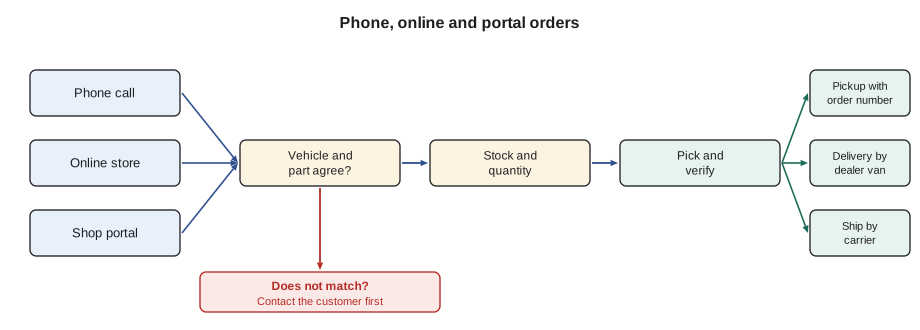
Before picking an online order, the parts technician checks:
- The vehicle and the part agree. Does the part fit the year, model, trim and VIN the customer entered? Lena's order failed this check.
- The quantity makes sense. One brake pad set covers an axle; ten wiper blades is probably a mistake.
- The related items are there. An order for a water pump without a gasket deserves a call or a note.
- The stock is available, and if not, the customer is told the new date.
- The delivery method is possible: some parts, such as batteries, airbags and aerosols, have shipping restrictions (APT-110 and APT-220).
When something does not match, contact the customer before filling the order. Most customers are grateful; a few will say they ordered exactly what they wanted, and that is their decision.
Click-and-collect
Click-and-collect, or buy online and pick up in store, lets a customer order and pay online, then collect the part at the counter. It combines the convenience of online ordering with the counter's chance to check the part. A good click-and-collect process has four parts:
- Confirm the order to the customer by email or text when it is picked and ready, with the pickup hours.
- Stage the order in a labeled pickup area, bagged and tagged with the order number and name, not on the counter.
- Verify the customer at pickup with the order number and a name or photo identification, so the part goes to the person who paid for it.
- Show the customer the part at the counter, so any problem is caught before they leave.
Orders that are not collected tie up stock and should be followed up. A common policy is a reminder after a few days and a refund or cancellation after a set period, as stated in the store's terms.
Shipping orders
Shipped orders add packing and carrier rules. The part must be packed to survive the trip, labeled correctly, and sent by a method the customer chose and paid for. APT-220 covers carriers and packing in detail, and the dangerous goods rules for batteries, airbags, aerosols and some fluids. At the counter, the key points are to give the customer a realistic shipping time, provide tracking information, and never ship a restricted item by a method that does not allow it.
Remote sales also have their own consumer protection rules. In the United States, the Federal Trade Commission's Mail, Internet, or Telephone Order Merchandise Rule requires sellers to ship within the time they state, or within 30 days if they state no time, and to tell the customer about delays and offer the choice to cancel. The online store's terms are written to meet these rules; counter staff follow the store's stated policies and do not promise anything different.
Wholesale ordering portals
Repair shops often order through an online ordering portal, either the manufacturer's or a third-party system that connects many suppliers. The shop's service writer looks up the part by VIN and sends the order to the dealer's counter, where it appears with the account, the part numbers and the delivery request. Wholesale orders are usually picked, invoiced to the account and loaded on the next delivery run. Lesson 7 covers wholesale and fleet accounts.
Worked problem
Planning a delivery run
Gideon's van leaves at 10 a.m. and 2 p.m. Portal orders received by 9:30 a.m. go on the 10 a.m. run; orders received by 1:30 p.m. go on the 2 p.m. run. A shop orders at 9:45 a.m. When will the order leave, and how long after the order is that?
Show solution
- Cut-off for the 10 a.m. run:
- 9:30 a.m., so 9:45 a.m. misses it
- Next run:
- 2 p.m.
- Wait:
- \[14{:}00 - 9{:}45 = 4\ \text{h}\ 15\ \text{min}\]
Answer: The order leaves on the 2 p.m. run, 4 hours and 15 minutes after it was placed. Telling shops the cut-off times helps them order in time. The schedule is a sample for this course.
Holding, transferring and calling back
Phone calls often need a hold, a transfer or a callback, and each one can go well or badly. A few habits keep callers on side:
- Ask before putting a caller on hold, and wait for the answer: "Can I put you on hold for a minute while I check stock?"
- Check back at least every minute or so, even if only to say you are still looking.
- Give the reason and the number when transferring a call: "I'm putting you through to the back counter, extension 214, in case we get cut off."
- Offer a callback for anything that will take more than a couple of minutes, and give a time: "I'll call you back by 3 o'clock." Then do it, even if the answer is not ready.
- Take a full message when the right person is not available: name, number, vehicle, the question and the best time to call.
Callers forgive a short wait much more easily than silence. A caller left on hold without a word for five minutes often hangs up and tries another store.
Email and text messages
Many customers now prefer email or text messages, and many DMS systems can send quotes, order confirmations and pickup notices directly. Written messages follow the same rules as a conversation, with a few additions:
- Be complete: include the part, the price with fees, the availability or arrival date, and how long the quote is valid.
- Be clear about the vehicle: state the vehicle or VIN the quote is for, so the customer can spot an error.
- Keep it professional: no slang or emojis, and read it once before sending.
- Protect personal information: never send card numbers by email or text, and check the address or number before sending.
- Follow the department's consent rules for marketing messages. Order and pickup messages are part of the sale; promotional email must follow the federal CAN-SPAM Act, including an easy way to opt out, and marketing text messages generally need the customer's prior consent.
A written quote is also a record. If a customer later says they were quoted a different price, the message shows what was said.
Worked problem
A phone order read-back
A caller orders 2 front wiper blades at 24.50 dollars each, 1 rear blade at 18.75 dollars and 2 gallons of washer fluid at 6.40 dollars each, for pickup after 4 p.m. What total before tax should be read back to confirm the order?
Show solution
- Front blades:
- \[2 \times 24.50 = 49.00\ \text{dollars}\]
- Washer fluid:
- \[2 \times 6.40 = 12.80\ \text{dollars}\]
- Total:
- \[49.00 + 18.75 + 12.80 = 80.55\ \text{dollars}\]
Answer: The read-back is "two front blades, one rear blade and two gallons of washer fluid, 80.55 dollars before tax, ready after 4 p.m." Reading the total back gives the caller a chance to catch a wrong quantity. The prices are sample values.
Talia found phone orders hardest in her first weeks, because she could not see the customer's face to tell whether they had understood. Imani's advice was simple: "Say it back to them, all of it, every time. If they say 'yes' to the whole order, you both know it's right."
Orders from outside the area
Online stores bring orders from customers the counter will never meet, sometimes from far away. These orders need the same care, plus a few extra checks: that the shipping address is complete, that the part can legally be shipped there, and that the customer understands how a return would work at a distance. When an order looks unusual, such as a large quantity of expensive parts shipped to an address that does not match the billing details, the parts technician follows the department's fraud checks before shipping (lesson 11). A short message to the customer confirming the vehicle and the address is often enough to settle the question, and genuine customers usually appreciate the care.
Common mistakes
MistakePacking an online order without checking it.
InsteadCheck that the part matches the vehicle and the quantity makes sense.
MistakeReading a VIN over the phone without confirming letters.
InsteadUse the phonetic alphabet and read the VIN back.
MistakeWriting a caller's card number on a note.
InsteadFollow the payment policy: a secure link or payment at pickup.
MistakeHanding over a click-and-collect order without checking who is collecting.
InsteadVerify the order number and the customer's name or ID.
MistakePromising a shipping time the carrier cannot meet.
InsteadGive a realistic time and the tracking details.
Summary and key terms
- Phone and online orders need the same information as counter sales, without seeing the vehicle or the part.
- Answer with the business, department and your name; serve the person at the counter first.
- Confirm VIN letters with a phonetic alphabet and read the order back.
- Never record card numbers on paper; follow the department's payment policy.
- Check every online order for vehicle fit, quantity and related items, and contact the customer when something does not match.
- Click-and-collect needs confirmation, staging, verification at pickup and a final check of the part.
- Remote sales are covered by consumer protection rules; follow the store's stated terms.
- Phonetic alphabet
- A set of words used to spell letters clearly over the phone, such as Bravo for B.
- Click-and-collect
- Ordering and paying online, then picking up the part at the counter.
- Ordering portal
- An online system that repair shops use to send parts orders to suppliers.
- Cut-off time
- The latest time an order can be placed to make a particular delivery run or shipment.
- PCI DSS
- The Payment Card Industry Data Security Standard, the card industry's rules for protecting card data.
Practice problems
Work each problem on paper first, then reveal the answer to check.
How would you confirm the letter M in a VIN over the phone?
Show answer
"M as in Mike."
An online order has ten wiper blades for one car. What do you do?
Show answer
Contact the customer to confirm the quantity before filling it.
What do you check when a customer collects a click-and-collect order?
Show answer
The order number and their name or ID, and show them the part.
A shop orders at 1:35 p.m. and the cut-off for the 2 p.m. run is 1:30 p.m. When is the next run?
Show answer
The next day's 10 a.m. run, if that is the next scheduled run.
Why should card numbers never be written down?
Show answer
Card security rules forbid it, and written numbers can be stolen.
Lesson quiz · 5 questions
Score 60% or more to complete this lesson.
Create a free account to save your progress, take quizzes and earn a certificate.