
APT-130 · Lesson 12 of 12 · 27 min
A busy morning at the counter
▶ Video coming soon A video version of this lesson is on the way.
Saturday, November 14, was Talia's first Saturday at the counter. Linmore Tessaro's parts department opened from 8 a.m. to 1 p.m. on Saturdays with a small crew: Talia and Imani at the front counter, one parts associate on the back counter for the Saturday service shift, and Gideon making a single delivery run at 10 a.m. Rolf was off. "Saturdays are retail days," Imani said as she unlocked the door. "People who work all week fix their cars today. You'll use everything you've learned this term before lunch."
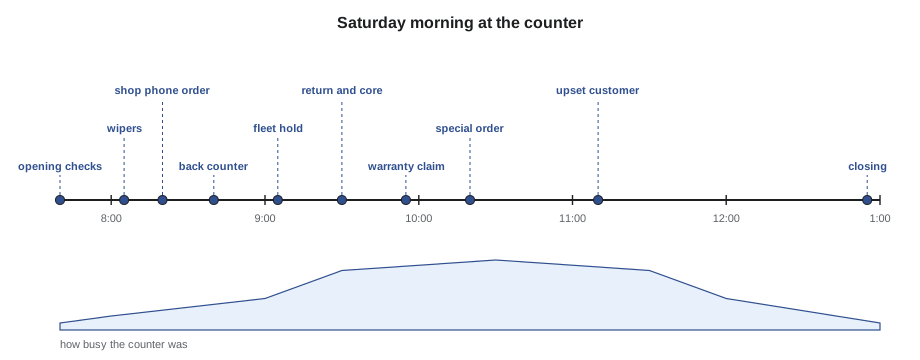
This lesson follows that morning from opening to closing. Each event draws on one or more earlier lessons. The aim is to see how the skills fit together under time pressure: greeting, listening, looking up, quoting, selling, handling accounts, returns and warranty, calming a difficult moment, and taking payment correctly.
Before the doors open
At 7:40 a.m. Imani and Talia ran the opening routine: terminals and the DMS on, the cash drawer float counted (200.00 dollars, matching the slip from Friday night), the click-and-collect shelf checked against the online order queue, and the special-order shelf checked for anything due today. Three online orders had arrived overnight. Talia read each one against the vehicle details, as in lesson 5. Two were fine. The third was a set of front brake pads for a 2021 Vela whose VIN showed the larger brake option; the ordered pads were for the standard brakes. She sent the customer a message through the online store asking him to call, and set the order aside.
| Time | Event | Lessons |
|---|---|---|
| 7:40 | Opening routine and online order checks | 1, 5, 11 |
| 8:05 | Retail customer: wiper blades and related items | 2, 3 |
| 8:20 | Phone order from a repair shop account | 5, 7 |
| 8:40 | Back counter request on a Saturday repair order | 6 |
| 9:05 | Fleet order and an account on credit hold | 7, 11 |
| 9:30 | Return with a core and a restocking question | 8 |
| 9:55 | Warranty claim on a fuel pump | 9 |
| 10:20 | Quote and special order with a deposit | 4, 11 |
| 11:10 | An upset customer and a wrong-fit part | 10 |
| 12:55 | Closing and balancing the drawer | 11 |
8:05 a.m.: wipers and the questions behind them
The first customer wanted "wipers for my Arden." Talia asked the year and body style, then asked whether she wanted the front blades only or the rear too, using the funnel from lesson 2. The customer had a 2022 Arden hatchback and said the rear blade was streaking as well. Talia confirmed the sizes from the VIN, suggested washer fluid rated for winter because the customer's bottle was nearly empty, and did not push the premium blades after the customer said she was replacing them every autumn anyway. The sale was four items, all needed, and the customer left in six minutes.
8:20 a.m.: a shop calls in
The phone rang while Talia was finishing. Imani took the call: Corinne Ferraby from Bramhall Auto Service needed a water pump and gasket for a 2019 Vela on their hoist. Imani took the VIN, confirmed two letters with the phonetic alphabet, found the pump in stock, and placed the order on Bramhall's account at their agreed price level (lesson 7). The van's 10 a.m. run had a 9:30 a.m. cut-off, so the pump would leave in plenty of time.
Worked problem
A wholesale line at an account price
The water pump lists at 186.00 dollars. Bramhall's account price for this part group is list less 25 in 100. The gasket lists at 14.00 dollars at the same discount. What is Bramhall's price for the order, before tax?
Show solution
- Pump:
- \[186.00 \times 0.75 = 139.50\ \text{dollars}\]
- Gasket:
- \[14.00 \times 0.75 = 10.50\ \text{dollars}\]
- Order total:
- \[139.50 + 10.50 = 150.00\ \text{dollars}\]
Answer: Bramhall pays 150.00 dollars before tax, invoiced to the account on its net 30 terms. The prices and discount are sample values.
8:40 a.m.: the back counter
Saturday service was a short shift, and the back counter associate was handling a request from Dario Pellicano for a cabin air filter and a battery terminal clamp on an RO. The clamp was not in stock. Rather than make Dario wait, the associate told him straight away and offered a clamp from Linmore Parts Supply, which opened at 9. Dario agreed, and the associate set up the outside purchase on the RO as the dealership's rules required (lesson 6). Talia noted how quickly the decision was made: Dario was back at his bay inside two minutes.
9:05 a.m.: a fleet order and an account on hold
Ewan Tullis from Orland Courier called to order brake pads and oil filters for three of the company's vans. When Talia opened the account, the DMS showed a credit hold: an invoice from September was more than 60 days past due. Talia did not refuse the order or mention the overdue invoice in a way that would embarrass Ewan. She said, "I can see there's a hold on the account this morning. Accounting isn't in on Saturday; would you like to pay by card today, or I can hold the parts until Monday when they can sort it out?" Ewan paid by company card and said he would check with his office about the September invoice. Talia left a note on the account for Ruth Brennagh in accounting.
This was the right approach for three reasons: the counter followed the credit policy without making a decision that belonged to accounting; the customer had a clear choice; and the note meant the issue would be followed up on Monday.
9:30 a.m.: a return with a core
The counter was at its busiest now, with four customers waiting. A customer returned the old caliper from a remanufactured brake caliper he had bought the week before, along with an unopened second caliper he had not needed. Talia inspected the core: complete, same part type, no cracks. She refunded the core charge. The unopened caliper was within the return period with its receipt, and the policy charged no restocking fee on unopened stock parts returned within 30 days (lesson 8). She completed both on one return transaction, so the customer's refund was a single amount.
Worked problem
One return transaction
The customer paid a core charge of 45.00 dollars on the reman caliper, and 96.00 dollars for the second caliper, which was unopened. Both are fully refundable under the policy. What is the refund before tax?
Show solution
- Core refund:
- 45.00 dollars
- Unopened part:
- 96.00 dollars
- Total before tax:
- \[45.00 + 96.00 = 141.00\ \text{dollars}\]
Answer: The refund is 141.00 dollars before tax, returned to the card the customer used for the original sale. The prices are sample values.
9:55 a.m.: a warranty claim
Next was a man with a fuel pump module from his 2018 Arden, bought from Linmore Tessaro in July and installed by his own shop. The engine had stalled twice and would not restart. Talia found the sale in the DMS, confirmed the part was within its warranty period, and wrote down how it had failed. The service department's diagnostic equipment was busy on a Saturday, so she explained the process: the part would be tagged and tested on Monday, and if it was confirmed defective, he would receive a replacement part. Because his shop had installed it, any labor claim would be through his shop, not the parts counter. He was not happy about the wait, but he accepted it once Talia offered to hold a replacement module from stock so it could go out the moment the test was done.
10:20 a.m.: a quote and a special order
A customer wanted a price on a side mirror assembly for her 2023 Vela, with the heated glass and turn signal. The part was not in stock; the PDC had it for delivery Tuesday. Talia quoted from the department's price matrix (lesson 4).
Worked problem
Quoting from the matrix
The mirror costs the department 210.00 dollars. The matrix multiplier for parts costing 100 to 500 dollars is 1.35. The department asks for a deposit of half the selling price on special orders over 200 dollars. What is the selling price, the margin, and the deposit?
Show solution
- Selling price:
- \[210.00 \times 1.35 = 283.50\ \text{dollars}\]
- Profit:
- \[283.50 - 210.00 = 73.50\ \text{dollars}\]
- Margin:
- \[73.50 \div 283.50 \approx 0.259,\ \text{about 26 in 100}\]
- Deposit:
- \[283.50 \div 2 = 141.75\ \text{dollars}\]
Answer: Talia quoted 283.50 dollars plus tax, arriving Tuesday, and took a deposit of 141.75 dollars, recorded against the special order with a receipt showing the cancellation terms. The cost, multiplier and deposit rule are sample values from this course.
Before the customer left, Talia read back the order and the arrival date, and told her she would receive a text when the part arrived. It is the small confirmations that prevent a second visit.
11:10 a.m.: an upset customer
The customer from the overnight online order called back, then arrived in person, annoyed. Earlier in the week he had bought standard pads at another store, found they did not fit, and then ordered the same pads from the dealership's website overnight, assuming the other store had boxed them wrongly. "Nobody can sell me the right pads," he said. Talia did not argue. She listened, acknowledged that he had lost his morning, and confirmed from the VIN that he needed the larger-brake pads, which were in stock. She explained that his online order had been held because it did not match, and offered to change it to the right pads now. He calmed down when he saw the VIN result on the screen. Imani watched without stepping in, and later said only, "That's LAST, done properly."
Talia also suggested he check whether the store that sold him the other pads would accept a return of the unused set, since that was his decision with that store. She did not comment on the other store.
12:55 p.m.: closing
After the last customer left, Talia ran the closing routine: finished the day's notes, checked the click-and-collect shelf, made sure the warranty part was tagged and stored, and balanced the drawer (lesson 11).
Worked problem
The morning in numbers
The DMS showed 31 counter transactions, with retail sales of 2,148.60 dollars before tax and wholesale and fleet sales of 1,312.40 dollars. Of the retail transactions, 22 included at least one related item. What were total sales, the retail share, and the fraction of transactions with related items?
Show solution
- Total sales:
- \[2148.60 + 1312.40 = 3461.00\ \text{dollars}\]
- Retail share:
- \[2148.60 \div 3461.00 \approx 0.621,\ \text{about 62 in 100}\]
- Related-item rate:
- \[22 \div 31 \approx 0.71,\ \text{about 71 in 100}\]
Answer: About 62 in 100 of the morning's sales were retail, much higher than on a weekday, and about 71 in 100 of transactions included a related item. The figures are sample values for this story.
The drawer balanced to the cent. As they locked up, Imani asked Talia what she would do differently. Talia thought about it. "I'd check the account status before I pick up a fleet call, so I'm not surprised by a hold. And I'd write the Monday notes as I go, not at the end." Imani nodded. "Then next Saturday will be easier."
What the morning shows
No single event that morning was difficult. What made the morning work was the habits behind each one: a VIN behind every lookup, a clear quote with the fees and arrival date, related items offered for a reason, policies explained before they were needed, records entered at the time, and calm when a customer was not. Those habits are what customers remember, and they are what the next courses build on.
Talia's plan for her next weeks, agreed with Imani, was to spend more time on the wholesale desk, learn the receiving and stocking routines in APT-210, and keep practicing lookups for the older Marlo models, which still came in for parts.
Keeping up when the counter is full
Between 9:30 and 11:30 the counter was rarely empty. Imani and Talia kept the queue moving with a few simple habits: greeting each person as they came in, serving in order, handling quick sales such as a bottle of fluid or a bulb as soon as a terminal was free, and taking long lookups to a second screen so the next customer could be served. When the phone rang during the busiest stretch, Imani answered, took the number and promised a callback within twenty minutes, which she kept.
The busy period is also when errors are most likely, so the checks matter most then. Talia read back every VIN and part, even when the line was long. "It feels slower," she said, "but it isn't. A wrong part takes twenty minutes to fix."
Common mistakes
MistakeRefusing an order on a credit hold without offering options.
InsteadExplain the hold politely and offer card payment or a hold until accounting can review it.
MistakeArguing with a customer about who caused a problem.
InsteadListen, acknowledge and show the facts calmly.
MistakeLeaving notes for Monday until the end of the day.
InsteadRecord follow-ups as each event happens.
MistakeMaking a technician wait for a part that is not in stock.
InsteadTell them straight away and offer an alternative.
MistakeQuoting a special order without a deposit or arrival date.
InsteadFollow the deposit policy and give a real date.
Summary and key terms
- A busy morning draws on every counter skill at once.
- Opening and closing routines catch problems before and after the customers.
- Listening and VIN lookups prevent most wrong parts.
- Accounts, credit holds and payment rules are followed politely and consistently.
- Returns, cores and warranty claims are handled by policy, with clear explanations.
- Quotes include the price, the arrival date and the deposit terms.
- Good records and follow-up notes make the next day easier.
- Opening routine
- The checks made before the counter opens, such as the float, terminals and order queues.
- Credit hold
- A block on new account charges, usually because of overdue invoices or a credit limit.
- Closing routine
- The checks made after the counter closes, such as balancing the drawer and filing notes.
- Transaction
- One completed sale, return or payment at the counter.
Practice problems
Work each problem on paper first, then reveal the answer to check.
A part lists at 120 dollars and the account discount is 25 in 100. What is the account price?
Show answer
90 dollars.
A part costs 180 dollars and the multiplier is 1.35. What is the selling price?
Show answer
243 dollars.
An account is on credit hold. What two options could you offer?
Show answer
Payment by card today, or holding the parts until accounting reviews the account.
Out of 40 transactions, 26 included a related item. What fraction is that?
Show answer
26 ÷ 40 = 0.65, or 65 in 100.
A customer arrives upset about a part bought elsewhere. What do you do?
Show answer
Listen, acknowledge, check the VIN and offer the right part; do not comment on the other store.
Lesson quiz · 5 questions
Score 60% or more to complete this lesson.
Create a free account to save your progress, take quizzes and earn a certificate.