
AERO-499 · Lesson 4 of 12 · 21 min
Concept selection
Week 7 is the convergent phase. The team has three concepts, two variants and a competing option, and by the concept review at the end of week 8 it must recommend one concept to carry into preliminary design. The decision is the most consequential the team will make. Later lessons will refine the chosen concept in great detail, but no amount of refinement turns a poorly chosen concept into a good aircraft. Studies of aircraft programs, and of engineering projects generally, find that most of the life-cycle cost of a product is fixed by decisions made in the concept phase, when only a small part of the money has been spent.
The danger in concept selection is not that the team chooses badly by accident. It is that it chooses the concept its members already liked, and then builds a scoring system that confirms the choice. The methods in this lesson are designed to make that harder: to state the criteria and weights before scoring, to base each score on evidence, and to test whether the result survives a change in the weights.
First, screen against the requirements
Some concepts can be eliminated without scoring because they cannot meet a requirement. Each concept is checked against the driving requirements with rough numbers. All three pass the take-off, climb and stall requirements with plausible wing areas and motor sizes. None can be ruled out on the lesson energy requirement until the sizing loop runs, but Owen's quick estimate gives an idea of the differences. The competing option, more simulator time, passes a different screen: it cannot replace flight time required for the license, so it reduces the number of flight hours but does not remove the need for a trainer. The team records it as a recommendation to the school, independent of the aircraft.
| Estimate | A tractor, low wing | B pusher, high wing | C two wing motors, V-tail |
|---|---|---|---|
| Zero-lift drag coefficient | 0.030 | 0.032 | 0.027 |
| Maximum lift coefficient, full flap | 1.9 | 1.9 | 2.4 (blown) |
| Wing area for a 45-knot stall | 14.0 m² | 14.0 m² | 11.2 m² |
| Maximum lift-to-drag ratio | 15.2 | 14.7 | 16.5 |
| Empty mass without battery (estimate) | 280 kg | 295 kg | 300 kg |
| Energy per design mission, relative to A | 1.00 | 1.05 | 0.92 |
| Motors and inverters | 1 | 1 | 2 |
The table already tells part of the story. Concept C is about 8 percent more efficient, because its smaller blown wing has less wetted area and its V-tail saves more. Concept B is worse than A on drag, because the high wing needs struts at this size to stay light, and the pusher installation adds a long tail cone. The question for selection is whether C's efficiency is worth its novelty, its second motor and its handling.
Criteria and weights
The team chooses seven criteria that together cover what matters to the stakeholders: energy per lesson, safety and crashworthiness, suitability for training, certification risk, empty mass, build and maintenance cost, and growth potential. Each criterion must be something on which the concepts actually differ; a criterion on which all three score the same adds work and no information.
Weights express how much each criterion matters, and setting them is a stakeholder decision, not an engineering one. The team uses pairwise comparison: for every pair of criteria, the school, the sponsor and the team decide which matters more. Counting how often each criterion wins gives a ranking, which the team converts into weights out of 100. Energy per lesson gets the largest weight, 25, because it decides whether the mission can be met at all and drives the battery cost. Safety gets 20. Training suitability and certification risk get 15 each. Empty mass and cost get 10 each, and growth potential, the ability to carry a heavier battery or a longer mission later, gets 5.
The weights are agreed and written down before anyone scores a concept. This is the single most important safeguard in the method. If weights are set after scoring, it is too easy to adjust them until the favored concept wins.
Scoring with evidence
Each concept is scored from 1 (poor) to 5 (excellent) on each criterion, and each score is backed by a sentence of evidence. On energy, the scores follow the table: C gets 5, B 4 and A 3. On safety, A gets 4: its packs are separated from the occupants by a firewall in front and a bulkhead behind, and a single motor in the nose is a familiar failure case for every flight instructor. B gets 3 because its battery is directly under the occupants. C gets 3 because a motor failure on one wing produces a yaw that a student must handle, although the remaining motor and rudder can control it at the speeds involved. On training suitability, A scores 5 because it flies like the low-wing trainers students will rent next; C scores 4; B scores 3 because the pusher's thrust line above the center of gravity gives pitch changes with power that students would have to unlearn.
Certification risk is where C loses most. Rachel explains that every unusual feature needs its own means of compliance and often a special condition: blown-wing lift that disappears if a motor fails, a V-tail with mixed control inputs, and wing batteries close to the motors whose crash and fire protection must be shown from scratch. A gets 4, B 3 and C 2. On cost, A gets 4, B 3, and C 2 for its second motor, inverter and cooling loop. On growth potential, C's efficiency gives it 4 and the others 3.
# Weighted decision matrix for the three Plover E2 concepts, with a check on how robust the ranking is
crit = {  # criterion: weight (sum 100)
    'energy per lesson': 25, 'safety and crashworthiness': 20, 'training suitability': 15,
    'certification risk': 15, 'empty mass': 10, 'build and maintenance cost': 10, 'growth potential': 5}
scores = {  # 1 poor .. 5 excellent, agreed at the concept review
    'A tractor, low wing':        [3, 4, 5, 4, 4, 4, 3],
    'B pusher, high wing':        [4, 3, 3, 3, 3, 3, 3],
    'C two wing motors, V-tail':  [5, 3, 4, 2, 3, 2, 4]}
w = list(crit.values())
def total(sc, w): return sum(a * b for a, b in zip(sc, w)) / sum(w)
print(f'{"concept":28s} {"weighted score":>14}')
base = {k: total(v, w) for k, v in scores.items()}
for k, v in sorted(base.items(), key=lambda x: -x[1]): print(f'{k:28s} {v:14.2f}')
lead = max(base, key=base.get)
print(f'\nleader: {lead}')
print('\nsensitivity: weight of each criterion changed by +/-50 %, others rescaled')
changed = 0
for i, name in enumerate(crit):
    for f in (0.5, 1.5):
        ww = list(w); ww[i] *= f
        t = {k: total(v, ww) for k, v in scores.items()}
        win = max(t, key=t.get)
        if win != lead:
            changed += 1; print(f'  {name} x{f}: leader changes to {win} ({t[win]:.2f} vs {t[lead]:.2f})')
if not changed: print('  no single change of +/-50 % alters the leader')
# break-even weight for energy per lesson at which C overtakes A
for we in range(25, 80):
    ww = list(w); ww[0] = we
    if total(scores['C two wing motors, V-tail'], ww) > total(scores['A tractor, low wing'], ww):
        print(f'C overtakes A when energy per lesson carries a weight of {we} (now 25)'); break
# Pugh comparison against the datum (concept A): + better, S same, - worse
pugh = {'B pusher, high wing': ['+', '-', '-', '-', '-', '-', 'S'],
        'C two wing motors, V-tail': ['+', '-', '-', '-', '-', '-', '+']}
for k, v in pugh.items():
print(f'Pugh {k}: {v.count("+")} better, {v.count("S")} same, {v.count("-")} worse than A')concept weighted score A tractor, low wing 3.85 C two wing motors, V-tail 3.45 B pusher, high wing 3.25 leader: A tractor, low wing sensitivity: weight of each criterion changed by +/-50 %, others rescaled no single change of +/-50 % alters the leader C overtakes A when energy per lesson carries a weight of 46 (now 25) Pugh B pusher, high wing: 1 better, 1 same, 5 worse than A Pugh C two wing motors, V-tail: 2 better, 0 same, 5 worse than A
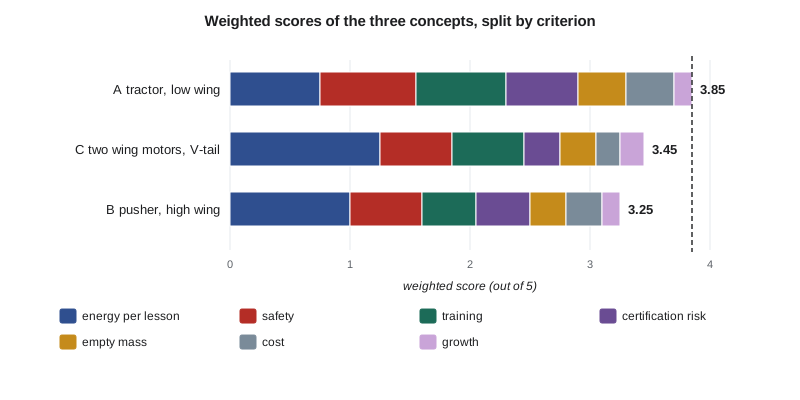
Concept A leads with 3.85, C follows with 3.45 and B is last with 3.25. The margin between A and C is 0.40, about a tenth of the score. Is that a real difference or an artifact of the weights?
Testing the result
A sensitivity test changes the inputs and watches the output. The code changes each weight in turn by 50 percent up and down, rescaling the others, and checks whether the leader changes. It does not: no single change of that size makes C or B the leader. The code then asks a sharper question: how heavily would energy per lesson have to be weighted for C to win? The answer is 46 out of 100, almost double the agreed weight. The team takes this to the concept review as the key fact: concept C would be the right choice only for a customer who cares about energy almost twice as much as the school does, relative to everything else.
The team also runs a Pugh comparison, a simpler check in which each concept is compared with a datum, here concept A, criterion by criterion, as better, the same or worse. B is better on one criterion and worse on five; C is better on two and worse on five. The Pugh method does not use weights at all, so it guards against the possibility that the weights themselves are biased. Both methods agree.
A third check is the most informal and perhaps the most useful. Professor Lindqvist asks each member to write down, privately, which concept they would choose if the matrix did not exist. Four write A. Owen writes C, and explains why: it is the only concept that improves the efficiency, which is the hardest problem. The team does not overrule him. It records the objection and keeps the blown-wing idea alive in a different form: if the sizing loop later shows that concept A cannot close, the first change considered will be a smaller, more heavily loaded wing with a high-lift system, which brings some of C's benefit without its second motor.
The concept review
The concept review is the first formal design review. Dr. Nakamura chairs it, with Élise, Rachel, Kenji, the school's chief flight instructor and Professor Lindqvist on the board. The team presents the requirements, the concepts, the matrix, the sensitivity results and Owen's dissent. The board asks questions for an hour. Kenji wants to know whether the second motor in concept C could be presented as a safety advantage; Grace explains that with two motors the aircraft must still be safe after losing one, and the asymmetric case is harder for a student than a single-motor forced landing that every license syllabus teaches. The chief flight instructor wants to know which concept he could train his instructors on in a day; the answer is A.
The board accepts concept A with two actions: run the sizing loop by week 10 with the pessimistic assumptions the team promised, and keep the smaller-wing option ready. The swappable pack variant is also kept, pending a look at the school's charging infrastructure and the battery mass handling it would require. The decision, the reasons, the dissent and the actions go into a decision record, a one-page document that will let anyone reading the report years later understand why the Plover E2 looks the way it does.
What the matrix cannot do
A weighted matrix is a tool for structuring a discussion, not a calculator that makes decisions. It assumes that the criteria are independent, which they rarely are: certification risk and cost are related, because certification takes money. It assumes that a score of 4 is worth twice a score of 2, which nobody really believes. It hides uncertainty: a score of 3 based on a calculation and a score of 3 based on a guess look the same. Teams that treat the total as precise, reporting 3.85 against 3.45 as though the difference were measured, misunderstand the method. The value is in the arguments the scoring forces, the evidence written next to each number, and the sensitivity test that shows how robust the choice is.
Worked problem
Finding the break-even weight
Concept A scores 3 on energy per lesson and C scores 5. With an energy weight of 25 out of 100, A's total is 3.85 and C's is 3.45. If the energy weight changes and the other weights stay as they are, at what energy weight do the two concepts tie?
Show solution
- Write each total as the sum of the energy term and the rest: \(T = (w_e s_e + R)/(w_e + 75)\), with \(R\) the weighted sum of the other criteria.
- For A: \(R_A = 385 - 25 \times 3 = 310\). For C: \(R_C = 345 - 25 \times 5 = 220\).
- Tie when \(3w_e + 310 = 5w_e + 220\), so \(w_e = 45\).
- Above 45, C wins; the code's search, which steps in whole numbers, finds C ahead at 46.
Answer: An energy weight of about 45 out of 100, close to twice the agreed 25.
Common mistakes
MistakeSetting weights after scoring.
InsteadAgree and record the criteria and weights before any concept is scored.
MistakeScoring without evidence.
InsteadWrite the reason for every score next to it, with a number where possible.
MistakeTreating the total as a precise measurement.
InsteadTest the ranking against changes in the weights and report how robust it is.
MistakeDiscarding a minority view.
InsteadRecord dissent in the decision record and keep a path open to revisit it if new evidence supports it.
Summary and key terms
- Concept selection is the convergent phase, and it fixes most of the life-cycle cost.
- Concepts are first screened against the requirements with rough numbers.
- Criteria must distinguish the concepts; weights are a stakeholder decision made by pairwise comparison and recorded before scoring.
- Each score needs evidence.
- Concept A, the conventional tractor, leads with 3.85 against 3.45 for the twin wing-motor C and 3.25 for the pusher B; no ±50 percent change in any weight changes the leader, and C would win only if energy carried a weight of about 46.
- A Pugh comparison agrees.
- The concept review accepts A, records a dissent in favor of C's efficiency, and keeps a smaller blown wing as a fallback.
- Convergent phase
- Narrowing many options to one by evaluation.
- Weighted decision matrix
- Scores times weights, summed for each concept.
- Pairwise comparison
- Ranking criteria by comparing them two at a time.
- Sensitivity test
- Changing inputs to see whether the result changes.
- Pugh method
- Comparison of concepts with a datum as better, same or worse.
- Decision record
- Document of a decision, its reasons, dissent and actions.
Practice problems
Work each problem on paper first, then reveal the answer to check.
Why are the weights fixed before scoring?
Show answer
To stop them being adjusted until a favored concept wins.
Why does concept C score lowest on certification risk?
Show answer
Blown-wing lift, a V-tail and wing batteries each need new means of compliance and probably special conditions.
How robust is the choice of A?
Show answer
No single ±50 percent weight change alters the leader; C needs an energy weight of about 46 out of 100.
What does the Pugh method guard against?
Show answer
Bias in the weights, because it uses none.
What fallback did the review keep from concept C?
Show answer
A smaller, more heavily loaded wing with a high-lift system, if A cannot close.
Lesson quiz · 5 questions
Score 60% or more to complete this lesson.
Create a free account to save your progress, take quizzes and earn a certificate.