
AERO-499 · Lesson 2 of 12 · 25 min
Requirements
In week 3 the team holds the requirements workshop that the recovery plan depends on. It takes a full Saturday in the classroom at Flint Hills Flight Academy, with the school's chief flight instructor, two of its instructors, its maintenance manager and its owner on one side of the table and the five students, Professor Lindqvist, Élise and Rachel Oduya on the other. Sam Littlechild, who learned to fly at a school much like this one, chairs it. By the end of the day the team must turn a one-page brief and a room full of opinions into a set of numbered, measurable, verifiable requirements that everyone has agreed to. Everything that follows, from the concept to the final recommendation, will be judged against them.
From needs to requirements
Stakeholders speak in needs, not requirements. The school's owner says the aircraft must be “cheap to run”. The chief flight instructor says it must “fly a full lesson”. The maintenance manager says it must be “easy to look after”. These statements are true and important, and none of them can be designed to or tested. The team's job is to translate each need into one or more requirements that state a measurable value, a condition under which it applies, and a way of showing that it has been met.
“Fly a full lesson” is the best example. The chief instructor explains that a typical circuit lesson at Jabara is booked as a 1.2-hour slot, of which the engine runs for about an hour and the aircraft is airborne for about 45 minutes: six to eight take-offs and landings, with time to taxi out, run up, and return. An air-work lesson, with stalls, steep turns and forced-landing practice in the training area, has a similar airborne time but more time at higher power. Sam then asks the question that turns the need into a requirement: what must be left in the battery when the lesson ends? The answer comes from the operating rules. For day flight under visual flight rules, 14 CFR 91.151 requires enough fuel to fly for 30 minutes at normal cruising speed after reaching the destination. The rule was written for fuel, but Rachel explains that the regulator expects the same intent to apply to stored energy, and the team must design to it.
The requirement becomes: the aircraft shall fly a 45-minute lesson, from take-off to landing, followed by a 30-minute reserve at normal cruise, with the battery at the end of its service life. The last clause is the one the school's maintenance manager added, and it is the most important. A battery loses capacity as it ages. An aircraft that meets the mission only when its battery is new will gradually fail to meet it, and the school will discover this one canceled lesson at a time.
What makes a good requirement
Systems engineering standards list the qualities a well-formed requirement should have. The team uses a short version of the list as a checklist during the workshop.
| Quality | Meaning | Failing example |
|---|---|---|
| Necessary | Traces to a stakeholder need or a regulation | The aircraft shall have a glass cockpit (nobody asked) |
| Unambiguous | Has one interpretation | Shall have a long endurance |
| Measurable | States a value with units and conditions | Shall take off in a short distance |
| Verifiable | Can be shown by test, analysis, inspection or demonstration | Shall be safe |
| Feasible | Can be met with known technology, cost and schedule | Shall fly a three-hour cross-country lesson |
| Singular | States one thing | Shall be quiet and cheap and easy to fly |
| Solution-free | States what, not how | Shall use two battery packs |
The last line is the one engineers break most often. “Shall use two battery packs” may turn out to be the right answer, but it is a design decision, and writing it as a requirement removes the option of a better one before anyone has looked. The team allows itself to record solution ideas, but in a separate list that goes to the concept stage, not into the requirements.
Kinds of requirement
Requirements fall into a few families, and a complete set covers all of them. Functional requirements say what the aircraft must do: carry two people, fly a lesson, be recharged. Performance requirements say how well: take-off distance, climb rate, stall speed, cruise speed, recharge time. Constraints limit the solution: the certification basis, the maximum mass the school's hangar floor and tie-downs accept, the charger power the airport's electrical service can supply. Interface requirements define what the aircraft connects to: the charging connector, the charging stand on the ramp, the avionics the school's instructors already know. Operating and support requirements cover maintenance, turnaround and service life. A team that writes only performance requirements ends up with an aircraft that flies well and cannot be supported.
The Plover E2 requirements
By the end of the workshop the team has about forty requirements. The ten that drive the design are below. The others matter, the cabin heater, the tie-down points, the placard locations, but they do not change the size or shape of the aircraft.
| ID | Requirement | Source | Verification |
|---|---|---|---|
| R1 | Two occupants of 90 kg (198 lb) each and 10 kg (22 lb) of baggage | School | Inspection |
| R2 | 45 min lesson plus 30 min reserve at normal cruise, battery at end of life | School, operating rules | Analysis, test |
| R3 | Take-off over a 15 m (50 ft) obstacle within 450 m (1,480 ft) at 400 m (1,310 ft) elevation, ISA + 20 °C | School | Analysis, test |
| R4 | Climb at least 3.5 m/s (690 ft/min) at maximum mass, sea level, ISA + 20 °C | School, sponsor | Analysis, test |
| R5 | Stall at no more than 45 knots CAS with full flap at maximum mass | School, certification | Test |
| R6 | Cruise at no less than 90 knots TAS at 900 m (3,000 ft) on maximum continuous power | School | Analysis, test |
| R7 | Recharge from 20 to 80 percent in 30 min or less | School | Test |
| R8 | Comply with the certification basis for a level 1, low-speed airplane | Regulation | Analysis, test, inspection |
| R9 | Cost per flight hour no more than 60 percent of the school's piston trainer | School, sponsor | Analysis |
| R10 | Fly after a cold soak at −25 °C with the charger pre-conditioning the battery | School | Test |
Several of these deserve comment. R3 and R4 are set for a hot day because density altitude, not elevation, decides take-off and climb performance; the 400 m field elevation covers both the school's home field and the other airports it uses. R5 sets a stall speed that the instructors want for a forgiving trainer: low stall speeds give students time on the approach and reduce the energy of a mishandled landing. R6 looks modest, but the instructors were firm that an aircraft slower than 90 knots would be unpleasant in the gusty winds of the open prairie and would hold up faster traffic in the circuit. R7 comes from the school's timetable: lessons start every 1.5 hours, and an aircraft that needs two hours to recharge would need a spare. R9 is the business case; without it the project has no reason to exist.
R8 needs more explanation. Under 14 CFR Part 23 at amendment 23-64, airplanes are grouped into certification levels by the number of passenger seats, and into low-speed and high-speed groups. A two-seat trainer, with one pilot seat and at most one passenger seat, is level 1, low speed, the least demanding level. The rules themselves state safety objectives rather than design details, and accepted means of compliance, many of them consensus standards published by ASTM International, say how to meet them. Rachel tells the team that this performance-based structure is what makes a small electric airplane certifiable at all: the old prescriptive rules assumed a piston engine and a fuel system, and had nothing to say about a 400-volt battery.
One requirement the team almost missed came from the chief flight instructor at the end of the day. US flight instructor applicants must receive spin training, and many schools teach spin awareness to all students. If the Plover E2 is to replace the school's trainers for those lessons, it must be approved for intentional spins, and that means the higher maneuvering load factors of the utility category, a spin test program and a structure that carries the extra load. The team adds it as R11 and marks it as a candidate for removal if the mass penalty is too high. Removing it would leave the school needing a second aircraft type for spin training, which the owner says would weaken the business case.
Verification methods
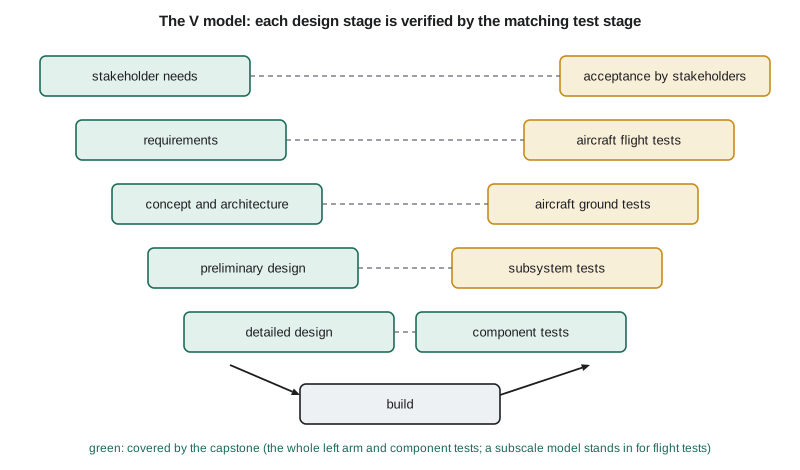
Every requirement names how it will be verified. The four standard methods are test (measure it on the aircraft or a representative article), analysis (calculate it from models whose validity has been shown), inspection (look at the drawing or the article) and demonstration (operate the aircraft and observe that the function works, without measuring a value). The choice is part of the requirement, because it decides what the team must build. A requirement verified only by analysis needs a validated model; one verified by test needs a test article and a test plan.
In a capstone the final verification of most requirements is beyond reach: there will be no full-scale Plover E2 to fly. The team therefore distinguishes the method that will eventually be used in certification from what it can do this year, which is analysis supported by component tests (battery cells), subscale flight tests and comparison with existing aircraft. This is a real limitation and the report must say so plainly, not hide it behind the word “verified”.
Traceability
Traceability means that every requirement links upward to the need or regulation it comes from and downward to the design features and verification that satisfy it. Upward links stop the team from designing things nobody asked for; downward links let anyone check that every requirement has been addressed. Grace keeps the links in a simple table and writes a script that checks it automatically before every design review.
# Requirements traceability check for the Plover E2: every requirement needs a parent, a number and a verification method
import re
needs = {'N1': 'Train student pilots on circuits and air work at low cost per hour',
         'N2': 'Operate from the flight school airfield all year',
         'N3': 'Meet the airworthiness and operating rules for training',
         'N4': 'Turn around quickly between lessons'}
reqs = [  # id, parent, text, verification (T test, A analysis, I inspection, D demonstration)
    ('R1', 'N1', 'carry two occupants of 90 kg each and 10 kg of baggage', 'I'),
    ('R2', 'N1', 'fly a 45 min lesson (take-off to landing) plus 30 min reserve at normal cruise, with the battery at end of life', 'A,T'),
    ('R3', 'N2', 'take off over a 15 m obstacle within 450 m at 400 m elevation, ISA + 20', 'A,T'),
    ('R4', 'N2', 'climb at no less than 3.5 m/s at sea level, ISA + 20, at maximum mass', 'A,T'),
    ('R5', 'N1', 'stall at no more than 45 knots CAS with full flap at maximum mass', 'T'),
    ('R6', 'N1', 'cruise at no less than 90 knots TAS at 900 m on maximum continuous power', 'A,T'),
    ('R7', 'N4', 'recharge from 20 % to 80 % in no more than 30 min', 'T'),
    ('R8', 'N3', 'comply with the applicable certification basis for a level 1 low-speed airplane', 'A,T,I'),
    ('R9', 'N1', 'cost no more than 60 % of a piston trainer per flight hour', 'A'),
    ('R10', 'N2', 'start and fly after a cold soak at -30 C with the charger pre-conditioning the battery', 'T'),
    ('R11', 'N1', 'be easy to fly for students', ''),
    ('R12', 'N9', 'keep cabin noise below 80 dBA in cruise', 'T'),
]
problems = 0
for rid, parent, text, ver in reqs:
    issues = []
    if parent not in needs: issues.append('parent need missing')
    if not ver: issues.append('no verification method')
    if not re.search(r'\d', text): issues.append('no measurable value')
    if re.search(r'\b(easy|user-friendly|adequate|sufficient|minimal)\b', text): issues.append('vague word')
    if issues: problems += 1
    print(f'{rid:4s} {parent:3s} {ver:6s} {"; ".join(issues) if issues else "ok"}')
print(f'\n{problems} of {len(reqs)} requirements need rework')
for n in needs:
    kids = [r[0] for r in reqs if r[1] == n]
    print(f'{n} -> {", ".join(kids)}')
methods = {}
for _, _, _, ver in reqs:
    for v in ver.split(','):
        if v: methods[v] = methods.get(v, 0) + 1
print('verification methods used:', ', '.join(f'{k} {v}' for k, v in sorted(methods.items())))R1 N1 I ok R2 N1 A,T ok R3 N2 A,T ok R4 N2 A,T ok R5 N1 T ok R6 N1 A,T ok R7 N4 T ok R8 N3 A,T,I ok R9 N1 A ok R10 N2 T ok R11 N1 no verification method; no measurable value; vague word R12 N9 T parent need missing 2 of 12 requirements need rework N1 -> R1, R2, R5, R6, R9, R11 N2 -> R3, R4, R10 N3 -> R8 N4 -> R7 verification methods used: A 6, I 2, T 9
The script finds two problems, which Grace planted on purpose to test it. R11 in this version is an early draft from the workshop, “be easy to fly for students”, which has no value, no method and a vague word. It becomes two measurable requirements on stick forces and stall behavior, taken from the certification standard's handling qualities rules, and the spin requirement described above. R12 has a parent need, N9, that does not exist: it is a cabin noise requirement copied from another project, and the team must either find its source or delete it. The instructors confirm that cabin noise matters to them, since students in a quiet cabin can hear instructions without shouting, so the team adds a need for a good learning environment and keeps the requirement.
The design mission
The requirements are turned into a design mission: the flight profile that the sizing in lesson 5 will use. It is not a typical lesson but a demanding one, so that a real lesson leaves margin.
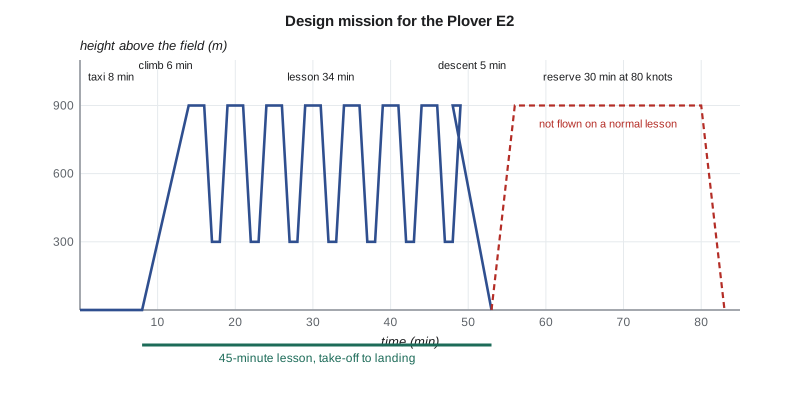
Taxi and run-up take 8 minutes at low power. Take-off and climb to 900 m take 6 minutes at high power. The lesson itself is 34 minutes of mixed flying, which the team models as an average power 15 percent above level cruise, to account for repeated climbs in the circuit, power changes and air work. Descent and landing take 5 minutes. The reserve follows: 30 minutes at the normal cruise speed of 80 knots. The design mission covers both kinds of lesson. Sam reviews it against the school's flight logs, which record engine time for every lesson, and confirms that more than 90 percent of last year's training flights were shorter.
Margins, unknowns and change control
Some values cannot be fixed at the workshop. The battery's specific energy depends on cells that will not be in production until the aircraft would enter service. The team marks such values as TBC (to be confirmed) and carries a margin. Requirements change, too; the cost target in R9 may move if fuel prices do. The charter therefore includes a change rule: once the requirements are signed at the end of week 5, a change needs a short written request explaining the reason and the effect, the agreement of the sponsor, and a new version number. The rule is not bureaucracy for its own sake. Without it, requirements drift as the design gets hard, and a team can find itself meeting a set of targets that nobody agreed to.
Worked problem
Turning a need into a requirement
The maintenance manager says the aircraft must be “easy to look after”. Write a measurable requirement for one part of this need.
Show solution
- Ask what makes maintenance hard on the current fleet: oil changes, spark plug fouling, cylinder inspections, and the 100-hour inspection taking two days.
- Pick a measurable aspect: the time for the scheduled inspection of the electric aircraft.
- State a value and condition: the scheduled 100-hour inspection shall take no more than 6 working hours for one licensed technician.
- Choose a verification method: demonstration on the first aircraft, supported by an analysis of the inspection task list.
Answer: “The scheduled 100-hour inspection shall be completed by one licensed technician in no more than 6 working hours,” verified by analysis of the task list and by demonstration. It traces to the need for low maintenance cost.
Common mistakes
MistakeWriting needs as requirements, such as “shall be safe”.
InsteadState a measurable value, a condition and a verification method for every requirement.
MistakeDesigning to the new battery.
InsteadState energy requirements at the end of battery life, the condition the operator will meet every day.
MistakeWriting the solution into the requirement.
InsteadSay what the aircraft must do, and keep solution ideas in a separate list for the concept stage.
MistakeCalling a requirement “verified” when only a model says so.
InsteadDistinguish the eventual certification method from what the project can show now, and say which is which.
Summary and key terms
- Stakeholders state needs; the team turns each one into requirements with a value, a condition and a verification method.
- Good requirements are necessary, unambiguous, measurable, verifiable, feasible, singular and free of solutions.
- The Plover E2 has ten driving requirements, including a 45-minute lesson plus a 30-minute reserve with the battery at end of life, hot-day take-off and climb, a 45-knot stall, 90-knot cruise, a 30-minute recharge, a level 1 low-speed certification basis and a cost per hour target.
- Spin training adds a utility category requirement.
- Verification is by test, analysis, inspection or demonstration.
- Traceability links each requirement up to a need and down to design and verification.
- The design mission turns the requirements into a flight profile for sizing.
- Requirement
- Measurable, verifiable statement of what the system must do or be.
- Traceability
- Links from each requirement to its source and to its design and verification.
- Verification method
- Test, analysis, inspection or demonstration.
- Design mission
- The flight profile used to size the aircraft.
- Certification level
- Grouping of airplanes by passenger seats that sets the safety objectives.
- Change control
- Agreed procedure for changing signed requirements.
Practice problems
Work each problem on paper first, then reveal the answer to check.
Why is the battery energy requirement stated at end of life?
Show answer
Capacity falls as the battery ages, and the school must meet the mission every day of the battery's service, not only when it is new.
What reserve does the design mission carry and where does it come from?
Show answer
30 minutes at normal cruise, from the day visual flight rules on fuel reserves, applied to stored energy.
What is wrong with “shall use two battery packs”?
Show answer
It states a solution, not a need, and closes off other options before the concept stage.
Name the four verification methods.
Show answer
Test, analysis, inspection and demonstration.
Why are the take-off and climb requirements set for ISA + 20 °C?
Show answer
Density altitude, which rises on hot days, sets take-off and climb performance.
Lesson quiz · 5 questions
Score 60% or more to complete this lesson.
Create a free account to save your progress, take quizzes and earn a certificate.