
AERO-300 · Lesson 4 of 12 · 24 min
Flow over cylinders and the Kutta-Joukowski theorem
The circular cylinder is the most important simple body in aerodynamics, not because aircraft have cylindrical wings but because its exact potential flow can be written down and then transformed into the flow around an airfoil. It is also the classic example of where inviscid theory fails, and understanding that failure tells us where drag really comes from. In this lesson Arjun works through the non-lifting and lifting cylinder, meets d'Alembert's paradox and the Magnus effect, and derives the Kutta-Joukowski theorem that connects circulation to lift for any two-dimensional body.
The non-lifting cylinder
Adding a doublet to a uniform stream produces a stream function that is zero on a circle of radius \(R = \sqrt{\kappa/(2\pi V_\infty)}\). That circle can be treated as a solid surface, giving the flow past a circular cylinder. The velocity on the surface is purely tangential, with magnitude depending on the angle \(\theta\) measured from the downstream axis, or equivalently from the front stagnation point if we measure the other way round.
The surface speed is zero at the front and rear stagnation points and reaches twice the free-stream speed at the top and bottom. The pressure coefficient therefore runs from \(+1\) at the stagnation points to \(-3\) at the shoulders. The distribution is symmetrical top to bottom, so there is no lift, and symmetrical front to back, so there is no drag. The pressure recovers completely on the rear half, pushing forward on the back of the cylinder exactly as hard as the front half is pushed backward.
d'Alembert's paradox and what really happens
Jean le Rond d'Alembert noticed in 1752 that ideal flow theory predicts zero drag on any body moving steadily through a fluid, which every experiment contradicts. The paradox was resolved only when Prandtl introduced the boundary layer. On the rear of a real cylinder the pressure rises along the surface, an adverse pressure gradient. The slow fluid in the boundary layer, already robbed of energy by friction, cannot climb that pressure hill, so it stops and reverses, and the flow separates from the surface. Behind the separation point there is a broad wake at roughly constant low pressure, and the missing pressure recovery on the rear face is the pressure drag.
For a cylinder with a laminar boundary layer, separation occurs about 80 degrees from the front stagnation point, before the shoulder, and the drag coefficient based on frontal area is about 1.2 over a wide range of Reynolds number. Above a critical Reynolds number, around 300 000 for a smooth cylinder, the boundary layer becomes turbulent before it separates. Turbulent boundary layers carry more momentum close to the wall, as Lesson 10 explains, so they resist the adverse gradient longer. Separation moves back past 110 degrees, the wake narrows, and the drag coefficient falls dramatically to about 0.3. This drag crisis is why golf balls have dimples: the dimples trip the boundary layer so that the ball enjoys the low-drag regime at speeds where a smooth ball would not.
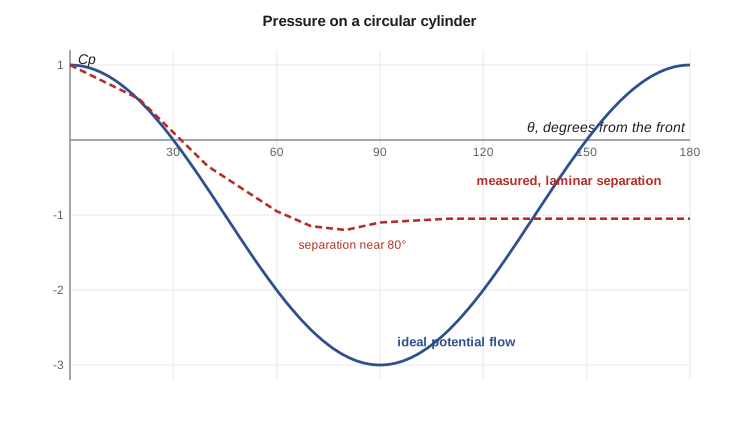
The lesson for wing design is direct. Drag at subsonic speeds comes from skin friction and from incomplete pressure recovery caused by separation and by the displacement effect of thick boundary layers. A good airfoil is shaped so that its pressure recovers gradually enough that the boundary layer stays attached almost to the trailing edge. The cylinder shows what happens when it does not.
The lifting cylinder
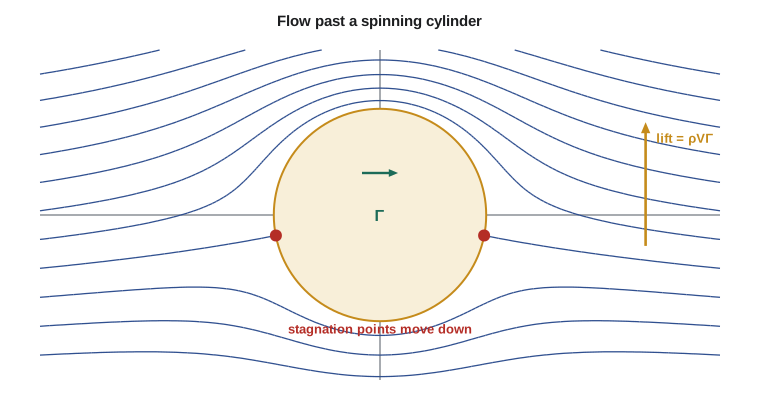
Now add a clockwise vortex of strength \(\Gamma\) at the center of the cylinder. The vortex alone has circular streamlines, so the circle \(r = R\) remains a streamline and the cylinder surface is still impermeable. The surface speed becomes the sum of the doublet's contribution and the vortex's.
With clockwise circulation the speed increases over the top of the cylinder and decreases underneath, so the pressure is lower on top and lift appears. The stagnation points, where \(V_\theta = 0\), move down from the horizontal axis to the angles where \(\sin\theta = -\Gamma/(4\pi V_\infty R)\). As the circulation grows, the two stagnation points slide down the surface and meet at the bottom when \(\Gamma = 4\pi V_\infty R\). For larger circulation the stagnation point leaves the surface and sits in the flow below the cylinder, with a ring of fluid circulating around the body.
The Kutta-Joukowski theorem
Integrating the surface pressure around the lifting cylinder gives a striking result. The drag is still zero, but the lift per unit span is exactly the density times the free-stream speed times the circulation. The radius of the cylinder does not appear.
The theorem holds far more generally. Martin Kutta in Germany and Nikolai Joukowski in Russia showed independently, early in the twentieth century, that the same result applies to any two-dimensional body of any shape in steady, inviscid, incompressible flow. The proof uses a control volume far from the body, where the flow is a uniform stream plus a distant vortex, and integrates the momentum flux and pressure around it. Whatever the body looks like close up, from far away it looks like a vortex of strength \(\Gamma\), and the force depends only on that strength. The shape matters only in so far as it, together with the Kutta condition, determines the value of \(\Gamma\).
# Lifting cylinder: pressure coefficient, stagnation points and the Kutta-Joukowski lift
import math
rho, V, R = 1.225, 20.0, 0.5
for Gam in (0.0, 30.0, 4 * math.pi * V * R):
    k = Gam / (4 * math.pi * V * R)
    if abs(k) <= 1:
        th = math.degrees(math.asin(-k))
        print(f"Gamma = {Gam:6.1f} m2/s: stagnation points at {th:6.1f} and {180 - th:6.1f} deg")
    # integrate pressure around the surface: lift = -int p sin(theta) R dtheta
    n = 3600; Lift = 0.0; Drag = 0.0
    for i in range(n):
        t = 2 * math.pi * (i + 0.5) / n
        vt = -2 * V * math.sin(t) - Gam / (2 * math.pi * R)
        cp = 1 - (vt / V) ** 2
        p = cp * 0.5 * rho * V * V
        Lift += -p * math.sin(t) * R * 2 * math.pi / n
        Drag += -p * math.cos(t) * R * 2 * math.pi / n
    print(f"   pressure integral: L' = {Lift:7.1f} N/m, D' = {Drag:6.2f} N/m;  rho V Gamma = {rho * V * Gam:7.1f} N/m")
for deg in (0, 30, 60, 90, 120, 180):
    t = math.radians(deg)
print(f"theta {deg:3d} deg, no circulation: Cp = {1 - 4 * math.sin(t) ** 2:6.2f}")Gamma = 0.0 m2/s: stagnation points at -0.0 and 180.0 deg pressure integral: L' = 0.0 N/m, D' = -0.00 N/m; rho V Gamma = 0.0 N/m Gamma = 30.0 m2/s: stagnation points at -13.8 and 193.8 deg pressure integral: L' = 735.0 N/m, D' = 0.00 N/m; rho V Gamma = 735.0 N/m Gamma = 125.7 m2/s: stagnation points at -90.0 and 270.0 deg pressure integral: L' = 3078.8 N/m, D' = -0.00 N/m; rho V Gamma = 3078.8 N/m theta 0 deg, no circulation: Cp = 1.00 theta 30 deg, no circulation: Cp = 0.00 theta 60 deg, no circulation: Cp = -2.00 theta 90 deg, no circulation: Cp = -3.00 theta 120 deg, no circulation: Cp = -2.00 theta 180 deg, no circulation: Cp = 1.00
The program integrates the surface pressure numerically around a 0.5 m radius cylinder in a 20 m/s stream. For each value of circulation, the integrated lift agrees with \(\rho V\Gamma\) to the last digit printed, and the integrated drag is zero within round-off. At \(\Gamma = 30\ \text{m}^2/\text{s}\) the stagnation points have moved 13.8 degrees below the horizontal axis. At \(\Gamma = 4\pi V R = 125.7\ \text{m}^2/\text{s}\) they meet at the bottom of the cylinder, and the lift has reached 3079 N per meter, a lift coefficient based on diameter of \(4\pi\), about 12.6. Real spinning cylinders never get close to that, because their boundary layers separate.
The Magnus effect
A real spinning cylinder or sphere does produce a sideways force, called the Magnus effect after Heinrich Magnus, who studied it in 1852. The spinning surface drags the adjacent air round with it through the no-slip condition, which delays separation on the side moving with the stream and promotes it on the side moving against it. The wake is deflected, and by the momentum argument of Lesson 1 the body feels a force in the opposite direction. The effect curves the flight of a tennis ball hit with topspin, a soccer ball struck off-center and a baseball curveball. In the 1920s Anton Flettner built ships with tall spinning cylinders called rotors in place of sails, and modern rotor sails based on the same idea now help some cargo ships save fuel. Measured lift coefficients of rotating cylinders reach perhaps 8 to 10 with end plates, far below the ideal value but still large.
From cylinder to airfoil: the Joukowski transformation
Lesson 3 mentioned that the Joukowski transformation \(\zeta = z + b^2/z\) maps circles into airfoil-like shapes. A circle centerd at the origin with radius \(b\) maps into a flat plate of length \(4b\). A circle slightly offset from the origin, but still passing through the point \(z = b\), maps into a profile with a rounded nose and a cusped trailing edge; shifting the center to the left adds thickness, and shifting it upward adds camber. Because conformal mapping preserves Laplace's equation, the flow past the circle, including its circulation, maps into the flow past the airfoil.
The mapped point \(z = b\) becomes the sharp trailing edge. At that point the transformation's derivative is zero, so a finite speed on the circle would become an infinite speed around the trailing edge, unless the speed on the circle there is zero. That is precisely the Kutta condition. Choosing the circulation so that the rear stagnation point on the circle sits at \(z = b\) gives the lift of the Joukowski airfoil in closed form. For a symmetrical Joukowski section of thickness ratio \(t/c\) at angle of attack \(\alpha\), the result is approximately \(c_l = 2\pi(1 + 0.77\,t/c)\sin\alpha\): thickness raises the lift slope slightly above \(2\pi\), a prediction the panel method in Lesson 7 confirms for a NACA section. Real airfoils fall slightly below \(2\pi\) instead, because the boundary layer thickens toward the trailing edge and effectively reduces the camber.
Worked problem
Circulation and lift on the Skiff-W wing
The Skiff-W cargo drone weighs 24 kg and has a wing span of 3.0 m. It cruises at 13.3 m/s at sea level. Find the average circulation per unit span and the average lift coefficient if the chord is 0.32 m.
Show solution
- Lift per unit span: \(L' = 24\times 9.81/3.0 = 78.5\ \text{N/m}\).
- Circulation: \(\Gamma = L'/(\rho V) = 78.5/(1.225\times 13.3) = 4.82\ \text{m}^2/\text{s}\).
- Lift coefficient: \(c_l = L'/(q c) = 78.5/(0.5\times 1.225\times 13.3^2\times 0.32) = 2\Gamma/(Vc) = 2.26\).
Answer: An average lift coefficient of 2.26 is far too high for a simple wing section at the drone's low Reynolds number. The Skiff-W must fly faster, carry less, or have a larger wing. Arjun took this result to the drone team, who confirmed that the 13.3 m/s figure is the endurance speed at light weight; at full payload the drone cruises at about 18 m/s, where \(c_l\) falls to about 1.2.
Worked problem
Stagnation points on a Flettner rotor
A rotor sail of radius 1.5 m stands in a 10 m/s apparent wind. In ideal flow, what circulation would place the stagnation points 30 degrees below the horizontal, and what lift per meter of height would result in air of density 1.225 kg/m³?
Show solution
- \(\sin\theta = -\Gamma/(4\pi V R)\) with \(\theta = -30°\): \(\Gamma = 4\pi\times 10\times 1.5\times 0.5 = 94.2\ \text{m}^2/\text{s}\).
- Lift per unit height: \(L' = \rho V\Gamma = 1.225\times 10\times 94.2 = 1154\ \text{N/m}\).
Answer: In ideal flow each meter of the rotor would produce about 1.15 kN. A real rotor produces a fraction of that, but a rotor 30 m tall still gives a useful force, which is why the idea has returned for wind-assisted ship propulsion.
Common mistakes
MistakeConcluding that potential flow is useless because it predicts no drag.
InsteadIt predicts pressure and lift very well where the flow stays attached. Drag needs the boundary layer added, which is exactly how modern design methods work.
MistakeThinking the Kutta-Joukowski theorem applies only to cylinders.
InsteadIt applies to any two-dimensional body in steady inviscid incompressible flow. The shape enters only through the circulation.
MistakeAssuming a spinning cylinder in real air reaches the ideal lift coefficient of 4π.
InsteadSeparation limits real values to well below that, typically under 10 even with end plates.
MistakeMixing up the sign convention for circulation.
InsteadAlways state the direction. In this course, clockwise circulation in a stream moving from left to right gives positive lift.
Summary and key terms
- The flow past a circular cylinder is a uniform stream plus a doublet, with surface pressure coefficient 1 − 4 sin²θ, no lift and no drag.
- Real cylinders have pressure drag because the boundary layer separates in the adverse pressure gradient on the rear, and a turbulent boundary layer delays separation and causes the drag crisis.
- Adding a vortex gives lift, moves the stagnation points down and leads to the Kutta-Joukowski theorem L' = ρVΓ, valid for any two-dimensional body.
- The Magnus effect is the viscous counterpart, and the Joukowski transformation turns cylinder flow into airfoil flow with the Kutta condition fixing the circulation.
- d'Alembert's paradox
- The prediction of zero drag on a body in steady inviscid flow.
- Adverse pressure gradient
- Pressure rising in the direction of flow, which slows the boundary layer and can separate it.
- Separation
- The departure of the boundary layer from the surface when it can no longer advance against the pressure rise.
- Drag crisis
- The sharp fall in a bluff body's drag when its boundary layer becomes turbulent before separating.
- Kutta-Joukowski theorem
- The lift per unit span of a two-dimensional body equals ρVΓ.
- Magnus effect
- The force on a spinning body moving through a fluid.
- Conformal mapping
- A transformation of the complex plane that preserves angles and therefore solutions of Laplace's equation.
- Joukowski airfoil
- An airfoil shape obtained by applying the Joukowski transformation to an offset circle.
Practice problems
Work each problem on paper first, then reveal the answer to check.
Find the surface speed and C_p on a non-lifting cylinder at 45° in a 30 m/s stream.
Show answer
V = 2 × 30 × sin 45° = 42.4 m/s; C_p = 1 − 4 × 0.5 = −1.0.
A cylinder of radius 0.2 m in a 15 m/s stream has circulation 10 m²/s. Where are the stagnation points?
Show answer
sin θ = −10/(4π × 15 × 0.2) = −0.265, so θ = −15.4° and 195.4°.
What lift per meter does the cylinder in the previous problem produce at sea level?
Show answer
L' = 1.225 × 15 × 10 = 184 N/m.
Why does a smooth cylinder's drag fall sharply above a Reynolds number of about 300 000?
Show answer
The boundary layer turns turbulent before separating, separation moves aft and the wake narrows.
In the program, change the radius to 0.25 m but keep Γ = 30 m²/s. What happens to the lift and the stagnation points?
Show answer
Lift is unchanged at 735 N/m. The stagnation points move further down, since sin θ = −30/(4π × 20 × 0.25) = −0.477, θ = −28.5°.
A symmetrical Joukowski section 12 percent thick is at 5°. Estimate its inviscid lift coefficient.
Show answer
c_l ≈ 2π(1 + 0.77 × 0.12) sin 5° = 0.60.
Lesson quiz · 5 questions
Score 60% or more to complete this lesson.
Create a free account to save your progress, take quizzes and earn a certificate.