
AERO-300 · Lesson 2 of 12 · 24 min
Vorticity and circulation
When Arjun asked Tomasz why a wing produces lift, he expected an answer about air going faster over the top. Tomasz answered with a question of his own: if lift comes from the air going faster over the top, what makes it go faster? The honest answer, he said, is circulation. A lifting wing carries a net circulation of air around it, superimposed on the free stream, and the lift per unit span equals the air density times the free-stream speed times that circulation. This lesson defines circulation and its local relative, vorticity, and shows how a wing comes to have circulation in the first place.
Vorticity: the local spin of the fluid
Imagine dropping a tiny paddle wheel into a flow and watching whether it spins. If it rotates, the fluid at that point has vorticity. Mathematically, vorticity is the curl of the velocity field. For a two-dimensional flow in the x-y plane only one component survives, pointing out of the plane.
Vorticity equals twice the local angular velocity of a fluid element. In solid-body rotation, where fluid turns like a rigid disc at angular speed \(\Omega\), the vorticity is \(2\Omega\) everywhere. A flow with zero vorticity everywhere is called irrotational. That does not mean particles move in straight lines: in the free vortex of a whirlpool, particles travel in circles, yet the paddle wheel does not spin, because the faster inner fluid and the slower outer fluid shear the element in a way that cancels its rotation. The free vortex is irrotational everywhere except at its center, where the speed formula becomes infinite.
Where does vorticity come from? In a flow that starts uniform and has no viscosity, it cannot be created. Helmholtz and Kelvin showed in the nineteenth century that in an inviscid fluid with constant density and conservative body forces, vorticity is carried along with the fluid particles and never appears from nothing. Real air does have viscosity, and the no-slip condition at a solid surface generates intense vorticity in the boundary layer. That vorticity stays inside the boundary layer and the wake. Outside those thin regions the air around a wing in steady flight has essentially no vorticity, which is why the irrotational model of the next lessons works so well.
Circulation
Circulation is a property of a closed curve rather than a point. It is the line integral of the tangential velocity around the curve. Positive circulation is usually taken counter-clockwise, although aerodynamics texts often define it clockwise so that a lifting wing in a flow from left to right has positive circulation; in this course we state the direction every time.
Stokes' theorem connects the two ideas: the circulation around a curve equals the total vorticity passing through any surface bounded by the curve. So in an irrotational region, the circulation around any curve that does not enclose a solid body or a vortex is zero. Around a curve that does enclose a wing, the circulation can be nonzero, because the wing and its boundary layer hold vorticity inside the curve.
The program checks Stokes' theorem numerically for two flows. For solid-body rotation the circulation grows with the area enclosed, because the vorticity is spread uniformly through the fluid. For the free vortex the circulation is exactly the vortex strength, 10 m²/s, whatever the radius of the circle: all the vorticity is concentrated at the center, so every circle enclosing the center captures the same amount.
# Circulation as a line integral and as the integral of vorticity
import math
def circulation(u, v, R, n=2000):
    """Integrate V . ds counter-clockwise around a circle of radius R."""
    G = 0.0
    for i in range(n):
        th = 2 * math.pi * (i + 0.5) / n
        x, y = R * math.cos(th), R * math.sin(th)
        dsx, dsy = -math.sin(th) * R * 2 * math.pi / n, math.cos(th) * R * 2 * math.pi / n
        ux, vy = u(x, y), v(x, y)
        G += ux * dsx + vy * dsy
    return G
w = 4.0                                    # solid-body rotation, angular speed rad/s
rigid = (lambda x, y: -w * y, lambda x, y: w * x)
G0 = 10.0                                  # free vortex of strength 10 m2/s
free = (lambda x, y: -G0 * y / (2 * math.pi * (x * x + y * y)), lambda x, y: G0 * x / (2 * math.pi * (x * x + y * y)))
for R in (0.5, 1.0, 2.0):
    print(f"R = {R:3.1f} m  rigid rotation: line integral {circulation(*rigid, R):7.3f}, "
          f"vorticity x area {2 * w * math.pi * R * R:7.3f};  free vortex: {circulation(*free, R):6.3f}")
# Circulation needed for the Tern's wing at cruise (Kutta-Joukowski per unit span)
rho, V, m, g, b = 0.909, 105.6, 6500, 9.81, 17.0
Lp = m * g / b                             # average lift per meter of span
Gam = Lp / (rho * V)
print(f"Average lift per unit span {Lp:.0f} N/m needs circulation {Gam:.1f} m2/s")
c = 28.0 / b
print(f"Mean chord {c:.2f} m: average extra speed difference (top minus bottom) about {2 * Gam / c:.1f} m/s")R = 0.5 m rigid rotation: line integral 6.283, vorticity x area 6.283; free vortex: 10.000 R = 1.0 m rigid rotation: line integral 25.133, vorticity x area 25.133; free vortex: 10.000 R = 2.0 m rigid rotation: line integral 100.531, vorticity x area 100.531; free vortex: 10.000 Average lift per unit span 3751 N/m needs circulation 39.1 m2/s Mean chord 1.65 m: average extra speed difference (top minus bottom) about 47.4 m/s
Circulation and lift: a first look at Kutta-Joukowski
Lesson 4 derives the Kutta-Joukowski theorem properly. Here we use it to get a feeling for the numbers. For a two-dimensional section in a uniform stream, the lift per unit span is the density times the free-stream speed times the circulation around the section, with the circulation taken clockwise for a stream moving from left to right.
The Tern weighs 63.8 kN and has a span of 17 m, so on average each meter of span carries 3751 N. At cruise speed and density, the program finds the circulation needed is about 39 m²/s. Dividing by the mean chord gives a rough idea of the speed difference between the upper and lower surfaces: on average the air must travel about 47 m/s faster over the top than underneath. That is an average; near the leading edge the difference is much larger and near the trailing edge it falls to zero.
This picture also explains a common misconception. Many popular accounts say the air over the top must go faster because it has farther to travel and must meet the air from underneath at the trailing edge. Wind tunnel smoke shows that this is false: air over the upper surface of a lifting wing arrives at the trailing edge well before the air that went underneath. The speed difference is set by the circulation, and the circulation is set by the Kutta condition described below, not by any requirement that particles reunite.
How a wing acquires circulation: the starting vortex
If vorticity cannot be created in the outer flow, and the air ahead of a wing has no circulation, how does the wing come to have circulation at all? Kelvin's circulation theorem says that the circulation around a closed curve that always contains the same fluid particles stays constant. Draw a large curve in still air around a wing at rest on the runway. Its circulation is zero, and it must stay zero as the wing accelerates and starts to lift.
The resolution is the starting vortex. When the wing begins to move, the flow initially tries to curl around the sharp trailing edge from the lower surface to the upper surface. Real air cannot turn that sharp corner: the speeds would be infinite, and viscosity in the boundary layer makes the flow separate at the edge. A vortex is shed from the trailing edge and carried downstream. It has, say, anticlockwise circulation. To keep the total inside the large curve at zero, an equal clockwise circulation must appear around the wing. That bound circulation is what gives lift.
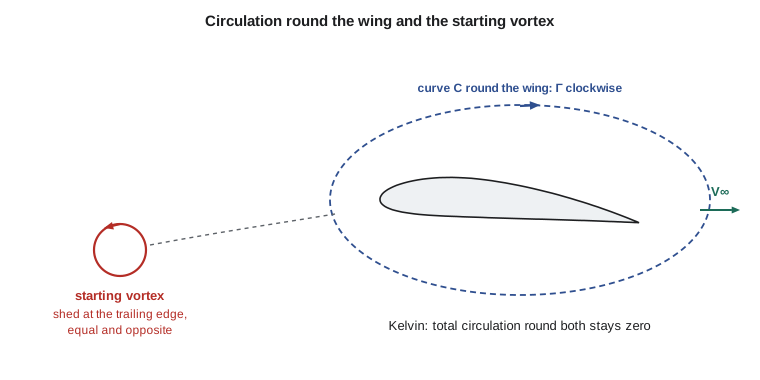
Each time the wing's lift changes, for example when the pilot pulls back on the control column or the aircraft flies into a gust, a little more vorticity is shed so that the total stays balanced. The shed vortices are real: they can be seen in water tanks and in smoke visualizations, and the delay while the circulation builds up after a sudden change in angle of attack, called the Wagner effect, matters in gust response and flutter.
The Kutta condition
The starting vortex stops growing when the flow leaves the trailing edge smoothly from both surfaces. This is the Kutta condition: for a section with a sharp trailing edge, the circulation adjusts until the flow leaves the edge without wrapping around it. For a trailing edge with a finite angle, the trailing edge becomes a stagnation point; for a cusped edge, the speeds on the upper and lower surfaces become equal there. Either way, the trailing edge fixes the circulation and therefore the lift.
The Kutta condition is the bridge between real viscous air and the inviscid theory. Inviscid theory alone admits any value of circulation around a body, and therefore any lift. Nature picks one value, and the reason is viscosity acting at the trailing edge. That is why the aerodynamic theory in the next lessons, which is entirely inviscid, still has to add this one condition borrowed from the real behavior of the boundary layer.
Vortex lines in three dimensions
Helmholtz's vortex theorems describe how vorticity behaves in three dimensions. The strength of a vortex filament is constant along its length. A vortex filament cannot end in the fluid; it must form a closed loop, extend to infinity or end on a solid boundary. And in an inviscid fluid a vortex filament moves with the fluid particles.
These rules have a dramatic consequence for a wing of finite span. The bound vortex that gives each section its circulation cannot simply stop at the wingtip. It must turn and trail downstream. A real wing therefore leaves behind a pair of trailing vortices, one from each tip, joined far behind by the starting vortex, so that the whole system forms a closed loop. Those trailing vortices cause downwash, induced drag and the wake turbulence that air traffic controllers separate aircraft for. Lessons 8 and 9 build the theory of finite wings on exactly this horseshoe of vortex lines.
Worked problem
Circulation of a test rotor wake
Arjun measures the tangential speed around a trailing vortex in the wind tunnel at a radius of 0.12 m and finds 2.9 m/s, nearly constant around the circle. Estimate the vortex strength, and the tangential speed it would induce at 0.30 m if it behaves as a free vortex.
Show solution
- For a free vortex, \(V_\theta = \Gamma/(2\pi r)\), so \(\Gamma = 2\pi r V_\theta = 2\pi\times 0.12\times 2.9 = 2.19\ \text{m}^2/\text{s}\).
- At 0.30 m: \(V_\theta = 2.19/(2\pi\times 0.30) = 1.16\ \text{m/s}\).
Answer: The vortex strength is about 2.2 m²/s. Measurements closer to the center would show the speed falling again inside a viscous core, where the flow rotates nearly as a solid body. Real tip vortices are well described by such a core surrounded by a free vortex.
Worked problem
Bound circulation of the Tern on approach
On approach the Tern flies at 52 m/s at sea level (ρ = 1.225 kg/m³) at its 6300 kg landing weight. Find the average bound circulation per unit span.
Show solution
- Lift per unit span: \(L' = 6300\times 9.81/17 = 3636\ \text{N/m}\).
- Circulation: \(\Gamma = L'/(\rho V) = 3636/(1.225\times 52) = 57.1\ \text{m}^2/\text{s}\).
Answer: At low speed the wing needs nearly half as much circulation again as in cruise to carry almost the same weight. High circulation at low speed is precisely what the high-lift devices of Lesson 12 provide.
Common mistakes
MistakeSaying the air over the top must arrive at the trailing edge at the same time as the air underneath.
InsteadThere is no such requirement. On a lifting wing the upper-surface air arrives first. The speed difference comes from the circulation fixed by the Kutta condition.
MistakeAssuming an irrotational flow means particles move in straight lines.
InsteadIrrotational means fluid elements do not spin. In a free vortex particles move in circles, yet the flow is irrotational away from the center.
MistakeBelieving inviscid theory alone determines the lift.
InsteadInviscid theory allows any circulation. The Kutta condition, which comes from viscous behavior at the trailing edge, selects the actual value.
MistakeImagining that a wing's bound vortex ends at the wingtip.
InsteadHelmholtz's theorems forbid a vortex line ending in the fluid. It turns at the tip and trails downstream as a tip vortex.
Summary and key terms
- Vorticity is the curl of velocity and measures the local spin of fluid elements.
- Circulation is the line integral of velocity around a closed curve and, by Stokes' theorem, equals the vorticity enclosed.
- Around a lifting wing the outer flow is irrotational but the curve enclosing the wing carries circulation, and the lift per span is ρVΓ.
- Kelvin's theorem explains the starting vortex, the Kutta condition fixes the circulation at the sharp trailing edge, and Helmholtz's theorems require the bound vortex of a finite wing to trail downstream from the tips.
- Vorticity
- The curl of the velocity field, equal to twice the local angular velocity of a fluid element.
- Irrotational flow
- A flow with zero vorticity everywhere in the region considered.
- Circulation
- The line integral of tangential velocity around a closed curve.
- Starting vortex
- The vortex shed from the trailing edge when a wing starts to produce lift.
- Bound vortex
- The circulation carried around a lifting wing, represented as a vortex fixed to the wing.
- Kutta condition
- The requirement that flow leaves a sharp trailing edge smoothly, which fixes the circulation.
- Kelvin's theorem
- In an inviscid flow the circulation around a curve moving with the fluid stays constant.
- Helmholtz's theorems
- Rules stating that vortex strength is constant along a filament and that filaments cannot end in the fluid.
Practice problems
Work each problem on paper first, then reveal the answer to check.
Find the vorticity of the flow u = −3y, v = 3x.
Show answer
ω = ∂v/∂x − ∂u/∂y = 3 − (−3) = 6 s⁻¹, solid-body rotation at 3 rad/s.
A wing section produces 900 N/m of lift at 40 m/s in air of density 1.2 kg/m³. Find the circulation.
Show answer
Γ = 900/(1.2 × 40) = 18.75 m²/s.
What circulation does a free vortex with tangential speed 5 m/s at radius 0.4 m have?
Show answer
Γ = 2π × 0.4 × 5 = 12.6 m²/s.
Why must the circulation around a large curve enclosing a wing and its starting vortex remain zero?
Show answer
Kelvin's theorem: the curve contains the same fluid particles, the outer flow is inviscid, and the circulation was zero before the wing moved.
In the program, double the angular speed of the solid-body rotation. What happens to the circulation around each circle?
Show answer
It doubles, because vorticity 2Ω doubles and the enclosed area is unchanged.
Using the program's numbers, how does the required circulation change if the Tern flies the same weight at 3000 m but 20 percent slower?
Show answer
Γ = L'/(ρV) rises by a factor 1/0.8 = 1.25, to about 48.9 m²/s.
Lesson quiz · 5 questions
Score 60% or more to complete this lesson.
Create a free account to save your progress, take quizzes and earn a certificate.