
AERO-300 · Lesson 10 of 12 · 23 min
Boundary layers
The inviscid theory of Lessons 2 to 9 predicts lift and induced drag, but it says the Block 2 wing section has no drag at all, and it cannot say when the wing will stall. Both answers live in a layer of air a few millimeters thick: the boundary layer. In this lesson Arjun learns what happens inside it, how thick it is on the Tern's wing, how laminar and turbulent boundary layers differ and how to estimate the skin-friction drag that makes up most of a clean wing's profile drag.
The no-slip condition and Prandtl's boundary layer
At a solid surface the air does not slip: its velocity relative to the surface is zero. A short distance away it moves at nearly the local speed of the outer, inviscid flow. In between is the boundary layer, where the velocity rises from zero to the outer value \(u_e\) and where viscous stresses are as important as inertia. Prandtl showed in 1904 that at high Reynolds number this layer is very thin compared with the body, so the pressure across it is essentially constant and equal to the outer-flow pressure at the edge. That one result allows the problem to be split: solve the inviscid flow first to get the pressure along the surface, then solve the much simpler boundary-layer equations using that pressure.
The boundary layer's thickness \(\delta\) is usually defined as the distance from the wall at which the velocity reaches 99 percent of \(u_e\). Two integral thicknesses are more useful. The displacement thickness \(\delta^*\) is the distance the outer flow is pushed away from the surface by the slowed fluid; adding it to the airfoil shape gives the effective shape the inviscid flow sees. The momentum thickness \(\theta\) measures the momentum lost in the layer; at the trailing edge it is directly related to the section's profile drag.
The ratio \(H\), the shape factor, describes the shape of the velocity profile. It is about 2.6 for a laminar flat-plate boundary layer, about 1.3 to 1.4 for a turbulent one, and it rises toward 3.5 or more for a laminar layer, and 2.5 or more for a turbulent one, as separation approaches. Engineers watch the shape factor in boundary-layer calculations as an early warning of separation.
The laminar boundary layer
Close to the leading edge the boundary layer is laminar: the fluid moves in smooth layers and momentum is transferred across them only by molecular viscosity. For a flat plate with no pressure gradient, Prandtl's student Heinrich Blasius found the exact solution in 1908. The boundary layer grows with the square root of distance, and the local skin-friction coefficient falls with the square root of the local Reynolds number.
Laminar boundary layers are thin and have low skin friction because the velocity rises gradually from the wall. Their weakness is that their slow fluid near the wall has little momentum, so they separate easily when the pressure rises. A laminar boundary layer can tolerate only a small adverse pressure gradient, which is why the laminar region on most wings ends near the suction peak.
Transition and the turbulent boundary layer
As the Reynolds number grows, small disturbances in a laminar boundary layer grow too. Beyond a point they break down into turbulence, an irregular, three-dimensional eddying motion that transfers momentum across the layer far more effectively than molecular viscosity. This change is transition. On a smooth flat plate with very quiet air it happens around \(Re_x\) of 3 to 5 million; on a real wing it happens much earlier, near the suction peak where the pressure starts to rise, or wherever roughness, insects, rain or a joint in the skin trips it. Lesson 11 looks at transition more closely.
A turbulent boundary layer is thicker and has a fuller velocity profile: the mean velocity rises steeply very close to the wall and is nearly uniform across the outer part. A simple description is the one-seventh power law, \(u/u_e = (y/\delta)^{1/7}\), with growth and friction given by empirical results for a smooth flat plate.
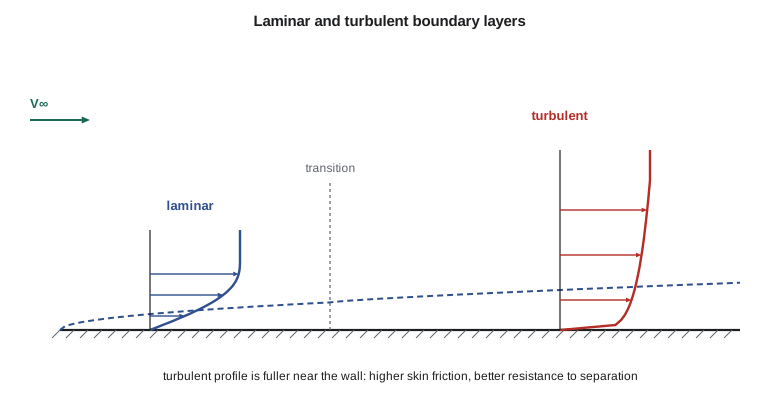
The steep velocity gradient at the wall means much higher wall shear stress, and so much higher skin friction than a laminar layer at the same Reynolds number. But the same fullness is a strength. Turbulent mixing constantly brings high-momentum fluid down toward the wall, so a turbulent boundary layer can push much further against an adverse pressure gradient before it separates. That is the trade at the heart of wing design: laminar flow for low friction, turbulent flow for resistance to separation.
# Laminar and turbulent flat-plate boundary layers, and skin-friction drag of the Tern wing
import math
nu_sl, nu_3000 = 1.461e-5, 1.858e-5          # kinematic viscosity of air, m2/s
def laminar(Re_x, x):                        # Blasius results
    return 5.0 * x / math.sqrt(Re_x), 1.7208 * x / math.sqrt(Re_x), 0.664 * x / math.sqrt(Re_x), 0.664 / math.sqrt(Re_x)
def turbulent(Re_x, x):                      # one-seventh power law, smooth plate
    d = 0.37 * x / Re_x ** 0.2
    return d, d / 8, 7 * d / 72, 0.0592 / Re_x ** 0.2
V, x = 105.6, 0.50                           # cruise speed, half a meter from the leading edge
Re = V * x / nu_3000
for name, f in (('laminar (Blasius)', laminar), ('turbulent (1/7 power)', turbulent)):
    d, ds, th, cf = f(Re, x)
    print(f"{name:22s} at x = {x} m, Re_x = {Re:.2e}: delta = {d * 1000:5.2f} mm, delta* = {ds * 1000:5.2f} mm, "
          f"theta = {th * 1000:5.3f} mm, local cf = {cf:.5f}")
def plate_CF(Re_L, x_tr_frac=0.0):           # average friction coefficient, both sides counted once
    if x_tr_frac <= 0: return 0.074 / Re_L ** 0.2
    Re_tr = Re_L * x_tr_frac
    return 0.074 / Re_L ** 0.2 - (0.074 / Re_tr ** 0.2 - 1.328 / math.sqrt(Re_tr)) * x_tr_frac
c, S_wet = 1.73, 2.04 * 28.0                  # mean chord, wing wetted area (both surfaces, less fuselage)
q = 0.5 * 0.909 * V * V
ReL = V * c / nu_3000
print(f"Wing Reynolds number on the mean chord: {ReL:.2e}")
for frac in (0.0, 0.10, 0.30, 0.50):
    CF = plate_CF(ReL, frac)
    print(f"transition at {frac * 100:3.0f}% chord: average Cf = {CF:.5f}, friction drag of the wing = {CF * q * S_wet:5.0f} N")
print(f"fully laminar (for comparison only): Cf = {1.328 / math.sqrt(ReL):.5f}")laminar (Blasius) at x = 0.5 m, Re_x = 2.84e+06: delta = 1.48 mm, delta* = 0.51 mm, theta = 0.197 mm, local cf = 0.00039 turbulent (1/7 power) at x = 0.5 m, Re_x = 2.84e+06: delta = 9.47 mm, delta* = 1.18 mm, theta = 0.921 mm, local cf = 0.00303 Wing Reynolds number on the mean chord: 9.83e+06 transition at 0% chord: average Cf = 0.00296, friction drag of the wing = 856 N transition at 10% chord: average Cf = 0.00262, friction drag of the wing = 759 N transition at 30% chord: average Cf = 0.00206, friction drag of the wing = 596 N transition at 50% chord: average Cf = 0.00156, friction drag of the wing = 451 N fully laminar (for comparison only): Cf = 0.00042
Skin friction on the Tern's wing
Half a meter behind the leading edge in cruise, the local Reynolds number is 2.8 million. If the boundary layer were still laminar there, it would be only 1.5 mm thick, with a local friction coefficient of 0.0004. If it is turbulent, it is about 9.5 mm thick and its friction coefficient is nearly eight times higher, 0.0030. The momentum thickness, which measures the momentum the layer has taken from the flow, is nearly five times larger.
For the whole wing, with a mean chord Reynolds number of 9.8 million and a wetted area of about 57 m², the program estimates the friction drag using a classic composite method: laminar Blasius friction up to the transition point and turbulent friction after it. If transition occurs at the leading edge, the friction drag in cruise is about 860 N. If the boundary layer stays laminar to 30 percent chord, it falls to about 600 N; to 50 percent, about 450 N. Those differences, a few hundred newtons out of about 5 kN for the whole aircraft, are why laminar-flow wings are so attractive and why the Block 2 team will test the effect of leading-edge roughness carefully. On the gravel-strip routes, insect and stone damage mean the team assumes transition near 10 percent chord for the performance guarantees, and treats more laminar flow as a bonus.
Skin friction is not the whole profile drag. A section also has pressure drag, because the boundary layer's displacement thickness changes the effective shape so that the pressure on the rear does not fully recover. For a well-designed section in attached flow, pressure drag is a fraction of the friction drag, and empirical form factors of 1.2 to 1.4 multiply the friction to account for it, as the component build-up in AERO-220 did. As the angle of attack rises and the boundary layer on the upper surface thickens toward separation, pressure drag grows rapidly and eventually dominates.
The boundary layer and the inviscid flow
Because the boundary layer displaces the outer flow, the effective airfoil is a little thicker than the real one and, more importantly, its effective trailing edge is thickened and moved upward on the suction side at high lift. That reduces the effective camber and the circulation the Kutta condition gives, which is why real lift slopes are a few percent below inviscid predictions. Viscous-inviscid interaction methods iterate between a panel method and a boundary-layer calculation, adding the displacement thickness to the shape at each pass, until the two agree. Programs built on this idea predict section drag within a few percent and lift up to near the stall, and are the everyday tools of airfoil designers.
Worked problem
Boundary-layer thickness at the tip trailing edge
At the approach speed of 52 m/s at sea level, \(\nu = 1.461\times 10^{-5}\ \text{m}^2/\text{s}\), estimate the turbulent boundary-layer thickness and displacement thickness at the trailing edge of the 1.02 m tip chord, treating it as a flat plate turbulent from the leading edge.
Show solution
- \(Re_x = 52\times 1.02/1.461\times 10^{-5} = 3.63\times 10^6\).
- \(\delta = 0.37\times 1.02/(3.63\times 10^6)^{0.2} = 0.377/20.5 = 0.0184\ \text{m}\).
- \(\delta^* = \delta/8 = 2.3\ \text{mm}\).
Answer: About 18 mm thick, with a displacement thickness of 2.3 mm. On the upper surface at high angle of attack the adverse pressure gradient makes the real layer much thicker, which is exactly how stall begins.
Worked problem
Laminar or turbulent drag on the Skiff-W wing
The Skiff-W wing has a chord of 0.32 m and flies at 18 m/s at sea level. Estimate the average friction coefficient if the boundary layer is fully laminar, and if it is fully turbulent.
Show solution
- \(Re_L = 18\times 0.32/1.461\times 10^{-5} = 3.94\times 10^5\).
- Laminar: \(C_F = 1.328/\sqrt{3.94\times 10^5} = 0.00212\).
- Turbulent: \(C_F = 0.074/(3.94\times 10^5)^{0.2} = 0.00562\).
Answer: At low Reynolds number the turbulent friction is more than two and a half times the laminar value, so a drone wing gains a lot from laminar flow. The catch, covered in Lesson 11, is that laminar layers at this Reynolds number separate easily and form laminar separation bubbles.
Common mistakes
MistakeAssuming pressure varies across the boundary layer.
InsteadFor a thin boundary layer the pressure across it equals the outer-flow pressure at the edge.
MistakeThinking turbulent boundary layers are always bad.
InsteadThey have higher friction but resist separation much better, which is often decisive near the stall.
MistakeUsing the 99 percent thickness to correct the inviscid shape.
InsteadThe displacement thickness, not δ, is the distance by which the outer flow is displaced.
MistakeExpecting transition at the flat-plate Reynolds number on a real wing.
InsteadPressure gradients, roughness and free-stream turbulence usually cause transition much earlier.
Summary and key terms
- Because of the no-slip condition, the velocity near a surface rises from zero to the outer-flow value across a thin boundary layer in which viscosity matters.
- The pressure across the layer is constant, so the inviscid flow supplies it.
- Displacement thickness, momentum thickness and the shape factor describe the layer.
- Laminar layers are thin with low friction but separate easily; turbulent layers are thicker with several times the friction but resist adverse pressure gradients.
- The position of transition largely determines skin-friction drag, and the displacement effect explains why real lift slopes fall slightly below inviscid values.
- No-slip condition
- The requirement that fluid at a solid surface has zero velocity relative to it.
- Boundary layer
- The thin region near a surface where viscous effects are important.
- Displacement thickness
- The distance by which the outer flow is displaced by the slowed fluid in the boundary layer.
- Momentum thickness
- A measure of the momentum lost in the boundary layer.
- Shape factor
- The ratio of displacement thickness to momentum thickness.
- Transition
- The change from laminar to turbulent flow in the boundary layer.
- Skin-friction coefficient
- The wall shear stress divided by the dynamic pressure at the edge of the layer.
- Blasius solution
- The exact solution for a laminar boundary layer on a flat plate with no pressure gradient.
Practice problems
Work each problem on paper first, then reveal the answer to check.
Find the laminar boundary-layer thickness 0.2 m from the leading edge of a plate at 20 m/s in sea-level air.
Show answer
Re_x = 20 × 0.2/1.461 × 10⁻⁵ = 2.74 × 10⁵; δ = 5 × 0.2/√(2.74 × 10⁵) = 1.91 mm.
For the same point, what are the laminar and turbulent local friction coefficients?
Show answer
Laminar 0.664/523 = 0.00127; turbulent 0.0592/(2.74 × 10⁵)^0.2 = 0.0048.
What shape factor does a velocity profile with δ* = 1.2 mm and θ = 0.9 mm have, and is it laminar or turbulent?
Show answer
H = 1.33, typical of an attached turbulent layer.
In the program, move transition to 70 percent chord. What does the friction drag become?
Show answer
Roughly 300 N, since most of the wing would then have low laminar friction.
Why does a thicker boundary layer near the trailing edge reduce lift?
Show answer
It displaces the flow and reduces the effective camber, so the Kutta condition gives less circulation.
Why might a performance guarantee assume early transition?
Show answer
Roughness, insects and erosion in service trip the boundary layer, so laminar flow cannot be relied on.
Lesson quiz · 5 questions
Score 60% or more to complete this lesson.
Create a free account to save your progress, take quizzes and earn a certificate.