
ACCT-331 · Lesson 4 of 12 · 28 min
Client acceptance, planning and understanding the entity
An audit is won or lost in planning. A team that understands the client's business knows where misstatements are likely, spends its time there, and recognizes an unusual number when it sees one. A team that does not understand the business tests everything evenly, spends too much effort on low-risk balances and too little on the ones that matter. This lesson covers the first phase of the audit: deciding whether to accept the client, agreeing the terms of the engagement, developing an overall strategy, and building the understanding of the entity and its environment from which the auditor identifies the risks of material misstatement. It applies all of this to the planning of the Fairhaven audit for the year ending December 31, 2026.
Accepting or continuing a client
Before agreeing to audit, a firm must decide whether it should. Under the firm's quality management system, acceptance and continuance decisions consider three questions. Does management have integrity? Can the firm perform the engagement competently, with the time, people and expertise it needs? Can the firm and the team comply with independence and other ethical requirements? A client whose management lacks integrity is the single largest source of audit failure; no amount of testing reliably detects a well-designed fraud by people determined to deceive the auditor.
For a new client, the proposed auditor gathers information from public sources, background checks on key executives and, with the client's permission, communication with the previous auditor. The codes of conduct require the proposed auditor to ask the client for permission to contact the predecessor, and a refusal is a serious warning sign. The predecessor should respond promptly and say whether there were disagreements with management, concerns about integrity, communications about fraud or illegal acts, or problems with internal control.
For issuer and non-issuer audits, AS 2610 and AU-C 210 require the successor to attempt communication with the predecessor before accepting the engagement. AU-C 510 and AS 2610 deal with opening balances in an initial audit, including reviewing the predecessor's working papers.
| Factor | Evidence considered | Fairhaven assessment |
|---|---|---|
| Management integrity | Background checks, predecessor communication, reputation, history of disputes | No concerns; the CFO joined in 2024 from a large retailer |
| Competence | Industry experience, availability of specialists (IT, valuation, tax) | The office audits two other consumer goods companies |
| Independence | Firm-wide search of financial interests, services and relationships | One senior held shares; removed from the team |
| Risk of the engagement | Financial condition, public listing, complexity, accounting policies | Listed, growing quickly, moderate leverage: higher than average |
| Fees and resources | Budget, timetable, staffing | Feasible with a 10-day earlier start on inventory |
Terms of the engagement
Once the firm accepts, it agrees the terms of the engagement in writing, normally in an engagement letter signed by management and acknowledged by those charged with governance. The letter states the objective and scope of the audit, the responsibilities of the auditor, the responsibilities of management, the financial reporting framework, and the expected form of the report.
A critical precondition is management's acknowledgment of its responsibilities: preparing the statements in accordance with the framework, designing and maintaining internal control, and giving the auditor access to all relevant information and people. Without that acknowledgment, the auditor cannot accept the engagement. The letter also typically covers fees, timetables, the use of the firm's specialists and any limitation of liability permitted by law.
AS 2015 requires the auditor of an issuer to establish an understanding with the audit committee in an engagement letter and to have the audit committee, not just management, appoint the auditor. AU-C 210 sets out the equivalent requirements for non-issuer audits.
Overall audit strategy and audit plan
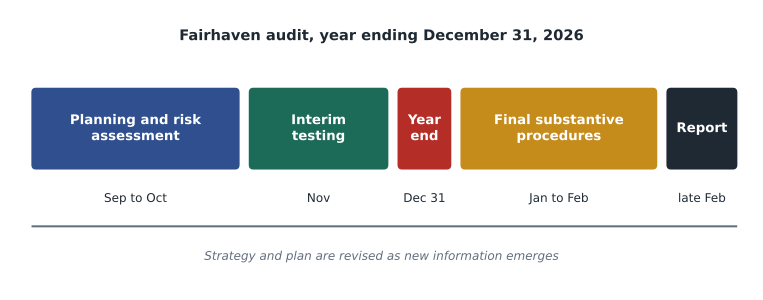
Planning produces two documents. The overall audit strategy sets the scope, timing and direction of the audit: the reporting framework, the locations and components to be audited, key dates, materiality, preliminary risk areas, and the resources to be assigned. The audit plan is more detailed: it sets out the nature, timing and extent of the risk assessment procedures and the further audit procedures to be performed at the assertion level. Planning is not a one-time event; the strategy and plan are revised as the audit progresses and new information emerges.
| Date (2026–27) | Activity |
|---|---|
| September | Continuance decision, engagement letter, team planning meeting |
| October | Understanding the entity, walkthroughs of key processes, preliminary materiality |
| November | Interim tests of controls; interim substantive tests of revenue and payroll |
| December 31 | Year end; observation of the physical inventory count at the distribution center |
| January–February | Final substantive procedures, confirmations, cut-off, estimates |
| Late February | Completion, engagement quality review, audit committee meeting, report signed |
Understanding the entity and its environment
AS 2110 requires the auditor of an issuer to obtain an understanding of the company and its environment, including relevant industry, regulatory and other external factors, the nature of the company, its objectives, strategies and related business risks, and its measurement and review of financial performance, along with internal control over financial reporting. For non-issuer audits, SAS 145, effective for periods ending on or after December 15, 2023, revised AU-C 315 to align it with the international standard and introduced a spectrum of inherent risk.
In practice, the understanding covers several areas. Industry, regulatory and other external factors include competition, seasonality, supplier and customer concentration, exchange rates and regulation. The nature of the entity includes its operations, ownership and governance, investments, financing and the accounting policies it uses. Objectives, strategies and business risks matter because a business risk, such as the risk that a rapid expansion strains systems, often becomes a risk of misstatement. Measurement and review of performance, such as management bonuses based on profit targets, can create pressure to misstate.
For Fairhaven, the team's understanding includes several facts that bear directly on risk. The business is seasonal, with about 40 percent of sales in the fourth quarter, so year-end cut-off matters. Wholesale customers have extended payment terms and rights to return unsold goods in some contracts. Inventory includes technical apparel with rapidly changing styles, so obsolescence is a judgment. Management bonuses depend on reaching 12 million in income before tax, a target the draft statements exceed by only 0.6 million. And the company replaced its warehouse management system in July 2026.
Risk assessment procedures
The auditor obtains the understanding through risk assessment procedures: inquiries of management and others within the entity, analytical procedures, and observation and inspection. Inquiries should go beyond the CFO to people such as warehouse managers, sales staff, in-house legal counsel and internal auditors, who often know about problems that never reach the finance department. Observation and inspection include touring the premises, reading board minutes and business plans, and walking through processes. The engagement team also holds a discussion, often called a brainstorming session, about where the statements are susceptible to material misstatement, including through fraud.
Preliminary analytical procedures
Analytical procedures evaluate financial information by studying plausible relationships among financial and non-financial data. In planning, they help the auditor identify unusual transactions, events, amounts, ratios and trends that may indicate risk. The program below computes common ratios from Fairhaven's draft statements and flags any that moved by more than 10 percent.
# Preliminary analytical procedures on Fairhaven's draft 2026 statements (thousands of dollars)
cy = {"revenue": 184_000, "cost_of_sales": 110_400, "opex": 58_600, "interest": 2_400,
      "receivables": 21_400, "inventory": 38_500, "payables": 17_800, "cash": 6_200,
      "current_liabilities": 31_600, "debt": 46_000, "equity": 64_400}
py = {"revenue": 168_000, "cost_of_sales": 102_500, "opex": 54_100, "interest": 2_200,
      "receivables": 16_100, "inventory": 31_200, "payables": 16_900, "cash": 9_800,
      "current_liabilities": 29_900, "debt": 42_000, "equity": 56_100}

def ratios(d):
    pretax = d["revenue"] - d["cost_of_sales"] - d["opex"] - d["interest"]
    current_assets = d["cash"] + d["receivables"] + d["inventory"]
    return {
        "Gross margin %": 100 * (d["revenue"] - d["cost_of_sales"]) / d["revenue"],
        "Pre-tax margin %": 100 * pretax / d["revenue"],
        "Days sales outstanding": 365 * d["receivables"] / d["revenue"],
        "Days inventory on hand": 365 * d["inventory"] / d["cost_of_sales"],
        "Days payables outstanding": 365 * d["payables"] / d["cost_of_sales"],
        "Current ratio": current_assets / d["current_liabilities"],
        "Debt to equity": d["debt"] / d["equity"],
        "Interest coverage": (pretax + d["interest"]) / d["interest"],
    }

a, b = ratios(cy), ratios(py)
print(f"{'Measure':<28}{'2026':>9}{'2025':>9}{'Change':>9}")
for k in a:
    ch = a[k] - b[k]
    flag = "  <- investigate" if abs(ch) / abs(b[k]) > 0.10 else ""
print(f"{k:<28}{a[k]:>9.2f}{b[k]:>9.2f}{ch:>+9.2f}{flag}")Measure 2026 2025 Change Gross margin % 40.00 38.99 +1.01 Pre-tax margin % 6.85 5.48 +1.37 <- investigate Days sales outstanding 42.45 34.98 +7.47 <- investigate Days inventory on hand 127.29 111.10 +16.18 <- investigate Days payables outstanding 58.85 60.18 -1.33 Current ratio 2.09 1.91 +0.18 Debt to equity 0.71 0.75 -0.03 Interest coverage 6.25 5.18 +1.07 <- investigate
Several measures stand out. Days sales outstanding rose from about 35 to about 42 days, which could reflect slower collections, a change in customer mix toward wholesale, or revenue recorded before it was earned. Days inventory on hand rose from about 111 to about 127 days, which could mean slow-moving stock that needs writing down. Pre-tax margin improved sharply, and interest coverage improved with it, at the same time as the bonus target was just met. Taken together, these patterns point the auditor toward revenue recognition and cut-off, the valuation of receivables and the valuation of inventory, which lessons 9 and 10 test in detail.
| Observation | Possible explanation | Possible misstatement | Risk area |
|---|---|---|---|
| DSO up from 35 to 42 days | Larger wholesale share; slower payers | Fictitious or early-recorded sales; understated allowance | Revenue occurrence and cut-off; receivable valuation |
| Inventory days up from 111 to 127 | Stock built up for new stores; slow sellers | Obsolete inventory not written down | Inventory valuation |
| Gross margin up 1 point | Price increases; better sourcing | Costs capitalized into inventory; cut-off errors | Inventory costing; cost of sales completeness |
| Profit just above bonus target | Genuine improvement | Management bias in estimates | Estimates; fraud risk |
| New warehouse system mid-year | Planned upgrade | Data conversion errors; control gaps | IT general controls; inventory existence |
Using the work of others
Planning also decides whose work the auditor will use. Auditors' experts, such as valuation specialists or actuaries, may be needed for complex estimates. Management's experts, such as an appraiser hired by the company, produce evidence the auditor must evaluate for competence, capability and objectivity. Internal auditors' work may be used to change the nature, timing or extent of the external auditor's procedures, within limits. Where the client outsources processes such as payroll to a service organization, the auditor may rely on a service auditor's report on controls at that organization.
For audits involving other auditors, AS 1206 and amendments to AS 2101, effective for fiscal years ending on or after December 15, 2024, strengthened the lead auditor's responsibilities for planning and supervising other auditors. For non-issuers, SAS 149, the revised AU-C 600, applies for periods ending on or after December 15, 2026 (as of October 2026). ACCT-431 covers group audits in more depth.
Worked problem
Responding to a predecessor's silence
A prospective client tells Bramble Shaw it does not want the firm to contact its previous auditor, citing confidentiality. What should the firm do?
Show solution
- Explain that communication with the predecessor is required before acceptance.
- Ask again for permission and ask why the client objects.
- If the client still refuses, treat the refusal as a serious integrity concern.
Answer: Without permission to communicate with the predecessor, the firm should normally decline the engagement.
Worked problem
A business risk becomes an audit risk
Fairhaven replaced its warehouse management system in July 2026. Why does that matter to the audit?
Show solution
- Data conversion may have introduced errors in quantities or costs.
- Controls designed for the old system may not operate in the new one.
- Staff unfamiliar with the system may override or work around controls.
Answer: The change raises the risk of misstated inventory, so the team plans to test conversion controls and IT general controls before relying on the new system.
Common mistakes
MistakeTreating planning as a phase that ends when fieldwork begins.
InsteadStrategy and plan are revised throughout the audit as new information emerges.
MistakeLimiting inquiries to the finance department.
InsteadInquire of operations, sales, legal and internal audit staff, who often know of problems finance does not.
MistakeAccepting a new client without communicating with the predecessor.
InsteadCommunication with the predecessor, with the client's permission, is required before acceptance.
MistakeViewing preliminary analytics as substantive evidence.
InsteadPlanning analytics identify risk; they are not designed to provide evidence about assertions.
MistakeIgnoring non-financial information.
InsteadHeadcount, store counts, square footage and units shipped help test whether financial trends make sense.
Summary and key terms
- Acceptance and continuance consider management integrity, competence and independence.
- A successor must communicate with the predecessor auditor, with the client's permission, before accepting.
- The engagement letter records the terms and management's acknowledgment of its responsibilities.
- The overall audit strategy sets scope, timing and direction; the audit plan sets detailed procedures.
- AS 2110 and AU-C 315 require an understanding of the company, its environment and internal control.
- Risk assessment procedures include inquiry, analytics, observation and inspection, plus a team discussion of susceptibility to misstatement.
- Preliminary analytics at Fairhaven point to revenue, receivables and inventory valuation as key risk areas.
- Engagement letter
- A written agreement setting out the terms of the audit engagement.
- Predecessor auditor
- The auditor who previously audited the client's statements.
- Overall audit strategy
- A document setting the scope, timing and direction of the audit.
- Audit plan
- A detailed plan of risk assessment and further audit procedures.
- Risk assessment procedures
- Procedures to understand the entity and identify and assess risks of material misstatement.
- Analytical procedures
- Evaluations of financial information through plausible relationships among data.
- Business risk
- A risk that could prevent the entity from achieving its objectives.
- Days sales outstanding
- Receivables divided by revenue, multiplied by 365.
- Auditor's expert
- A specialist in a field other than accounting or auditing whose work the auditor uses.
- Service organization
- A third party that performs services, such as payroll, that are part of the entity's information system.
Practice problems
Work each problem on paper first, then reveal the answer to check.
What three main questions does an acceptance decision consider?
Show answer
Management integrity, the firm's competence and resources, and independence.
What should a predecessor tell a successor?
Show answer
Disagreements with management, integrity concerns, fraud or illegal acts communications and control problems.
Rerun the analytics program with 2026 receivables of 17,600. What is DSO?
Show answer
About 34.9 days, roughly unchanged from 2025.
Rerun it with inventory of 33,500. Is inventory days still flagged?
Show answer
About 110.8 days, slightly below 2025, so no longer flagged.
What is the difference between the overall audit strategy and the audit plan?
Show answer
The strategy sets scope, timing and direction; the plan sets detailed procedures at the assertion level.
Why does the bonus target matter to the auditor?
Show answer
It creates an incentive for management to bias estimates or misstate profit.
Name three people outside finance to whom the auditor might direct inquiries.
Show answer
For example the warehouse manager, sales staff and in-house counsel.
What is a precondition for an audit relating to management?
Show answer
Management's acknowledgment of its responsibility for the statements, internal control and access to information.
Why is a mid-year system change a risk?
Show answer
Conversion errors and control gaps may cause misstatements.
What did Fairhaven's current ratio do between 2025 and 2026?
Show answer
It rose from about 1.91 to about 2.09, mainly because of higher receivables and inventory.
Lesson quiz · 5 questions
Score 60% or more to complete this lesson.
Create a free account to save your progress, take quizzes and earn a certificate.