
ACCT-331 · Lesson 11 of 12 · 31 min
Fraud, going concern and completing the audit
By the end of fieldwork, the Fairhaven audit team has tested controls, confirmed receivables, attended the count and searched for unrecorded liabilities. Several misstatements have turned up. Before the engagement partner can sign the report, three larger questions remain. Has the team responded adequately to the risk of fraud? Can the company continue as a going concern for the foreseeable future? And taking everything together, including events after year end and the misstatements found, are the financial statements fairly presented? This lesson covers the auditor's responsibilities for fraud, going concern, related parties, subsequent events, written representations and the final evaluation of misstatements. ACCT-460 takes forensic accounting and fraud investigation much further; here we stay with what the financial statement auditor must do.
The auditor's responsibility for fraud
Fraud is an intentional act involving deception to obtain an unjust or illegal advantage. Auditors are concerned with two types that cause material misstatement: fraudulent financial reporting, deliberate misstatement of the statements to deceive users, and misappropriation of assets, theft that the statements fail to reflect. Management has primary responsibility for preventing and detecting fraud. The auditor's responsibility is to obtain reasonable assurance that the statements as a whole are free from material misstatement, whether caused by fraud or error. Because fraud involves concealment, collusion and sometimes forgery, the risk of not detecting a material fraud is higher than the risk of not detecting a material error, and an audit properly planned and performed may still fail to detect it.
The fraud triangle, developed from the work of criminologist Donald Cressey, describes three conditions usually present when fraud occurs: an incentive or pressure, an opportunity, and an attitude or rationalization. Auditors look for fraud risk factors in each. At Fairhaven, the bonus target is an incentive; the new warehouse system and the failed credit approval control create opportunity; and a CFO who threatened to tender the audit if the inventory write-down was proposed (lesson 2) may signal an attitude worth noting.
AS 2401 governs fraud in issuer audits and AU-C 240 in non-issuer audits. Both require the engagement team discussion, inquiries of management and the audit committee, the presumption of fraud risk in revenue recognition, and procedures for management override. The IAASB's revised ISA 240, issued in July 2025, may influence future AICPA standard setting (as of October 2026).
| Required procedure | Purpose | At Fairhaven |
|---|---|---|
| Engagement team discussion | Consider how and where the statements could be misstated by fraud | Focus on year-end wholesale shipments and the inventory write-down |
| Inquiries of management, governance, internal audit and others | Learn of known or suspected fraud and fraud risk assessments | Inquiries of the audit committee chair, the credit manager and warehouse staff |
| Presume revenue recognition fraud risk | Respond specifically to the most common scheme | Cut-off tests, confirmations, January credit notes |
| Respond to management override | Address a risk present in every entity | Journal entry testing, review of estimates for bias, unusual transactions |
| Unpredictability | Prevent management anticipating the audit | Unannounced test counts at two stores |
If the auditor identifies a misstatement that may result from fraud, it evaluates the implications for the rest of the audit, especially the reliability of management's representations. The 100 percent tainting in lesson 8, an invoice for goods never shipped, is such a case. Investigation showed that a wholesale sales representative had raised the invoice to meet a quarterly sales quota. It was small and involved no senior management, so the auditor concluded that it did not indicate a pervasive problem, but it extended its review of sales by that representative and reported the matter to the audit committee. Had senior management been involved, the auditor would have had to reconsider the reliability of all management evidence, and possibly whether to continue the engagement.
Laws and regulations, and related parties
The auditor obtains sufficient appropriate evidence about compliance with laws and regulations that directly affect the statements, such as tax and pension laws, and performs limited procedures, mainly inquiry and inspection of correspondence with regulators, to identify non-compliance with other laws that could have a material effect, such as environmental or product safety rules. Identified or suspected non-compliance is communicated to those charged with governance and, in some circumstances, to authorities, as lesson 2 described.
Related party transactions, such as sales to a company owned by a director or loans to executives, are not necessarily improper, but they may not be conducted on market terms, and they have played a part in many frauds. The auditor identifies related parties through inquiry, board minutes, conflict of interest declarations and data analytics, and evaluates whether related party transactions are properly identified, accounted for and disclosed. At Fairhaven, the CEO's family owns the building that houses the main distribution center near Boise; the auditor compares the lease terms with market rents and checks the disclosure.
Going concern
Financial statements are normally prepared on the assumption that the entity will continue in operation for the foreseeable future. Management must assess the entity's ability to continue as a going concern, generally for at least twelve months from the balance sheet date, and disclose material uncertainties. The auditor evaluates management's assessment and considers whether events or conditions cast significant doubt on the entity's ability to continue.
AS 2415 requires the auditor of an issuer to evaluate whether there is substantial doubt about the company's ability to continue as a going concern for a reasonable period, not exceeding one year beyond the date of the statements. Under US GAAP (ASC 205-40), management must evaluate whether there is substantial doubt within one year after the date the statements are issued. For non-issuers, AU-C 570 applies.
Indicators of going concern problems include recurring operating losses, negative operating cash flows, breaches of debt covenants, loss of a key customer or supplier, inability to refinance debt and legal proceedings that could bankrupt the company. When indicators exist, the auditor evaluates management's plans to deal with them, such as raising equity, selling assets, refinancing or cutting costs, and considers whether the plans are feasible and likely to be effective. Cash flow forecasts are tested for reasonableness, including downside scenarios.
# Going concern indicators: cash runway under a downside case (thousands of dollars)
cash = 6_200
undrawn_credit = 10_000
monthly = {"base": -150, "downside": -1_350}   # average monthly operating cash flow, Jan 2027 to Mar 2028
debt_due_2027 = 4_000                           # scheduled repayment in June 2027
for case, flow in monthly.items():
    available = cash + undrawn_credit
    month = 0
    while available > 0 and month < 15:
        month += 1
        available += flow
        if month == 6:
            available -= debt_due_2027
    status = "covers the 12 months after the report date" if month >= 15 and available > 0 else f"funds run out in month {month}"
print(f"{case:<9} cash and credit {cash + undrawn_credit:,}; {status}")base cash and credit 16,200; covers the 12 months after the report date downside cash and credit 16,200; funds run out in month 10
For Fairhaven, the base case shows comfortable liquidity, and the debt-to-equity covenant remains satisfied after the misstatements are corrected (about 0.72 against the 0.75 limit). Only a severe downside case, with sustained operating outflows of 1.35 million a month, would exhaust cash and credit within the coming year. The auditor concludes there is no material uncertainty, but notes the narrow covenant headroom as a matter to discuss with the audit committee.
| Conclusion | Effect on the auditor's report |
|---|---|
| Going concern basis appropriate; no material uncertainty | Unmodified opinion; report describes responsibilities |
| Material uncertainty exists and is adequately disclosed | Unmodified opinion with an explanatory paragraph on substantial doubt |
| Material uncertainty exists but disclosure is inadequate | Qualified or adverse opinion |
| Going concern basis inappropriate | Adverse opinion |
Subsequent events
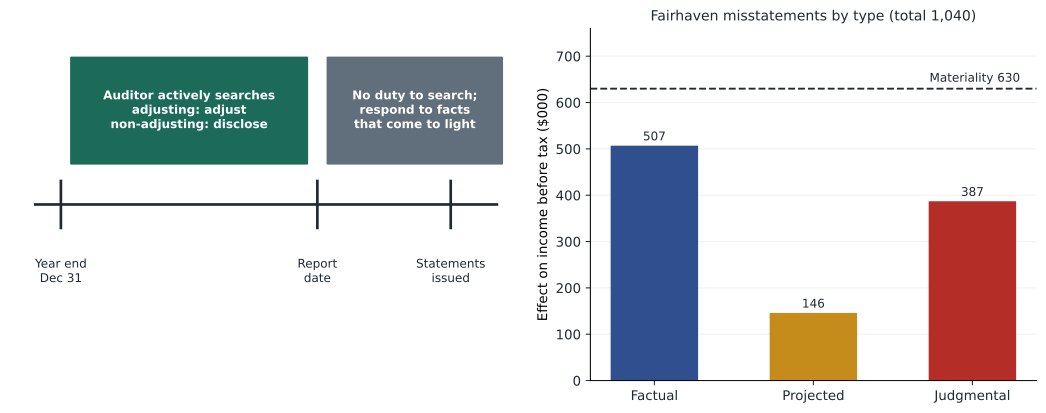
Events between the balance sheet date and the date of the auditor's report may affect the statements. Adjusting events provide evidence of conditions that existed at year end, such as the bankruptcy in January of a customer whose balance was already doubtful at December 31, or the settlement of a lawsuit that was pending at year end; the statements are adjusted. Non-adjusting events relate to conditions that arose after year end, such as a fire at a store in February or a new share issue; they are disclosed if material, but the amounts are not adjusted.
The auditor performs procedures to identify subsequent events up to the date of the report: reading minutes of board meetings held after year end, reviewing the latest interim financial information, inquiring of management and legal counsel, and reviewing subsequent cash receipts and payments (many of which the auditor has already examined). If the auditor becomes aware of a fact after the report date that would have changed the report, it discusses the matter with management, which may need to amend the statements, and the auditor may need to issue a new report.
Evaluating misstatements
Throughout the audit, the team has accumulated misstatements above the clearly trivial threshold on a summary of misstatements. They fall into three types. Factual misstatements are those about which there is no doubt. Judgmental misstatements are differences arising from the auditor's judgment about estimates that it considers unreasonable, or about the selection or application of accounting policies. Projected misstatements are the auditor's best estimate of misstatements in populations, projected from samples. The auditor asks management to correct all misstatements other than clearly trivial ones; if management refuses, the auditor understands its reasons and evaluates whether the uncorrected misstatements, individually or in aggregate, are material.
# Summary of misstatements for the Fairhaven audit (thousands of dollars; effect on income before tax)
materiality, trivial, bonus_target = 630, 30, 12_000
draft_pretax = 12_600
items = [  # description, type, effect on income before tax (negative = reduces income)
    ("Revenue cut-off: net early-recorded sales (307 at 40% margin)", "factual", -123),
    ("Unrecorded December purchases and utilities", "factual", -359),
    ("Receivables: return and invoice with no shipment found in sample", "factual", -25),
    ("Receivables: projected misstatement beyond items found", "projected", -146),
    ("Allowance for doubtful accounts understated", "judgmental", -254),
    ("Inventory write-down understated", "judgmental", -133),
]
total = sum(e for _, _, e in items)
print(f"{'Misstatement':<64}{'Type':>11}{'Effect':>8}")
for d, t, e in items:
    print(f"{d:<64}{t:>11}{e:>8}")
print(f"{'Total':<64}{'':>11}{total:>8}")
print(f"Income before tax if all are corrected: {draft_pretax + total:,}")

corrected = {"factual"}                       # management first offers to correct only the factual items
unc = sum(e for _, t, e in items if t not in corrected)
print(f"Uncorrected if only factual items are booked: {unc}  (materiality {materiality})")
pretax = draft_pretax + sum(e for _, t, e in items if t in corrected)
print(f"Income before tax would be {pretax:,}; correcting the rest as well would give {pretax + unc:,}")
crosses = pretax >= bonus_target > pretax + unc
print("Uncorrected items would move income across the bonus target: qualitatively material" if crosses else "No bonus-target effect")Misstatement Type Effect Revenue cut-off: net early-recorded sales (307 at 40% margin) factual -123 Unrecorded December purchases and utilities factual -359 Receivables: return and invoice with no shipment found in sample factual -25 Receivables: projected misstatement beyond items found projected -146 Allowance for doubtful accounts understated judgmental -254 Inventory write-down understated judgmental -133 Total -1040 Income before tax if all are corrected: 11,560 Uncorrected if only factual items are booked: -533 (materiality 630) Income before tax would be 12,093; correcting the rest as well would give 11,560 Uncorrected items would move income across the bonus target: qualitatively material
Taken together, the misstatements reduce income before tax by 1,040, which exceeds overall materiality. Management first offers to correct only the factual items, leaving 533 uncorrected. That is below materiality of 630 in quantitative terms, but the qualitative test changes the answer: with the factual corrections alone, income is 12,093, just above the 12 million bonus target, and the uncorrected items would bring it below. A misstatement that determines whether management earns a bonus is material regardless of its size. After discussion with the audit committee, management records the inventory and allowance adjustments as well. Income before tax becomes 11,706, the remaining uncorrected projected misstatement of 146 is immaterial, and the bonus target is not met.
AS 2810 deals with evaluating audit results in issuer audits, including qualitative factors and the possibility of management bias in the aggregate of misstatements; SEC Staff Accounting Bulletin 99 lists qualitative factors, including whether a misstatement affects management's compensation.
Written representations and final review
Before signing, the auditor obtains a representation letter from management, dated as of the date of the report. Management confirms that it has fulfilled its responsibility for the statements, has provided all relevant information and access, has recorded all transactions, and believes the effects of uncorrected misstatements are immaterial (with a schedule attached). It also confirms specific matters, such as the completeness of related party disclosures and the absence of known fraud. Representations are necessary evidence, but they do not substitute for other evidence; if management refuses to provide them, the auditor generally must disclaim an opinion.
The final steps include an overall analytical review of the statements to see whether they make sense in light of everything learned, a review of the disclosures for completeness and consistency with the evidence, the engagement partner's review of significant judgments, and the engagement quality review. The auditor also communicates with those charged with governance: significant findings, uncorrected misstatements, significant deficiencies, the fraud identified, and independence. Only then is the auditor ready to form the opinion, the subject of lesson 12.
Worked problem
Adjusting or non-adjusting?
In January 2027, a wholesale customer owing Fairhaven 380 at December 31 files for bankruptcy because of losses it had been incurring all of 2026. In February, a fire destroys inventory worth 900 at one of its stores. Classify each.
Show solution
- The customer's bankruptcy confirms that its balance was impaired at year end: an adjusting event.
- The fire arose after year end: a non-adjusting event, disclosed if material.
- Both are found through post-year-end procedures such as reading minutes and inquiry.
Answer: Adjust the allowance for the bankruptcy; disclose the fire.
Worked problem
Representations that contradict evidence
The CFO is willing to sign a representation that all December 2026 shipments were recorded correctly, but the cut-off test found an invoice for goods shipped on January 2. What does the auditor do?
Show solution
- Representations cannot override contrary evidence.
- Ask management to correct the misstatement and explain the contradiction.
- Reconsider the reliability of other representations and evidence from the same source.
Answer: Rely on the evidence, not the representation, and consider the implications for management's integrity.
Common mistakes
MistakeBelieving an audit is designed to detect all fraud.
InsteadThe auditor obtains reasonable assurance that the statements are free of material misstatement due to fraud or error.
MistakeTreating uncorrected misstatements below materiality as automatically acceptable.
InsteadQualitative factors such as bonus targets or covenants can make them material.
MistakeAdjusting the statements for every event after year end.
InsteadAdjust only for events that provide evidence of conditions at year end; disclose others.
MistakeAccepting representations in place of evidence.
InsteadRepresentations complement, but never replace, other evidence.
MistakeIgnoring going concern when the company is profitable.
InsteadCovenant headroom, refinancing and liquidity still need evaluation.
Summary and key terms
- Auditors seek reasonable assurance against material misstatement from fraudulent reporting and misappropriation.
- The fraud triangle comprises incentive, opportunity and rationalization.
- Required fraud procedures include a team discussion, inquiries, the revenue presumption, override responses and unpredictability.
- The auditor evaluates management's going concern assessment and reports material uncertainties.
- Adjusting events reflect year-end conditions; non-adjusting events are disclosed.
- Misstatements are factual, judgmental or projected; Fairhaven's total of 1,040 was largely corrected after qualitative evaluation.
- Written representations, final analytics, engagement quality review and communication with governance complete the audit.
- Fraudulent financial reporting
- Intentional misstatement of the financial statements to deceive users.
- Misappropriation of assets
- Theft of an entity's assets, often concealed by false records.
- Fraud triangle
- Incentive or pressure, opportunity, and attitude or rationalization.
- Going concern
- The assumption that an entity will continue operating for the foreseeable future.
- Material uncertainty
- An uncertainty about events that may cast significant doubt on going concern.
- Adjusting event
- An event after year end giving evidence of conditions that existed at year end.
- Non-adjusting event
- An event after year end reflecting conditions that arose after year end.
- Factual misstatement
- A misstatement about which there is no doubt.
- Judgmental misstatement
- A difference arising from the auditor's judgment about estimates or policies.
- Projected misstatement
- The auditor's estimate of misstatement in a population based on a sample.
- Representation letter
- A written statement from management confirming certain matters.
Practice problems
Work each problem on paper first, then reveal the answer to check.
Name the two types of fraud relevant to the auditor.
Show answer
Fraudulent financial reporting and misappropriation of assets.
Give a Fairhaven example for each side of the fraud triangle.
Show answer
Incentive: the bonus target; opportunity: the failed credit control and new system; rationalization: pressure on the auditor over the write-down.
Rerun the summary program with management correcting factual and judgmental items. What is uncorrected?
Show answer
146 (the projected misstatement), below materiality, with income at 11,706.
Rerun the going concern program with a downside of −900 a month. When do funds run out?
Show answer
Funds run out in month 14, just short of the 15-month horizon, so the downside still needs attention.
Is a customer bankruptcy in January, caused by losses during 2026, adjusting?
Show answer
Yes; it is evidence of a condition at year end.
What should the auditor do if management refuses to provide written representations?
Show answer
Generally disclaim an opinion and reconsider management's integrity.
Why might the auditor consider a 146 projected misstatement immaterial even though it affects income?
Show answer
It is well below materiality and does not cross the bonus target or a covenant once the other items are corrected.
What is the related party issue at Fairhaven?
Show answer
The distribution center is leased from the CEO's family; terms must be compared with market and disclosed.
List three subsequent events procedures.
Show answer
Read post-year-end minutes, inquire of management and counsel, review interim results and subsequent cash transactions.
What happens if the auditor learns of a fact after the report date that would have changed the report?
Show answer
Discuss with management; the statements may be amended and a new report issued.
Lesson quiz · 5 questions
Score 60% or more to complete this lesson.
Create a free account to save your progress, take quizzes and earn a certificate.