
ACCT-331 · Lesson 3 of 12 · 27 min
Legal liability of auditors
Auditors sell assurance, and when that assurance proves wrong, someone may lose money and look for a defendant who can pay. Audit firms carry insurance and have partners with assets, so they are often the deepest pocket left after a company fails. This lesson explains who can sue an auditor, on what legal theories, and what defenses are available. It covers the common law of negligence, statutory liability under securities legislation, and the regulatory and disciplinary consequences that can follow a failed audit. The aim is not to make you a lawyer, and nothing here is legal advice. It is to show why the standards in the rest of the course are written as they are: much of what auditors document, they document because one day they may need to show a court or a regulator what they did and why.
Sources of liability
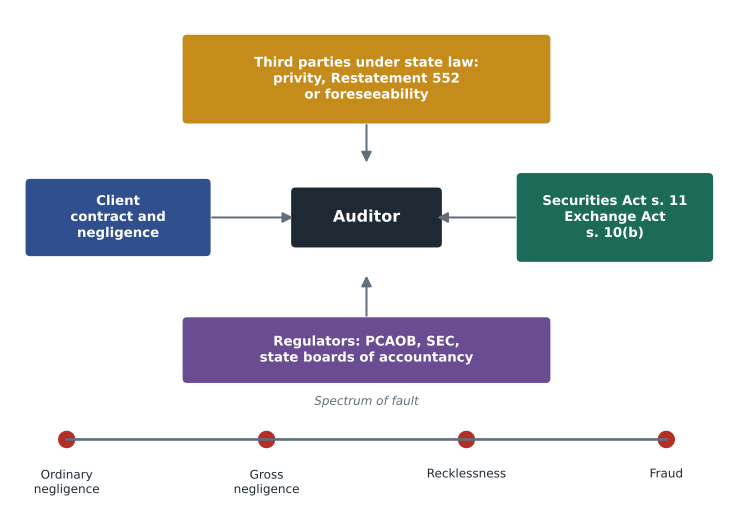
An auditor can face four broad kinds of consequence. First, civil liability to the client under contract and in tort, if the audit was negligent and the client suffered a loss as a result. Second, civil liability to third parties, such as investors and lenders, who relied on the audited statements. Third, statutory civil liability under securities legislation, which may be easier for investors to establish than common law claims. Fourth, regulatory, disciplinary and, in rare cases, criminal consequences: sanctions from the oversight body, discipline from the professional body, or prosecution where an auditor knowingly participated in fraud.
| Kind of claim | Who brings it | What must usually be shown |
|---|---|---|
| Breach of contract | The client | A contractual duty, breach and resulting loss |
| Negligence (to the client) | The client, often through a liquidator or trustee | Duty of care, breach (failure to meet the standard of a reasonable auditor), causation and damages |
| Negligent misrepresentation (to third parties) | Investors, lenders, others who relied | A duty owed to that plaintiff, reasonable reliance, breach, causation and loss |
| Fraud or deceit | Anyone who relied | The auditor knew the statement was false or was reckless |
| Statutory securities claims | Purchasers of securities | A misrepresentation in a disclosure document; defenses depend on the statute |
| Regulatory and disciplinary action | Regulators and professional bodies | Breach of standards or rules of conduct |
Negligence and the standard of care
Negligence requires the plaintiff to prove four elements. The auditor owed the plaintiff a duty of care. The auditor breached that duty by failing to meet the standard of care. The breach caused the plaintiff's loss. And the loss was not too remote. The standard of care is that of a reasonably competent auditor in the same circumstances, and courts look to the auditing standards as strong evidence of what that requires. An auditor who followed the standards is not automatically safe, and one who departed from them is not automatically liable, but compliance with the standards, and documentation that shows it, is the auditor's best defense.
A spectrum of fault runs from ordinary negligence, a lack of reasonable care, through gross negligence, an extreme departure from reasonable care, to constructive fraud or recklessness, and finally to actual fraud, a knowing misstatement intended to deceive. Some claims, especially under United States federal securities law, require proof at the upper end of that spectrum.
Who is owed a duty: third parties
The hardest question in auditor liability is how far the duty extends. An audit report is read by thousands of people the auditor never meets, and if every one of them could sue for any loss, liability would be indeterminate. Courts have drawn the line in different places.
The starting point in the common law world is the 1931 New York case Ultramares Corp. v. Touche. Judge Cardozo held that an auditor who was negligent, though not fraudulent, was not liable to a lender it did not know about, because otherwise auditors would face liability "in an indeterminate amount for an indeterminate time to an indeterminate class." Ultramares limited negligence liability to those in privity of contract with the auditor, or in a relationship so close as to approach privity.
In the United States, auditor liability to third parties under common law is a matter of state law, and the states follow three broad approaches. A minority, led by New York, follow a refined Ultramares rule: the auditor must have known the statements would be used by a particular party for a particular purpose, and there must be conduct linking the auditor to that party (Credit Alliance v. Arthur Andersen, 1985). Most states follow the Restatement (Second) of Torts Section 552, which extends liability to a limited group of persons the auditor intends or knows will receive the information, for a transaction the auditor intends or knows the information will influence. A few states once applied a broad foreseeability test, liability to anyone the auditor could reasonably foresee would rely, but several have since retreated from it, and California rejected it in Bily v. Arthur Young (1992).
Two United States Supreme Court cases shaped how courts treat claims under federal securities law. In Ernst & Ernst v. Hochfelder (1976), the Court held that a private claim under Section 10(b) of the Securities Exchange Act of 1934 and Rule 10b-5 requires scienter, an intent to deceive, manipulate or defraud, so ordinary negligence is not enough; lower courts generally accept recklessness. In Central Bank of Denver v. First Interstate Bank (1994), the Court held that private plaintiffs cannot sue for aiding and abetting a Rule 10b-5 violation, so an auditor can be liable only as a primary violator who made a misstatement, though the SEC itself can still pursue aiders and abettors.
| Approach | Who can sue the auditor for negligence | Example states or cases |
|---|---|---|
| Privity (Ultramares) | Only the client and those in a near-privity relationship | New York, Credit Alliance (1985) |
| Known users and purposes | Identified users relying for the specific purpose the auditor knew about | Restatement (Second) Section 552, most states |
| Reasonable foreseeability | Anyone the auditor could foresee would rely | A few states, much narrowed; rejected in California (Bily, 1992) |
Statutory liability under securities law
Under Section 11 of the Securities Act of 1933, purchasers of securities in a registered offering can sue anyone who signed or certified part of the registration statement, including the auditor whose report is included, if it contains a material misstatement or omission. The plaintiff need not prove reliance or negligence; the auditor must prove its due diligence defense, that after reasonable investigation it had reasonable grounds to believe the statements were true. Secondary-market investors usually sue under Section 10(b) of the Exchange Act and Rule 10b-5, which require proof of a material misstatement, scienter, reliance (often presumed under the fraud-on-the-market doctrine), loss causation and damages. The Private Securities Litigation Reform Act of 1995 (PSLRA) raised pleading standards, introduced a safe harbor for forward-looking statements, and replaced joint and several liability with proportionate liability for defendants who did not knowingly commit a violation.
Joint and several versus proportionate liability
When several defendants caused a loss, the law must decide how to share the damages. Under joint and several liability, each defendant can be made to pay the full award, and a solvent defendant may end up paying the share of one who cannot. Under proportionate liability, each defendant pays only its share of fault. Because company directors and officers are often insolvent or underinsured after a collapse, joint and several liability can make an auditor that was 25 percent at fault pay much more than 25 percent of the damages.
# Allocating a damages award between defendants: joint and several vs proportionate liability
award = 30_000_000                         # damages assessed in a misrepresentation case
fault = {"Fairhaven directors": 0.60, "Bramble Shaw (auditor)": 0.25, "Underwriter": 0.15}
can_pay = {"Fairhaven directors": 4_000_000, "Bramble Shaw (auditor)": 50_000_000, "Underwriter": 20_000_000}

def joint_and_several(award, fault, can_pay):
    # each defendant pays its share; any shortfall falls on the solvent defendants in proportion to fault
    paid = {d: min(award * f, can_pay[d]) for d, f in fault.items()}
    short = award - sum(paid.values())
    solvent = {d: f for d, f in fault.items() if can_pay[d] > paid[d]}
    tot = sum(solvent.values())
    for d, f in solvent.items():
        paid[d] += short * f / tot
    return paid

def proportionate(award, fault, can_pay):
    return {d: min(award * f, can_pay[d]) for d, f in fault.items()}

for name, rule in (("Joint and several", joint_and_several), ("Proportionate", proportionate)):
    paid = rule(award, fault, can_pay)
    print(name)
    for d, v in paid.items():
        print(f"  {d:<26}{v:>14,.0f}")
print(f" {'Recovered by plaintiffs':<26}{sum(paid.values()):>14,.0f}")Joint and several Fairhaven directors 4,000,000 Bramble Shaw (auditor) 16,250,000 Underwriter 9,750,000 Recovered by plaintiffs 30,000,000 Proportionate Fairhaven directors 4,000,000 Bramble Shaw (auditor) 7,500,000 Underwriter 4,500,000 Recovered by plaintiffs 16,000,000
Under joint and several liability, Bramble Shaw would pay far more than its 25 percent share because the directors cannot pay theirs. The PSLRA applies proportionate liability to federal securities claims against defendants who did not knowingly violate the law, with an exception that makes them jointly liable for the uncollectable share owed to small investors (those with net worth under $200,000 who lost more than 10 percent of it), and an extra 50 percent of their own share where other defendants cannot pay. State law varies for common law claims.
Regulatory and disciplinary consequences
The PCAOB can censure, fine, suspend or bar registered firms and their associated persons. The SEC can bring civil enforcement actions and, under Rule 102(e) of its Rules of Practice, deny accountants the privilege of practicing before it. State boards of accountancy can revoke licenses. Criminal liability under federal securities and mail and wire fraud statutes applies to knowing participation in fraud; Sarbanes-Oxley Section 802 made it a crime to destroy or alter audit records to obstruct an investigation and requires auditors to retain audit documentation for seven years.
High-profile failures shape the rules. The collapse of Enron and the conviction (later overturned) of Arthur Andersen in 2002 led to Sarbanes-Oxley. In Canada, the failure of Livent and later cases involving Nortel and Sino-Forest pushed securities regulators and CPAB toward stronger oversight. The 2020 collapse of Wirecard in Germany, after auditors failed for years to confirm cash balances that did not exist, shows why lesson 9 insists on direct confirmation of cash with banks.
Managing liability
Firms manage legal risk mainly by doing good audits, and the rest of this course is about exactly that. A few practices matter particularly for liability. A clear engagement letter defines the scope of the work and the responsibilities of each party. Careful client acceptance avoids clients whose management lacks integrity (lesson 4). Thorough documentation shows what the auditor did and why; work that is not documented is, as far as a court or inspector is concerned, work that was not done. Firms also carry professional liability insurance and organize as limited liability partnerships (LLPs), which protect partners' personal assets from claims arising from other partners' negligence, though not from their own.
AS 1215 requires audit documentation sufficient to enable an experienced auditor with no previous connection to the engagement to understand the work performed, who performed and reviewed it, and the conclusions reached. The complete file must be assembled within 14 days of the report release date and kept for seven years. For non-issuer audits, AU-C 230 sets a 60-day assembly period and a minimum five-year retention.
Worked problem
Applying the third-party test
Bramble Shaw knew Fairhaven would give its 2026 audited statements to Pacific Coast Bank to support a $10 million increase in its credit line. The statements turn out to be materially misstated because of a negligent audit, and the bank loses money. A retail investor who bought shares on Nasdaq also lost money. In a Restatement state, who is likely owed a duty?
Show solution
- The bank is a known user relying on the statements for a transaction the auditor knew about; Section 552 extends the duty to it.
- The investor was not a known or intended user for a specific transaction, so a common law negligence claim is unlikely.
- The investor may instead sue under Section 10(b), but must prove scienter, not mere negligence.
Answer: The bank likely has a negligence claim; the investor's route is statutory and harder to win on negligence alone.
Common mistakes
MistakeThinking following auditing standards makes an auditor immune from liability.
InsteadCompliance is strong evidence of due care, but courts decide the standard of care; documentation of compliance is what protects the auditor.
MistakeAssuming any investor can sue the auditor for negligence under federal securities law.
InsteadRule 10b-5 claims require scienter; negligence is not enough.
MistakeConfusing joint and several with proportionate liability.
InsteadUnder joint and several liability a solvent defendant may pay others' shares; under proportionate liability each pays only its share of fault.
MistakeBelieving an LLP protects a partner from her own negligence.
InsteadAn LLP shields partners from others' negligence, not their own.
MistakeTreating undocumented work as done.
InsteadIf it is not documented, a court or inspector will generally treat it as not done.
Summary and key terms
- Auditors face civil claims from clients and third parties, statutory securities claims, and regulatory and disciplinary action.
- Negligence requires a duty, breach of the reasonable-auditor standard, causation and damages.
- Ultramares (1931) limited negligence liability to those in near-privity with the auditor.
- States follow privity, the Restatement Section 552 known-user test, or (rarely) foreseeability.
- Section 11 requires no proof of reliance or negligence; Section 10(b) requires scienter.
- The PSLRA adopted proportionate liability for non-knowing violations.
- Good documentation, careful acceptance, clear engagement letters and LLP structures help manage liability.
- Restatement Section 552
- The tort rule extending liability to a limited group of known or intended users.
- Duty of care
- A legal obligation to exercise reasonable care toward a particular person.
- Privity of contract
- A direct contractual relationship between the parties.
- Negligent misrepresentation
- A careless false statement relied on by someone to whom a duty was owed.
- Gross negligence
- An extreme departure from the standard of reasonable care.
- Scienter
- Intent to deceive, manipulate or defraud, or recklessness.
- Due diligence defense
- A defense that the defendant conducted a reasonable investigation and had reasonable grounds for belief.
- Joint and several liability
- Each defendant may be required to pay the entire award.
- Proportionate liability
- Each defendant pays only the share of damages matching its share of fault.
- Limited liability partnership
- A partnership in which partners are not personally liable for other partners' negligence.
- Indeterminate liability
- Liability in an indeterminate amount, for an indeterminate time, to an indeterminate class.
Practice problems
Work each problem on paper first, then reveal the answer to check.
Name the four elements of negligence.
Show answer
Duty, breach, causation and damages (loss not too remote).
What did Ultramares decide?
Show answer
A negligent auditor is not liable to unknown third parties; liability extended only to privity or near-privity.
What must a Rule 10b-5 plaintiff prove about the auditor's state of mind?
Show answer
Scienter, an intent to deceive or at least recklessness.
Rerun the allocation program with the directors able to pay 18 million. What changes?
Show answer
The directors pay their full 18 million share, so there is no shortfall and both rules give the same result.
Under joint and several liability in the program, how much does Bramble Shaw pay?
Show answer
16.25 million, against a fault share of 7.5 million, because it absorbs part of the directors' 14 million shortfall.
Under Section 11, who bears the burden on due diligence?
Show answer
The auditor must prove it conducted a reasonable investigation.
Why is documentation so important for liability?
Show answer
It shows what was done and why; undocumented work is treated as not done.
How long must issuer audit documentation be kept?
Show answer
Seven years under AS 1215 and SOX Section 802.
Does an LLP protect a partner from claims arising from her own negligence?
Show answer
No.
Which collapse led to Sarbanes-Oxley?
Show answer
Enron, with Arthur Andersen, in 2001–2002, along with WorldCom.
Lesson quiz · 5 questions
Score 60% or more to complete this lesson.
Create a free account to save your progress, take quizzes and earn a certificate.