
ACCT-240 · Lesson 7 of 12 · 25 min
Production, payroll and the general ledger and reporting cycle
The revenue and expenditure cycles get most of the attention, but three other parts of the AIS matter just as much to the financial statements: the production (or conversion) cycle that values inventory, the human resources and payroll cycle that pays employees, and the general ledger and reporting system that brings every cycle together. This lesson looks at each from a systems and controls point of view. ACCT-102 and ACCT-222 cover how product costs are calculated; here we are concerned with how the data behind those calculations is captured and protected.
Production and inventory
For a manufacturer the production cycle starts with a production plan, uses a bill of materials (the list of components and quantities in each product) and a routing (the sequence of operations and the time each takes), issues materials to production with materials requisitions, records labor and machine time, and moves finished goods into inventory. Each of those records feeds cost accounting. If the bill of materials is wrong, every unit's cost is wrong; if labor time is recorded against the wrong job, job costs and margins are misstated. Changes to bills of materials and routings should therefore be approved by engineering and costing staff and logged like any other master data change.
Ridgeback is a distributor, so its production cycle is mostly inventory management: receiving goods, storing them in bin locations, picking and shipping, handling returns and counting. The ERP keeps a perpetual inventory record that is updated by every receipt and shipment, but the record can drift from reality through theft, damage, mis-picks and keying errors. Cycle counting, in which a few bins are counted every day so that every location is counted several times a year, keeps the records accurate without shutting the warehouse for a full annual count. Counters should not know the system quantity in advance (a blind count), and differences above a threshold should be recounted and investigated before the records are adjusted.
| Risk | Example at Ridgeback | Control |
|---|---|---|
| Inventory theft or loss | High-value headlamps disappear | Restricted access to the high-value cage; cycle counts weighted to valuable items |
| Inaccurate records | Receipts keyed to the wrong bin | Scanning at receipt and putaway; blind cycle counts |
| Unauthorized adjustments | Clerk writes off counted shortages to hide theft | Adjustments above a threshold approved by someone outside the warehouse |
| Obsolete stock | Last year's colors unsold | Aging and slow-moving reports reviewed for write-downs |
| Wrong costs | Freight not added to landed cost | Standard landed-cost rules and review of margin exceptions |
Inventory also needs periodic valuation review. Accounting standards require inventory to be carried at the lower of cost and net realizable value, so the AIS should produce reports of slow-moving items, items with no sales in a set period, and items whose recent selling prices are below cost. For Ridgeback, last season's colors and discontinued models are the usual candidates for write-down. These reports draw on the same perpetual records, which is another reason their accuracy matters: if the system thinks there are 300 tents in a bin that holds 30, both the balance sheet and the write-down analysis are wrong.
The human resources and payroll cycle
The payroll cycle hires employees, records their pay rates and deductions, captures time worked, calculates pay and withholdings, pays employees, remits deductions to the government and keeps the records the law requires. Payroll is usually a large expense, it is processed often, and errors are visible immediately to employees. It is also a target for fraud: ghost employees (people on the payroll who do not work there), inflated hours and unauthorized pay rate changes. The key separation is between the human resources function, which hires, sets pay rates and terminates employees in the HR master file, and the payroll function, which calculates and pays. If one person can both add an employee and run payroll, a ghost employee is easy to create.
Other payroll controls include approval of timesheets by supervisors, automatic comparison of hours to schedules, reports of changes to pay rates and bank accounts each pay period, reconciliation of the payroll register to the general ledger and to government remittances, and occasional payroll audits in which someone confirms that each employee on the register exists and works in the department charged. Paying through direct deposit reduces the risk of lost checks but makes employee bank account changes a fraud target, so changes requested by email should be verified directly with the employee.
In the United States, employers withhold federal income tax, Social Security tax of 6.2 percent on wages up to the 2026 wage base of $184,500, and Medicare tax of 1.45 percent on all wages (plus an additional 0.9 percent on wages above $200,000), match the Social Security and Medicare amounts, and deposit them with the IRS on a monthly or semiweekly schedule. Employers also pay federal unemployment tax (FUTA), effectively 0.6 percent on the first $7,000 of each employee's wages after the state credit, and state unemployment tax (SUTA) at a rate and wage base set by the state. The code below uses those federal rates; the income tax withheld and the SUTA rate are illustrative, and state income tax is ignored. Confirm current rates with the IRS and the state before relying on them.
# Ridgeback: one biweekly payroll register (United States, illustrative 2026 rates)
SS_RATE, MEDICARE_RATE = 0.062, 0.0145
FUTA_RATE, FUTA_BASE, SUTA_RATE, SUTA_BASE = 0.006, 7000, 0.027, 9000   # SUTA is illustrative
staff = [("A. Chen", 2400.00, 248.00, 2400), ("B. Okafor", 3100.00, 371.00, 6200), ("C. Tremblay", 1850.00, 164.00, 8800)]
# (name, gross pay, federal income tax withheld - illustrative, year-to-date wages before this period)
tot = dict(gross=0, ss=0, med=0, fit=0, net=0, futa=0, suta=0)
print(f"{'Employee':12s} {'Gross':>9s} {'SocSec':>8s} {'Medicare':>8s} {'FIT':>8s} {'Net':>9s}")
for name, gross, fit, ytd in staff:
    ss, med = round(gross * SS_RATE, 2), round(gross * MEDICARE_RATE, 2)
    net = round(gross - ss - med - fit, 2)
    futa = round(max(0, min(gross, FUTA_BASE - ytd)) * FUTA_RATE, 2)
    suta = round(max(0, min(gross, SUTA_BASE - ytd)) * SUTA_RATE, 2)
    print(f"{name:12s} {gross:9,.2f} {ss:8,.2f} {med:8,.2f} {fit:8,.2f} {net:9,.2f}")
    for k, v in (("gross", gross), ("ss", ss), ("med", med), ("fit", fit), ("net", net), ("futa", futa), ("suta", suta)): tot[k] += v
deposit = 2 * (tot["ss"] + tot["med"]) + tot["fit"]
print(f"Employer FUTA {tot['futa']:,.2f}; employer SUTA {tot['suta']:,.2f}")
print(f"Federal tax deposit (FICA both halves plus income tax): {deposit:,.2f}")
print(f"Check: gross {tot['gross']:,.2f} = net {tot['net']:,.2f} + deductions {tot['ss'] + tot['med'] + tot['fit']:,.2f}")Employee Gross SocSec Medicare FIT Net A. Chen 2,400.00 148.80 34.80 248.00 1,968.40 B. Okafor 3,100.00 192.20 44.95 371.00 2,491.85 C. Tremblay 1,850.00 114.70 26.83 164.00 1,544.47 Employer FUTA 19.20; employer SUTA 145.80 Federal tax deposit (FICA both halves plus income tax): 1,907.56 Check: gross 7,350.00 = net 6,004.72 + deductions 1,345.28
The final line of the output is a simple but important control: gross pay must equal net pay plus deductions for the register as a whole. The payroll register then drives a journal entry debiting wages expense and the employer's payroll taxes, and crediting cash for net pay and liabilities for each amount withheld or owed. Reconciling those liability accounts to the remittances actually made each month catches errors before the tax authority does.
The general ledger and reporting system
Every cycle posts its results to the general ledger, either as detailed entries or as summary entries generated by the ERP's subledgers. The general ledger and reporting system also accepts entries that do not come from any cycle: accruals, depreciation, prepaid expense amortization, reclassifications, corrections and consolidation entries. These manual or semi-automated journal entries carry the highest risk in the ledger, because they bypass the controls built into the cycles. Studies of financial reporting fraud consistently find that inappropriate journal entries, particularly at quarter or year end, are a common method of manipulation. Auditing standards therefore require auditors to test journal entries, and good practice is for management to review them too.
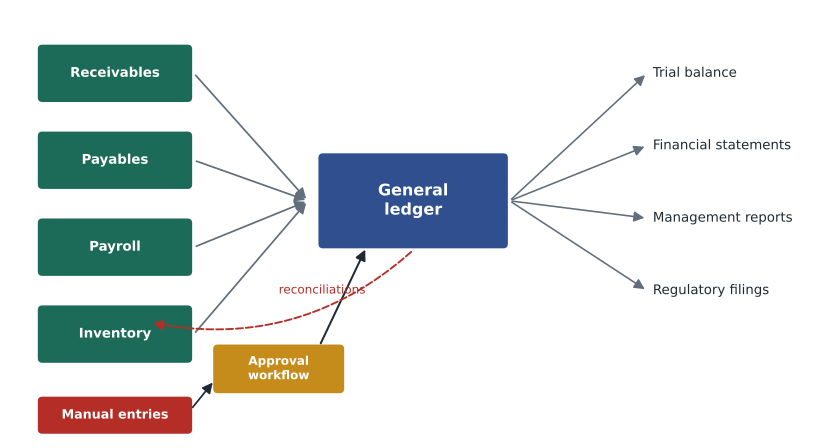
Controls over the general ledger include: a chart of accounts maintained by a small group with change approval; posting rules that prevent entries to control accounts (such as receivables and payables) except from the subledger; approval workflows for manual entries based on amount and account; supporting documentation attached to each manual entry; restricted access to post to closed periods; and a month-end close checklist with account reconciliations prepared and reviewed for every balance sheet account. A reconciliation compares the ledger balance with independent evidence, such as a bank statement, a subledger, a fixed asset register or a confirmation, and explains any difference.
Worked problem
Reviewing manual journal entries
Ridgeback's controller exports all October manual journal entries and filters for entries that are (1) posted after the close date, (2) made by users who rarely post entries, (3) round amounts of $10,000 or more, or (4) entered to revenue or receivables directly. Three entries are flagged: a $25,000 credit to revenue posted on 3 November to October by the sales director, a $12,000 accrual of rent by the senior accountant, and a $40,000 reclassification between two expense accounts by the controller. Which deserves the closest look?
Show solution
- The rent accrual is a routine month-end entry by an accountant; check its support, but it is low risk.
- The reclassification is large but moves amounts between expense accounts with no net effect on profit; confirm the reason.
- The revenue entry is posted after the close, to a period already closed, directly to revenue, by a sales director who has a bonus tied to sales.
- It should be traced to supporting documents (contracts, shipments) and its approval checked; the sales director's access to post to the ledger should also be questioned.
Answer: The $25,000 revenue entry by the sales director is the highest risk and should be investigated first.
The financial close and reporting
The close turns a month of transactions into reliable statements. A typical close sequence is: cut off transactions at period end, complete subledger processing, post accruals and adjustments, reconcile accounts, review the trial balance and analytical comparisons, post consolidation and elimination entries for groups, prepare statements and reports, and lock the period. ERP systems and close management software track tasks, owners and deadlines, and leading organizations aim for a close of five working days or less. Speed is valuable only if accuracy holds, so close metrics should include the number of post-close adjustments as well as the number of days.
Reporting goes well beyond the external financial statements. Management needs budget-versus-actual reports, segment and product profitability, key performance indicator dashboards and cash forecasts. Regulators may require filings in specific digital formats, such as XBRL (lesson 12). Each report should draw from the ledger or a controlled data warehouse rather than from spreadsheets that have drifted away from the books, a common source of conflicting numbers and errors in management decisions.
Common mistakes
MistakeLetting HR staff also process payroll.
InsteadSeparate adding and changing employees from calculating and paying wages.
MistakeAllowing manual journal entries to control accounts such as receivables.
InsteadBlock direct posting to control accounts; post only through subledgers.
MistakeAdjusting inventory records to the count without investigation.
InsteadRecount and investigate large differences, and have adjustments approved outside the warehouse.
MistakeTreating all journal entries as equally risky.
InsteadFocus review on manual, late, unusual, round-sum and revenue-related entries.
MistakeMeasuring the close only by speed.
InsteadTrack post-close adjustments and reconciliation quality too.
Summary and key terms
- The production cycle depends on accurate bills of materials, routings and time records.
- Distributors keep perpetual inventory accurate with scanning and blind cycle counts.
- Payroll needs separation between HR (master file) and payroll processing.
- Payroll registers must reconcile gross to net plus deductions and to government remittances.
- Manual journal entries are the highest-risk entries in the ledger.
- Every balance sheet account needs a regular, reviewed reconciliation.
- The close should be fast, accurate and locked, with reports drawn from controlled data.
- Bill of materials
- The list of components and quantities in a product.
- Routing
- The sequence of operations and times required to make a product.
- Cycle counting
- Counting a few inventory locations each day so all are counted regularly.
- Blind count
- A count made without knowing the quantity the system expects.
- Ghost employee
- A fictitious or departed person kept on the payroll to divert pay.
- Payroll register
- A listing of each employee's gross pay, deductions and net pay for a period.
- Source deductions
- Amounts withheld from employees' pay for taxes and government plans.
- Manual journal entry
- An entry keyed directly into the ledger rather than generated by a subledger.
- Account reconciliation
- Comparing a ledger balance with independent evidence and explaining differences.
- Financial close
- The process of completing, checking and locking a period's accounts.
Practice problems
Work each problem on paper first, then reveal the answer to check.
Why must changes to a bill of materials be controlled?
Show answer
A wrong bill of materials misstates the cost of every unit produced.
What is a blind count and why is it used?
Show answer
A count made without seeing the system quantity, so counters cannot simply confirm the expected figure.
Which separation of duties prevents ghost employees?
Show answer
HR adds and changes employees; payroll calculates and pays; neither does both.
In the US code example, what is A. Chen's Social Security tax?
Show answer
2,400 × 6.2% = $148.80.
What check proves the payroll register is internally consistent?
Show answer
Gross pay equals net pay plus total deductions.
Why are manual journal entries high risk?
Show answer
They bypass the controls built into the transaction cycles.
Give three attributes that make a manual entry worth reviewing.
Show answer
Posted after close, by an unusual user, round amount, to revenue or receivables directly.
What does an account reconciliation compare?
Show answer
The ledger balance with independent evidence such as a bank statement or subledger.
List four steps of the financial close.
Show answer
Cut-off, subledger processing, accruals and adjustments, reconciliations (also review, consolidation, reporting, lock).
Why should management reports draw from the ledger or a controlled warehouse?
Show answer
To avoid spreadsheets that drift from the books and produce conflicting numbers.
Lesson quiz · 5 questions
Score 60% or more to complete this lesson.
Create a free account to save your progress, take quizzes and earn a certificate.