
ACCT-240 · Lesson 1 of 12 · 27 min
What an accounting information system is
An accounting information system (AIS) is the combination of people, procedures, data, software, hardware and controls that captures business events, turns them into accounting records and delivers useful information to the people who make decisions. ACCT-101 taught you the accounting cycle as if a careful bookkeeper wrote every journal entry by hand. In a modern organization almost none of those entries are written by hand. A sale is recorded when a customer clicks a button on a website; a payroll run posts hundreds of entries in seconds; the bank feed matches deposits to invoices overnight. The debits and credits are the same as the ones you learned, but they are produced by systems, and the accountant's job shifts from writing entries to designing, controlling and questioning the systems that write them.
This course looks at accounting from that systems point of view. We ask how data about business events enters the organization, how it is stored, how it flows through the transaction cycles, where it can go wrong, and which controls keep it complete, accurate, authorized and secure. Those questions matter to every accounting career. Controllers own the systems that produce the financial statements. Auditors must understand those systems before they can rely on them. Tax specialists depend on the data the systems keep. Analysts and consultants spend much of their time extracting, cleaning and explaining data that came out of an enterprise resource planning (ERP) system.
Throughout the course we follow one invented company, Ridgeback Outdoor Gear, a distributor of camping, paddling and winter equipment based in Spokane, Washington. Ridgeback buys from about 60 manufacturers, holds stock in one warehouse, and sells to about 400 independent retailers on credit and to consumers through its online store. It has 85 employees, annual revenue of roughly $38 million, and a mid-market cloud ERP system that it adopted three years ago. Ridgeback and all of its figures are invented for teaching; they do not describe any real company.
The components of an AIS
Textbooks describe an AIS as having six components, and the list is a useful checklist whenever you study a system. People use and run the system: sales clerks, warehouse staff, the accounts payable team, the controller, the IT administrator. Procedures and instructions describe how work is done, both manually and automatically: the steps for approving a new customer, the month-end close checklist. Data is the raw material: facts about customers, products, orders, shipments, payments and employees. Software processes the data: the ERP, the online store, the bank's portal, spreadsheets. Information technology infrastructure is the hardware, networks and cloud services the software runs on. Internal controls and security measures protect the data and make the other five components trustworthy.
Data and information are not the same thing. Data are individual facts: order number 50218, quantity 12, product TENT-4P, customer 1043. Information is data organized and processed so that it is useful for a decision: a report showing that sales of four-person tents to mountain-region retailers fell 18 percent this quarter while returns doubled. The value of information comes from the decisions it improves. Good information is relevant, reliable, complete, timely, understandable, verifiable and accessible to the people entitled to it. An AIS that produces a perfect report three weeks after the decision was made has failed, and so has one that produces a fast report nobody can trust.
| Component | At Ridgeback | What can go wrong |
|---|---|---|
| People | Sales, warehouse, AP and payroll clerks, controller, IT administrator | Errors, fraud, too few people to separate duties |
| Procedures | Credit approval, receiving, month-end close checklist | Steps skipped or undocumented |
| Data | Customers, products, orders, shipments, invoices, payments | Incomplete, duplicated or out-of-date records |
| Software | Cloud ERP, online store, bank portal, spreadsheets | Bugs, wrong configuration, unapproved changes |
| IT infrastructure | Cloud hosting, warehouse scanners, laptops, network | Outages, lost devices, weak connectivity |
| Controls and security | Approvals, access rights, backups, reconciliations | Missing, poorly designed or not operating |
Business events, transactions and the transaction cycles
Not every business event is an accounting transaction. When a retailer phones to ask about a new kayak, nothing is recorded in the general ledger, although the sales system may record the inquiry. When Ridgeback signs a contract to buy 500 sleeping bags next spring, that is an important event with no journal entry yet. When the sleeping bags arrive and Ridgeback accepts them, a liability and an asset come into existence and the AIS must record them. An AIS captures many events that never become journal entries because managers need them: quotes, backorders, delivery dates, customer complaints. Accountants care about this wider data because it is the evidence behind the entries that eventually are made.
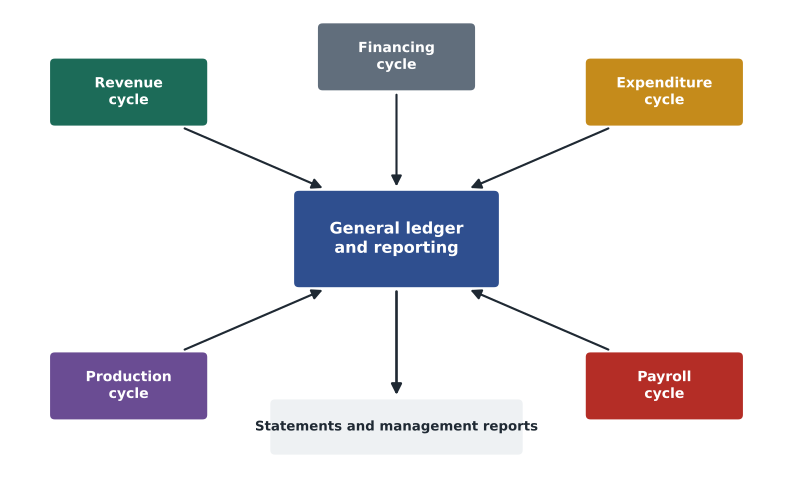
Organizations repeat the same kinds of transactions over and over, so systems are organized around transaction cycles. The revenue cycle covers everything from taking a customer's order to collecting the cash. The expenditure cycle covers requesting, ordering, receiving and paying for goods and services. The production cycle (or conversion cycle) turns materials, labor and overhead into finished goods, and for a distributor like Ridgeback it is mostly inventory management. The human resources and payroll cycle hires, pays and manages employees. The financing cycle raises and repays capital. All of the cycles feed the general ledger and reporting system, which consolidates their results into financial statements and management reports. Lessons 5 to 7 work through these cycles in detail.
From journal entries to integrated data
In a manual system each cycle kept its own journals and subsidiary ledgers, and clerks posted totals to the general ledger at month end. Early computer systems automated each cycle separately, so the order entry system, the inventory system and the accounting system each held their own copy of the customer and product files. Reconciling those copies was a constant chore, and errors crept in whenever one file was updated and another was not. Modern ERP systems instead keep one shared database. When the warehouse records a shipment, the same event updates inventory, triggers the invoice, updates the customer's balance and posts to the general ledger. There is one source of truth, and the subsidiary ledgers are views of it rather than separate books.
Integration brings large benefits: faster closes, fewer reconciliations, better information. It also concentrates risk. A single wrong setting, such as an incorrect tax code or a default account mapping, can post thousands of wrong entries before anyone notices. A user with too much access can change master data, enter transactions and approve them, all from one screen. That is why so much of this course is about controls. The ledger is only as reliable as the master data, configuration and access rights behind it, and accountants are expected to understand and test those things, not only the entries.
Worked problem
Classifying business events
Ridgeback's controller lists five events from one Monday: (a) a retailer requests a quote for 40 headlamps; (b) the warehouse ships an order of 25 tents to a retailer on 30-day terms; (c) the purchasing manager signs a supply agreement for next year; (d) a customer pays an invoice by electronic funds transfer; (e) a supplier emails a new bank account number for future payments. Which events should create a general ledger entry, and which belong in the AIS anyway?
Show solution
- Event (a) creates a quote record in the sales system but no ledger entry, because nothing has been exchanged.
- Event (b) is a sale: revenue and a receivable are recognized when control of the goods passes, and inventory and cost of goods sold are updated.
- Event (c) is a commitment; under most frameworks there is no entry until goods are received, although large commitments may need disclosure.
- Event (d) reduces accounts receivable and increases cash.
- Event (e) is a master data change, not a transaction, but it is one of the highest-risk events in the whole system, because a fraudulent change would redirect future payments (lesson 11).
Answer: Only (b) and (d) produce ledger entries that day, but all five events must be captured and controlled by the AIS.
The accountant and the systems
Accountants interact with an AIS in four roles. As users they enter, review and approve transactions and run reports. As designers they help define the chart of accounts, the approval workflows, the reports and the controls when a system is selected or changed. As evaluators, whether internal or external auditors, they assess whether the system and its controls can be relied on. As managers they decide how much to invest in systems, staff and controls. Professional bodies now expect entry-level accountants to have real data and technology skills. The CPA competency frameworks in Canada and the United States include information systems, data management, analytics and cybersecurity, and the profession's exams test them.
In the United States the CPA Evolution model, which reshaped the Uniform CPA Examination in 2024, includes a discipline section on Information Systems and Controls (ISC) alongside the core. The AICPA and the state boards expect candidates to understand data management, systems controls, service organization control (SOC) reports and the IT environment. Auditing standards, including the PCAOB's standards for public companies, require auditors to understand IT general controls before relying on automated controls. Lessons 8 and 9 return to these requirements.
The rest of the course is organized in three parts. Lessons 2 to 4 cover how to document processes and how accounting data is structured and queried. Lessons 5 to 7 walk through the main transaction cycles and the general ledger. Lessons 8 to 12 cover control frameworks, IT controls, ERP systems, cybersecurity and privacy, and emerging technologies, ending with a capstone in which you design the controls for Ridgeback's procure-to-pay process. Data analytics and auditing get their own courses (ACCT-341 and ACCT-331), so this course gives you the systems foundation they build on.
Measuring the value of information
Better systems cost money, so organizations must judge whether the information they produce is worth it. The value of information is the improvement in decisions it causes, less the cost of producing it. Costs include software subscriptions, implementation, staff time, training, data storage and the controls needed to keep the data reliable. Benefits include fewer errors, faster collection, lower inventory, better pricing, reduced fraud losses and lower audit fees. Many benefits are hard to measure, but a rough expected-value calculation still disciplines the discussion, as the code example below shows for a proposed automatic bank reconciliation feature.
# Ridgeback: is automatic bank reconciliation worth it? (illustrative)
hours_saved_per_month = 34          # staff hours on manual matching
hourly_cost = 48.0                  # loaded cost per hour
error_rate_before, error_rate_after = 0.012, 0.002   # share of items mismatched
items_per_month = 2600
cost_per_error = 22.0               # time to investigate and fix
subscription_per_month = 900.0

staff_saving = hours_saved_per_month * hourly_cost
error_saving = (error_rate_before - error_rate_after) * items_per_month * cost_per_error
net_monthly = staff_saving + error_saving - subscription_per_month
print(f"Staff-time saving per month: ${staff_saving:,.2f}")
print(f"Error saving per month:  ${error_saving:,.2f}")
print(f"Net benefit per month:   ${net_monthly:,.2f}")
print(f"Net benefit per year: ${net_monthly * 12:,.2f}")Staff-time saving per month: $1,632.00 Error saving per month: $572.00 Net benefit per month: $1,304.00 Net benefit per year: $15,648.00
The calculation is simple, but it forces the team to state its assumptions, which can then be questioned and tested. The same reasoning applies to controls: a control is worth having when the expected loss it prevents exceeds its cost, a principle we use throughout lessons 8 and 9. Some information has value that resists measurement, such as the reputational benefit of accurate reporting or the deterrent effect of a control that makes fraud harder, and judgment fills the gap.
Common mistakes
MistakeTreating the AIS as just the accounting software.
InsteadAn AIS includes people, procedures, data, software, infrastructure and controls; weaknesses in any one undermine the others.
MistakeAssuming that because the ERP calculates entries automatically, they must be right.
InsteadAutomated entries are only as reliable as the master data, configuration and access controls behind them.
MistakeRecording only events that create journal entries.
InsteadThe AIS must also capture quotes, orders, commitments and master data changes, because they are evidence and some carry high risk.
MistakeThinking systems knowledge belongs to IT, not accounting.
InsteadAccountants design, use, evaluate and manage systems, and professional frameworks test these skills.
MistakeJudging a system only by its cost.
InsteadCompare the cost with the value of better decisions, fewer errors and reduced losses.
Summary and key terms
- An accounting information system combines people, procedures, data, software, infrastructure and controls.
- Data are raw facts; information is data organized to support a decision.
- Transactions are grouped into revenue, expenditure, production, payroll and financing cycles that feed the general ledger.
- ERP systems keep one shared database, which removes reconciliations but concentrates risk.
- Master data changes, such as a supplier bank account change, can be riskier than individual transactions.
- Accountants act as users, designers, evaluators and managers of systems.
- The value of information is the improvement in decisions it causes, less the cost of producing it.
- Accounting information system
- People, procedures, data, software, infrastructure and controls that capture business events and produce accounting information.
- Data
- Individual facts about business events, resources and agents.
- Information
- Data organized and processed so that it supports a decision.
- Transaction cycle
- A group of related, recurring business activities, such as the revenue or expenditure cycle.
- Enterprise resource planning (ERP) system
- Integrated software that records all of an organization's main business processes in one shared database.
- Master data
- Relatively permanent records, such as customers, suppliers, products and employees, used by many transactions.
- Business event
- Something that happens in the business; it may or may not create an accounting transaction.
- General ledger and reporting system
- The part of the AIS that consolidates cycle results into financial statements and reports.
- Value of information
- The improvement in decisions caused by information, less its cost.
- Internal control
- Processes designed to provide reasonable assurance that objectives for reporting, operations and compliance are met.
Practice problems
Work each problem on paper first, then reveal the answer to check.
Name the six components of an AIS and give one Ridgeback example of each.
Show answer
People (AP clerk), procedures (credit approval steps), data (customer records), software (cloud ERP), infrastructure (warehouse scanners), controls (three-way match).
Distinguish data from information with a Ridgeback example.
Show answer
Data: invoice 50218 for 12 tents; information: a report showing tent returns doubled in one region this quarter.
Which cycle records a retailer's payment of an invoice?
Show answer
The revenue cycle (cash collection).
Why is a supplier bank account change a high-risk event even though it is not a transaction?
Show answer
Because a fraudulent change redirects every future payment to that supplier.
Give one benefit and one risk of an integrated ERP database.
Show answer
Benefit: one source of truth with no reconciliations between files; risk: one configuration or access error affects many records at once.
List four characteristics of useful information.
Show answer
Relevant, reliable, complete, timely (also understandable, verifiable, accessible).
What are the four roles accountants play with systems?
Show answer
Users, designers, evaluators and managers.
Using the code example, what is the yearly net benefit if the subscription rises to $1,400 per month?
Show answer
Net monthly becomes 1,632 + 572 − 1,400 = $804, so about $9,648 per year.
Why might a signed purchase commitment not create a journal entry?
Show answer
No goods or services have been received, so no asset or liability is recognized yet; only disclosure may be needed.
Which later courses build on this one for analytics and auditing?
Show answer
ACCT-341 Data Analytics for Accountants and ACCT-331 Auditing and Assurance I.
Lesson quiz · 5 questions
Score 60% or more to complete this lesson.
Create a free account to save your progress, take quizzes and earn a certificate.