
ACCT-240 · Lesson 6 of 12 · 25 min
The expenditure cycle
The expenditure cycle covers acquiring and paying for the goods and services an organization needs: identifying the need, choosing a supplier, ordering, receiving, approving the supplier's invoice and paying it. Practitioners call it procure-to-pay (P2P) or purchase-to-pay. For a distributor like Ridgeback, the largest part of the cycle is buying inventory from manufacturers, but the same process handles freight, rent, software subscriptions, professional services and office supplies. The expenditure cycle is where most cash leaves an organization, which makes it the main target for both errors, such as duplicate payments, and fraud, such as fictitious suppliers and payment diversion.
CON-330 looked at procurement from a construction contractor's point of view, with subcontracts, long-lead items and buyout. This lesson takes the accounting systems view: what records the AIS keeps, how the ERP enforces the process, and which controls stop the organization paying for things it did not order, did not receive or does not owe.
Activities and documents
The cycle has four main activities. Requisitioning identifies a need: the inventory system flags items below their reorder point, or an employee submits a purchase requisition. Purchasing selects a supplier and issues a purchase order (PO), a legally significant document stating the items, quantities, prices and terms. Receiving accepts the goods, counts and inspects them and records a receiving report (or goods receipt) in the ERP. Accounts payable receives the supplier's invoice, matches it to the PO and the receipt, records the liability and schedules payment. Treasury or the payments team then releases payment by electronic funds transfer, card or check.
| Activity | Key documents and data | Main risks | Typical controls |
|---|---|---|---|
| Requisitioning | Purchase requisition, reorder report | Buying what is not needed | Approval limits by role; reorder points reviewed |
| Purchasing | Purchase order, approved supplier list, contracts | Unapproved suppliers; inflated prices; kickbacks | Approved supplier master; competitive quotes above thresholds; PO approval workflow |
| Receiving | Goods receipt, packing slip, inspection record | Accepting goods not ordered; short or damaged shipments | Receive only against open POs; blind counts; inspection |
| Accounts payable | Supplier invoice, voucher, three-way match result | Paying wrong amounts, duplicates or fictitious invoices | Three-way match with tolerances; duplicate invoice check |
| Payment | Payment run, remittance advice, bank file | Paying the wrong party; diverted payments | Separate approval of payment runs; verified bank details; positive pay |
The approved supplier master
Every payment goes to a supplier record, so control over the supplier master file is the foundation of the cycle. Creating a supplier should require documentation: legal name, address, tax registration number, banking details and the business reason. A person in a role separate from purchasing and accounts payable creates and changes supplier records, and every change is logged. The most dangerous change is to bank details, because a fraudster who changes them can redirect payments without creating any fake invoice. Lesson 11 covers the call-back verification procedure that defends against that scheme.
Fictitious supplier fraud works the other way: an employee creates a supplier record for a company they control, then submits invoices for goods or services that were never provided. Red flags include suppliers with no tax number, a post office box or the same address or bank account as an employee, invoices just below approval thresholds, and suppliers that appear suddenly and receive round-sum payments. Matching the supplier master against the employee master on address and bank account is a simple, effective data test.
The three-way match
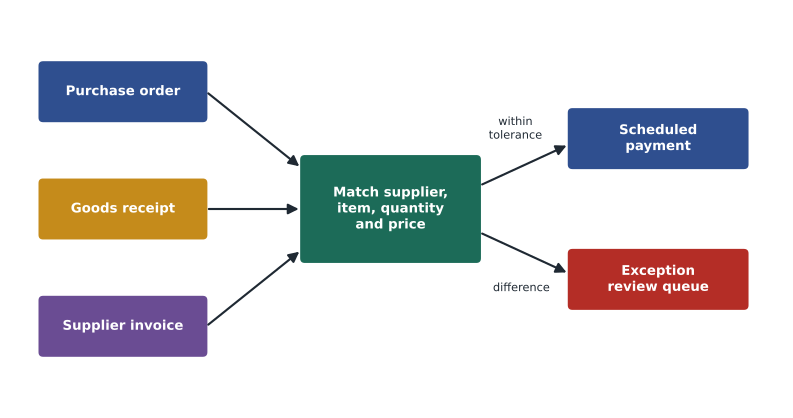
The central control in accounts payable is the three-way match: before an invoice is approved for payment, the ERP compares it with the purchase order (what was ordered and at what price) and the goods receipt (what actually arrived). Quantities invoiced should not exceed quantities received, and prices should agree with the PO within a small tolerance. Invoices that match post automatically; exceptions go to a buyer or AP clerk to resolve with the supplier. For services, where nothing is physically received, a two-way match between invoice and PO plus an approval by the budget owner replaces the receipt.
# Ridgeback: three-way match with tolerances (illustrative)
PRICE_TOL = 0.02     # 2% price tolerance
po = {"PO-7731": {"supplier": "Northwind Textiles", "lines": {"SB-20": (400, 52.00), "SB-35": (200, 61.50)}},
      "PO-7735": {"supplier": "Alpine Buckle Co", "lines": {"BK-01": (5000, 0.84)}}}
received = {"PO-7731": {"SB-20": 400, "SB-35": 180}, "PO-7735": {"BK-01": 5000}}
invoices = [("NW-90412", "PO-7731", "Northwind Textiles", {"SB-20": (400, 52.00), "SB-35": (200, 61.50)}),
            ("AB-3310", "PO-7735", "Alpine Buckle Co", {"BK-01": (5000, 0.87)}),
            ("AB-3311", "PO-7735", "Alpine Buckle Co", {"BK-01": (5000, 0.85)})]

for inv_no, po_no, supplier, lines in invoices:
    issues = []
    order = po[po_no]
    if supplier != order["supplier"]:
        issues.append("supplier differs from PO")
    for item, (qty, price) in lines.items():
        ordered_qty, po_price = order["lines"][item]
        got = received[po_no].get(item, 0)
        if qty > got:
            issues.append(f"{item}: invoiced {qty}, received {got}")
        if abs(price - po_price) / po_price > PRICE_TOL:
            issues.append(f"{item}: price {price:.2f} vs PO {po_price:.2f}")
        received[po_no][item] = got - min(qty, got)   # consume matched quantity
    total = sum(q * p for q, p in lines.values())
print(f"{inv_no} {total:>10,.2f} " + ("MATCHED - schedule payment" if not issues else "EXCEPTION: " + "; ".join(issues)))NW-90412 33,100.00 EXCEPTION: SB-35: invoiced 200, received 180 AB-3310 4,350.00 EXCEPTION: BK-01: price 0.87 vs PO 0.84 AB-3311 4,250.00 EXCEPTION: BK-01: invoiced 5000, received 0
The output shows three typical results. The Northwind invoice bills 200 units of SB-35 but only 180 were received, so it is held until the remaining 20 arrive or the supplier issues a credit. The first Alpine invoice is about 3.6 percent above the PO price, outside the 2 percent tolerance, so the buyer must approve the higher price or ask for a correction. The second Alpine invoice is a second bill for the same 5,000 buckles; because the matched quantity was consumed by the first invoice, the receipt no longer supports it. That consumption logic is what makes the match an effective duplicate-payment control, and it is worth testing whenever the match is configured.
Payments
Payment runs group approved invoices due for payment, generate a bank file and produce remittance advices for suppliers. Controls at this stage include approval of the payment run by someone other than the AP clerk who processed the invoices, a review of the payment register for unusual suppliers, amounts or bank accounts, and secure transmission of the bank file so that it cannot be altered between the ERP and the bank. Many banks offer positive pay: the company sends the bank a list of checks or payments issued, and the bank pays only items that match. Payment runs should be compared with the bank's confirmations, and the bank account reconciled daily or at least monthly.
Organizations also look for early-payment discounts. Terms of 2/10, net 30 mean the supplier allows a 2 percent discount if the invoice is paid within 10 days rather than 30. Skipping the discount is equivalent to borrowing for 20 days at an annual rate of about 2/98 × 365/20 ≈ 37 percent, which is far more expensive than most credit lines. AP systems can flag discount invoices and schedule them to pay on day 10, and a monthly report of discounts lost is a useful measure of AP performance.
Worked problem
Cost of missing a discount
Alpine Buckle offers Ridgeback terms of 1/15, net 45 on a $42,500 invoice. Ridgeback's line of credit costs 7.5 percent a year. Should Ridgeback take the discount?
Show solution
- Discount = 1% × $42,500 = $425; paying on day 15 costs $42,075.
- Not taking the discount means paying $425 for 30 extra days of credit on $42,075.
- Effective annual cost ≈ (425 ÷ 42,075) × (365 ÷ 30) ≈ 1.01% × 12.17 ≈ 12.3 percent.
- Borrowing on the line at 7.5 percent to pay on day 15 is cheaper than forgoing the discount.
Answer: Take the discount: forgoing it costs about 12.3 percent a year against 7.5 percent on the credit line.
Automating accounts payable
Many organizations now automate large parts of accounts payable. Invoices arrive as electronic documents through a supplier portal or e-invoicing network, or as PDFs read by optical character recognition (OCR) and machine-learning extraction tools. The extracted data is validated against the supplier master and the PO, matched automatically, and routed for approval only when an exception occurs. Some organizations go further with evaluated receipt settlement (ERS), in which there is no supplier invoice at all: the buyer pays based on the PO price and the quantity received, and sends the supplier a self-billed statement. ERS removes invoice processing but makes the accuracy of PO prices and goods receipts even more important, so it is used mainly with trusted, high-volume suppliers.
Automation changes the control focus rather than removing it. When thousands of invoices post without human review, the controls that matter most are the configuration of the matching rules and tolerances, the accuracy of the supplier and price master data, the security of the supplier portal, and the monitoring of exceptions and overrides. An AP clerk who can override a failed match without approval undoes the benefit of the control. Lesson 9 explains how auditors test automated controls of this kind, and lesson 12 returns to OCR and AI tools.
Accounts payable analytics
Data analytics complements the preventive controls. Useful AP tests include duplicate payments (lesson 4), invoices just below approval limits, invoices dated on weekends or holidays, suppliers created and paid within a few days, payments to suppliers with no purchase orders, round-sum invoices, sequential invoice numbers from one supplier (which may mean the organization is that supplier's only customer), and Benford's law on invoice amounts. None of these proves an error or fraud, but together they direct attention to a small number of transactions worth examining. Running them every month, rather than once a year, turns them into a continuous monitoring control.
Corporate cards and expense reports
Low-value purchases are often handled with purchasing cards (p-cards) and employee expense reports rather than full POs, because the cost of processing a PO for a $40 item exceeds its value. The control focus shifts to card limits, merchant category blocks (for example, no casinos or cash advances), monthly review of card statements by the cardholder's manager, receipts for every transaction and data analytics on card spending, such as split transactions just under the single-purchase limit or purchases on weekends. Expense report systems apply policy rules automatically, such as per diem limits and receipt requirements above a set amount.
In the United States, businesses must collect a Form W-9 with the taxpayer identification number of each domestic supplier they may need to report, and issue Forms 1099-NEC or 1099-MISC for reportable payments. The supplier master should capture W-9 status, and missing taxpayer identification numbers both create backup withholding obligations and can signal a fictitious supplier.
Common mistakes
MistakeLetting AP clerks create and change supplier records.
InsteadSupplier master maintenance belongs to a separate role, with documentation and change logs.
MistakePaying invoices that match the PO without checking the receipt.
InsteadUse a three-way match so payment depends on goods actually received.
MistakeSetting very wide price tolerances to reduce exceptions.
InsteadTolerances should be small; wide tolerances let overcharges and errors through.
MistakeLetting the AP clerk who processed invoices also release the payment run.
InsteadA separate person approves payment runs and reviews the register.
MistakeIgnoring missed early-payment discounts.
InsteadMissing 2/10, net 30 costs about 37 percent a year; schedule and report discounts.
Summary and key terms
- Procure-to-pay covers requisitioning, purchasing, receiving, accounts payable and payment.
- Control over the supplier master, especially bank details, is the foundation of the cycle.
- The three-way match compares PO, goods receipt and invoice before payment.
- Consuming matched quantities lets the match catch duplicate invoices.
- Payment runs need separate approval, secure bank files and reconciliation.
- Missing early-payment discounts is usually an expensive form of borrowing.
- P-cards and expense reports need limits, merchant blocks, reviews and analytics.
- Procure-to-pay
- The expenditure cycle from identifying a need to paying the supplier.
- Purchase requisition
- An internal request to buy goods or services.
- Purchase order
- A document sent to a supplier stating items, quantities, prices and terms.
- Goods receipt
- The record that goods were received, counted and accepted.
- Three-way match
- Comparing invoice, purchase order and goods receipt before payment.
- Tolerance
- The allowed difference between invoice and PO before an exception is raised.
- Fictitious supplier
- A fake supplier record used to obtain payment for goods or services never provided.
- Positive pay
- A bank service that pays only items matching the company's issued list.
- Payment run
- A batch of approved invoices paid together.
- Purchasing card
- A company card used for low-value purchases under set limits.
Practice problems
Work each problem on paper first, then reveal the answer to check.
List the five activities of the expenditure cycle in order.
Show answer
Requisitioning, purchasing, receiving, accounts payable, payment.
Why is a change to supplier bank details so risky?
Show answer
It redirects every future payment to that supplier without needing a fake invoice.
Give two warning signs of a fictitious supplier.
Show answer
No tax number; same address or bank account as an employee (also invoices just below thresholds).
In the code example, why was invoice NW-90412 held?
Show answer
It billed 200 units of SB-35, but only 180 were received.
Why did invoice AB-3311 fail the match?
Show answer
The receipt quantity had already been consumed by AB-3310, so it looked like a duplicate.
What replaces the goods receipt for services?
Show answer
A two-way match with the PO plus approval by the budget owner.
Compute the annual cost of missing 2/10, net 30.
Show answer
About 2/98 × 365/20 ≈ 37 percent.
What does positive pay do?
Show answer
The bank pays only items matching the list of payments the company issued.
Give two p-card controls.
Show answer
Merchant category blocks and monthly manager review of statements with receipts.
Which data test compares suppliers with employees?
Show answer
Matching supplier and employee master records on address and bank account.
Lesson quiz · 5 questions
Score 60% or more to complete this lesson.
Create a free account to save your progress, take quizzes and earn a certificate.