
ACCT-240 · Lesson 10 of 12 · 25 min
ERP systems and implementation
Enterprise resource planning systems run the finances of most medium and large organizations. An ERP integrates financial accounting, purchasing, sales, inventory, manufacturing, human resources and often customer relationship and analytics functions in one system with one database. The market is led by a few large vendors, including SAP (S/4HANA), Oracle (Fusion Cloud ERP and NetSuite), Microsoft (Dynamics 365), Infor and Workday, along with many mid-market and industry-specific products. This course is vendor-neutral: the concepts here apply to any of them. What matters for accountants is how an ERP is structured, how it is configured to reflect the organization's accounting, what can go wrong when one is implemented, and how to keep it under control afterwards.
Ridgeback moved from a small accounting package and separate spreadsheets to a mid-market cloud ERP three years ago. Before the change, the warehouse kept its own inventory system, the online store sent a daily spreadsheet of orders to accounting, and month-end close took 12 working days. After a 10-month implementation, the close takes five days, inventory is updated in real time and the online store posts orders directly. The project also ran over budget by about a third and caused a difficult first quarter, a common pattern that this lesson explains.
How an ERP is organized
An ERP is built from modules that share common master data and post to a common general ledger. A typical financial core includes general ledger, accounts payable, accounts receivable, fixed assets, cash management and consolidation. Operational modules include procurement, sales and distribution, inventory and warehouse management, manufacturing, project accounting and human capital management. Because the modules share data, a single business event, such as a goods receipt, can update inventory quantities, the open purchase order, the goods-received-not-invoiced liability and the general ledger at once, through account determination rules that map business events to ledger accounts.
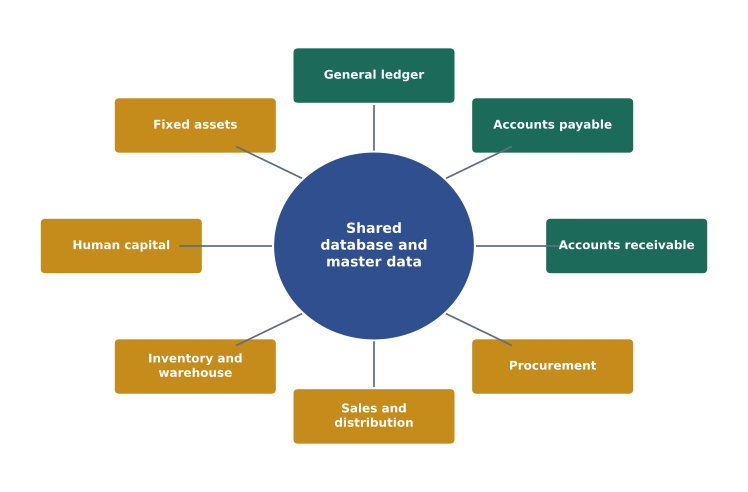
Configuration, not programming, adapts most modern ERPs to an organization. During implementation the team defines the organizational structure (legal entities, business units, warehouses), the chart of accounts, fiscal calendars, currencies, tax codes, payment terms, approval workflows, account determination rules and many other settings. Cloud ERP vendors encourage customers to adopt standard processes and avoid custom code, because customizations make upgrades difficult and expensive. When a process genuinely differs, extensions are built through the vendor's approved tools rather than by changing the core software.
Designing the chart of accounts
The chart of accounts is the most important design decision in an ERP from the accountant's point of view, because every report depends on it and it is hard to change later. Modern ERPs use a segmented chart, in which each account string combines several segments: for example, company, natural account, department, product line and location. The natural account (such as 4000 sales or 6100 office expense) says what the amount is; the other segments say where and for what. This lets one natural account serve many reporting needs without creating hundreds of accounts like "sales of tents in the west region". Good design keeps the natural account list short, uses segments and dimensions for analysis, defines each account clearly, and controls who may create new accounts or segment values.
# Ridgeback: validating segmented account strings before posting (illustrative)
segments = {
    "company": {"10": "Ridgeback Outdoor Gear", "20": "Ridgeback Online"},
    "account": {"1100": "Accounts receivable", "4000": "Sales", "5000": "Cost of goods sold",
                "6100": "Office expense", "6200": "Freight out"},
    "dept": {"000": "None", "110": "Sales", "210": "Warehouse", "310": "Finance"},
    "product": {"00": "None", "TE": "Tents", "PA": "Paddling", "WI": "Winter"},
}
# cross-validation rules: balance sheet accounts must not carry a department or product
balance_sheet = {"1100"}
lines = ["10-4000-110-TE", "10-6100-310-00", "20-1100-110-PA", "10-6250-210-00", "30-5000-000-WI"]
for line in lines:
    co, acct, dept, prod = line.split("-")
    errors = []
    for name, val in (("company", co), ("account", acct), ("dept", dept), ("product", prod)):
        if val not in segments[name]:
            errors.append(f"invalid {name} {val}")
    if acct in balance_sheet and (dept != "000" or prod != "00"):
        errors.append("balance sheet account cannot carry department or product")
print(f"{line:16s} " + ("OK" if not errors else "REJECTED: " + "; ".join(errors)))10-4000-110-TE OK 10-6100-310-00 OK 20-1100-110-PA REJECTED: balance sheet account cannot carry department or product 10-6250-210-00 REJECTED: invalid account 6250 30-5000-000-WI REJECTED: invalid company 30
Cross-validation rules like the one in the example stop combinations that make no sense, such as a receivable coded to a sales department and product line. Without them, reports by department or product fill with balance sheet noise and someone eventually spends days reclassifying entries. The code also rejects an unknown natural account (6250) and an unknown company (30), which is exactly what an ERP's segment validation does at entry.
Selecting an ERP
Choosing an ERP is a major investment decision, usually made every ten to twenty years. A selection project typically starts with a business case and a statement of requirements, covering functional needs (multi-currency, inventory costing method, project accounting), technical needs (cloud or on-premises hosting, integration with the online store and banks), control needs (workflow approvals, segregation of duties tools, audit trails, change logs) and reporting needs. Shortlisted vendors give scripted demonstrations using the organization's own scenarios, not the vendor's polished examples, and references from similar customers are checked. Total cost of ownership over several years, including subscriptions, implementation partner fees, internal staff time, training, data conversion and future upgrades, matters more than the first-year license price.
Accountants should insist that control requirements are part of the selection, because retrofitting them later is expensive. Useful questions include: can the system enforce segregation of duties rules and report conflicts? Does it keep an unalterable log of master data and configuration changes? Can approval limits vary by amount, entity and account? Does the vendor provide independent controls reports for its hosting and operations? Can data be exported in full if the organization ever leaves?
Why ERP implementations fail
ERP implementations are large, risky projects. They change software, processes, roles and data at the same time, often across the whole organization. Well-known failures illustrate the risks. Hershey's 1999 go-live of new ERP, supply chain and CRM systems, timed just before its busiest season, left it unable to ship about $100 million of orders. The US Air Force canceled its Expeditionary Combat Support System in 2012 after spending about $1 billion without usable capability. Lidl abandoned a seven-year SAP project in 2018 after reportedly spending around €500 million, in part because it wanted to keep valuing inventory at purchase prices rather than adopt the system's standard approach. Canada's Phoenix pay system for federal employees, launched in 2016, produced years of incorrect pay and billions of dollars in remediation costs (CMPUT-301 discusses it as a software engineering case).
| Risk | Typical cause | Mitigation |
|---|---|---|
| Scope creep and customization | Every department asks for its old process to be rebuilt | Adopt standard processes; a design authority approves exceptions |
| Poor data conversion | Dirty legacy data loaded without cleansing or reconciliation | Cleanse early; reconcile counts and balances after each trial load |
| Weak testing | Testing compressed when the schedule slips | Protect integration and user acceptance testing; test end-to-end with real scenarios |
| Controls designed late | Controls treated as an audit issue after go-live | Design roles, SoD rules and automated controls with the processes |
| Insufficient training and change management | Users meet the system for the first time at go-live | Train by role, use super-users, support heavily after go-live |
| Bad timing of go-live | Going live at the busiest season or year end | Choose a quiet period; plan a fallback |
Accountants play several roles in an implementation. The finance team defines requirements for the chart of accounts, reporting, closing and controls. Internal audit or an external adviser reviews the project's governance and the design of controls, ideally before go-live, when changes are cheap. The external auditor will want evidence that data was converted completely and accurately, because the opening balances in the new system become the basis of the next audit. And finance staff must be trained early, since they often discover configuration problems only when they try to close the first month.
Worked problem
Reconciling a data conversion
At Ridgeback's go-live, the legacy system shows 1,284 open customer invoices totaling $3,912,450.18, and 41,300 inventory units valued at $6,105,220.00. After loading, the ERP shows 1,283 open invoices totaling $3,907,060.18, and 41,300 units valued at $6,105,220.00. What should the project team do?
Show solution
- Inventory agrees on both count and value, so that load can be signed off, subject to sample checks of item-level costs.
- Receivables differ by one invoice and $3,907,060.18 − $3,912,450.18 = −$5,390.00.
- Find the missing invoice by comparing invoice numbers between the two files (an anti-join query), not by adjusting the total.
- Once found, load it, rerun the reconciliation and keep the signed reconciliation as audit evidence of complete and accurate conversion.
Answer: One invoice for $5,390 was not converted; it must be identified, loaded and reconciled before receivables are signed off.
Living with an ERP
Go-live is the start, not the end. Cloud ERPs receive vendor updates several times a year, and each one can change screens, processes and sometimes controls. Organizations need a regression testing approach for key controls and reports, a process for reviewing vendor release notes, and governance for the configuration changes that users will continue to request. Master data governance (lesson 3) becomes a permanent function. Access must be reviewed as people join, move and leave (lesson 9). Many organizations set up a center of excellence, a small team of business and IT staff who own the ERP's processes and configuration after the implementation consultants have gone.
Cloud ERP shifts some responsibilities to the vendor. The vendor runs the data center, the database, the core software and the security of the infrastructure, and provides SOC 1 and SOC 2 type reports (in Canada, CSAE 3416 for the financial reporting controls) describing its controls. The customer remains responsible for its own configuration, users, data and the complementary user entity controls in those reports. Contracts should address data ownership, where data is stored, how it can be exported if the organization leaves, and what happens in an outage. For Canadian organizations with public-sector or health data, data residency can be a specific requirement.
US organizations with operations in several states must configure the ERP for state-level sales tax, payroll tax and reporting differences, often through tax engines that integrate with the ERP. Public companies also need the ERP to support SEC reporting, including the data needed for inline XBRL tagging of financial statements (lesson 12).
Common mistakes
MistakeRecreating every legacy process in the new ERP.
InsteadAdopt standard processes where possible; customizations make upgrades costly.
MistakeCreating a natural account for every analysis need.
InsteadUse segments and dimensions for analysis, and keep the natural account list short.
MistakeAccepting a data conversion because totals look close.
InsteadReconcile counts and balances exactly and find every difference.
MistakeDesigning controls after go-live.
InsteadDesign roles, SoD rules and automated controls alongside the processes.
MistakeAssuming a cloud vendor is responsible for everything.
InsteadThe customer still owns configuration, users, data and complementary controls.
Summary and key terms
- An ERP integrates modules that share one database, master data and general ledger.
- Configuration, rather than custom code, adapts a modern ERP to the organization.
- A segmented chart of accounts separates the natural account from analysis segments, with cross-validation rules.
- ERP failures usually come from scope creep, poor data, weak testing, late controls, poor training and bad timing.
- Data conversion must be reconciled exactly and documented as audit evidence.
- After go-live, updates, configuration changes, master data and access need ongoing governance.
- Cloud ERP shares responsibility: the vendor runs the platform, the customer owns its configuration, users and data.
- Enterprise resource planning (ERP)
- Integrated software for an organization's main business processes on one database.
- Module
- A functional part of an ERP, such as accounts payable or inventory.
- Configuration
- Settings that adapt standard software to an organization without changing its code.
- Customization
- Changing or adding software code beyond standard configuration.
- Account determination
- Rules that map business events to general ledger accounts.
- Segmented chart of accounts
- An account structure combining natural account and analysis segments such as department and product.
- Cross-validation rule
- A rule that blocks invalid combinations of account segments.
- Data conversion
- Moving and transforming legacy data into a new system.
- Go-live
- The moment a new system starts processing real transactions.
- Center of excellence
- A permanent team that owns an ERP's processes and configuration after implementation.
Practice problems
Work each problem on paper first, then reveal the answer to check.
Name four modules in a typical ERP financial core.
Show answer
General ledger, accounts payable, accounts receivable, fixed assets (also cash management, consolidation).
Why do cloud vendors discourage customization?
Show answer
Custom code makes upgrades difficult and expensive.
What does the natural account segment represent?
Show answer
What the amount is, such as sales or office expense.
In the code example, why was 20-1100-110-PA rejected?
Show answer
A balance sheet account carried a department and product.
Give two lessons from the Lidl case.
Show answer
Avoid forcing the system to fit old practices, and make key design decisions early; scope and customization drove failure.
How should a missing converted invoice be found?
Show answer
Compare invoice numbers between legacy and new data (an anti-join), not by adjusting totals.
What is account determination?
Show answer
Rules that map business events, such as a goods receipt, to ledger accounts.
Why should go-live avoid the busiest season?
Show answer
Problems at go-live then hit the most transactions and customers, as at Hershey.
What responsibilities stay with a cloud ERP customer?
Show answer
Configuration, users and access, data, and complementary user entity controls.
What is a center of excellence?
Show answer
A permanent team owning ERP processes and configuration after the project ends.
Lesson quiz · 5 questions
Score 60% or more to complete this lesson.
Create a free account to save your progress, take quizzes and earn a certificate.