
ACCT-240 · Lesson 3 of 12 · 26 min
Data, databases and the REA model
Every accounting report is built from stored data, so the way data is organized decides what questions an organization can answer and how reliably. A ledger answers the question "what is the balance of accounts receivable?" A well-designed database also answers "which retailers in the north region took more than 45 days to pay for tents last winter, and which salesperson approved their credit limits?" This lesson introduces the vocabulary of data and databases from an accountant's point of view, explains why relational databases replaced flat files, and presents the resources-events-agents (REA) model, a way of designing accounting databases around business events rather than around debits and credits.
CMPUT-291 Introduction to Databases covers the relational model, SQL and normalization in depth for computing students. Here we stay at the level an accountant needs: enough to read a data model, understand why an ERP stores data the way it does, recognize data quality problems, and write the basic queries in lesson 4. If you have taken CMPUT-291, treat this lesson as a review with an accounting lens.
From files to databases
Data is organized in a hierarchy. A field (or attribute) holds one fact, such as a customer's credit limit. A record (or row) is a set of related fields about one thing, such as one customer. A file or table is a set of records of the same kind, such as all customers. A database is a set of related tables managed together. Early accounting systems kept each application's data in its own flat files. The billing program had a customer file; the shipping program had another; the credit department kept a spreadsheet. When a customer moved, someone had to update three files, and usually one was missed. The result was data redundancy (the same fact stored in several places), inconsistency (the copies disagree) and program-data dependence (changing a file layout meant rewriting every program that used it).
A database management system (DBMS) solves these problems by storing data once and letting many applications share it through a common interface. Users and programs ask for data by describing what they want, not where it is physically stored, which gives data independence. The DBMS enforces rules such as "every invoice must refer to an existing customer", controls who may read or change each table, logs changes and supports backup and recovery. Almost every modern accounting system and ERP sits on a relational DBMS such as Microsoft SQL Server, Oracle Database, SAP HANA, PostgreSQL or MySQL, often hidden behind a cloud service.
Relational database concepts for accountants
A relational database stores data in tables of rows and columns. Each table has a primary key, a field or combination of fields whose value uniquely identifies each row, such as a customer number. A foreign key is a field in one table that refers to the primary key of another, which is how tables are linked: each invoice row holds the customer number of the customer billed. Referential integrity is the rule that every foreign key value must match an existing primary key, so an invoice cannot point to a customer who does not exist. Entity integrity is the rule that a primary key can never be empty. These rules are controls built into the database itself, and they prevent whole classes of errors that plagued flat-file systems.
Well-designed relational databases are normalized: each fact is stored in exactly one place, and tables are split so that data about different things is not mixed. A table that repeats a customer's address on every invoice line is not normalized; if the address changes, old lines disagree with new ones. Normalization reduces anomalies when data is inserted, updated or deleted. ERP databases are heavily normalized, which is why a single invoice may draw on a dozen tables: header, lines, customer, product, tax codes, payment terms, currency and more. Reports and data warehouses sometimes deliberately denormalize data for speed, but the transaction database underneath should be normalized.
| Concept | Meaning | Ridgeback example |
|---|---|---|
| Primary key | Uniquely identifies each row | customer_id 1043 |
| Foreign key | Refers to a primary key in another table | invoice.customer_id = 1043 |
| Referential integrity | Every foreign key must match an existing row | Cannot invoice customer 9999 if it does not exist |
| Entity integrity | Primary keys cannot be empty | Every invoice has an invoice number |
| Normalization | Each fact stored once; tables split by subject | Address held only in the customer table |
| Redundancy | Same fact stored in many places | Address copied onto every invoice line |
The REA model
Traditional accounting systems were designed around the chart of accounts and journal entries. William McCarthy proposed in 1982 that accounting databases should instead model the underlying economic reality: the resources an organization controls, the economic events that change those resources, and the agents who participate in those events. This resources-events-agents (REA) model has become the standard way of teaching AIS data design, and its ideas sit underneath many ERP data structures and the ISO/IEC 15944-4 standard for business transactions.
Resources are things of economic value the organization wants to plan, monitor and control: cash, inventory, equipment, employee time. Events are business activities that management wants to plan and control: sales, cash receipts, purchases, cash disbursements, payroll. Agents are the people and organizations who participate in events: customers, suppliers, employees. Each economic event is linked to the resource it affects and to two agents, one internal (the salesperson or clerk) and one external (the customer or supplier). The most distinctive REA idea is duality: every economic exchange has a give event and a take event. A sale gives up inventory; a cash receipt takes in cash. A purchase takes in inventory; a cash disbursement gives up cash. The duality relationship between a sale and its cash receipt replaces the accounts receivable balance: receivables are simply sales not yet matched by receipts, and the database can compute them at any moment.
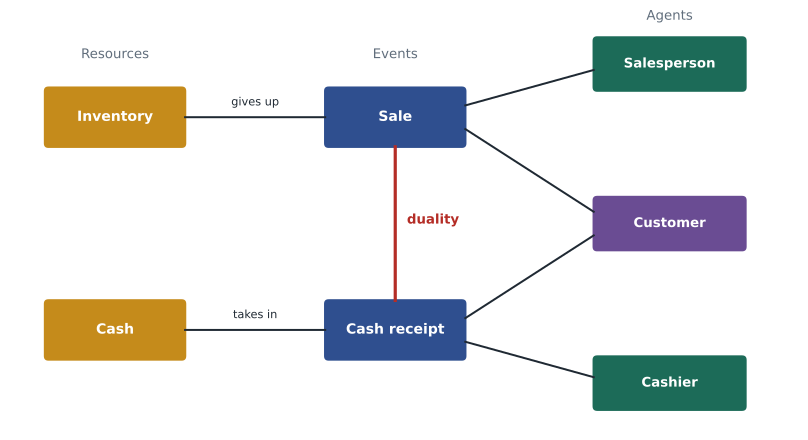
REA diagrams are usually drawn with resources on the left, events in the middle and agents on the right. Relationships carry cardinalities that state business rules: one sale can be paid by many cash receipts (installments) and one cash receipt can pay many sales (a retailer paying several invoices at once), so the sale-to-receipt relationship is many-to-many and is implemented as a separate linking table. Getting cardinalities right matters. If a designer assumes one receipt per sale, the system cannot record partial payments, and clerks invent workarounds that break the data.
# A small REA-style revenue database for Ridgeback in SQLite (illustrative)
import sqlite3
db = sqlite3.connect(":memory:")
db.execute("PRAGMA foreign_keys = ON")
db.executescript("""
CREATE TABLE customer (customer_id INTEGER PRIMARY KEY, name TEXT NOT NULL, credit_limit REAL);
CREATE TABLE sale (sale_id INTEGER PRIMARY KEY, sale_date TEXT, customer_id INTEGER NOT NULL
                   REFERENCES customer(customer_id), amount REAL NOT NULL);
CREATE TABLE cash_receipt (receipt_id INTEGER PRIMARY KEY, receipt_date TEXT, customer_id INTEGER
                   NOT NULL REFERENCES customer(customer_id), amount REAL NOT NULL);
CREATE TABLE sale_receipt (sale_id INTEGER REFERENCES sale(sale_id), receipt_id INTEGER
                   REFERENCES cash_receipt(receipt_id), applied REAL NOT NULL,
                   PRIMARY KEY (sale_id, receipt_id));
INSERT INTO customer VALUES (1043, 'Summit Trail Outfitters', 20000), (1077, 'Lakehead Paddle', 8000);
INSERT INTO sale VALUES (1, '2026-09-02', 1043, 6200), (2, '2026-09-15', 1043, 4100),
                        (3, '2026-09-20', 1077, 2900);
INSERT INTO cash_receipt VALUES (501, '2026-10-01', 1043, 8000);
INSERT INTO sale_receipt VALUES (1, 501, 6200), (2, 501, 1800);
""")
rows = db.execute("""
SELECT c.name, ROUND(SUM(s.amount) - COALESCE(SUM(sr.applied_total), 0), 2) AS receivable
FROM sale s JOIN customer c USING (customer_id)
LEFT JOIN (SELECT sale_id, SUM(applied) AS applied_total FROM sale_receipt GROUP BY sale_id) sr
  USING (sale_id)
GROUP BY c.name ORDER BY c.name""").fetchall()
for name, bal in rows: print(f"{name:26s} receivable {bal:>9,.2f}")
try:
    db.execute("INSERT INTO sale VALUES (4, '2026-10-02', 9999, 500)")
except sqlite3.IntegrityError as e:
print("Rejected:", e)Lakehead Paddle receivable 2,900.00 Summit Trail Outfitters receivable 2,300.00 Rejected: FOREIGN KEY constraint failed
Two controls appear in the output. First, the receivables balance is computed from sales and their linked receipts, so it cannot drift away from the transactions behind it; there is no separately keyed balance to fall out of agreement. Second, the attempt to record a sale to customer 9999 is rejected because of referential integrity. In a flat-file system that sale might have been recorded against a customer that did not exist, which is one way fictitious sales hide.
Data quality and master data
Data quality has several dimensions: accuracy (the value is correct), completeness (nothing required is missing), consistency (the same fact agrees everywhere), timeliness (it is current enough for its use), validity (it follows the defined format and rules) and uniqueness (each real-world thing appears once). Poor data quality is expensive. Duplicate supplier records lead to duplicate payments. Missing tax registration numbers cause tax errors. Customers with two account numbers have two credit limits. Accountants should treat master data, the relatively permanent records of customers, suppliers, products, employees and accounts, as an asset that needs an owner, rules and regular review.
Master data governance assigns each master data domain an owner, defines who may create and change records, requires approval for sensitive fields such as bank details and credit limits, and logs every change with the user, date and old and new values. Many organizations run a periodic clean-up: merging duplicate suppliers, blocking inactive ones, and checking that every active supplier has a valid tax number and verified bank details. These steps reduce both errors and fraud risk, as lessons 6 and 11 show.
Operational databases, data warehouses and data lakes
The database behind an ERP is an operational (transaction) database, optimized for recording many small transactions quickly and safely. Heavy reporting and analysis can slow it down, so many organizations copy data each night into a data warehouse, a separate database organized for queries across years of history and many sources. Data warehouses are often designed as star schemas: a central fact table of events, such as sales lines, surrounded by dimension tables for customers, products, dates and regions. A data lake stores raw data of many types, including files, logs and documents, before it is structured. For accountants the key point is lineage: every number in a dashboard should be traceable back through the warehouse to the transaction that produced it, and the copying process (often called extract, transform and load, or ETL) needs its own controls, such as record counts and control totals compared at each step. ACCT-341 works with warehouse data in depth.
Worked problem
Applying duality to a partial payment
Summit Trail Outfitters owes Ridgeback for two sales: $6,200 on 2 September and $4,100 on 15 September. On 1 October it pays $8,000. Show how an REA database records this, and compute the remaining receivable.
Show solution
- Record one cash_receipt row of $8,000 for customer 1043.
- Record two sale_receipt rows: $6,200 applied to sale 1 (fully paid) and $1,800 applied to sale 2.
- Sale 2 has $4,100 − $1,800 = $2,300 not yet matched by receipts.
- The receivable is computed as total sales $10,300 less total applied $8,000 = $2,300; no receivable balance is stored.
Answer: The receivable of $2,300 relates entirely to the 15 September sale, which the aging report will show as partly paid.
| Traditional ledger design | REA design |
|---|---|
| Organized around accounts and journal entries | Organized around resources, events and agents |
| Stores balances such as accounts receivable | Computes balances from events and duality links |
| Captures mainly financial amounts | Captures who, what, when and where for each event |
| Non-financial data kept in separate systems | Financial and non-financial data share one model |
| Easy for traditional accountants to read | Better for integrated analysis and ERP design |
Common mistakes
MistakeStoring the same customer address in several tables.
InsteadStore it once in the customer table and refer to it with a foreign key.
MistakeAssuming one cash receipt always pays exactly one sale.
InsteadModel sale-to-receipt as many-to-many so partial and combined payments work.
MistakeTreating master data as an IT matter.
InsteadAssign accounting owners, approval rules and change logs to master data.
MistakeDisabling referential integrity to make data loads easier.
InsteadFix the data instead; integrity rules prevent orphan transactions and fictitious records.
MistakeThinking REA removes the need for financial statements.
InsteadREA stores events; statements and balances are produced from them as views and reports.
Summary and key terms
- Data is organized as fields, records, tables and databases.
- Flat files caused redundancy, inconsistency and program-data dependence; a DBMS stores data once and shares it.
- Primary keys, foreign keys and referential integrity are controls built into the database.
- Normalization stores each fact once and reduces update anomalies.
- The REA model links resources, economic events and agents, with give and take events joined by duality.
- Balances such as receivables can be computed from events rather than stored.
- Master data needs owners, approval rules and change logs.
- Field
- A single fact about an entity, such as a credit limit.
- Primary key
- A field or fields that uniquely identify each row in a table.
- Foreign key
- A field that refers to the primary key of another table.
- Referential integrity
- The rule that every foreign key value matches an existing primary key.
- Normalization
- Designing tables so that each fact is stored once.
- Database management system
- Software that stores, protects and shares data for many applications.
- REA model
- A data model built from resources, economic events and agents.
- Duality
- The REA link between a give event and the take event in an exchange.
- Cardinality
- The minimum and maximum number of related records in a relationship.
- Master data governance
- Ownership, rules and controls over customer, supplier, product and other master records.
Practice problems
Work each problem on paper first, then reveal the answer to check.
What three problems did flat files cause?
Show answer
Redundancy, inconsistency and program-data dependence.
Give an example of a foreign key in Ridgeback's database.
Show answer
customer_id in the sale table, referring to the customer table.
Why is referential integrity a control?
Show answer
It stops transactions that refer to non-existent customers, suppliers or products.
Name the give and take events in a purchase exchange.
Show answer
Take: purchase (receipt of goods); give: cash disbursement.
Why is the sale-to-receipt relationship many-to-many?
Show answer
One sale can be paid in installments and one receipt can pay several sales.
In the code example, why was the sale to customer 9999 rejected?
Show answer
Foreign key enforcement found no customer 9999.
List the six dimensions of data quality.
Show answer
Accuracy, completeness, consistency, timeliness, validity and uniqueness.
How can duplicate supplier records cause losses?
Show answer
The same invoice may be paid twice, once to each supplier record.
If Summit Trail pays a further $2,300, what is its receivable?
Show answer
Zero; total applied equals total sales of $10,300.
Give two master data fields that should need approval to change.
Show answer
Supplier bank details and customer credit limits.
Lesson quiz · 5 questions
Score 60% or more to complete this lesson.
Create a free account to save your progress, take quizzes and earn a certificate.