
WLD-230 · Lesson 8 of 12 · 17 min
Overhead fillet welds (4F)
Overhead welding has a reputation it partly deserves. Sparks and spatter fall on the welder, the pool hangs upside down from the joint, the arm is held up with nothing to rest it on, and the welder's head is under the fume. But many welders who struggle with vertical welding find overhead easier than they expected once they are set up properly, because the overhead pool is small and freezes quickly, and gravity, although it pulls the pool away from the joint, does not pull it along the joint the way it does in the vertical position. Devon's overhead work starts with fillets, 4F, in week seven.
Protection first
Before Devon welds his first overhead joint, Priya Natarajan goes through his gear with him. Overhead welding sends sparks and molten spatter straight down, and the welder is underneath it.
- A fire-resistant welding cap or a hood with a cape, so that spatter does not land in the hair or down the neck.
- A leather welding jacket with a closed collar, or leather sleeves and a bib over a cotton or fire-resistant shirt buttoned to the top. Synthetic clothing melts onto the skin.
- Earplugs. Spatter that falls into the ear canal causes serious burns, and overhead work is where it happens.
- Leather gauntlet gloves that cover the cuff of the jacket, so that spatter cannot fall inside the glove.
- Trousers without cuffs, worn over the boots, and boots with the tongue and laces covered.
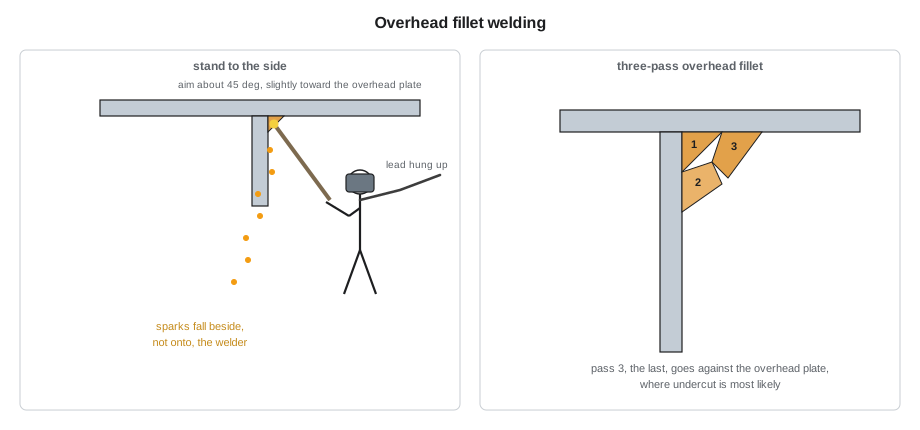
Priya also checks the area below and around the work. Anything that can catch fire must be moved or covered, because spatter falls a long way and bounces. And she reminds Devon about fume: overhead, the plume rises past the welder's face, so he positions himself to the side of the arc, never directly under it, and uses the fume extractor arm close to the joint.
Body position
A good overhead position puts the welder to the side of the joint, with the head out of the line of falling spatter and fume and the eyes looking up at the joint at an angle. The joint should be at a height where the welder's arm is bent, not fully stretched, and where the welder can stand comfortably for the length of an electrode. Devon sets the practice T-joints in the overhead fixture at about the height of his forehead, so that his welding arm works below shoulder height and his elbow can rest against his side or chest.
The weight of the lead and stinger is the main cause of fatigue in overhead welding. Devon drapes the lead over his shoulder or over a hook above the work so that the stinger hangs free, and he uses both hands where he can: one on the stinger and one steadying it or braced against the work. Marta also has him use a slightly shorter electrode stub than usual, burning each electrode down to about 50 mm (2 in) rather than less, because the last part of a hot electrode drips and is hard to control overhead.
Current and arc length
Overhead welds are made at slightly lower current than flat welds, about 5 to 10 percent lower, giving a starting range for 3.2 mm (1/8 in) E4918 (7018) of about 100 to 125 A. The arc must be kept as short as possible. A long arc overhead means a larger, hotter pool that drips, and with a low-hydrogen electrode it lets in air and causes porosity. Devon finds his best overhead fillets at about 110 A, with the coating almost touching the joint.
The aim is a small pool that freezes quickly, held in the joint by surface tension and the force of the arc. A pool that grows too large becomes too heavy for surface tension to hold, and drops or sags. The welder keeps the pool small by keeping the current down, the arc short and the travel steady.
Electrode angles
For an overhead fillet in a T-joint, the work angle is about 45 degrees, splitting the angle between the two plates. In the overhead position, the plate that is horizontal overhead tends to undercut, and the vertical plate below it tends to have weld metal sag onto it, so many welders aim slightly more toward the overhead plate, about 40 degrees from it. The travel angle is a slight drag or push of 5 to 15 degrees. Marta teaches a slight push, with the electrode pointing in the direction of travel, because it lets Devon see the joint ahead of the pool.
Stringers, not weaves
Overhead fillets are made with stringer beads. A weave overhead makes a wider, heavier pool that sags in the middle and undercuts at the edges. A single-pass overhead fillet is limited to about 6 mm (1/4 in) leg size, and anything larger is built up with several stringer passes. A common sequence for an 8 mm (5/16 in) overhead fillet is three passes: a root pass in the corner, a second pass against the vertical plate overlapping the root by about half, and a third pass against the overhead plate overlapping the second. The order puts the last pass on the overhead plate, where undercut is most likely, so that it can be controlled directly.
Each pass is run with a short arc and steady travel, with a slight pause or circular motion only to fill the edges. The rhythm for an overhead stringer is a smooth, even movement along the joint; any sudden stop lets the pool grow and drip.
Cleaning overhead
Slag falls when it is chipped overhead, onto the welder's face shield and anyone below. Devon wears clear safety glasses under his hood and chips with the shield down or with a clear face shield. He chips each pass completely and brushes it before the next, and he checks the toes carefully: slag at the upper toe of an overhead fillet is common, because the bead tends to roll away from the overhead plate.
Planning an overhead fillet job
Overhead welding takes longer than flat welding for the same weld, both because of the smaller passes and because the welder needs more breaks. Glen plans overhead work with a lower operating factor, the fraction of the welder's time that the arc is actually burning, and more electrodes per metre because of the extra passes and longer stubs.
# Overhead fillet job estimate: weld metal, electrodes and welder time (illustrative factors)
import math
def fillet_mass(leg, length, rho=7.85e-6, convex=1.10):
    return 0.5 * leg * leg * convex * length * rho
def estimate(name, leg, length, dep_rate, per_electrode, op_factor):
    mass = fillet_mass(leg, length)
    arc_hours = mass / dep_rate
    hours = arc_hours / op_factor
    elec = math.ceil(mass / per_electrode)
    print(f"{name:9}: {mass:.2f} kg of weld, about {elec} electrodes, {arc_hours * 60:.0f} min of arc, {hours:.1f} h of welder time")
L, LEG = 9600, 8          # joint length mm and fillet leg mm
estimate("flat", LEG, L, 1.0, 0.02, 0.35)
estimate("overhead", LEG, L, 0.75, 0.018, 0.22)flat : 2.65 kg of weld, about 133 electrodes, 159 min of arc, 7.6 h of welder time overhead : 2.65 kg of weld, about 148 electrodes, 212 min of arc, 16.1 h of welder time
The numbers are for the overhead fillets under the Coldwater skid's upper deck: the deck plate is welded to the top flanges of the deck beams from underneath, because the deck has equipment set on it and cannot be turned over. There are about 9.6 m (31.5 ft) of 8 mm (5/16 in) fillet. Welded flat, the job would take about a day; overhead, it takes about two. The deposition rate is lower because the current is lower, the electrodes are burned to a longer stub, and the operating factor drops because the welder needs to rest the arm, chip overhead and change position more often.
Common overhead fillet defects
| Defect | Cause | Correction |
|---|---|---|
| Sag and drips | Pool too large: current too high, arc too long, travel too slow | Lower current, shorten the arc, keep travel steady |
| Undercut on the overhead plate | Aim too low, current too high | Aim slightly toward the overhead plate; run the last pass there |
| Convex, ropy bead | Current too low, travel too slow | Raise current a little, keep moving |
| Porosity | Long arc, damp electrode | Short arc, electrodes from the oven |
| Slag at the upper toe | Bead rolling away from the overhead plate, poor cleaning | Aim at the overhead plate; chip and check each pass |
Production overhead work
After two weeks of practice, Devon's overhead fillets pass Marta's checks and Lucia's break tests. His first production overhead welds are the pipe support shoes for the Unit 4 spools: short fillets on the underside of steel shoes that sit on the pipe rack, welded in the field because the shoes are positioned after the spools are set. The 6 mm (1/4 in) fillets are single-pass overhead welds, and the rack is 6 m (20 ft) up, so the work is done from a scissor lift with a harness, a fire watch below and a spark blanket over the rack. Priya reviews the hot work permit with him, the first permit he has filled in himself since the first course.
The farm repair comes the same week. Wes Brandvold's loader frame, repaired in the metallurgy course, has a cracked bracket on its underside that holds a hydraulic line. The bracket is welded in place overhead, with the loader on stands and Devon lying on a creeper underneath. Marta reminds him that welding lying down puts the stinger and the falling spatter close to the face and chest, and that the creeper must be on bare concrete with nothing flammable around.
Seeing the joint overhead
Overhead, the welder looks up at the joint through the lens, often at an awkward angle, and the light from the arc reflects off the plate above. Devon finds he sees the pool better with a slightly lighter lens shade than he uses for flat work, within the range the shade chart allows for the current, and Priya confirms it is still inside the safe range for 3.2 mm (1/8 in) electrodes at about 110 A. Some welders add a magnifying cheater lens behind the filter for overhead and out-of-position work. A small headlamp under the hood, or a work light aimed at the joint from the side, helps between arcs, when the welder needs to see the end of the last bead to start the next.
Visibility also depends on where the welder stands. From directly underneath, the electrode and the hand hide the pool. From the side, at an angle of about 30 to 45 degrees off the joint line, the welder can see the leading edge of the pool and the toe on the overhead plate. Devon chooses his standing position for each joint by looking along it with an unlit electrode before he lowers his hood.
How overhead differs from vertical
It helps to understand why the pool behaves as it does. In the vertical position, gravity pulls the pool along the joint, downward, and the welder fights it with the shelf. In the overhead position, gravity pulls the pool straight down, away from the joint and toward the welder. A small pool is held up by surface tension, the same effect that lets a drop of water hang from a tap without falling, and by the force of the arc pushing metal up into the joint. Surface tension can only hold a small pool. Double the width of the pool and it holds about four times as much metal, but the surface tension along its edges only doubles, and the pool drops.
That is why every rule of overhead welding comes back to keeping the pool small: lower current, a short arc, small stringers, steady travel. It is also why overhead welding with a low-hydrogen electrode, whose molten pool is fairly fluid, is more demanding than with a fast-freezing cellulosic electrode, and why the welder must not let the electrode overheat toward the end of its length.
Practising overhead in steps
Marta starts Devon's overhead practice with short single-pass 6 mm (1/4 in) fillets on T-joints clamped overhead, about 150 mm (6 in) long, so that one electrode makes the whole weld. When those are consistent, he moves to three-pass 8 mm (5/16 in) fillets, then to longer joints with restarts. Each practice fillet is broken, and the break is examined for root fusion and porosity, exactly as for the 3F fillets. After two weeks, Devon can run an overhead stringer as steadily as a horizontal one, although he still finds it twice as tiring.
Fatigue shows up in the welds before the welder feels it. Lucia points out that Devon's practice log shows more porosity and more undercut on the last overhead plate of each afternoon than on the first, and Marta changes his schedule so that overhead practice comes first in the session, when his arm is fresh.
Common mistakes
MistakeWelding overhead without earplugs and a closed collar.
InsteadWear earplugs, a cap, and a jacket closed at the neck.
MistakeStanding directly under the arc.
InsteadStand to the side, out of the line of spatter and fume.
MistakeWeaving an overhead fillet.
InsteadUse stringers; build larger fillets in several passes.
MistakeHolding the full weight of the lead on the wrist.
InsteadDrape the lead over the shoulder or a hook.
MistakeLetting the pool grow to finish a pass faster.
InsteadKeep the pool small with low current, a short arc and steady travel.
Summary and key terms
- Overhead welding needs a cap or cape, a closed collar, earplugs and gauntlet gloves.
- Stand to the side of the joint, with the arm bent and the lead supported.
- Use about 5 to 10 percent less current than flat and the shortest possible arc.
- Aim about 45 degrees, slightly toward the overhead plate.
- Make overhead fillets with stringers, finishing on the overhead plate.
- Overhead work has a lower deposition rate and operating factor.
- 4F
- A fillet weld in the overhead position.
- Operating factor
- The fraction of a welder's working time during which the arc is burning.
- Surface tension
- The property of a liquid surface that lets a small overhead weld pool hold its shape.
- Stub loss
- The length of electrode left in the holder and thrown away.
Practice problems
Work each problem on paper first, then reveal the answer to check.
An 8 mm overhead fillet is needed. How should it be made?
Show answer
In about three stringer passes, finishing on the overhead plate.
A flat setting of 125 A works for a 3.2 mm electrode. Where should the overhead setting start?
Show answer
About 115 A, 5 to 10 percent lower.
Why does the operating factor drop for overhead work?
Show answer
The welder needs more rest, more chipping time and more position changes.
Lesson quiz · 5 questions
Score 60% or more to complete this lesson.
Create a free account to save your progress, take quizzes and earn a certificate.