
WLD-230 · Lesson 4 of 12 · 18 min
Open-root technique on plate
Not every groove weld has a backing bar. Pipe joints, joints welded from one side where backing cannot be left in place, and many repair and field joints are welded with an open root: the plates are set with a small gap and a land, and the root pass is made so that it melts through and forms a small bead on the back of the joint without any support. Open-root welding is one of the defining skills of a welder, it is the basis of all pipe welding, and it is harder than welding on backing because the welder must control the weld pool from one side while it hangs over an open gap. This lesson covers open-root technique on plate in the flat and vertical positions, as preparation for the pipe welding course. Devon's goal here is not an open-root qualification yet; it is to learn to read and control the keyhole.
The open-root joint
An open-root single-V groove looks different from the backed groove. The groove angle is wider, usually 60 degrees, made from two 30 degree bevels, so that the electrode can reach the root at a steeper angle. Each bevel has a root face, or land, typically 1.5 to 2.5 mm (1/16 to 3/32 in), and the root opening is smaller, typically 2.5 to 3.2 mm (3/32 to 1/8 in). The land and the opening together control how the root melts through. A thin land with a wide gap melts through easily and can blow out; a thick land with a tight gap does not melt through at all.
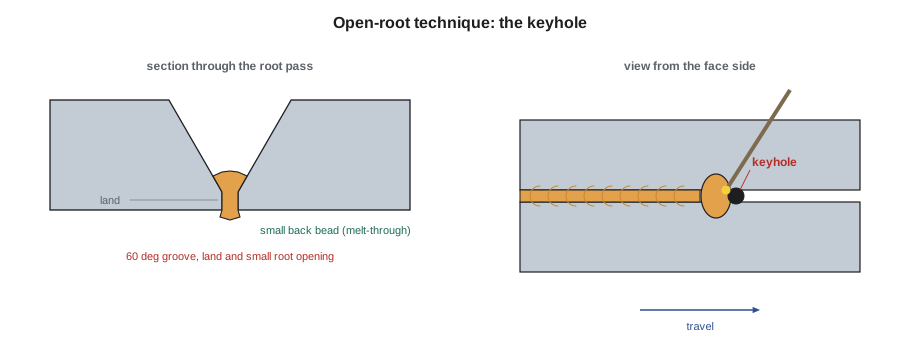
Hartwell's practice procedure for open-root plate uses 10 mm (3/8 in) plate with 30 degree bevels, a 2 mm (5/64 in) land and a 3 mm (1/8 in) root opening. The ends are tacked with small tacks on the face side, and the plates are pre-set to allow for distortion, more than for the backed plate because an open root closes up as it is welded if the tacks are too small.
The electrode for the root
Open roots on structural plate and on most pipe are run with a cellulosic electrode, E4310 (6010) or E4311 (6011), often called a fast-freeze electrode. The cellulose in the coating burns to produce a forceful, digging arc and a thin, fast-freezing slag. The force of the arc pushes through the root and the fast-freezing pool holds itself up over the open gap and in the vertical and overhead positions. E4310 (6010) runs on DCEP; E4311 (6011) will also run on AC, which matters with older field machines.
Cellulosic electrodes are not low-hydrogen. Their coating is designed to contain moisture, and the weld metal they make contains much more diffusible hydrogen than an E4918 (7018) weld. They are never kept in the low-hydrogen oven, which would dry them out and ruin their arc. Where the procedure allows them, they are used for the root and the hot pass, and the rest of the joint is filled with low-hydrogen electrodes. On steels or thicknesses where hydrogen cracking is a concern, the procedure may call for a low-hydrogen open root instead, which is harder to run, or for preheat.
Reading the keyhole
As the root pass advances, the arc melts the two lands and a small hole opens through the joint just ahead of the weld pool. This hole is the keyhole. Molten metal flows from its edges around behind the arc and fills it, forming the root bead on the back of the joint. The keyhole is the welder's gauge:
- A keyhole about the size of the root opening plus a little, so that each land is melted back about 1 mm (1/32 in), means correct penetration. The back bead will be a small, even reinforcement.
- A keyhole that grows larger means too much heat: too much current, too slow travel or the electrode held too long in one place. The back bead will sag or the root will blow out, leaving a hole.
- A keyhole that shrinks or disappears means the arc is no longer penetrating. The root is lying on top of the lands, and the back will show incomplete penetration.
The welder adjusts the keyhole continuously with travel speed, electrode angle and, on cellulosic electrodes, with a whipping motion: the electrode is moved forward out of the pool for a moment, letting the pool freeze slightly, and then brought back into the keyhole. The forward movement also lets the arc preheat the lands ahead of the pool. Marta teaches a small, steady whip rather than a large one, because a large whip pulls the arc out long and lets air in.
Settings and angles
For the 3.2 mm (1/8 in) E4310 (6010) root in the flat position, Devon starts at about 85 A, DCEP, and adjusts between about 75 and 105 A. The electrode is held at about 90 degrees across the joint and with a slight drag, 5 to 10 degrees from vertical. The arc is kept short, with the electrode tip pushed into the keyhole so that the arc acts on the back of the joint. Cellulosic electrodes tolerate a tight arc; the welder can almost bury the tip in the root.
In the vertical position, the open root is usually run uphill with the same electrode, with the electrode angled up about 10 to 15 degrees and a small side-to-side motion between the lands. Pipeline welders often run E4310 (6010) roots downhill, which is faster but needs a tighter fit-up and a different technique; that comes in the pipe course.
Restarts in an open root
A restart in an open root is where most open-root failures start. When the arc is broken, the end of the bead freezes with the keyhole open in front of it, and the next electrode must reopen the keyhole and fuse into the end of the previous bead without leaving a cold lap or a hole. The method:
- Grind the end of the bead to a long taper, so that the bead thins down to nothing at the keyhole.
- Strike the arc on the taper, about 10 mm (3/8 in) back from the keyhole, and move forward along the taper.
- When the arc reaches the keyhole, push the electrode in and hold for a moment until the keyhole reopens, then continue at normal speed.
Devon checks every restart on his practice plates from the back. A good restart shows a continuous back bead with no gap or thickening; a poor one shows a gap where the new bead did not fuse through, or a lump where it overheated.
The hot pass
The surface of a cellulosic root pass usually has small slag lines trapped along each side of the bead, called wagon tracks. They are too fine to remove by chipping. The hot pass, the second pass, is run with the same cellulosic electrode at a higher current, often 10 to 20 percent above the root, and faster travel. Its job is to burn out the wagon tracks and give a clean, slightly concave surface for the fill. Some welders grind the root face instead of running a hot pass, which works well on plate and removes the slag lines mechanically. Hartwell's practice procedure allows either.
Heat input in the root and hot pass
Because the root and hot pass are small beads run at low current, their heat input is low, and on thicker or harder steel the procedure may set a minimum heat input or a preheat to keep the root from cooling too fast. Heat input is worked out from the arc voltage, the current and the travel speed:
where H is the heat input in kJ/mm (kJ/in), E is the arc voltage, I is the current and v is the travel speed in mm/min (in/min). Devon times his beads with a stopwatch and measures their length with a tape, the same way he did in the first course.
# Travel speed and heat input from timed passes on an open-root practice plate
passes = [("root", 24.0, 85, 150, 72), ("hot pass", 26.0, 100, 150, 45), ("fill 1", 23.0, 125, 150, 50), ("cap", 22.5, 115, 150, 95)]          # (pass, volts, amps, bead length mm, seconds)
for name, volts, amps, length, sec in passes:
    speed = length / (sec / 60)                 # mm per minute
    h = 60 * volts * amps / (1000 * speed)       # kJ per mm
print(f"{name:9} {amps:4d} A {volts:4.1f} V {speed:6.0f} mm/min heat input {h:.2f} kJ/mm")root 85 A 24.0 V 125 mm/min heat input 0.98 kJ/mm hot pass 100 A 26.0 V 200 mm/min heat input 0.78 kJ/mm fill 1 125 A 23.0 V 180 mm/min heat input 0.96 kJ/mm cap 115 A 22.5 V 95 mm/min heat input 1.64 kJ/mm
The root and hot pass run slowly enough that their heat input is similar to the fill, even at lower current, because a whipped root advances slowly. The cap, run with a weave in this plate, has the highest heat input of the joint. The numbers matter for procedures with heat input limits, which are common on bridge steels and on steels with toughness requirements.
Checking the back of the joint
An open root can be inspected from the back, and on practice plates Devon looks at every one. The back bead should be continuous, even in width, slightly convex and fused smoothly into both plates. The welder test standards set limits on the back bead of an open-root test plate: melt-through, the amount the root sticks out the back, is limited to about 3 mm (1/8 in), and root concavity, where the root bead sucks back below the plate surface, to about 2 mm (1/16 in), provided the total weld thickness is not less than the plate.
| What the back shows | Cause | Fix |
|---|---|---|
| No back bead in places | Keyhole lost: travel too fast, current too low, land too thick | Slow down, push the electrode into the keyhole, check the land |
| Holes or icicles | Keyhole too large: current too high, travel too slow | Lower the current, speed up, use more whip |
| Back bead on one side only | Electrode angled toward one plate | Hold the work angle square |
| Concave root, sucked back | Too much heat in the overhead or vertical position, or gap too wide | Lower the current, shorten the pause |
| Gap or lump at a restart | Taper not ground, arc not pushed into the keyhole | Grind a long taper, hold at the keyhole |
Open roots with low-hydrogen electrodes
A few structural procedures, and most pressure procedures on certain steels, call for a low-hydrogen open root. E4918 (7018) can run an open root, but its arc is softer and its pool is more fluid, so the land is made thinner, the gap a little wider, and the root is run with a slight weave rather than a whip. Marta has Devon try two plates this way, mainly so that he understands why most welders prefer a cellulosic root and why GTAW, which comes in a later course, is often used for critical open roots.
How open-root practice helps on backing
Devon's next lessons go back to backed joints, but the open-root work pays off there too. Watching the keyhole trains him to look at the leading edge of the pool and the fusion at the sides, which is exactly what makes a backed root fuse its corners. Marta's view is that a welder who has run fifty open roots never again leaves a cold corner on backing without noticing it.
Fitting an open-root practice plate
The fit-up of an open root is less forgiving than a backed joint, so Devon checks it more carefully. He files the land on each bevel to an even 2 mm (5/64 in) with a flat file, checking it with a small gauge at both ends and the middle, because a land that varies along the joint makes the keyhole grow and shrink no matter what the welder does. He sets the root opening with a piece of bare 3 mm (1/8 in) filler wire laid in the gap, tacks both ends on the face side with small, hot tacks, and removes the wire.
As the root advances, the shrinkage of the weld pulls the plates together ahead of it, so an open root that starts at the right gap can be too tight by the far end. There are two ways to deal with this. The first is to set the far end slightly wider than the start, by about 0.5 to 1 mm (1/32 in). The second is to put a third tack in the middle of the joint and grind it to a feather edge, so that it holds the gap and is welded through when the root reaches it. Marta shows him both and has him use the wider far end on short practice plates and the middle tack on anything longer than 200 mm (8 in).
On each practice plate, Devon writes the land and gap he measured on the plate beside his settings. After a dozen plates, the log shows that his keyhole was easiest to control with a land of about 2 mm (5/64 in) and a gap of 3 mm (1/8 in), which is the procedure's nominal setting, and that most of his blow-outs happened on plates where the land had been filed thin at one end.
Common mistakes
MistakeStoring cellulosic electrodes in the low-hydrogen oven.
InsteadCellulosic electrodes need their moisture; keep them in their own closed container at room temperature.
MistakeLetting the keyhole grow because the bead looks good on top.
InsteadWatch the keyhole size; a growing keyhole means a sagging or blown root.
MistakeRestarting over the end of an open root without a taper.
InsteadGrind a long taper and push the arc into the keyhole before moving on.
MistakeSkipping the hot pass or root grind.
InsteadWagon tracks along a cellulosic root must be burned out or ground off.
MistakeUsing a thick land with a tight gap.
InsteadSet the land and opening to the procedure so the root can melt through.
Summary and key terms
- Open-root joints use a wider groove angle, a land and a small root opening.
- Cellulosic electrodes give a digging arc and fast-freezing pool for open roots, but are not low-hydrogen.
- The keyhole shows whether the root is penetrating; keep its size constant.
- Grind restarts to a taper and reopen the keyhole before continuing.
- A hot pass or root grind removes wagon tracks before fill passes.
- Heat input is 60 E I divided by 1000 times travel speed.
- Open root
- A groove joint welded without backing, with a root opening through which the root pass penetrates.
- Land
- Another name for the root face of a bevel.
- Keyhole
- A small hole melted through the root of an open joint just ahead of the weld pool.
- Cellulosic electrode
- An electrode with a cellulose-based coating that produces a forceful, deeply penetrating arc.
- Hot pass
- The second pass in an open-root weld, run hot to burn out slag along the root.
- Wagon tracks
- Lines of slag trapped along both sides of a root bead.
- Melt-through
- Weld metal protruding from the back of an open-root weld.
Practice problems
Work each problem on paper first, then reveal the answer to check.
A root bead 150 mm long takes 72 s at 24 V and 85 A. What is the heat input?
Show answer
Speed = 125 mm/min; H = 60 x 24 x 85 / (1000 x 125) = about 0.98 kJ/mm.
The keyhole on an open root keeps getting larger. Name two corrections.
Show answer
Lower the current and travel faster, or whip the electrode further forward.
Why is E4310 never stored in the low-hydrogen oven?
Show answer
Its coating needs moisture to work; drying it ruins the arc.
Lesson quiz · 5 questions
Score 60% or more to complete this lesson.
Create a free account to save your progress, take quizzes and earn a certificate.