
WLD-210 · Lesson 4 of 12 · 17 min
Shielding gases and gas delivery
Shielding gas does more than keep the air out. The gas is the medium the arc burns in, and its chemistry and physics decide how hot the arc is, how the metal crosses it, how deep the weld penetrates, how much spatter flies and what the bead looks like. Change the gas and the same wire at the same settings makes a different weld. At Hartwell, the structural bay runs mainly on a mix of 75 percent argon and 25 percent carbon dioxide, the carriage line on a 90 and 10 mix, the pressure bay on argon-rich mixes for stainless, and one old machine on straight carbon dioxide for heavy fillet work. This lesson explains what each gas does, how mixtures are named, how gas gets from the cylinder or tank to the arc, how much is needed, and why the most common cause of porosity in a wire weld is not the gas itself but the gas not getting there.
Why the air must be kept out
Air is about 78 percent nitrogen and 21 percent oxygen, with some water vapour. At arc temperatures, all three attack molten steel. Oxygen forms oxides and burns out manganese and silicon; nitrogen dissolves in the pool and comes out as porosity or stays in the metal as nitrides that make it brittle; water breaks down into hydrogen and oxygen, bringing the hydrogen cracking risk the metallurgy course described. A shielding gas flows out of the nozzle and pushes the air away from the arc and the pool until the metal has frozen. Even a few percent of air mixed into the shield can cause porosity and lower toughness.
The gases and what they do
Four gases make up most shielding mixtures for steel:
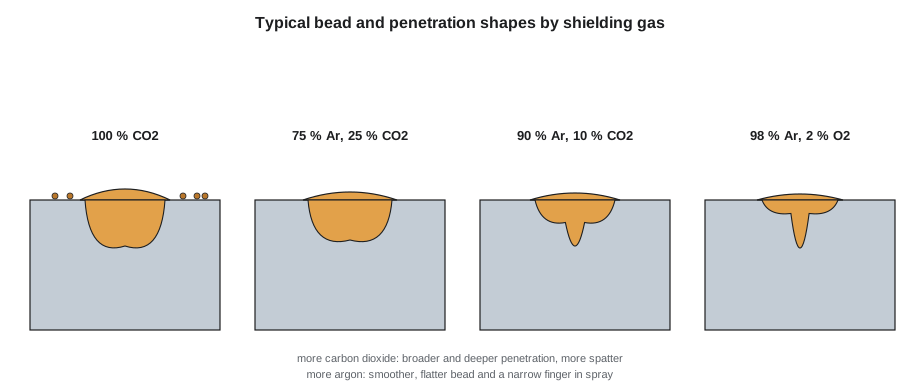
- Argon is inert: it does not react with the weld metal. It ionizes easily, so the arc starts and stays stable, and it conducts heat poorly, so the arc has a hot, narrow core. With enough current, argon-rich gases allow spray transfer, with a smooth, spatter-free arc and a bead with a finger-shaped penetration down the middle. Pure argon on steel gives an unstable, wandering arc and poor wetting, so a little oxygen or carbon dioxide is always added.
- Carbon dioxide is active. In the arc it breaks down into carbon monoxide and oxygen, absorbing heat, and recombines at the cooler edges, releasing it. That makes a hotter, broader arc with deep, wide penetration. It is cheap and penetrates well, but it cannot support true spray transfer, makes more spatter, and its oxidizing effect burns out some deoxidizers, which is why wires for carbon dioxide carry plenty of manganese and silicon.
- Oxygen in small amounts, 1 to 5 percent, stabilizes the arc and improves wetting with argon, especially for spray transfer on clean steel and for stainless steel. More than that oxidizes the weld.
- Helium conducts heat very well and makes a hot, broad arc with high voltage. It is used mostly with argon on thick aluminum and copper and in some stainless mixes, and is expensive.
Common steel mixes sit between the pure gases. A mix of 75 percent argon and 25 percent carbon dioxide is the standard all-round gas for short-circuit and flux-cored welding: less spatter than straight carbon dioxide, good penetration and good bead shape, but no true spray. Mixes of 90 percent argon and 10 percent carbon dioxide, or argon with 5 to 8 percent carbon dioxide, support spray and pulsed spray with a smoother arc while keeping some penetration. Argon with 2 percent oxygen gives a very fluid, clean spray arc on clean plate. Three-part mixes, such as argon with carbon dioxide and oxygen, or helium, argon and carbon dioxide for stainless, are tuned for particular jobs.
How gases are named
Shielding gases are named by the international gas classification, ISO 14175, which both CSA W48 and AWS filler metal specifications use for the gas field in wire classifications. Each group has a letter and number: I1 is argon, I3 is argon with helium, C1 is pure carbon dioxide, and the M groups are argon-based mixtures with active gases. M20 covers argon with roughly 5 to 15 percent carbon dioxide, M21 argon with roughly 15 to 25 percent carbon dioxide, and M12 and M13 cover low carbon dioxide and oxygen mixes for stainless and spray. A wire classified with M21 has been tested with a gas in that group, and the welding procedure normally names either the group or the actual mixture. Gas suppliers print the mixture on the cylinder label and on the delivery documents, and many add their own trade names, which is why Lucia insists that the procedure, not the trade name, is checked against the cylinder label.
The 2025 edition of AWS D1.1 adds a definition of oxygen equivalent for GMAW and FCAW gases, a way of expressing how oxidizing a mixture is, because mixtures with the same carbon dioxide content but different oxygen behave differently. The principle is useful everywhere: oxidizing gases burn out deoxidizers and alloys, so a wire chosen for one gas may give different strength and toughness in another.
| Mixture | Group | Typical use on steel |
|---|---|---|
| 100 % carbon dioxide | C1 | Short-circuit and flux-cored on carbon steel; deep penetration; most spatter |
| 75 % argon, 25 % carbon dioxide | M21 | General short-circuit, flux-cored and metal-cored; the shop standard |
| 90 % argon, 10 % carbon dioxide | M20 | Spray, pulsed spray and metal-cored; smoother arc |
| 95 % argon, 5 % carbon dioxide | M12 or M20 (at the boundary) | Spray and pulse on clean steel |
| 98 % argon, 2 % oxygen | M13 | Spray on clean carbon and stainless steel |
| Argon, helium and carbon dioxide (three-part) | As labelled by the supplier | Short-circuit and pulsed stainless |
Getting gas to the arc
Gas comes from high-pressure cylinders, from liquid cylinders (dewars) that hold the gas as a cold liquid and vaporize it as it is used, or from a bulk tank outside the building with a mixer and piping to each station. At a cylinder, a regulator-flowmeter drops the pressure and meters the flow, usually in litres per minute in Canada and cubic feet per hour in the United States. A ball flowmeter must be read at the centre of the ball with the tube vertical, and only while gas is flowing, with the trigger pulled. Carbon dioxide cylinders hold liquid, and drawing gas quickly cools the regulator; at high flows, a heater on the regulator stops it from freezing up. From the regulator, a hose runs to the feeder, where a solenoid valve opens when the trigger is pulled, and on through the gun cable to the diffuser and nozzle.
Most power sources can set preflow, gas flow for a short time before the arc starts, and postflow, gas flow for a few seconds after it stops, to protect the crater as it cools. When the solenoid opens, gas that has built up in the hose at regulator pressure rushes out in a surge, then settles to the set flow. Long hoses at high pressure make large surges that waste gas and, briefly, draw air into the shield. Flow-control devices at the feeder and short hoses reduce this.
How much gas?
More gas is not always better. The gas must flow fast enough to push air away from the arc, but if it comes out of the nozzle too fast it becomes turbulent and pulls air in from the sides. Typical flow rates for steel are about 15 to 20 L/min (30 to 40 cfh) for short-circuit welding with a small nozzle and 20 to 25 L/min (40 to 50 cfh) for spray and flux-cored welding with a larger nozzle. Wider nozzles need more gas, and so do drafts, wide joints and long contact tip distances. Too little gas, too much gas, a dented or spatter-choked nozzle, or a nozzle held too far from the work all let air in. The wire manufacturer's data sheet and the welding procedure give the range for each job.
# Gas needed to keep the same exit velocity from different nozzles (illustrative)
import math
base_flow = 18          # L/min that works with the reference nozzle in still air
base_d = 16             # reference nozzle bore, mm
for d in (13, 16, 19):
    flow = base_flow * (d / base_d) ** 2
    print(f"nozzle {d} mm -> about {flow:4.0f} L/min for the same gas velocity")
draft_factor = 1.3        # rule of thumb for a light draft, if no screens are used
print(f"with a light draft, the reference nozzle needs about {base_flow * draft_factor:.0f} L/min")nozzle 13 mm -> about 12 L/min for the same gas velocity nozzle 16 mm -> about 18 L/min for the same gas velocity nozzle 19 mm -> about 25 L/min for the same gas velocity with a light draft, the reference nozzle needs about 23 L/min
The square law in this illustration shows why changing to a larger nozzle without raising the flow lets the shield get weak: a nozzle with a bore one third larger needs nearly twice the gas for the same velocity. In a draft, screens are better than more gas, because very high flows become turbulent.
Wind and drafts
Gas shielding fails in moving air. Structural codes limit gas-shielded welding where the wind speed near the weld is more than about 8 km/h (5 mph) unless the weld is protected by a shelter or screen. In the shop, the problems come from open doors, fans, fume extraction hoods placed too close and too strong, and the gun's own cooling air. On the Riverside field splices, Hartwell will build tarped enclosures for the gas-shielded welds or use self-shielded wire. Devon learns to look for drafts the way Marta does: watch the smoke, feel for air on the back of the neck, and look at the bead for the fine surface pores and the grey, sooty surface that are the first signs of a weak shield.
Leaks and contamination
Gas can be lost or contaminated along the way. A leak at a fitting or a split in a hose wastes gas and can also draw air in by venturi action when gas flows past the leak, so a hose with a pinhole can cause porosity even though the flowmeter reads correctly. Cylinders that have been emptied completely can let moist air in, and a mixture cylinder that has stood very cold can separate; suppliers recommend leaving some pressure in returned cylinders and storing mixtures above freezing. Water-cooled guns can leak coolant into the gas path. Devon learns the shop's leak check: close the cylinder valve with the regulator pressurized and watch the gauge for a few minutes; any drop means a leak between the cylinder and the solenoid. The bubble test with a leak-detecting solution finds where.
Gas cost and consumption
Gas is a significant part of the cost of a wire weld. A shop pays for gas while the trigger is pulled, during preflow and postflow, and through every leak. Bulk systems reduce the price per litre or cubic foot and the time spent changing cylinders, but they make leaks harder to notice because nobody watches a cylinder empty. Hartwell's bulk system for the structural bay has a meter, and Glen compares the gas used each month with the wire used; when the ratio rises, someone goes looking for leaks.
# Gas use and cylinder life for a day of flux-cored welding
flow = 20                 # L/min
arc_hours = 3.2           # arc-on time in the shift
extra = 0.15               # preflow, postflow and surges, as a fraction
cylinder = 9000           # gas in a full cylinder, L
price = 0.012               # dollars per litre of gas, illustrative
per_hour = flow * 60      # L per arc hour
used = per_hour * arc_hours * (1 + extra)
print(f"gas used in the shift: {used:,.0f} L")
print(f"a full cylinder lasts about {cylinder / (per_hour * (1 + extra)):.1f} arc hours")
print(f"gas cost: about {used * price:.2f} dollars per shift")gas used in the shift: 4,416 L a full cylinder lasts about 6.5 arc hours gas cost: about 52.99 dollars per shift
Cylinder safety, again
The cylinder rules from the welding safety course apply to every shielding gas cylinder: secure it upright with a chain or strap, keep the cap on when it is moved, open the valve slowly while standing to the side of the regulator, and close it when the job is done. Argon, helium and carbon dioxide are not toxic, but they displace oxygen. They are heavier than air (argon and carbon dioxide) or lighter (helium), and they collect in tanks, pits and trenches or high in closed rooms. Welding with a wire process inside a vessel such as the Coldwater separator brings the confined space rules into play, with continuous oxygen monitoring, because the gas from the gun can lower the oxygen content of the vessel atmosphere.
Common mistakes
MistakeTurning up the gas to cure porosity.
InsteadFind the cause first: drafts, leaks, a dirty nozzle, wrong gun angle or too much flow can all cause porosity.
MistakeReading the flowmeter with the trigger released.
InsteadRead flow with gas flowing and the tube vertical.
MistakeUsing a spray-transfer procedure with a 75 percent argon mix.
InsteadTrue spray needs about 80 percent argon or more.
MistakeWelding with gas shielding next to an open door on a windy day.
InsteadScreen the weld or move it; codes limit wind speed near the arc.
MistakeIgnoring a slow pressure drop on the regulator.
InsteadFind the leak; it can draw air into the gas line.
Summary and key terms
- Shielding gas keeps oxygen, nitrogen and moisture away from the weld and shapes the arc.
- Argon is inert, gives a stable narrow arc and allows spray transfer; carbon dioxide is active, cheap and penetrates deeply with more spatter.
- Small amounts of oxygen or carbon dioxide stabilize argon arcs on steel.
- Gases are named by ISO 14175 groups such as C1, M20 and M21, which appear in wire classifications.
- Flow must be enough to shield but not so much that it becomes turbulent; nozzle size and drafts change the need.
- Codes limit gas-shielded welding in wind unless the weld is screened.
- Leaks waste gas and can draw air into the shield.
- Shielding gas
- Gas that protects the arc and weld pool from the atmosphere.
- Inert gas
- A gas such as argon or helium that does not react with the weld metal.
- Active gas
- A gas such as carbon dioxide or oxygen that takes part in reactions in the arc and pool.
- ISO 14175
- The international classification of shielding gases used in wire classifications.
- Preflow and postflow
- Gas flow before the arc starts and after it stops.
- Gas surge
- The burst of gas when the solenoid opens on a pressurized hose.
Practice problems
Work each problem on paper first, then reveal the answer to check.
Which gas group is 75 percent argon and 25 percent carbon dioxide?
Show answer
M21.
A shop runs 20 L/min for 3 arc hours. How much gas is used, ignoring surges?
Show answer
20 × 60 × 3 = 3,600 L.
Why does a pinhole in a gas hose cause porosity even when the flowmeter reads correctly?
Show answer
Gas flowing past the hole draws air in by venturi action.
Lesson quiz · 5 questions
Score 60% or more to complete this lesson.
Create a free account to save your progress, take quizzes and earn a certificate.