
WLD-210 · Lesson 10 of 12 · 16 min
Metal-cored wires and productivity
On the Riverside girders, each girder has two flange-to-web fillets running its full length on both sides of the web, four long fillets per girder, eight for the pair, plus the welds at the bearing stiffeners and the splices. Glen Teskey has bid the job on the basis that those long fillets will run on a tractor carriage with metal-cored wire, not by hand. Devon's job for the week is to help set up the carriage, and Marta uses it to teach him two things: what a metal-cored wire is and why it is so fast, and how a fabricator thinks about the cost of a weld. In a shop that charges by the hour, a weld that takes half the time costs nearly half as much, whatever the wire costs.
What metal-cored wire is
A metal-cored wire is a tube, like a flux-cored wire, but its core is mostly metal powder: iron, manganese, silicon and sometimes alloys, with only a small amount of arc stabilizers. In the arc, the current flows almost entirely through the thin steel sheath, which melts first, and the arc spreads around the circumference of the tube instead of concentrating on a solid tip. That gives three useful effects. Because current density in the sheath is high, the wire melts fast for its current, so deposition rates are high. Because the arc is broad, the penetration profile is wider and rounder than the narrow finger of a solid wire in spray, which makes it more forgiving of a slightly misplaced wire in a fillet root. And because the core carries extra deoxidizers, it handles mill scale and light rust better than most solid wires.
Metal-cored wire leaves little slag, only small silicon islands like solid wire, so multiple passes can often be made without cleaning, and the weld can be painted with little preparation. It is run with argon-rich gases, typically 90 and 10 or 75 and 25 argon and carbon dioxide, on DCEP, usually in a spray-like transfer in the flat and horizontal positions, or with pulse for vertical and thinner work.
In Canada, metal-cored wires are classified with the tubular wires in CSA W48, with a T15 usability, for example E491T15-M21A4-CS1-H4. Because the classification includes the gas group, a wire classified with M21 has been tested with argon and 15 to 25 percent carbon dioxide.
Why it is fast
Compared with a solid wire of the same diameter at the same current, a metal-cored wire typically melts and deposits more metal, often 10 to 20 percent more, and it can be run at higher currents in the horizontal fillet position without the large, rolling spray pool that undercuts the vertical plate. On a carriage, the result is travel speeds that a hand-held gun could not sustain. On the Riverside flange-to-web fillets, the procedure calls for 1.4 mm (0.052 in) metal-cored wire at about 330 A and 30 V on a carriage travelling at about 600 mm/min (24 in/min), making an 8 mm (5/16 in) fillet in one pass.
Mechanization adds its own gains. The carriage holds a constant travel speed, gun angle and stickout, so the weld size and heat input are uniform over the full length, and the operator can watch the arc and make small corrections instead of carrying the gun. The operating factor rises because there is no stopping to reposition every arm's length. The welder still matters: setting up the carriage, checking the fit and tacks ahead of the arc, watching the bead, and stopping before a tack weld, a run-off tab or a stiffener.
Setting up the carriage
Devon helps Marta set up the tractor on the first girder:
- The girder is blocked level with the web horizontal, and the flange-to-web fit is checked along its length; gaps over the procedure's limit are noted for repair before welding.
- Tack welds are checked: they must be sound and small enough to be consumed by the carriage weld, with their ends feathered so the arc does not stumble over them.
- The gun is set at the procedure's work angle, about 45 degrees for an equal-leg fillet, and a small travel angle, with the wire aimed at the root.
- CTWD is set with a gauge, and the guide wheel is adjusted to run against the flange.
- A trial run on a scrap T-joint of the same plate checks leg size, bead shape and penetration with a macro etch.
- Travel speed is checked with a tape and stopwatch, and the weld settings are recorded.
- Run-off tabs or the end plates allow the arc to start and stop off the finished weld at each end.
The first girder fillet takes about 50 minutes per side for the full length. By hand with gas-shielded flux-cored wire, Glen's estimate was about a full shift.
The cost of a weld
Fabricators estimate weld cost per metre or foot of weld. The pieces are:
- Labour and overhead: the welder's wage plus the shop's overhead, charged for every hour the welder is paid, whether the arc is on or not. In most shops this is by far the largest part, often 70 to 90 percent or more of the cost of a weld.
- Filler metal: the wire or electrodes, allowing for deposition efficiency.
- Shielding gas: charged for the arc hours, with an allowance for purging and surges.
- Power and equipment wear: usually small.
- Cleanup: slag removal, spatter grinding and repairs, often forgotten in estimates but real on the floor.
The weld itself is a volume of metal. For a fillet, the cross-section is a triangle with area equal to half the leg squared, plus some reinforcement. That has an important consequence: weld cost goes with the square of the leg size. An 8 mm (5/16 in) fillet made 10 mm (3/8 in) because the welder wanted to be safe uses about half as much weld metal again and takes about half as long again, for no gain in strength that the design asked for. Overwelding is one of the most common ways fabricators lose money.
Here a is the leg size, ρ the density of steel and r the reinforcement allowance. The code below adds the time and filler for three processes and estimates the cost per metre or foot of an 8 mm (5/16 in) fillet.
# Cost per m of a fillet weld by three processes (illustrative prices and rates)
leg = 8                       # fillet leg, mm
weld_mass = leg ** 2 / 2 * 0.00785 * 1.10       # kg per m, with 10 percent reinforcement
labour_rate = 95               # dollars per hour, wages plus overhead
processes = [  # name, deposition kg/h arc on, operating factor, deposition efficiency, filler price per kg, gas per arc hour
    ("SMAW low hydrogen", 1.8, 0.25, 0.62, 6.5, 0.0),
    ("FCAW gas-shielded", 4.5, 0.40, 0.86, 6.0, 1.4),
    ("metal-cored, carriage", 6.5, 0.55, 0.95, 5.0, 1.4),
]
for name, dep, of, eff, price, gas in processes:
    arc_hours = weld_mass / dep                 # arc hours per m
    paid_hours = arc_hours / of
    filler = weld_mass / eff * price
    labour = paid_hours * labour_rate
    total = labour + filler + gas * arc_hours
print(f"{name:22} {total:5.2f} dollars per m (labour {labour / total:4.0%})")SMAW low hydrogen 61.23 dollars per m (labour 95%) FCAW gas-shielded 16.60 dollars per m (labour 88%) metal-cored, carriage 8.86 dollars per m (labour 83%)
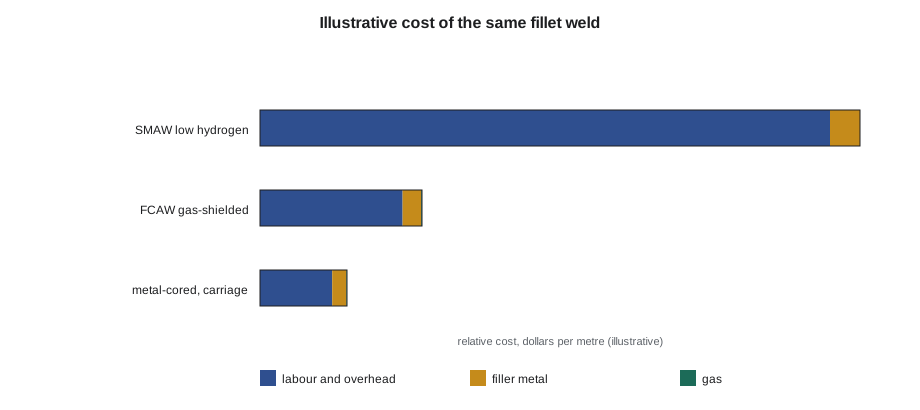
The illustration makes Marta's point. The metal-cored wire is not the cheapest filler per kilogram or pound, but the weld costs far less because the hours fall. The same logic explains why a fabricator will buy a pulse machine, a fume extraction gun or a positioner: each one raises the operating factor or the deposition rate, and the labour saving pays for it.
Other ways to cut weld cost
Productivity is not only about the process:
- Weld the size the drawing calls for. A fillet gauge on every welder's belt saves more money than most equipment.
- Fit up well. A gap of 2 mm (1/16 in) in a fillet root needs a larger leg, and a sloppy groove needs more passes.
- Position the work. Welding flat or horizontal on a positioner or by turning the part is faster and better than welding vertical or overhead.
- Use the right joint. A double-sided groove uses about half the weld metal of a single-sided groove in thick plate.
- Reduce cleanup. Correct settings and the right gas cut spatter and grinding; metal-cored wire avoids slag removal between passes.
- Plan the sequence. Fewer starts and stops, fewer moves of the crane, and less distortion to correct.
# Effect of oversized fillets on weld metal and time
design_leg = 8                 # mm
for actual in (8, 9, 10, 12):
    ratio = (actual / design_leg) ** 2
print(f"leg {actual} mm instead of {design_leg} mm -> {ratio:4.2f} x the weld metal and arc time ({(ratio - 1) * 100:+.0f} %)")leg 8 mm instead of 8 mm -> 1.00 x the weld metal and arc time (+0 %) leg 9 mm instead of 8 mm -> 1.27 x the weld metal and arc time (+27 %) leg 10 mm instead of 8 mm -> 1.56 x the weld metal and arc time (+56 %) leg 12 mm instead of 8 mm -> 2.25 x the weld metal and arc time (+125 %)
Limits of metal-cored wire
Metal-cored wire is not the answer to every joint. Its spray-like arc at high current is a flat and horizontal arc; vertical and overhead welding needs pulse or a lower-current short-circuit mode, and in short-circuit it carries the same lack-of-fusion risk as solid wire. It costs more per kilogram or pound than solid wire. It needs gas and shelter, so it is mainly a shop process. And like any wire, it must match the procedure: on the Riverside girders, the metal-cored wire and its gas were part of the procedure qualified for the flange-to-web fillets, with the weld metal tested for strength and toughness.
Tracking productivity
Modern power sources and weld data systems record arc time, wire used and the settings of every weld. Hartwell's newer machines report each shift's arc-on hours, which gives Glen a measured operating factor for each station instead of a guess. Marta is wary of using the numbers to push welders: the operating factor depends on the job, and a welder who stops to clean, check fit-up and measure is doing the job right. But the data shows where the time goes, and when a station's arc time falls, it often turns out that the welder is waiting for the crane or for parts, which is a planning problem, not a welding one.
# Operating factor from logged arc time, and where the rest of the shift went
shift_min = 480
arc_min = 190
other = {"cleaning between passes": 70, "fit-up and tacking": 65, "waiting for crane": 55, "setup and breaks": 60}
of = arc_min / shift_min
print(f"operating factor {of:.0%}")
for k, v in other.items():
    print(f"  {k:24} {v:3} min ({v / shift_min:.0%})")
print(f" unaccounted {shift_min - arc_min - sum(other.values()):3} min")operating factor 40% cleaning between passes 70 min (15%) fit-up and tacking 65 min (14%) waiting for crane 55 min (11%) setup and breaks 60 min (12%) unaccounted 40 min
Productivity on the Riverside girders
At the end of the first girder, Glen compares the actual hours with his estimate. The four flange-to-web fillets took about seven hours of carriage time, including setup and moves, against an estimate of about four shifts for hand welding with flux-cored wire. The stiffener fillets, welded by hand with flux-cored wire because the carriage cannot reach between stiffeners, took almost as long again, which tells him where the next saving might come from: a smaller carriage on a flexible track that can run between stiffeners, or a change to the stiffener detail that the engineer might accept on the next bridge. He also notes that the time spent repairing the few places where the flange-to-web fit was poor was larger than expected, and he passes that back to the fitting crew. The welding was fast; the fit-up decided how fast it could be.
Common mistakes
MistakeChoosing a wire by its price per kilogram or pound alone.
InsteadLabour dominates; compare cost per metre or foot of finished weld.
MistakeMaking fillets larger than the drawing to be safe.
InsteadWeld metal goes with the square of the leg; oversize welds waste time and add distortion.
MistakeRunning metal-cored wire vertical up in high-current spray.
InsteadUse pulse or a different process out of position.
MistakeLetting the carriage run over thick tack welds.
InsteadMake tacks small and feathered so the carriage weld consumes them.
MistakeTreating the operating factor as a measure of effort.
InsteadIt depends on the job; use it to find delays, not to rush cleaning and checking.
Summary and key terms
- Metal-cored wire is a tube filled mainly with metal powder, run with argon-rich gas and leaving little slag.
- It deposits more metal than solid wire at the same current, with a broader penetration profile and good tolerance of scale.
- It suits flat and horizontal fillets and grooves, especially on carriages; out of position it needs pulse.
- Labour and overhead are usually 70 to 90 percent or more of weld cost.
- Fillet weld metal goes with the square of the leg size, so oversize welds are expensive.
- Mechanization, positioning, fit-up and correct weld size raise productivity as much as process choice.
- Metal-cored wire
- A tubular wire with a core of metal powder and little flux.
- Composite electrode
- The term used in classifications for metal-cored and flux-cored tubular wires.
- Tractor carriage
- A motorized carriage that carries the welding gun along a joint at a set speed.
- Overwelding
- Making welds larger than the design requires.
- Weld cost per unit length
- The total of labour, filler, gas and other costs for a metre or foot of weld.
- Run-off tab
- A piece attached at the end of a joint so the arc can start or stop beyond the finished weld.
Practice problems
Work each problem on paper first, then reveal the answer to check.
How much more weld metal does a 10 mm fillet need than an 8 mm fillet?
Show answer
(10/8)² = 1.56, about 56 percent more.
What fraction of weld cost is typically labour and overhead?
Show answer
About 70 to 90 percent or more.
What is the cross-sectional area of an 8 mm equal-leg fillet without reinforcement?
Show answer
8² / 2 = 32 mm².
Lesson quiz · 5 questions
Score 60% or more to complete this lesson.
Create a free account to save your progress, take quizzes and earn a certificate.