
WLD-210 · Lesson 1 of 12 · 18 min
How GMAW and FCAW work
Devon Okafor has spent his first months at Hartwell Fabrication with a stinger in his hand. He can strike an arc, run stringers and make fillet welds with low-hydrogen electrodes that pass a break test. Now Glen Teskey moves him into the structural bay, where most of the welding on the Riverside pedestrian bridge girders, the Coldwater skid base and the everyday shop work is done with a gun instead of a holder. Marta Kowalchuk explains why on his first morning: a welder with a wire-fed gun can keep the arc going for minutes at a time instead of stopping every electrode, and in a shop that sells hours, that changes everything. This course covers the two wire-fed processes Hartwell uses every day, gas metal arc welding and flux-cored arc welding, from the equipment and the wires to the ways metal crosses the arc, the settings that control them, and the procedures that make them acceptable on code work. This first lesson explains what the processes are, how the arc stays stable, and where each one fits.
Continuous wire processes
In shielded metal arc welding, the electrode is a short stick with a flux covering, and the welder feeds it into the arc by hand, moving the holder closer as the stick burns. In gas metal arc welding (GMAW) and flux-cored arc welding (FCAW), the electrode is a continuous wire wound on a spool or packed in a drum. A wire feeder pushes the wire at a set speed through a cable to a gun, where it picks up welding current from a copper contact tip a short distance before it reaches the arc. The welder holds the gun, controls its angle, distance and travel speed, and pulls a trigger to start and stop. Because the machine feeds the wire, these processes are called semi-automatic when a person holds the gun, mechanized when the gun is on a carriage the welder watches, and automatic or robotic when no one adjusts it during the weld.
The two processes differ in how they protect the molten metal from the air:
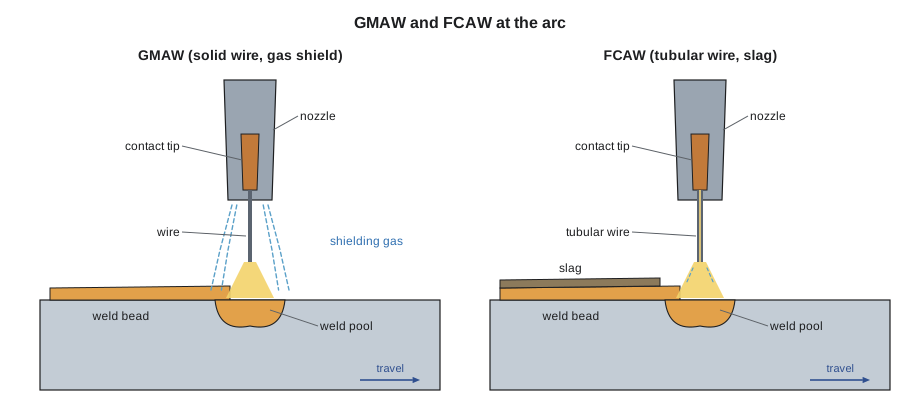
- GMAW uses a solid wire and a shielding gas that flows out of a nozzle around the contact tip. The gas alone protects the arc and the weld pool. There is little or no slag, only small islands of glassy silicate on the bead. In the trade, GMAW is often still called MIG welding, for metal inert gas, and when the gas contains carbon dioxide or oxygen it is sometimes called MAG, for metal active gas.
- FCAW uses a tubular wire: a thin steel sheath folded around a core of flux and metal powders. The core makes slag and, in some wires, gas. Gas-shielded flux-cored wires (FCAW-G) also use a shielding gas from the gun, and the core adds slag and alloy. Self-shielded flux-cored wires (FCAW-S) need no external gas at all; the core produces enough gas and slag to protect the weld by itself.
A third family sits between them. Metal-cored wires are tubular like flux-cored wires, but the core is mainly metal powder with very little flux. They are welded with a shielding gas, leave only small silicate islands like solid wire, and are classified with the GMAW wires, but they behave in many ways like flux-cored wire. They get their own lesson later in the course.
How the arc keeps its length
With a stick electrode, the welder holds the arc length by hand. With a wire feeding at a fixed speed, something else has to keep the arc from either stubbing the wire into the plate or burning back to the contact tip. That something is the power source. Wire processes are almost always run on a constant-voltage power source, sometimes called constant potential. The welder sets a voltage on the power source and a wire feed speed on the feeder. The power source holds the voltage nearly constant and lets the current change to whatever is needed.
The result is a self-regulating arc. Suppose the welder's hand dips and the arc gets shorter. A shorter arc has less resistance, so at the same voltage much more current flows. More current melts the wire faster than the feeder is pushing it, and the arc grows back to its original length. If the arc gets longer, the current falls, the wire melts more slowly, and the feeding wire catches up. This happens within a fraction of a second, without the welder noticing. It is why a beginner can usually run a reasonable GMAW bead sooner than a reasonable stick bead, and why the main settings are voltage and wire feed speed rather than current.
Current still matters, of course; it sets penetration and deposition. But on a constant-voltage machine, current is not set directly. It follows the wire feed speed. Feeding a given wire faster demands more current to melt it, so turning up the wire feed speed turns up the amperage. The relationship depends on the wire diameter, the wire type and the distance from the contact tip to the work, which is why a welder talks about wire speed in metres or inches per minute and reads the current off the meter afterwards.
What each process is good at
Each process earns its place in the shop for different reasons:
| Process | Strengths | Limits |
|---|---|---|
| SMAW | Simple, portable equipment; works in wind; any position; good on dirty or awkward work | Low arc time; stops every electrode; slag on every pass; skill to hold arc length |
| GMAW (solid wire) | Clean, little slag; high arc time; easy to learn the basics; good for thin metal and stainless and aluminum | Gas blown away by drafts; short-circuit transfer can leave lack of fusion on thick plate |
| FCAW-G (gas-shielded flux-cored) | High deposition; good all-position welding with fast-freezing slag; tolerant of mill scale; deep, reliable fusion | Slag to remove; more fume; still needs gas |
| FCAW-S (self-shielded flux-cored) | No gas: works outdoors in wind; portable feeders | Most fume; some wires limited in thickness or passes; careful technique and stickout needed |
| Metal-cored (GMAW-C) | Very high deposition and travel speed; almost no slag; good on scale | Mostly flat and horizontal unless pulsed; needs gas |
At Hartwell, solid wire GMAW handles the light sheet guards and covers on the skids, stainless piping in the pressure bay, and aluminum work. Gas-shielded flux-cored wire is the main process for the Riverside girders and other heavy structural welding. Metal-cored wire runs on the carriage that welds long flange-to-web fillets. Self-shielded wire goes out on the field truck for erection welding when the wind is up. Stick electrodes are still used for repairs, field tack welds and anything awkward to reach with a gun.
Arc time and productivity
Marta puts a number on the advantage. The fraction of a welder's paid time that the arc is actually burning is called the operating factor or arc time percentage. With stick electrodes, the welder stops every minute or two to change the electrode, chip the slag from the crater, and restart. With a wire process, the welder stops only to reposition, clean between passes and change spools. A stick welder on structural work might run an operating factor of about 20 to 30 percent; the same welder with a semi-automatic gun might reach 35 to 50 percent, and a mechanized carriage more still. The deposition rate while the arc is on is also higher, because the current can be higher on a short length of wire between the contact tip and the arc than on a long stick that would overheat.
# Weld metal deposited in a shift: stick versus wire (illustrative)
shift_hours = 8
processes = [  # name, deposition while arc is on (kg/h), operating factor
    ("SMAW low hydrogen", 1.8, 0.25),
    ("GMAW solid wire", 3.5, 0.40),
    ("FCAW gas-shielded", 4.5, 0.40),
    ("Metal-cored on a carriage", 6.0, 0.55),
]
for name, rate, of in processes:
    arc_hours = shift_hours * of
    deposited = rate * arc_hours
print(f"{name:26} arc on {arc_hours:3.1f} h deposits about {deposited:5.1f} kg")SMAW low hydrogen arc on 2.0 h deposits about 3.6 kg GMAW solid wire arc on 3.2 h deposits about 11.2 kg FCAW gas-shielded arc on 3.2 h deposits about 14.4 kg Metal-cored on a carriage arc on 4.4 h deposits about 26.4 kg
The figures are illustrative, but the gap is typical. The wire processes deposit two to four times as much weld metal in a shift. On a girder with hundreds of metres of fillet weld, that is the difference between weeks and months of welding.
Heat input with a wire process
Heat input for GMAW and FCAW is calculated exactly as it was for SMAW: arc voltage times current, divided by travel speed, with the result in kilojoules per millimetre or per inch. Some codes and specifications ask for the arc energy, without any efficiency factor; others multiply by a process efficiency to estimate the heat that actually enters the plate. A commonly used efficiency is about 0.8 for GMAW, FCAW and SMAW, and about 1.0 for submerged arc welding. The welder must know which one the procedure means. Heat input still controls cooling rate and the properties of the heat-affected zone, as the metallurgy course showed, and many procedures for bridge girders and quenched and tempered plate put limits on it.
Here E is the arc voltage, I the current in amperes, S the travel speed in millimetres or inches per minute, and the efficiency η is left out when the specification asks for arc energy. Measuring travel speed with a wire process is simple: Lucia Ferreira, Hartwell's welding inspector, times a measured length of bead with a stopwatch while reading the voltage and current from the meters, or from the power source's own display, which on newer machines also records each weld.
# Heat input from a timed FCAW bead on a girder fillet
volts, amps = 26, 240
length = 300          # mm welded
seconds = 45
eff = 0.8               # process efficiency, if the specification uses it
speed = length / seconds * 60                  # mm per minute
arc_energy = 60 * volts * amps / (1000 * speed)
print(f"travel speed {speed:.0f} mm/min")
print(f"arc energy  {arc_energy:.2f} kJ/mm")
print(f"heat input {eff * arc_energy:.2f} kJ/mm with efficiency {eff}")travel speed 400 mm/min arc energy 0.94 kJ/mm heat input 0.75 kJ/mm with efficiency 0.8
The parts of the system
Every semi-automatic wire welding setup has the same parts, whatever the brand:
- A constant-voltage power source, often a multiprocess inverter that can also do stick and gouging.
- A wire feeder with drive rolls that grip the wire and push it at a set speed, either built into the power source or in a separate case that can be carried away from it on a long cable.
- A gun with a trigger, a cable that carries the wire inside a liner along with the welding current and the gas, and a contact tip and nozzle at the front.
- A shielding gas supply, from a cylinder with a regulator and flowmeter or from a bulk system, with a hose to the feeder and a solenoid valve that opens when the trigger is pulled. Self-shielded wire needs none.
- A work lead and clamp to complete the circuit.
Each part has its own adjustments and its own ways to cause trouble. A crushed liner causes erratic feeding that looks like a bad setting. A worn contact tip makes the arc wander. A loose work clamp makes the current unstable. The next lesson goes through the equipment piece by piece.
Safety differences from stick welding
The hazards from the welding safety course all apply, with some changes in emphasis. Wire processes run at higher currents for longer, so the arc radiation is more intense and burns exposed skin quickly; GMAW on aluminum and stainless is especially bright in ultraviolet. Flux-cored wires, and self-shielded wires above all, produce more fume per kilogram or pound of weld metal than solid wire, so fume extraction at the gun or on a local arm matters. Shielding gas cylinders bring the cylinder handling rules, and argon and carbon dioxide can displace air in tanks and pits. The gun cable and the wire are electrically hot whenever the trigger is pressed, including the wire on the spool, so a welder never touches the wire to feel whether it is moving. Spatter from short-circuit and globular transfer is hot enough to start fires in the same way as stick spatter.
Devon's first beads
Marta sets Devon up on a practice plate with a 1.2 mm (0.045 in) gas-shielded flux-cored wire and a mix of 75 percent argon and 25 percent carbon dioxide. She shows him the two knobs, the trigger and the gun angle, then lets him run. His first beads are fast and narrow because he expects to feed the gun into the joint the way he fed a stick; the machine is doing that for him, and he only has to hold the distance and move along. By the end of the morning his beads are even, and he has learned the first rule of a wire process: the welder controls position and travel, and the machine controls the arc only if the settings are right. The rest of the course explains how to get them right.
Common mistakes
MistakeTreating GMAW and FCAW as the same process with different wires.
InsteadThey differ in shielding, slag, positional ability, fume and how they qualify on code work.
MistakeTurning the voltage knob to raise the current on a constant-voltage machine.
InsteadWire feed speed sets the current; voltage sets the arc length.
MistakeTouching the wire to see if it is feeding.
InsteadThe wire is live whenever the trigger is pressed.
MistakeUsing self-shielded wire with gas, or gas-shielded wire without it.
InsteadUse each wire only with the shielding its classification calls for.
MistakeCalculating heat input with an efficiency factor when the specification asks for arc energy.
InsteadCheck which quantity the procedure limits.
Summary and key terms
- GMAW feeds a solid wire and shields the weld with gas alone.
- FCAW feeds a tubular wire whose core makes slag and, in self-shielded wires, gas.
- Metal-cored wire is tubular but mostly metal powder and behaves like a hybrid of the two.
- A constant-voltage power source makes the arc self-regulating: current rises and falls to keep the arc length.
- Wire feed speed sets current; voltage sets arc length.
- Wire processes give a much higher operating factor and deposition rate than stick welding.
- Heat input is calculated the same way as for SMAW, with or without an efficiency factor as the specification requires.
- GMAW
- Gas metal arc welding: a continuous solid or metal-cored wire shielded by gas.
- FCAW
- Flux-cored arc welding: a continuous tubular wire with a flux core, with or without shielding gas.
- FCAW-S
- Self-shielded flux-cored arc welding, which needs no external gas.
- Constant-voltage power source
- A power source that holds voltage nearly constant and lets current change with arc length.
- Self-regulating arc
- An arc whose length is restored automatically by changes in current and melting rate.
- Operating factor
- The fraction of a welder's paid time during which the arc is burning.
- Semi-automatic welding
- Welding with a machine-fed wire and a hand-held gun.
Practice problems
Work each problem on paper first, then reveal the answer to check.
A bead 300 mm long takes 50 s at 25 V and 230 A. What is the arc energy?
Show answer
Speed 360 mm/min; 60 × 25 × 230 / (1000 × 360) = 0.96 kJ/mm.
Why does a shorter arc on a constant-voltage machine draw more current?
Show answer
Its resistance is lower, so at the same voltage more current flows and melts the wire back.
A welder deposits 4 kg/h with the arc on and works at a 40 percent operating factor. How much weld metal in 8 hours?
Show answer
8 × 0.40 × 4 = 12.8 kg.
Lesson quiz · 5 questions
Score 60% or more to complete this lesson.
Create a free account to save your progress, take quizzes and earn a certificate.