
WLD-130 · Lesson 9 of 12 · 19 min
Stainless steels, aluminum and other metals
Most of this course has been about carbon and low-alloy steel, because that is what most welders weld most of the time. But Hartwell's pressure bay has a stainless area with its own tools, the Coldwater skid has stainless piping welded to carbon steel supports, the repair bay sees cast iron and wear plate, and every so often a contractor brings in an aluminum ramp or truck box. Each of these metals has its own metallurgy and its own way of going wrong. This lesson covers the families of stainless steel and the problems of sensitization, hot cracking and heat tint; welding stainless to carbon steel and reading a constitution diagram; aluminum and why it is welded so differently from steel; and short notes on cast iron, copper alloys, chromium-molybdenum steels and abrasion-resistant plate.
What makes steel stainless
Steel becomes stainless when it contains at least about 10.5 to 11 percent chromium. The chromium forms an extremely thin, invisible, self-repairing film of chromium oxide on the surface, the passive layer, which protects the metal underneath from corrosion. Anything that robs the surface or the grain boundaries of chromium, or damages the passive film, reduces corrosion resistance. Stainless steels are grouped by their microstructure at room temperature:
- Austenitic stainless steels: 16 to 26 percent chromium and enough nickel, usually 8 to 22 percent, to keep the FCC austenite structure stable at room temperature. Grades 304, 304L, 316 and 316L are the common ones. Non-magnetic in the annealed condition, tough to very low temperatures, cannot be hardened by heat treatment, and the most widely welded.
- Ferritic stainless steels: 11 to 30 percent chromium with little or no nickel, BCC and magnetic. Used for exhaust systems, appliances and some process equipment. They suffer grain growth and low toughness in the HAZ.
- Martensitic stainless steels: 11 to 18 percent chromium with more carbon. Hardenable, used for cutlery, valve trim and turbine parts, and difficult to weld, needing preheat and post-weld heat treatment.
- Duplex stainless steels: a balanced mixture of austenite and ferrite, stronger than austenitic grades and more resistant to stress corrosion cracking. Welding procedures control heat input and cooling closely to keep the balance.
- Precipitation-hardening stainless steels: strengthened by fine particles formed in an ageing heat treatment; welding needs special procedures.
Physical properties that change technique
Austenitic stainless steel differs from carbon steel in three physical properties that change how it is welded. It conducts heat only about a third as well, so heat concentrates near the weld. It expands about half as much again for each degree of temperature rise. And it has higher electrical resistance, so electrode stub ends and wire heat up more. The combination means more distortion, a hotter weld area for longer, and a need for lower current, smaller beads and faster travel than the same thickness of carbon steel.
# How much different metals expand when heated, and how well they conduct heat (typical values)
metals = {  # name: (expansion per degree C x 1e-6, conductivity relative to carbon steel)
    "carbon steel":        (12, 1.0),
    "austenitic stainless": (17, 0.3),
    "aluminum":            (23, 4.5),
    "copper":              (17, 7.5),
}
length = 1000        # length of a part, mm
rise = 300         # temperature rise, C
for name, (alpha, k_rel) in metals.items():
    growth = alpha * 1e-6 * length * rise
print(f"{name:21} grows {growth:5.1f} mm over {length} mm for a {rise} C rise; conducts heat {k_rel:3.1f} times as well as carbon steel")carbon steel grows 3.6 mm over 1000 mm for a 300 C rise; conducts heat 1.0 times as well as carbon steel austenitic stainless grows 5.1 mm over 1000 mm for a 300 C rise; conducts heat 0.3 times as well as carbon steel aluminum grows 6.9 mm over 1000 mm for a 300 C rise; conducts heat 4.5 times as well as carbon steel copper grows 5.1 mm over 1000 mm for a 300 C rise; conducts heat 7.5 times as well as carbon steel
A stainless part grows about 40 percent more than carbon steel for the same heating, and because it holds the heat near the weld, the hot band is narrower and more intense. Aluminum grows nearly twice as much as steel but spreads the heat so quickly that a much wider zone is warm.
Sensitization and the L grades
When austenitic stainless steel is held in the range of about 450 to 850 °C (840 to 1,560 °F), carbon in the steel combines with chromium to form chromium carbides along the grain boundaries. The metal right next to each boundary is left short of chromium, below the level needed to stay passive. The steel is then said to be sensitized, and in a corrosive environment it can corrode along its grain boundaries, a form of attack called intergranular corrosion. In a weld, sensitization occurs in a band of the HAZ a short distance from the fusion line, which passes through that temperature range during welding, and in multipass welds it can build up with each pass.
The standard solutions are to use low-carbon grades, marked L, such as 304L and 316L, with carbon limited to about 0.03 percent so there is too little to form carbides in the time available; to use stabilized grades, such as 321 and 347, in which titanium or niobium combines with the carbon first; to limit heat input and interpass temperature, which shortens the time in the sensitizing range; and to use L-grade filler metals. Nearly all of Hartwell's stainless piping is 304L or 316L for this reason.
Hot cracking and ferrite
Fully austenitic weld metal is prone to solidification cracking, a form of hot cracking in which low-melting films of sulphur, phosphorus and other impurities collect between the dendrites as the weld freezes and are torn apart by shrinkage. A small amount of delta ferrite in the weld metal, typically about 3 to 10 percent, greatly improves resistance, because ferrite dissolves more of the impurities and changes the way the weld freezes. Austenitic stainless filler metals are therefore designed to deposit weld metal with a few percent of ferrite. The amount is measured as a ferrite number, with a magnetic gauge, and some procedures specify a range.
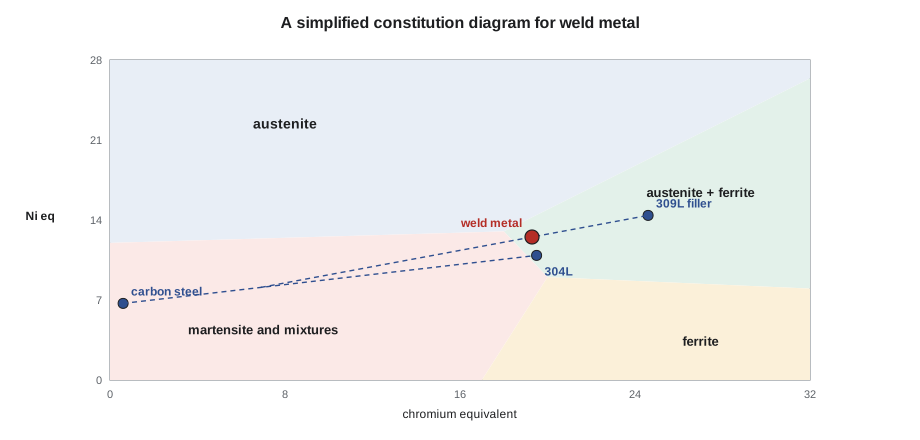
The amount of ferrite depends on the balance between ferrite-forming elements such as chromium, molybdenum, silicon and niobium, and austenite-forming elements such as nickel, carbon, manganese and nitrogen. Constitution diagrams, the oldest of which was published by Anton Schaeffler in 1949, plot a chromium equivalent against a nickel equivalent and show which structures form in weld metal of a given composition: austenite, ferrite, martensite or mixtures. Later diagrams by DeLong and by the Welding Research Council refined the predictions for ferrite content.
Welding stainless to carbon steel
The Coldwater skid has stainless pipe supported by carbon steel clips and a stainless nozzle welded into a carbon steel vessel. Such dissimilar joints are common, and the weld metal is a mixture of the stainless steel, the carbon steel and the filler. If the joint were welded with a 308L filler, the dilution with carbon steel would drop the chromium and nickel in the weld so far that it could form martensite and crack. The usual answer is a more highly alloyed filler, such as 309L, which contains about 23 to 24 percent chromium and 12 to 14 percent nickel, enough that even after dilution the weld stays austenitic with some ferrite. For higher temperature service, nickel-based fillers are used instead.
# Weld metal composition for a stainless-to-carbon-steel joint (simplified Schaeffler equivalents)
def cr_eq(c):  return c["Cr"] + c["Mo"] + 1.5 * c["Si"] + 0.5 * c["Nb"]
def ni_eq(c):  return c["Ni"] + 30 * c["C"] + 0.5 * c["Mn"]
carbon_steel = dict(C=0.18, Mn=1.0, Si=0.25, Cr=0.0, Ni=0.0, Mo=0.0, Nb=0.0)
stainless_304L = dict(C=0.02, Mn=1.5, Si=0.5, Cr=18.5, Ni=9.5, Mo=0.2, Nb=0.0)
filler_308L = dict(C=0.02, Mn=1.8, Si=0.4, Cr=20.0, Ni=10.0, Mo=0.1, Nb=0.0)
filler_309L = dict(C=0.02, Mn=1.8, Si=0.4, Cr=23.5, Ni=13.0, Mo=0.1, Nb=0.0)
d_cs, d_ss = 0.20, 0.10              # base metal in the weld: 20 percent carbon steel, 10 percent stainless
for name, filler in (("308L", filler_308L), ("309L", filler_309L)):
    mix = {k: d_cs * carbon_steel[k] + d_ss * stainless_304L[k] + (1 - d_cs - d_ss) * filler[k] for k in filler}
    cr, ni = cr_eq(mix), ni_eq(mix)
    # rough reading of the diagram: low equivalents risk martensite; below the sloping line some ferrite forms
    if cr < 17 and ni < 11:
        region = "risk of martensite: unsuitable"
    elif ni < 0.95 * cr - 4:
        region = "austenite with some ferrite: suitable"
    else:
        region = "nearly fully austenitic: hot cracking risk"
print(f"{name}: weld Cr eq {cr:4.1f}, Ni eq {ni:4.1f} -> {region}")308L: weld Cr eq 16.5, Ni eq 10.3 -> risk of martensite: unsuitable 309L: weld Cr eq 19.0, Ni eq 12.4 -> austenite with some ferrite: suitable
With 30 percent dilution, two thirds of it from the carbon steel plate, the 308L weld drifts toward the martensite region, while the 309L weld stays austenitic with ferrite. This rough model mirrors what welding engineers do on the real diagram, and it explains a rule that every welder in a stainless shop learns early: stainless to carbon steel, use 309L unless the procedure says otherwise.
Heat tint, purging and contamination
Stainless steel heated in air forms coloured oxide layers called heat tint, from straw yellow through blue to dark grey, and under the heaviest oxide the chromium-depleted surface has lost much of its corrosion resistance. On the outside of a weld, heat tint is removed by brushing with a stainless wire brush, by pickling with acid paste, or by grinding, followed by passivation. On the inside of a pipe or tank, where it cannot be reached, it must be prevented by purging the back of the weld with argon or another inert gas until the oxygen is very low. A root welded without a purge is covered in a crusty, dark oxide often called sugaring, which is what Marta's stainless coupon shows.
Stainless is also easily contaminated by carbon steel. Particles from a carbon steel wire brush, grinding disc, clamp or work table embed in the surface and rust, starting pitting. That is why Hartwell's stainless area has its own brushes, discs, clamps and benches, all marked, and why stainless is never set down on carbon steel racks.
Aluminum
Aluminum and its alloys are welded more and more, in trailers, truck bodies, boats, ramps and structures. They behave very differently from steel:
- A tough oxide skin: aluminum forms a thin, hard oxide layer that melts at over 2,000 °C (3,600 °F), about three times the melting point of the metal itself, near 660 °C (1,220 °F). The oxide must be removed by brushing just before welding and broken up by the arc, which is why GTAW on aluminum uses alternating current and why GMAW uses electrode-positive polarity.
- High thermal conductivity: heat drains away so fast that thick sections need high current and sometimes preheat, and the HAZ is wide.
- No colour change: aluminum does not glow before it melts, so a beginner can melt through without warning.
- Hydrogen porosity: liquid aluminum dissolves hydrogen from moisture, oil and hydrated oxide, which forms pores as it freezes. Cleanliness is critical.
- Hot cracking: some alloys, especially the 6000 series used for extrusions, crack if welded with a filler of the same composition. Fillers such as 4043, with silicon, or 5356, with magnesium, are chosen to change the weld chemistry and avoid cracking.
- HAZ softening: heat-treatable alloys like 6061-T6 get their strength from ageing, and non-heat-treatable alloys from cold work. Welding heat removes much of it in the HAZ, which may lose a third or more of its strength. Designs for welded aluminum use the reduced HAZ strength, not the strength of the parent alloy.
Aluminum structures in Canada are welded to CSA W59.2, and in the United States to AWS D1.2. Welding a heat-treated aluminum part on a trailer or truck body without the manufacturer's procedure can leave it much weaker than the original.
Other metals in the repair bay
- Cast iron: over 2 percent carbon, mostly as graphite flakes in gray iron or nodules in ductile iron. It has almost no ductility in gray form, and the HAZ forms hard white iron and martensite. Repairs use nickel-based electrodes, very short beads with peening to relieve shrinkage, and either a very cold technique, keeping the casting cool enough to touch by hand, or a hot technique with uniform preheat of the whole casting and slow cooling. Brazing is often a better choice.
- Copper and its alloys: very high conductivity calls for heavy preheat on thick sections; some brasses boil off zinc as toxic fume.
- Chromium-molybdenum steels: used for high-temperature service, they are hardenable and need preheat, controlled interpass and post-weld heat treatment, with matching filler metals so the weld has the same creep strength and oxidation resistance.
- Abrasion-resistant and quenched and tempered plate: high hardness from the mill heat treatment. Welding can reharden the HAZ near the weld and soften it further out, and preheat must stay within the maker's limits so the plate is not tempered. Makers publish welding guides by grade and thickness.
- Weathering steel: welds on weathering steel that will be left unpainted, such as the Riverside girders, are made with fillers that contain nickel, chromium and copper so the weld weathers to the same colour and protective layer as the plate. Small single-pass welds are often allowed with ordinary fillers, because dilution with the plate gives enough alloy.
Stainless structural work follows AWS D1.6 in many specifications, and pressure work in both countries follows the ASME code. Whatever the metal, the procedure tells the welder the filler, the gas, the heat limits and any cleaning, and the metallurgy explains why.
Common mistakes
MistakeWelding stainless to carbon steel with 308L because it is in the cabinet.
InsteadDilution can make the weld martensitic; use 309L or the filler the procedure names.
MistakeUsing a carbon steel wire brush on stainless.
InsteadEmbedded iron rusts and starts pitting; keep separate stainless tools.
MistakeWelding a stainless pipe root without a purge.
InsteadThe inside oxidizes heavily and loses corrosion resistance; purge with inert gas.
MistakeWelding aluminum straight from storage without cleaning.
InsteadRemove the oxide and any oil or moisture just before welding to prevent porosity.
MistakeRepairing a cracked cast iron housing with steel electrodes and long beads.
InsteadUse nickel fillers, short peened beads and a controlled cold or hot technique, or braze.
Summary and key terms
- Stainless steels need at least about 11 percent chromium; they are grouped as austenitic, ferritic, martensitic, duplex and precipitation-hardening.
- Austenitic stainless conducts less heat and expands more than carbon steel, so it distorts more.
- Sensitization forms chromium carbides at grain boundaries; L grades and low heat input prevent it.
- A few percent of ferrite protects austenitic weld metal from hot cracking; constitution diagrams predict it.
- Stainless to carbon steel joints use a richer filler such as 309L.
- Heat tint and iron contamination reduce corrosion resistance; purge, clean and use separate tools.
- Aluminum needs oxide removal, cleanliness, the right filler and design for HAZ softening.
- Cast iron, copper, chromium-molybdenum and wear plate each have their own procedures.
- Passive layer
- The thin chromium oxide film that protects stainless steel.
- Sensitization
- Chromium carbide formation at grain boundaries that reduces corrosion resistance.
- L grade
- A low-carbon stainless grade, such as 304L, that resists sensitization.
- Ferrite number
- A measure of the delta ferrite content of austenitic stainless weld metal.
- Constitution diagram
- A chart predicting weld metal structure from chromium and nickel equivalents.
- Heat tint
- Coloured oxide on stainless steel heated in air.
- Purge
- Shielding the back of a weld with inert gas to prevent oxidation.
- HAZ softening
- Loss of strength from heat treatment or cold work in the HAZ of aluminum and some steels.
Practice problems
Work each problem on paper first, then reveal the answer to check.
Why are 304L and 316L used for welded piping?
Show answer
Their low carbon prevents chromium carbides forming in the HAZ, avoiding sensitization.
What filler is normally used to weld 304L stainless to carbon steel?
Show answer
309L, which stays austenitic with some ferrite after dilution.
Why does aluminum need its oxide removed before welding?
Show answer
The oxide melts at about three times the metal's temperature and traps contamination and moisture.
What happens to the strength of 6061-T6 aluminum in the HAZ?
Show answer
It drops substantially because welding heat undoes the ageing treatment.
Lesson quiz · 5 questions
Score 60% or more to complete this lesson.
Create a free account to save your progress, take quizzes and earn a certificate.