
WLD-130 · Lesson 7 of 12 · 17 min
Hardenability, carbon equivalent and hydrogen cracking
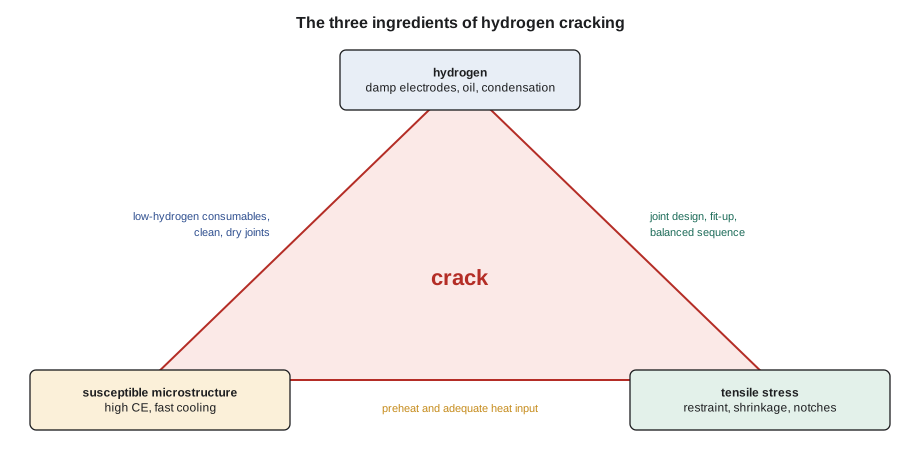
The cultivator toolbar on Marta's bench is now ready to explain itself. It cracked along the toe of a repair weld, in the coarse-grained HAZ, some time after the welder had finished and left. The steel was a higher-carbon grade, the shed was cold, and the electrode came from an open box. Each of those facts fed one of the three ingredients of hydrogen-induced cracking: a hard, susceptible microstructure, hydrogen, and tensile stress. This lesson takes the three in turn. It explains hardenability and why some steels form martensite in the HAZ much more readily than others, how carbon equivalent formulas sum up a steel's tendency to harden, where hydrogen comes from and how it is controlled and measured, and how stress and time complete the picture. It ends with how procedures combine all of this, which leads into the next lesson on preheat.
Hardenability
Hardness and hardenability are different things. The hardness of martensite depends almost entirely on its carbon content. Hardenability is the ease with which a steel forms martensite at all: how slowly it can be cooled from austenite and still harden. A plain carbon steel with 0.4 percent carbon must be quenched in water to harden right through a thick section; the same carbon with a few percent of chromium, nickel and molybdenum hardens in air. Alloying elements slow down the formation of ferrite and pearlite, which need atoms to move, giving martensite and bainite the chance to form at slower cooling rates.
Metallurgists show this on a continuous cooling transformation diagram, or CCT diagram, a chart of temperature against time on which cooling curves for different rates are drawn across regions marking where ferrite, pearlite, bainite and martensite form. A steel with high hardenability has its ferrite and pearlite regions pushed far to the right, toward long times, so even moderate cooling curves miss them and pass straight into bainite or martensite. For a welder, the practical meaning is simple: the more hardenable the steel, the slower the HAZ must cool to avoid hard structures, and the more preheat and heat input it needs.
Several things raise the hardenability of a HAZ:
- Carbon, the strongest single factor, which raises both hardenability and the hardness of the martensite that forms.
- Manganese, chromium, molybdenum, nickel, vanadium, copper and boron, each to a different degree.
- Coarse austenite grains, which is why the coarse-grained HAZ is the most hardenable part of the weld.
- Fast cooling: thick plate, low heat input, small beads, cold base metal, T-joints and cruciform joints.
Carbon equivalent
Because so many elements contribute, engineers sum them into a single number, the carbon equivalent, in which each element is weighted by how strongly it hardens compared with carbon. The most widely used formula was adopted by the International Institute of Welding and is known as the IIW carbon equivalent:
Each element symbol stands for its percentage by weight. The IIW formula works well for carbon and carbon-manganese steels with carbon above about 0.18 percent. For modern low-carbon, microalloyed and thermomechanically processed steels, the Japanese metallurgist Yoshio Ito and colleagues developed another formula, Pcm, which gives carbon more weight relative to the alloys and also includes silicon and boron:
As rough guides used by many fabricators for structural steel, a CE below about 0.40 means the steel is easily welded without preheat in moderate thicknesses; between about 0.40 and 0.50, preheat and low-hydrogen practice become increasingly necessary as thickness grows; above about 0.50, the steel needs careful procedures, often with substantial preheat and sometimes post-weld heat treatment. A Pcm below about 0.20 to 0.25 usually indicates good weldability. Steel specifications put maximum limits on CE for exactly this reason: A992 shapes, for example, are limited to a CE of 0.45 for most sizes, and many purchasers of structural and line pipe steel specify a maximum.
# IIW carbon equivalent, Pcm, and the hardness of fully martensitic HAZ
steels = {
    "structural plate": dict(C=0.16, Si=0.25, Mn=1.35, Cu=0.20, Ni=0.10, Cr=0.08, Mo=0.03, V=0.04, B=0.0),
    "TMCP plate":       dict(C=0.07, Si=0.30, Mn=1.50, Cu=0.15, Ni=0.20, Cr=0.05, Mo=0.02, V=0.00, B=0.0),
    "weathering steel": dict(C=0.15, Si=0.40, Mn=1.10, Cu=0.30, Ni=0.30, Cr=0.55, Mo=0.02, V=0.04, B=0.0),
    "shaft steel":      dict(C=0.44, Si=0.25, Mn=0.80, Cu=0.15, Ni=0.10, Cr=0.10, Mo=0.02, V=0.00, B=0.0),
    "cultivator shank": dict(C=0.62, Si=0.25, Mn=0.85, Cu=0.10, Ni=0.05, Cr=0.10, Mo=0.01, V=0.00, B=0.0),
}
for name, s in steels.items():
    ce = s["C"] + s["Mn"] / 6 + (s["Cr"] + s["Mo"] + s["V"]) / 5 + (s["Ni"] + s["Cu"]) / 15
    pcm = s["C"] + s["Si"] / 30 + (s["Mn"] + s["Cu"] + s["Cr"]) / 20 + s["Ni"] / 60 + s["Mo"] / 15 + s["V"] / 10 + 5 * s["B"]
    c = s["C"]
    hv_martensite = 884 * c * (1 - 0.3 * c ** 2) + 294        # estimated hardness of fully martensitic HAZ
    band = "easy" if ce < 0.40 else ("take care" if ce <= 0.50 else "difficult")
print(f"{name:16} CE {ce:4.2f} Pcm {pcm:4.2f} martensite about {hv_martensite:3.0f} HV ({band})")structural plate CE 0.44 Pcm 0.26 martensite about 434 HV (take care) TMCP plate CE 0.36 Pcm 0.17 martensite about 356 HV (easy) weathering steel CE 0.50 Pcm 0.27 martensite about 426 HV (take care) shaft steel CE 0.61 Pcm 0.50 martensite about 660 HV (difficult) cultivator shank CE 0.79 Pcm 0.68 martensite about 779 HV (difficult)
The last column uses a formula proposed by the Japanese researcher Nobutaka Yurioka for the hardness of fully martensitic steel as a function of carbon. It shows why carbon matters so much: the structural plate would form martensite around 430 HV if cooled very fast, while the cultivator shank would form martensite near 780 HV, close to the hardness of a file and extremely brittle. Real HAZs are often a mixture of structures, so their actual hardness is lower than the fully martensitic value, but the ranking holds. The modern low-carbon TMCP plate has the lowest numbers of all, which is why such steels can often be welded thick without preheat.
Hydrogen in welds
Hydrogen is the second ingredient. Liquid steel dissolves a great deal of it, and the arc breaks down any water vapour or hydrogen-bearing compound into atomic hydrogen, which the weld pool absorbs. As the weld freezes and cools, the solubility of hydrogen drops sharply, and the excess is trapped in the solid. Some escapes from the surface over the following hours and days. The rest diffuses through the steel, tiny atoms moving between iron atoms, and collects where the lattice is strained: at inclusions, at grain boundaries, at the tips of tiny cracks and in hard martensite.
The sources of hydrogen are mostly the welder's business:
- Moisture in electrode coverings and fluxes, which is why low-hydrogen electrodes are stored in ovens, issued in limited quantities and timed out of the oven.
- Cellulosic electrodes such as E6010, whose coverings produce hydrogen-rich shielding gas by design. They deposit far more hydrogen than low-hydrogen types.
- Moisture, oil, grease, paint, rust and marking crayon on the joint or the filler wire.
- Condensation on cold steel, especially plate brought in from outside in winter.
- Humid air drawn into a poorly shielded arc, and moisture in shielding gas lines.
Hydrogen in deposited weld metal is measured as diffusible hydrogen, the hydrogen that comes out of a standard test weld at room temperature or slightly above, reported in millilitres per 100 grams of weld metal. Filler metal classifications add an optional hydrogen designator: H16, H8, H4 and in some systems H2, meaning the electrode or wire, in its as-manufactured condition, deposits no more than 16, 8, 4 or 2 mL per 100 g. A cellulosic electrode might deposit 30 to 50 mL per 100 g; a well-stored low-hydrogen electrode, under 8; a solid wire with good shielding gas, often under 4. Those numbers apply only when the consumable is handled properly. A low-hydrogen electrode left out in a humid shop for a day can pick up enough moisture to deposit several times its rated hydrogen.
Stress and the delayed crack
The third ingredient is tensile stress, and every weld has it. As the weld and HAZ cool and shrink, they are held by the surrounding cold metal, so they end up in tension at or near the yield strength. Restraint adds to it: a joint between thick, rigid members cannot move, so all the shrinkage becomes stress. Notches add to it locally: the weld toe, the root of a fillet and any undercut concentrate stress exactly in the coarse-grained HAZ.
With all three present, hydrogen diffuses to the most highly stressed, hardest region, weakens the bonds there, and a microscopic crack opens. Hydrogen then collects at the new crack tip, which advances again, step by step. Because the process depends on hydrogen diffusing, it takes time, often hours, sometimes a day or two, and it happens near room temperature, below about 200 °C (390 °F). That is why it is called cold cracking or delayed cracking, and why some codes and specifications require final inspection of welds in high-strength or thick steel to wait a set time after welding.
Hydrogen cracks usually form in the coarse-grained HAZ, along or just under the weld toe or at the root, running roughly parallel to the fusion line. These are toe cracks, root cracks and underbead cracks; underbead cracks may not reach the surface at all and are found only by ultrasonic testing or sectioning. In high-strength weld metal, or where the base metal has low carbon equivalent but the weld metal is strongly alloyed, cracks can form in the weld metal itself, often transverse to the weld.
Preventing hydrogen cracking
Because all three ingredients are needed, prevention works on each of them, and good procedures work on all three at once:
- Reduce hydrogen: use low-hydrogen processes and consumables with a suitable designator; store, dry and time electrodes and fluxes as the manufacturer and the code require; keep joints clean and dry; warm cold steel before fitting.
- Avoid hard microstructures: choose steels with lower carbon equivalent where possible; slow the cooling with preheat and adequate heat input; use bead sequences that temper earlier HAZs.
- Reduce stress: design joints with less restraint and smooth transitions; fit up without forcing; use balanced welding sequences; avoid notches, undercut and stray arc strikes.
- Give hydrogen time to escape: maintain preheat through welding; for susceptible joints, hold the joint at an elevated temperature after welding for a period, called a post-heat or hydrogen bake-out, before letting it cool.
The combination is what matters. A low-carbon structural plate welded with a low-hydrogen electrode needs no preheat in moderate thickness; the same plate welded with a cellulosic electrode in a highly restrained joint may crack. A shaft steel welded with a good H4 electrode still needs substantial preheat because its HAZ is so hardenable. The next lesson shows how codes turn these ideas into preheat tables and calculation methods.
The toolbar, explained
Marta lays out the toolbar's story in the three ingredients. Microstructure: the steel's spark test and file test showed it was well above structural carbon content, and later a lab analysis put its carbon equivalent at about 0.62. Hydrogen: the electrode came from an open box in a damp shed, and the bar may have had condensation on it when it came in from the yard. Stress: the repair was a fillet around a heavy bracket on a rigid bar, and the farmer went straight back to the field. There was no preheat. The weld cooled fast, the HAZ formed hard martensite, and the hydrogen did the rest. Within weeks the crack had grown by fatigue along the toe. Lucia adds that the repair would have been sound with three changes: a dry low-hydrogen electrode, preheat of the bar to well over 150 °C (300 °F), and slow cooling under an insulating blanket.
Common mistakes
MistakeConfusing hardness with hardenability.
InsteadCarbon sets martensite hardness; alloy content and grain size set how easily it forms.
MistakeAssuming a low-hydrogen electrode stays low hydrogen once out of the oven.
InsteadCoverings pick up moisture from the air; follow the exposure limits and re-dry rules.
MistakeInspecting a high-strength weld right after welding and calling it done.
InsteadHydrogen cracks can form hours or days later; follow any required inspection delay.
MistakeUsing one carbon equivalent formula for every steel.
InsteadIIW CE suits ordinary carbon-manganese steel; Pcm suits low-carbon modern steels.
MistakeThinking a clean surface means no hydrogen.
InsteadCondensation on cold steel and moisture in coverings are invisible sources.
Summary and key terms
- Hardenability is the ease of forming martensite; carbon and alloys raise it, and so does fast cooling.
- Carbon equivalent sums the hardening effect of alloying elements; IIW CE and Pcm are the common formulas.
- The hardness of martensite depends mainly on carbon.
- Hydrogen comes from moisture, coverings, contaminants and condensation; diffusible hydrogen is measured in mL per 100 g.
- Hydrogen designators H16, H8, H4 and H2 limit the hydrogen a consumable deposits.
- Hydrogen cracking is delayed and occurs near room temperature in hard, stressed zones.
- Prevention reduces hydrogen, avoids hard structures, lowers stress and gives hydrogen time to escape.
- Hardenability
- The ability of a steel to form martensite at a given cooling rate.
- CCT diagram
- A chart showing which structures form from austenite at different cooling rates.
- Carbon equivalent
- A single number summing the hardening effect of carbon and alloying elements.
- Pcm
- A carbon equivalent formula suited to low-carbon modern steels.
- Diffusible hydrogen
- Hydrogen that can move through and escape from weld metal at low temperature.
- Hydrogen designator
- An optional suffix such as H4 limiting the diffusible hydrogen a consumable deposits.
- Underbead crack
- A hydrogen crack in the HAZ beneath a weld bead that may not reach the surface.
- Post-heat
- Holding a joint warm after welding so hydrogen can escape before it cools.
Practice problems
Work each problem on paper first, then reveal the answer to check.
Calculate the IIW CE of a steel with 0.20 C, 1.20 Mn, 0.10 Cr, 0.05 Mo, 0.20 Ni and 0.25 Cu.
Show answer
0.20 + 0.20 + 0.03 + 0.03 = 0.46.
What does the designator H8 on an electrode mean?
Show answer
It deposits no more than 8 mL of diffusible hydrogen per 100 g of weld metal as manufactured.
Name the three ingredients of hydrogen-induced cracking.
Show answer
Hydrogen, a susceptible hard microstructure and tensile stress.
Why do hydrogen cracks often appear hours after welding?
Show answer
Hydrogen has to diffuse to the stressed, hard zone and the crack grows step by step.
Lesson quiz · 5 questions
Score 60% or more to complete this lesson.
Create a free account to save your progress, take quizzes and earn a certificate.