
WLD-130 · Lesson 8 of 12 · 18 min
Preheat and interpass temperature
Preheat is the oldest and most reliable tool a welder has against hydrogen cracking, and it is one of the most often skipped. It costs time and gas, the joint is uncomfortable to weld, and on a cold morning it is tempting to strike an arc and hope. This lesson explains what preheat and interpass temperature do, how codes decide how much is needed, how to heat a joint properly and measure its temperature, what maximum interpass limits are for, and what post-heat and post-weld heat treatment add. Glen Teskey, Hartwell's foreman, puts the shop rule simply: "If the procedure says preheat, the joint gets preheated, measured and recorded. No exceptions, no estimates."
What preheat does
Preheat is heating the base metal around a joint to a specified minimum temperature before welding starts. The previous lessons have shown three reasons for it:
- It slows the cooling rate of the weld and HAZ, so less martensite forms and the HAZ is softer and tougher.
- It keeps the joint warm longer after welding, giving diffusible hydrogen time to escape before the steel reaches the temperature range where cracking happens.
- It reduces the temperature difference between the weld and the surrounding metal, which reduces shrinkage stresses and distortion a little.
It also drives off surface moisture and condensation, and it makes thick or highly conductive metal easier to fuse, which is why aluminum and copper are sometimes preheated even though they do not harden.
Interpass temperature
In a multipass weld, the interpass temperature is the temperature of the weld area just before the next pass is started. Procedures normally give a minimum interpass temperature, usually the same as the minimum preheat, so the joint never cools below the preheat between passes. Many also give a maximum interpass temperature. If the joint gets too hot, the cooling rate becomes very slow, grains coarsen, toughness falls and, in quenched and tempered or thermomechanically processed steels, the HAZ softens. In austenitic stainless steel, a low maximum interpass temperature limits the time spent in the range where chromium carbides form, and it limits distortion.
At Hartwell, typical procedure values are a maximum interpass of 250 °C (480 °F) on carbon steel structural work, 230 °C (450 °F) on the quenched and tempered wear plate repairs, and 150 °C (300 °F) on austenitic stainless. These come from the qualified procedures, not from habit.
How codes set preheat
Structural welding codes give preheat in two ways. CSA W59 in Canada and AWS D1.1 in the United States each contain a table of minimum preheat and interpass temperatures for prequalified procedures, arranged by steel group, by the thickness of the thickest part at the point of welding, and by whether the welding process is low hydrogen. A welder working to a prequalified procedure finds the steel's group, reads across at the thickness, and has the minimum. Both codes also allow other methods: AWS D1.1 Annex B, for example, gives guidelines for determining preheat by controlling HAZ hardness for fillet welds or by controlling hydrogen, taking into account the composition of the steel, the hydrogen level and the restraint. Procedures qualified by test can use the preheat that was proved in the test.
The tables share a pattern. Mild structural steels welded with low-hydrogen processes need no preheat in thin sections beyond bringing cold steel up to a minimum temperature. The requirement rises in steps as the thickness increases, because thicker plate cools the HAZ faster and is more restrained. Higher-strength or more hardenable steel groups start higher and rise faster. Non-low-hydrogen processes, where they are allowed at all, need more preheat for the same steel and thickness. The values below show the shape of such a table for a 350 MPa or 50 ksi class steel welded with a low-hydrogen process; they are typical of the requirement, and the code's current table governs.
| Thickest part at the joint | Typical minimum preheat (low hydrogen) |
|---|---|
| Up to 20 mm | None, but not below the code minimum for cold steel |
| Over 20 to 40 mm | About 10 °C (50 °F) |
| Over 40 to 65 mm | About 65 °C (150 °F) |
| Over 65 mm | About 110 °C (225 °F) |
When the base metal is below freezing, codes require it to be heated before welding even where the table says no preheat, typically to at least about room temperature, and no welding is done on wet or frosted steel. In practice, Hartwell's procedures say to warm any steel below 10 °C (50 °F) and to dry any joint with moisture on it, whatever the table says.
Pressure codes have their own rules. The ASME Boiler and Pressure Vessel Code, for example, lists preheat by material group, often recommended rather than mandatory for carbon steel, and mandatory for many chromium-molybdenum steels along with post-weld heat treatment above certain thicknesses. The Unit 4 chromium-molybdenum line has a procedure with a substantial preheat, a maximum interpass, and a heat treatment after welding done by a heat-treating contractor with electric pads and recorders.
Calculation methods
For steels and situations outside the tables, such as repair welding of an unknown machine part, engineers use calculation methods that combine the factors from the last lesson: carbon equivalent or Pcm, diffusible hydrogen level, thickness and restraint. One widely used approach, the basis of the hydrogen control method in AWS D1.1 Annex B and similar methods elsewhere, combines Pcm and the hydrogen level into a susceptibility index and then reads preheat from a table by restraint and thickness. The code below follows that logic with simplified, illustrative numbers. It is a teaching model to show how the factors interact, not a substitute for the code's own tables.
# Illustrative preheat estimate: susceptibility index from Pcm and hydrogen, then restraint and thickness
import math
def pcm(C, Si, Mn, Cu, Ni, Cr, Mo, V, B):
    return C + Si / 30 + (Mn + Cu + Cr) / 20 + Ni / 60 + Mo / 15 + V / 10 + 5 * B
def group(index):                 # susceptibility groups A (least) to G (most)
    for g, upper in zip("ABCDEF", (3.0, 3.5, 4.0, 4.5, 5.0, 5.5)):
        if index < upper:
            return g
    return "G"
# illustrative minimum preheat in C by group for MEDIUM restraint and three thickness bands (up to 20, 20-40, over 40 mm)
TABLE = {"A": (20, 20, 20), "B": (20, 20, 50), "C": (20, 50, 100), "D": (50, 100, 140),
         "E": (100, 140, 160), "F": (140, 160, 160), "G": (160, 160, 160)}
cases = [  # (name, chemistry, diffusible hydrogen mL/100g, thickness mm)
    ("350 class plate, H8 electrode", (0.16, 0.25, 1.35, 0.20, 0.10, 0.08, 0.03, 0.04, 0), 8, 30),
    ("350 class plate, H16 electrode", (0.16, 0.25, 1.35, 0.20, 0.10, 0.08, 0.03, 0.04, 0), 16, 30),
    ("shaft steel, H4 electrode", (0.44, 0.25, 0.80, 0.15, 0.10, 0.10, 0.02, 0.00, 0), 4, 60),
]
for name, chem, h, t in cases:
    p = pcm(*chem)
    si = 12 * p + math.log10(h)
    g = group(si)
    t_mm = t
    band = 0 if t_mm <= 20 else (1 if t_mm <= 40 else 2)
    pre_c = TABLE[g][band]
print(f"{name:31} Pcm {p:.3f} index {si:.2f} group {g} preheat about {pre_c} C")350 class plate, H8 electrode Pcm 0.258 index 3.99 group C preheat about 50 C 350 class plate, H16 electrode Pcm 0.258 index 4.29 group D preheat about 100 C shaft steel, H4 electrode Pcm 0.504 index 6.65 group G preheat about 160 C
Three things stand out. Changing only the electrode, from an H8 to an H16 consumable, moves the structural plate up a group and raises its preheat. The shaft steel, even with a very low-hydrogen H4 electrode, lands in the most susceptible group because of its carbon. And the thickness bands push the preheat up for the same steel. In the real methods, restraint also matters: a highly restrained joint, such as a repair in a rigid frame or a thick nozzle in a vessel, needs a step more than a joint free to shrink.
Heating the joint
Preheat must heat the metal through its thickness, not just the surface, and over a wide enough area that the heat does not drain away as soon as the torch is removed. Common methods are:
- Oxyfuel or propane heating torches, often with a multi-flame rosebud tip. Quick and portable, but uneven unless moved constantly, and the products of combustion include water vapour that briefly condenses on cold steel. Heat until the steel is above the dew point and the moisture has gone.
- Electric resistance heating pads strapped to the joint, controlled by thermocouples and a power console. Even, controllable and recordable; the standard for pipe, pressure work and long welds.
- Induction heating with coils wrapped around the part. Fast, even and efficient on pipe and round parts.
- Ovens or furnaces for small parts.
Heat should be applied evenly to both sides of the joint and over the full specified width. Heating only the surface of a thick part, or heating one member of a joint and not the other, leaves a cold side that quenches the HAZ. On thick work, the heat is applied from the side opposite the weld where possible, so the temperature measured on the welding side shows the heat has soaked through.
Measuring temperature
Preheat is measured, not guessed. The temperature that counts is the temperature of the base metal at a set distance from the joint, in all directions, just before welding begins and before each pass.
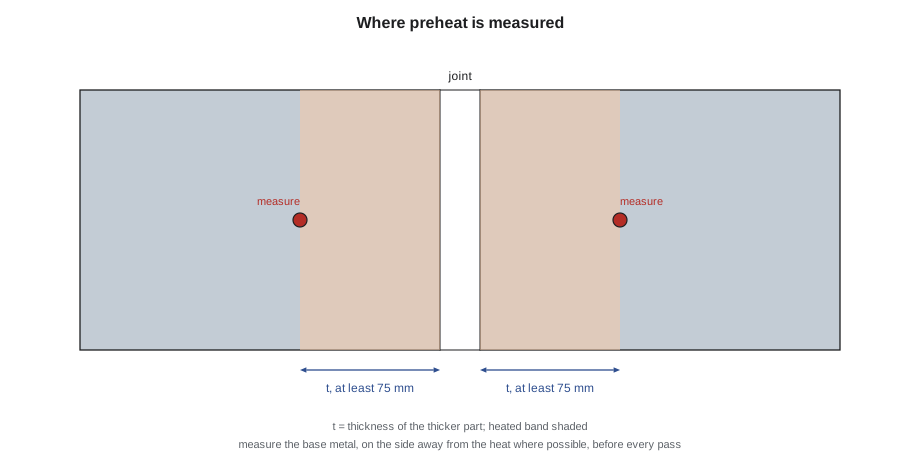
Codes typically require the temperature to be reached over a distance from the joint at least equal to the thickness of the thicker part, and not less than about 75 mm (3 in), in all directions from the point of welding. Hartwell's procedures say the same and add that the reading is taken on the face opposite the heat source where possible, and allowed to stabilize for a minute or two after the torch is removed.
Tools for measuring:
- Temperature-indicating crayons: sticks that melt at a stated temperature. A mark made on the steel that smears or melts shows the temperature has been reached. Cheap and reliable; welders carry one for the minimum preheat and one for the maximum interpass. Marks are made outside the joint, never in the groove.
- Contact thermometers: surface probes with a digital readout. Accurate when the probe is clean and held firmly.
- Infrared thermometers: quick and convenient, but they read shiny or bright surfaces low unless the emissivity is set correctly, and they average over a spot that grows with distance. Use them close to the surface, on dull or scaled steel, and check them against a contact probe.
- Thermocouples and recorders: wired to the part, used with electric heating and post-weld heat treatment to produce a chart for the quality record.
# Check an interpass temperature log against a procedure
min_preheat = 65     # C
max_interpass = 250   # C
log = [  # (pass number, reading before the pass in C)
    (1, 80), (2, 140), (3, 210), (4, 265), (5, 230), (6, 55), (7, 95),
]
for p, t in log:
    if t < min_preheat:
        action = "too cold: reheat before welding"
    elif t > max_interpass:
        action = "too hot: wait and remeasure"
    else:
        action = "ok to weld"
    print(f"pass {p}: {t:4} C  {action}")
print("Hottest reading", max(t for _, t in log), "C; coolest", min(t for _, t in log), "C")pass 1: 80 C ok to weld pass 2: 140 C ok to weld pass 3: 210 C ok to weld pass 4: 265 C too hot: wait and remeasure pass 5: 230 C ok to weld pass 6: 55 C too cold: reheat before welding pass 7: 95 C ok to weld Hottest reading 265 C; coolest 55 C
This log, from a practice joint in the training bay, shows both failures in one weld. Pass 4 was started too hot after the welder ran three passes without a break; pass 6 came after lunch with the joint left to cool. Both are caught only because the welder measured before every pass.
Keeping the heat on
Preheat must be maintained throughout welding, not just at the start. On long joints, the heat moves with the welder: a pad or torch keeps ahead of the arc, and the welder checks the temperature at the next stretch before reaching it. If welding is interrupted, the joint is kept at preheat or, if it must cool, it is cooled slowly and reheated before welding resumes. Some procedures do not allow a partly completed weld in a hardenable steel to cool at all until enough of the joint has been welded to resist cracking, and they specify a post-heat if it must be interrupted.
Post-heat and post-weld heat treatment
Two treatments after welding are easily confused:
- Post-heat, or hydrogen bake-out, holds the joint at a temperature somewhat above the preheat, commonly in the range of 200 to 300 °C (390 to 570 °F), for a period of an hour or more immediately after welding, before it has cooled. It lets hydrogen diffuse out. It does not change the microstructure significantly.
- Post-weld heat treatment, or PWHT, heats the welded part to a much higher temperature, typically 590 to 650 °C (1,100 to 1,200 °F) for carbon steel and higher for chromium-molybdenum steels, holds it for a time based on thickness, and cools it at a controlled rate. It relaxes residual stresses and tempers hard structures in the HAZ. It is required by pressure and piping codes for thick or alloyed joints and is specified on the drawing or procedure.
Neither is something a welder decides to do or skip. When a procedure requires them, they are part of the weld, and the record of the temperature and time is part of the quality documentation.
Cooling slowly
When a hardenable joint is finished, it is cooled slowly unless a post-heat or PWHT follows. Insulating blankets wrapped over the weld and the heated zone keep the heat in. Quenching a hot weld with water or compressed air to speed up the job undoes everything preheat achieved, and on hardenable steel it can crack the joint immediately. Hartwell keeps a stack of ceramic fibre blankets in the repair bay, and Marta's rule is that any job that needed preheat goes under a blanket afterwards.
Common mistakes
MistakeHeating the surface of a thick part briefly and starting to weld.
InsteadSoak the heat through; measure on the opposite side or after the temperature stabilizes.
MistakeMeasuring preheat on the weld bead or in the groove.
InsteadMeasure the base metal at the specified distance from the joint.
MistakeTrusting an infrared gun on shiny steel.
InsteadSet the emissivity, measure on dull steel and check against a contact probe or crayon.
MistakeIgnoring the maximum interpass temperature.
InsteadToo hot coarsens grains, lowers toughness and can soften quenched and tempered steel.
MistakeCooling a finished hardenable weld with water to save time.
InsteadCool slowly under insulation, or follow the specified post-heat.
Summary and key terms
- Preheat slows cooling, lets hydrogen escape and dries the joint.
- Minimum interpass is usually equal to the preheat; maximum interpass protects toughness and properties.
- Code tables set preheat by steel group, thickness and process hydrogen level; other methods use composition, hydrogen and restraint.
- Heat evenly through the thickness on both sides over the required width.
- Measure the base metal at the specified distance, before every pass, with crayons, contact probes or properly used infrared thermometers.
- Post-heat removes hydrogen; PWHT relaxes stress and tempers the HAZ.
- Cool hardenable welds slowly under insulation.
- Preheat
- Heating the base metal to a minimum temperature before welding.
- Interpass temperature
- The temperature of the weld area just before the next pass.
- Prequalified procedure
- A procedure that meets a code's prescribed conditions and needs no qualification test.
- Temperature-indicating crayon
- A stick that melts at a stated temperature, used to check preheat.
- Emissivity
- How well a surface radiates heat; it affects infrared thermometer readings.
- Post-heat
- Holding a joint warm after welding so hydrogen can escape.
- Post-weld heat treatment
- Heating a welded part to relax stresses and temper the HAZ.
Practice problems
Work each problem on paper first, then reveal the answer to check.
A joint between 25 mm and 45 mm plates is to be preheated. At what distance from the joint should the temperature be measured?
Show answer
At least the thickness of the thicker part, 45 mm, and not less than about 75 mm, so 75 mm.
A reading before pass 5 is 270 °C on a procedure with a 250 °C maximum interpass. What does the welder do?
Show answer
Wait, let the joint cool and remeasure before welding.
What is the difference between post-heat and PWHT?
Show answer
Post-heat removes hydrogen at a moderate temperature; PWHT relaxes stresses and tempers at a much higher temperature.
Lesson quiz · 5 questions
Score 60% or more to complete this lesson.
Create a free account to save your progress, take quizzes and earn a certificate.