
WLD-130 · Lesson 2 of 12 · 19 min
Structure of metals: crystals, grains and phases
To understand what welding heat does to steel, Devon first has to picture what steel is made of at a scale far too small to see. Every metal is built from atoms arranged in a regular, repeating pattern called a crystal lattice. The pattern, the way groups of crystals are packed together into grains, and the way different crystal types or phases can exist side by side explain almost everything about how a metal behaves: why it can be bent without breaking, why some metals are magnetic and others are not, why steel hardens when quenched and aluminum does not, and why the weld metal looks different from the plate when it is etched. This lesson covers metallic bonding, the three common crystal structures, how grains form and grow, what grain size does to properties, how alloying atoms fit into a lattice, and what metallurgists mean by phases and phase changes.
Metallic bonding
Atoms in a metal give up some of their outer electrons to a shared cloud that moves freely through the whole piece. The positively charged atoms, or ions, sit in an orderly lattice held together by that negative electron cloud. This metallic bond explains several properties welders rely on every day:
- Electrical conductivity: the free electrons carry current, which is why the welding circuit can run through the work and the work clamp.
- Thermal conductivity: the same electrons carry heat, which is why heat spreads through a plate and why copper and aluminum, with very high conductivity, are hard to bring up to welding temperature.
- Ductility: because the bond is not tied to particular pairs of atoms, planes of atoms can slide past one another without the bond breaking. A metal bends and stretches before it fractures.
- Shine: free electrons reflect light, giving clean metal its lustre.
Crystal structures
The atoms in a metal crystal are not packed at random. They sit at the corners, faces or centres of a tiny repeating box called the unit cell. Three structures cover nearly all the metals a welder meets:
- Body-centred cubic, or BCC: an atom at each corner of a cube and one in the middle. Iron at room temperature, called ferrite or alpha iron, is BCC, as are chromium, molybdenum and tungsten. BCC metals are strong but can become brittle at low temperature, which is why steels for cold service are impact tested.
- Face-centred cubic, or FCC: an atom at each corner and one in the centre of each face. Iron at high temperature, called austenite or gamma iron, is FCC, as are aluminum, copper, nickel and austenitic stainless steel. FCC metals stay tough even at very low temperature, which is why austenitic stainless and aluminum are used for cryogenic tanks.
- Hexagonal close-packed, or HCP: layers of atoms in a hexagonal pattern. Titanium at room temperature, magnesium and zinc are HCP. They are less ductile at room temperature than FCC metals.
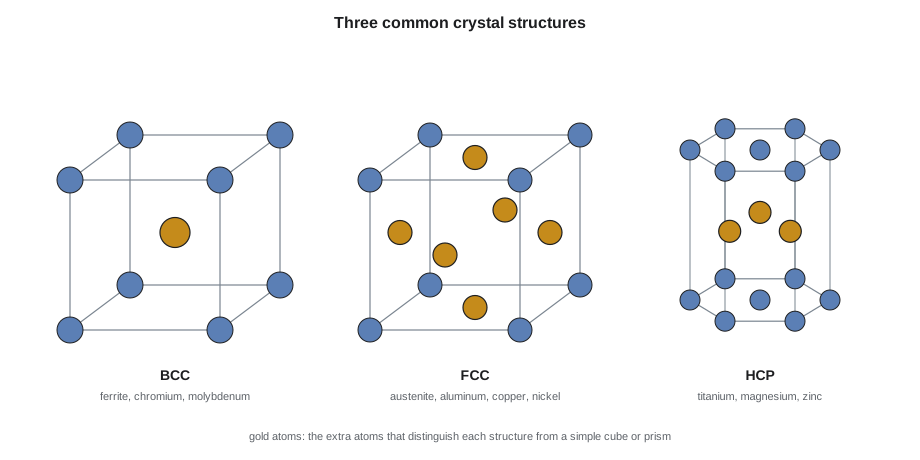
The way atoms are packed also controls how much space is left between them. FCC iron has larger holes between its atoms than BCC iron, so it can dissolve far more carbon: up to about 2 percent by weight, compared with a few hundredths of a percent in BCC iron. That difference, more than anything else, is the key to the heat treatment of steel and to the way welds harden.
# Density of iron from its crystal structure (BCC, 2 atoms per cell)
avogadro = 6.022e23          # atoms per mole
molar_mass = 55.85           # grams per mole of iron
a_bcc = 0.2866e-7            # BCC lattice parameter, cm (0.2866 nanometres)
atoms_per_cell = 2
mass_cell = atoms_per_cell * molar_mass / avogadro          # grams
volume_cell = a_bcc ** 3                                     # cubic cm
print(f"BCC iron density: {mass_cell / volume_cell:.2f} g/cm3")
# FCC iron (austenite) has 4 atoms per cell and a larger cell
a_fcc = 0.3591e-7            # extrapolated to room temperature, cm
print(f"FCC iron density: {4 * molar_mass / avogadro / a_fcc ** 3:.2f} g/cm3")
print("FCC packs atoms more tightly, so iron shrinks slightly when it turns to austenite on heating")BCC iron density: 7.88 g/cm3 FCC iron density: 8.01 g/cm3 FCC packs atoms more tightly, so iron shrinks slightly when it turns to austenite on heating
The calculation reproduces the familiar density of steel, about 7.87 grams per cubic centimetre, from nothing but the size of the cell and the mass of an iron atom. It also shows that FCC iron is slightly denser. When steel is heated through the BCC-to-FCC change it contracts a little, and when it changes back on cooling it expands. The expansion when austenite turns to harder structures in a weld HAZ adds to the stresses already there, one of the reasons such structures crack.
Imperfect crystals
Real crystals are never perfect. They contain missing atoms, called vacancies; extra atoms squeezed into the spaces, called interstitials; foreign atoms in place of the host, called substitutional atoms; and lines of misfit called dislocations. Dislocations matter most to mechanical properties. When a metal is bent or stretched permanently, dislocations move through the crystal, letting one plane of atoms slip over the next one step at a time. Anything that makes dislocations harder to move, such as foreign atoms, very small grains or fine particles of a second phase, makes the metal stronger and usually less ductile.
Cold working, the bending, rolling or hammering of metal at room temperature, multiplies dislocations until they tangle and block one another. The metal gets harder and stronger and loses ductility, which is why a bar bent back and forth breaks, and why cold-formed parts sometimes need special care when they are welded: the heat of welding can soften the worked metal near the weld.
Grains and grain boundaries
When molten metal freezes, crystals start growing at many points at once, each with its lattice pointing in a random direction. They grow until they meet their neighbours. Each crystal is called a grain, and the narrow zones where grains with different orientations meet are grain boundaries. A polished and etched sample under a microscope shows the grains as a mosaic of irregular shapes. In ordinary steel plate the grains are typically a few hundredths of a millimetre across.
Grain boundaries are disordered regions where atoms do not fit either grain's lattice. They block dislocations, so fine-grained metal, which has more boundary area, is stronger and also tougher than coarse-grained metal of the same composition. That double benefit makes grain size one of the most important features a metallurgist controls. Steel makers refine grains by controlled rolling and by small additions of aluminum, niobium, vanadium or titanium, which form tiny particles that pin the boundaries. Welding heat can undo that work: in the HAZ closest to the fusion line, steel is heated so high that its grains grow coarse, and coarse grains harden more easily and are less tough.
Grain boundaries are also where impurities and second phases tend to collect, where corrosion often attacks first, and where cracks frequently run. In a weld, the boundaries between the long grains of the weld metal are favourite sites for hot cracks when sulphur, phosphorus or other low-melting impurities gather there.
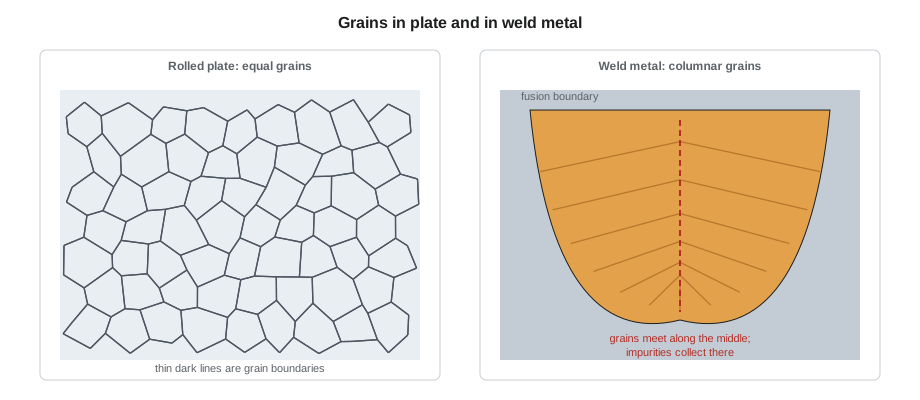
The way grains grow in a weld pool is distinctive. The cool, solid base metal at the edge of the pool acts as the starting surface, and grains grow from the partly melted grains of the base metal directly into the liquid, following the direction of heat flow, toward the hottest point. The result is long columnar grains. In a deep, narrow weld the columnar grains from the two sides meet along the centre line, and the last metal to freeze, rich in impurities, is trapped there. This is the mechanism behind centre-line cracking, a defect covered later in the course.
Measuring grain size
Grain size is reported in several ways. The simplest is the average grain diameter measured on a micrograph. Another, widely used in steel specifications, is the ASTM grain size number, a scale on which a larger number means finer grains. The number N is defined so that at a magnification of 100 times, the number of grains per square inch of image is 2 to the power N minus 1.
# ASTM grain size number and grain count
import math
for N in (3, 5, 7, 9):
    grains_per_sq_in_at_100x = 2 ** (N - 1)
    grains_per_mm2 = grains_per_sq_in_at_100x * (100 ** 2) / 645.16   # actual grains per square mm
    mean_diameter_um = 1000 / math.sqrt(grains_per_mm2)               # rough mean diameter, micrometres
print(f"N = {N}: {grains_per_sq_in_at_100x:4d} grains per sq in at 100x, about {mean_diameter_um:4.0f} micrometres across")N = 3: 4 grains per sq in at 100x, about 127 micrometres across N = 5: 16 grains per sq in at 100x, about 64 micrometres across N = 7: 64 grains per sq in at 100x, about 32 micrometres across N = 9: 256 grains per sq in at 100x, about 16 micrometres across
Fine-grained structural steels typically have grain size numbers of 7 or higher. Grain growth in the coarse-grained HAZ next to a high heat input weld can drop the local grain size to 3 or less, with grains several times larger. Codes that require impact testing of welding procedures often require HAZ specimens notched close to the fusion line for exactly this reason.
Alloys and solid solutions
Pure metals are rarely used for structures; they are too soft. Alloys mix a base metal with other elements. In a solid solution, the added atoms dissolve in the host lattice in one of two ways:
- Substitutional solid solution: the added atom takes the place of a host atom. Nickel, chromium, manganese and molybdenum dissolve this way in iron because their atoms are similar in size to iron atoms.
- Interstitial solid solution: a much smaller atom squeezes into the spaces between host atoms. Carbon, nitrogen and hydrogen dissolve this way in iron.
Either kind distorts the lattice and makes dislocations harder to move, which strengthens the metal. Interstitial carbon is especially powerful: a few tenths of a percent changes steel from soft and easily bent to strong and, if quenched, hard. Interstitial hydrogen is the opposite kind of problem. Its tiny atoms move through steel quickly even at room temperature, and that mobility is what lets hydrogen travel to a stressed, hard spot in a weld and start a crack.
Phases and phase changes
A phase is a region of a material with the same structure and composition throughout, separated from other regions by a boundary. Water, ice and steam are three phases of the same substance. In metals, the liquid is one phase, and different solid crystal structures or compounds are others. Steel at room temperature usually contains at least two phases: ferrite, which is nearly pure BCC iron, and cementite, a hard compound of iron and carbon. Austenitic stainless steel is mostly one phase, FCC austenite, often with a few percent of BCC ferrite.
Many metals change phase in the solid state when heated or cooled. Iron is the most important example. It is BCC ferrite up to about 912 °C (1,674 °F), FCC austenite from there to about 1,394 °C (2,541 °F), BCC again (called delta ferrite) up to its melting point near 1,538 °C (2,800 °F). Each change in pure iron happens at a fixed temperature; in steel, the carbon and alloying elements spread it over a range and shift it. Because the change can be pushed one way or the other by temperature, time and cooling rate, steels can be given an enormous range of properties by heat treatment, and welding is a heat treatment whether the welder intends it or not.
Aluminum, copper and austenitic stainless steel do not change crystal structure in the solid state. They cannot be hardened by quenching the way carbon steel can, and they do not form brittle structures in the HAZ in the same way. Instead, they have their own problems: grain growth, loss of strength from cold work or ageing treatments, and precipitation of unwanted phases. The lesson on stainless steels, aluminum and other metals returns to these.
Phase diagrams
A phase diagram is a map that shows which phases are stable at each combination of temperature and composition, assuming the metal is cooled slowly enough to reach equilibrium. The horizontal axis is composition, the vertical axis temperature, and lines divide the map into regions. Reading a phase diagram tells a welder, for a given alloy, the temperature at which it starts and finishes melting, which solid phases form as it cools, and roughly how much of each. The next lesson uses the most important phase diagram in welding, the iron-carbon diagram. Welding rarely cools slowly enough for equilibrium, so the diagram is a starting point, not the full story; the lessons on cooling rate and hardenability explain what happens when steel is cooled fast.
Common mistakes
MistakeThinking a crystal structure is fixed for a metal.
InsteadIron changes from BCC to FCC and back with temperature; that change makes steel heat-treatable.
MistakeAssuming bigger grains make a metal stronger.
InsteadFiner grains make metal both stronger and tougher; coarse HAZ grains are a weak point.
MistakeTreating weld metal as if it had the same structure as the plate.
InsteadWeld metal has a cast, columnar grain structure that grows from the fusion boundary.
MistakeIgnoring how quickly hydrogen moves in steel.
InsteadHydrogen's tiny interstitial atoms migrate at room temperature to hard, stressed zones.
MistakeExpecting aluminum or austenitic stainless to harden on quenching like carbon steel.
InsteadThey have no solid-state phase change of that kind; they have other welding concerns.
Summary and key terms
- Metals are crystals held together by a shared electron cloud, which gives conductivity and ductility.
- BCC, FCC and HCP are the common crystal structures; iron is BCC at room temperature and FCC at high temperature.
- Dislocations let metals deform; anything that blocks them strengthens the metal.
- Fine grains raise both strength and toughness; welding can coarsen grains near the fusion line.
- Weld metal freezes with columnar grains growing toward the hottest point.
- Alloying atoms dissolve substitutionally or interstitially; carbon and hydrogen are interstitial.
- A phase diagram maps the stable phases by temperature and composition under slow cooling.
- Crystal lattice
- The regular three-dimensional arrangement of atoms in a metal.
- BCC
- Body-centred cubic structure, as in ferrite.
- FCC
- Face-centred cubic structure, as in austenite, aluminum and copper.
- Dislocation
- A line defect in a crystal whose movement allows permanent deformation.
- Grain
- A single crystal within a metal, with its own lattice orientation.
- Grain boundary
- The disordered zone where grains of different orientation meet.
- Phase
- A region with uniform structure and composition, bounded by other phases.
- Solid solution
- An alloy in which added atoms dissolve in the host lattice.
Practice problems
Work each problem on paper first, then reveal the answer to check.
Which crystal structure does iron have at room temperature, and what is that phase called?
Show answer
Body-centred cubic; ferrite (alpha iron).
Why can austenite dissolve much more carbon than ferrite?
Show answer
Its FCC lattice has larger spaces between atoms for interstitial carbon.
A steel has ASTM grain size number 8. Is it finer or coarser than a steel with number 4?
Show answer
Finer; larger numbers mean smaller grains.
Why do hot cracks often form along the centre line of a deep, narrow weld?
Show answer
Columnar grains from both sides meet there, trapping the last, impurity-rich liquid to freeze.
Lesson quiz · 5 questions
Score 60% or more to complete this lesson.
Create a free account to save your progress, take quizzes and earn a certificate.