
WLD-130 · Lesson 1 of 12 · 18 min
Why welders need metallurgy
Devon Okafor has spent the last two courses learning to make a weld look right: a steady arc, the correct angles, flat beads that tie into the toes, fillets of the specified size. This course asks a different question. What happens inside the metal when it is welded, and why does the same weld, made by the same hands, crack on one job and hold for decades on another? The answer is metallurgy, the science of metals, their structure and how heat and alloying change them. A welder does not need a degree in it. A welder does need enough of it to understand why a procedure calls for preheat on one plate and not on another, why a low-hydrogen electrode has to come out of an oven, why stainless steel is welded with a small, fast bead and why a long fillet pulls a girder out of straight. This lesson sets out why metallurgy matters to the welder, what a weld does to the metal around it, and the main ideas the rest of the course builds on.
Three welds that went wrong
On the first evening of the metallurgy block at Hartwell Fabrication, Marta Kowalchuk puts three pieces of steel on the bench in the training room. Each came out of a real repair or failure, and each was made by a welder who knew how to run a bead.
- The first is a section of a cultivator toolbar from the farm repairs. A crack runs along the toe of an old repair weld, not through the weld itself but just beside it, in the steel that was heated but never melted. The repair had been made in winter, in a cold machine shed, with an electrode taken from an open box.
- The second is a stainless steel pipe coupon from a training exercise. It looks fine on the outside, but the inside of the pipe is covered in a dark, crusty oxide, and the metal near the weld has lost much of its corrosion resistance. It was welded without a purge gas inside the pipe and with too much heat.
- The third is a short length of girder flange from another shop, bowed by about 12 mm in 2 m (1/2 in in 6 ft) after a heavy fillet weld was run along one side in a single direction. No crack, no porosity; the weld would pass a visual inspection, and the part was still scrap.
"None of these welders was careless with the torch or the stinger," Marta says. "Each of them did something the metal could not tolerate, and none of them knew it. That's what this course is for." Lucia Ferreira, the shop's welding inspector, adds that every one of these faults is preventable with knowledge a welder can carry in their head: what the steel is, how much heat it gets, how fast it cools, how much hydrogen is around, and how the part is held.
What a weld does to metal
Fusion welding melts a small volume of the base metal, usually together with filler metal from the electrode or wire, and lets it freeze. That alone would be simple. The difficulty is that the heat does not stay where the metal melts. It flows outward into the surrounding plate, heating it to every temperature between the melting point and room temperature, for a few seconds, and then the plate cools again. Within a few millimetres of the fusion line, steel can be heated well above the temperature at which its crystal structure changes and then cooled quickly enough to form new, sometimes hard and brittle, structures. Further out, the metal is heated less and changes less. Further still, it barely notices.
A cross-section through a weld, polished and etched with a mild acid, shows these regions clearly. The etch darkens or lightens the metal according to its structure, revealing what welders and inspectors call the zones of the weld:
- Weld metal: the metal that melted and froze. It is a mixture of filler metal and melted base metal, with a cast structure of long grains that grew inward from the edges of the weld pool.
- Fusion line, or fusion boundary: the edge of the melted region, where weld metal meets base metal.
- Heat-affected zone, or HAZ: base metal that did not melt but was heated enough to change its structure or properties. In steel it is typically a few millimetres wide; in aluminum it is often much wider.
- Unaffected base metal: the plate as it came from the mill, with its original properties.
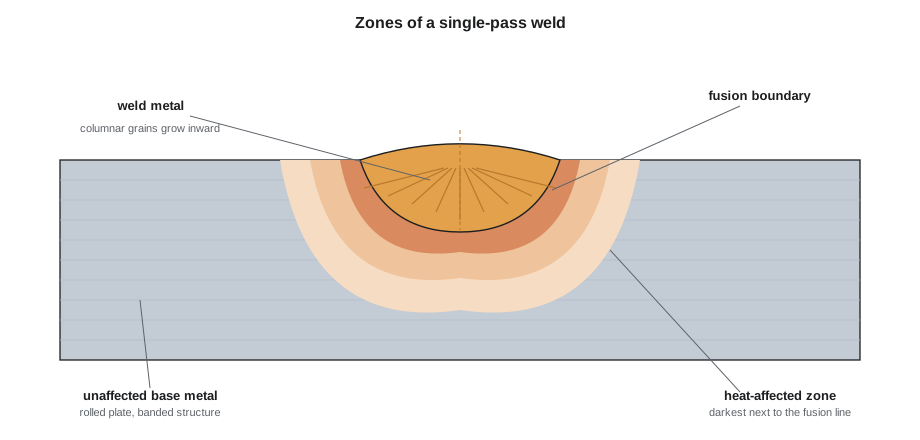
Each zone can have different strength, hardness, toughness and corrosion resistance from the others. A weld joint is only as good as its weakest zone, and the weakest zone is often not the weld metal, which the electrode maker designed, but the heat-affected zone, which nobody designed. It is simply what the welding heat did to the base metal.
Heat input: the first number in metallurgy
The amount of heat a weld puts into the work controls most of what happens in the metal: how big the weld pool is, how wide the HAZ is, how fast the joint cools, and how much it distorts. Welders measure it as heat input, the arc energy delivered per unit length of weld. Devon met arc energy in the SMAW course as volts times amps divided by travel speed. Metallurgists and many codes go one step further and multiply by a thermal efficiency, the fraction of the arc energy that actually enters the work rather than radiating away or heating the electrode and surroundings.
Here Q is the heat input in kilojoules per millimetre, η is the process thermal efficiency, E is the arc voltage in volts, I is the current in amperes and S is the travel speed in millimetres per minute.
Typical efficiency factors used in standards and textbooks are about 0.8 for shielded metal arc, gas metal arc and flux-cored arc welding, about 0.6 for gas tungsten arc welding, and close to 1.0 for submerged arc welding, where the flux blanket traps nearly all the heat. These are averages; real values depend on the joint, the arc length and the consumable. Some codes and procedures state heat input as arc energy without the efficiency factor, so the welder and the inspector always check which definition a document uses before comparing numbers.
# Arc energy and heat input for the same bead made with different processes
processes = {               # name: (volts, amps, travel mm/min, efficiency)
    "SMAW": (24, 140, 200, 0.8),
    "GMAW": (26, 230, 350, 0.8),
    "FCAW": (27, 240, 330, 0.8),
    "GTAW": (12, 150, 100, 0.6),
    "SAW":  (32, 550, 500, 1.0),
}
for name, (v, a, s, eff) in processes.items():
    arc_energy = 60 * v * a / (1000 * s)        # kJ/mm
    heat_input = eff * arc_energy
print(f"{name:5} arc energy {arc_energy:5.2f} kJ/mm heat input {heat_input:5.2f} kJ/mm")SMAW arc energy 1.01 kJ/mm heat input 0.81 kJ/mm GMAW arc energy 1.03 kJ/mm heat input 0.82 kJ/mm FCAW arc energy 1.18 kJ/mm heat input 0.94 kJ/mm GTAW arc energy 1.08 kJ/mm heat input 0.65 kJ/mm SAW arc energy 2.11 kJ/mm heat input 2.11 kJ/mm
The submerged arc bead carries more than twice the heat input of the stick bead, even at a much higher travel speed. That is why submerged arc procedures on thick plate pay close attention to toughness in the HAZ, and why a GTAW root on thin stainless can still overheat the metal if travel is slow.
Cooling rate: the second number
Heat input tells how much heat goes in. Cooling rate tells how fast it leaves, and for steel it is the more important of the two, because the structure that forms in the weld and the HAZ depends on how quickly the metal passes through a particular temperature range on the way down. Cooling rate depends on the heat input, on the thickness of the plate and the type of joint, on the starting temperature of the plate, and on the thermal properties of the metal. A thin plate cools slowly because the heat has nowhere to go but sideways; a thick plate draws heat away in every direction and cools quickly. A cold plate cools a weld faster than a warm one, which is the whole point of preheat. These ideas get a full lesson later in the course.
Hydrogen: the third ingredient
The cracked toolbar on Marta's bench failed by hydrogen-induced cracking, also called cold cracking or delayed cracking, the most common serious cracking problem in welded carbon and low-alloy steel. It needs three things at once: hydrogen in the weld area, a hard, susceptible microstructure in the HAZ or weld metal, and tensile stress. Hydrogen comes from moisture in electrode coverings and fluxes, from water, oil, rust and paint on the joint, and from humid air. It dissolves easily in hot liquid steel, gets trapped as the metal cools, and moves to places where the structure is hard and stressed. Hours or even days after welding, a crack can form there with no warning. The SMAW course introduced low-hydrogen electrodes and their storage; this course explains why the rules exist, and how preheat, heat input and hydrogen control fit together.
Stress and shape: the fourth
The bowed flange is a reminder that metallurgy is not only about microstructure. Hot metal expands and cold metal shrinks. A weld that freezes and cools while the plate around it stays cooler cannot shrink freely, so it pulls on everything around it. The result is residual stress, locked into the part, and distortion, the part changing shape. Both are predictable, and both can be reduced by the way the joint is designed, fitted, held and welded.
Materials a welder will meet
Hartwell's jobs show the range of metals a working welder handles in a few months:
- The Riverside bridge girders are weathering steel to CSA G40.21 grade 350AT, a low-alloy structural steel that forms a tight, protective rust layer and is tested for toughness at low temperature.
- The Coldwater separator skid has a pressure vessel of carbon steel plate made to a pressure vessel specification, piping in carbon steel and austenitic stainless steel, and a structural base of 350W plate.
- The Unit 4 turnaround spools include carbon steel pipe, a few lengths of chromium-molybdenum alloy pipe for a hot service line, and stainless steel.
- The farm repairs bring in anything: mild steel frames, high-carbon steel shafts and cultivator shanks, abrasion-resistant wear plate on buckets, cast iron housings and, occasionally, aluminum.
Each of these behaves differently under the arc. Part of a welder's job is to know what metal is in front of them, or to find out, before striking an arc. On code work the material is identified on the drawing and traced by heat number to its mill test report, which lists the chemistry and mechanical properties. On repair work, it can take a manufacturer's parts book, a spark test, a magnet, a file test or a chemical analysis to find out.
# A first look at what a mill test report tells a welder
plate = {"heat": "B48213", "grade": "350W", "thickness": 25,
         "C": 0.17, "Mn": 1.30, "Si": 0.25, "Cr": 0.05, "Mo": 0.02, "V": 0.04, "Ni": 0.10, "Cu": 0.12,
         "yield": 385, "tensile": 505, "elong_pct": 24, "charpy": 68}
print("Heat", plate["heat"], "grade", plate["grade"], "thickness", plate["thickness"], "mm")
print("Carbon", plate["C"], "percent; manganese", plate["Mn"], "percent")
ce = plate["C"] + plate["Mn"] / 6 + (plate["Cr"] + plate["Mo"] + plate["V"]) / 5 + (plate["Ni"] + plate["Cu"]) / 15
print(f"Carbon equivalent (IIW): {ce:.2f}")
print("Yield", plate["yield"], "MPa, tensile", plate["tensile"], "MPa, elongation", plate["elong_pct"], "percent")
print("Charpy impact average", plate["charpy"], "J")
if ce > 0.40:
print("CE above 0.40: check the procedure for preheat before welding")Heat B48213 grade 350W thickness 25 mm Carbon 0.17 percent; manganese 1.3 percent Carbon equivalent (IIW): 0.42 Yield 385 MPa, tensile 505 MPa, elongation 24 percent Charpy impact average 68 J CE above 0.40: check the procedure for preheat before welding
The carbon equivalent printed at the end is a single number that sums the hardening effect of carbon and the alloying elements. It is one of the main tools of this course and gets its own lesson. For now, it is enough to know that the chemistry on a mill report is not just paperwork: it predicts how the steel will behave when welded.
How the course is organized
The first part of the course builds the basic science: how atoms are arranged in metals and how grains and phases form; iron, carbon and the families of steel; and the mechanical properties that tests measure. The middle part applies it to welding: heat flow and cooling rate, the zones of a weld, hardenability and hydrogen cracking, and preheat and interpass temperature. The last part covers other metals, distortion and residual stress, and the defects that form in welds and why. The capstone puts it all together on a real repair, where Devon helps plan the preheat, the welding sequence and the distortion control for a cracked loader boom.
Throughout, the course connects the science to what the welder actually controls: the choice of consumable and its condition, the preheat and interpass temperature, the heat input through current, voltage and travel speed, the bead size and sequence, and the way the part is fitted and held. Welding procedures specify most of these. Understanding why they are specified makes a welder far less likely to ignore them on a cold morning when the job is behind.
Common mistakes
MistakeAssuming the weld metal is always the weakest part of the joint.
InsteadThe heat-affected zone, which nobody designs, is often where cracks and low toughness appear.
MistakeTreating heat input from two documents as the same number.
InsteadCheck whether the efficiency factor is included; arc energy and heat input differ by it.
MistakeThinking a weld that passes visual inspection is sound and fit for service.
InsteadHydrogen cracks can appear hours later, and distortion or lost corrosion resistance can make a clean-looking weld scrap.
MistakeWelding an unknown repair part as if it were mild steel.
InsteadIdentify the material first: parts book, mill report, spark or chemical test.
MistakeSeeing a mill test report as paperwork for the inspector.
InsteadIts chemistry predicts weldability; the carbon equivalent comes straight from it.
Summary and key terms
- Metallurgy explains why welds crack, lose toughness or corrosion resistance, and distort.
- A weld has weld metal, a fusion boundary, a heat-affected zone and unaffected base metal, each with its own properties.
- Heat input is the arc energy per length times the process efficiency; cooling rate depends on heat input, thickness, joint type and preheat.
- Hydrogen-induced cracking needs hydrogen, a hard microstructure and tensile stress together.
- Shrinkage of the weld causes residual stress and distortion.
- Identify the material before welding; on code work, by its mill test report.
- Metallurgy
- The science of metals, their structure, and how processing changes their properties.
- Heat-affected zone
- Base metal whose structure or properties were changed by welding heat without melting.
- Fusion boundary
- The edge of the melted region where weld metal meets base metal.
- Heat input
- Arc energy per unit length of weld multiplied by the thermal efficiency of the process.
- Thermal efficiency
- The fraction of arc energy that enters the work.
- Hydrogen-induced cracking
- Cracking caused by hydrogen in a hard, stressed weld or HAZ, often delayed after welding.
- Mill test report
- The steel maker's certificate of chemistry and mechanical properties for a heat of steel.
Practice problems
Work each problem on paper first, then reveal the answer to check.
A GMAW bead is made at 25 V, 220 A and 300 mm/min. What is the heat input with an efficiency of 0.8?
Show answer
Arc energy 60 × 25 × 220 / (1000 × 300) = 1.10 kJ/mm; heat input 0.8 × 1.10 = 0.88 kJ/mm.
Name the four zones seen in an etched weld cross-section.
Show answer
Weld metal, fusion boundary, heat-affected zone, unaffected base metal.
What three conditions together cause hydrogen-induced cracking?
Show answer
Hydrogen, a hard susceptible microstructure, and tensile stress.
Lesson quiz · 5 questions
Score 60% or more to complete this lesson.
Create a free account to save your progress, take quizzes and earn a certificate.