
WLD-120 · Lesson 9 of 12 · 16 min
Joint types and fit-up for fillet welds
Fillet welds are the most common welds in structural and general fabrication. Every stiffener on the Riverside girders, every gusset on the Coldwater base frame, every clip angle on a building and most farm repairs are joined with fillets. Before Devon runs a fillet on company work, Devon has to know the joints a fillet can join, the names of the parts of a fillet weld, how its size is measured and specified, and how to fit up and tack the parts so the weld can be made right. Fit-up is not the welder's afterthought. A joint with a gap, a misaligned edge, mill scale or oil, or parts that are free to move will produce a poor weld however skilled the hand. This lesson covers the five basic joints, fillet weld terminology and size, the relation between leg and throat, weld metal volume, root gaps, cleaning, tacking and fixturing, and how distortion is anticipated at fit-up. Weld symbols on drawings have their own course; here the drawing simply says what size fillet goes where.
The five basic joints
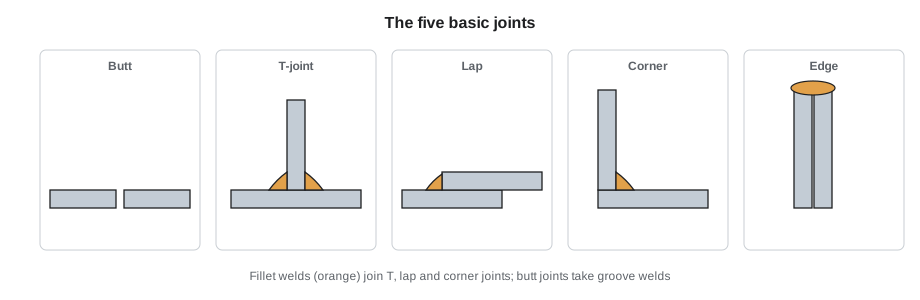
A joint is the way two pieces meet. There are five basic types, and fillet welds can be used on four of them:
- Butt joint: the pieces lie in the same plane, edge to edge. Normally joined with groove welds, covered in the next SMAW course.
- T-joint: one piece meets the face of the other at about a right angle, forming a T. The commonest fillet weld joint: stiffeners, gussets, brackets, flanges to webs.
- Lap joint: the pieces overlap, face to face. Joined with fillets along one or both edges of the overlap.
- Corner joint: the pieces meet at their edges at an angle, forming an L. Can be welded with a fillet inside the corner, a groove on the outside, or both.
- Edge joint: the edges of two parallel or nearly parallel pieces are flush and welded along the edge. Used on sheet and light flanges, rarely with fillets.
Parts of a fillet weld
A fillet weld is roughly triangular in cross-section, filling the corner between two surfaces at approximately right angles. Its parts have names that appear on drawings, procedures and inspection reports:
- Root: the point where the two pieces meet, at the back of the corner, which the weld must fuse into.
- Legs: the distances from the root to the toes along each plate. A fillet specified by size is described by its leg.
- Toes: the points where the weld face meets the base metal on each plate.
- Face: the exposed surface of the weld between the toes.
- Throat: the shortest distance from the root to the face. The theoretical throat is measured to a straight line joining the toes, assuming no penetration beyond the root and a flat face.
- Convexity and concavity: how far the face bulges beyond, or dips inside, the straight line joining the toes.
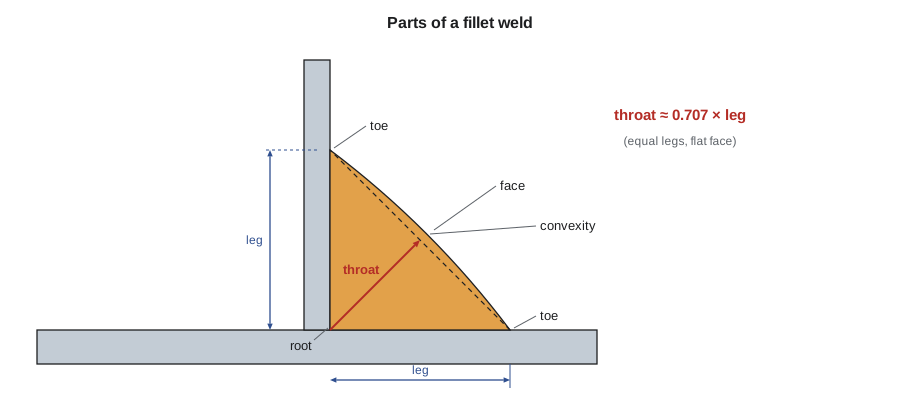
The strength of a fillet weld comes from its throat, because that is the smallest section through which the load must pass. For an equal-leg fillet between plates at right angles, with a flat face, the theoretical throat is the leg times the cosine of 45 degrees, about 0.707 times the leg. A 6 mm (1/4 in) fillet therefore has a theoretical throat of about 4.2 mm (0.177 in). Convexity adds metal but not designed strength; concavity reduces the actual throat and can make the weld undersize even when the legs measure correctly.
Here t is the theoretical throat and s is the leg size, both in millimetres.
Fillets can also have unequal legs, specified as two dimensions, used where one plate is thinner or the joint geometry calls for it. The designer specifies the size; the welder's job is to make it, neither smaller, which weakens the joint, nor much bigger, which wastes metal, adds heat and distortion, and costs time.
Weld metal volume
A fillet's cross-sectional area grows with the square of its leg. An equal-leg fillet with a flat face has an area of half the leg squared. Doubling the leg from 6 to 12 mm (1/4 to 1/2 in) quadruples the weld metal, the electrodes, the time and much of the heat. This is why an oversized fillet is expensive, and why designers and shops pay attention to fillet size. Real welds carry some convexity, often adding ten to twenty percent to the area.
# Fillet weld throat, cross-section, metal per length and electrodes per length
import math
steel_density = 7.85            # g/cm3
convexity_allow = 1.15            # extra metal for a slightly convex face
for leg in (5, 6, 8, 10, 12):                # leg sizes (mm)
    throat = leg * math.cos(math.radians(45))
    area = leg ** 2 / 2 * convexity_allow          # mm2
    metal = area * 1000 * steel_density / 1000    # kg/m
print(f"leg {leg:5} mm throat {throat:5.3f} mm area {area:7.3f} mm2 metal {metal:6.3f} kg/m")leg 5 mm throat 3.536 mm area 14.375 mm2 metal 112.844 kg/m leg 6 mm throat 4.243 mm area 20.700 mm2 metal 162.495 kg/m leg 8 mm throat 5.657 mm area 36.800 mm2 metal 288.880 kg/m leg 10 mm throat 7.071 mm area 57.500 mm2 metal 451.375 kg/m leg 12 mm throat 8.485 mm area 82.800 mm2 metal 649.980 kg/m
The 12 mm fillet needs almost six times the weld metal of the 5 mm fillet. In the metric calculation, mm² times 1000 mm gives cubic millimetres per metre, and multiplying by 7.85 g/cm³ and dividing by 1000 converts to kilograms per metre.
Fit-up and root gap
Fit-up is the preparation, positioning and holding of the parts before welding. For a fillet weld in a T-joint, good fit-up means the standing plate sits tight against the face of the other, square or at the specified angle, in the right location, and held so it cannot move while the weld is made. A root gap, a space between the standing plate and the face plate, reduces the effective size of the weld: the weld still measures to its legs from the face of each plate, but some of the metal fills the gap instead of building throat. Codes deal with this explicitly.
Under CSA W59 and AWS D1.1, a small gap at the root of a fillet weld is tolerated, but once the gap exceeds a small amount, about 1.5 mm (1/16 in), the leg of the fillet must be increased by the amount of the gap, or the designer must show that the effective throat is still enough, and larger gaps beyond about 5 mm (3/16 in) are generally not allowed without special treatment. Hartwell's shop standard is simpler: fit tight, and if a gap over 1.5 mm cannot be closed, call the foreman.
# Leg size needed when there is a root gap on a fillet
specified_leg = 8      # leg on the drawing (mm)
limit = 1.5              # gap allowed without increasing the leg (mm)
max_gap = 5            # largest gap normally allowed (mm)
for gap in (0.5, 1.5, 3, 6):
    if gap > max_gap:
        print(f"gap {gap} mm: too large, fix the fit-up or get engineering approval")
    elif gap > limit:
        print(f"gap {gap} mm: weld a {specified_leg + gap:.0f} mm leg instead of {specified_leg} mm")
    else:
print(f"gap {gap} mm: weld the specified {specified_leg} mm leg")gap 0.5 mm: weld the specified 8 mm leg gap 1.5 mm: weld the specified 8 mm leg gap 3 mm: weld a 11 mm leg instead of 8 mm gap 6 mm: too large, fix the fit-up or get engineering approval
Cleaning the joint
The surfaces to be welded, and about 25 mm (1 in) either side, are cleaned before fit-up. Mill scale, the blue-black oxide on hot-rolled plate, can be welded over by many electrodes in small amounts, but heavy or loose scale, rust, paint, oil, grease, cutting fluid, marker crayon and moisture all cause porosity, poor wetting and, with low-hydrogen work, hydrogen pickup. Cleaning is done with a grinder, flap disc or wire wheel; oil and grease are removed with a solvent first, because grinding just smears them. The faying surfaces of a T-joint, where the standing plate sits on the face plate, are cleaned too, because contaminants there end up at the root of the weld.
Cut edges from oxyfuel or plasma cutting, covered in the first course, are cleaned of slag and dross, and any hardened or notched edge is ground. On the Coldwater skid, gussets cut on the CNC plasma table have a fine dross line on the bottom edge, which Devon grinds off before fit-up so the gusset sits tight on the base plate.
Tack welds
Tack welds are short welds that hold the parts in position until the final welds are made. They are small, but they become part of the finished weld, so they must be made with the same care: with the electrode classification and procedure required for the final weld, on clean metal, with full fusion, and with craters filled. A cracked or porous tack left in a joint becomes a defect inside the final weld. On code work, tacks are made by welders qualified for the work, or by tack welders qualified for tacking, and tacks that will not be incorporated into the final weld are removed.
Tacks are placed to hold the parts square and to resist distortion. On a stiffener, the first tack goes at one end, the part is checked for square and position, the second tack goes at the other end, and then intermediate tacks are added at a regular spacing. Tacks are usually a few times the electrode diameter long, perhaps 15 to 25 mm (5/8 to 1 in), and the fillet leg of a tack is smaller than the final weld so it is fully consumed. The welder grinds the ends of tacks to a taper, or makes the tack with feathered ends, so the final weld ties in smoothly without a lump or cold lap.
Holding and distortion
Welding heats a narrow band of metal far above the temperature of the rest of the part. As the weld cools, it shrinks, and the shrinkage pulls the parts out of position. A single fillet on one side of a T-joint pulls the standing plate toward the weld; a long fillet bows the base plate; a ring of fillets around a gusset can pull the base plate into a dish. The metallurgy course explains why; at fit-up, the welder anticipates it.
- Fixtures and clamps hold parts in place during welding; strongbacks, temporary bars tacked across a joint, hold long seams.
- Presetting places parts slightly out of position so the shrinkage pulls them into position, for example tilting a standing plate a degree or two away from the side to be welded first.
- Balanced welding puts welds alternately on opposite sides of a joint so their shrinkage pulls against each other.
- Intermittent or skip welding spreads heat by making short welds in a planned sequence rather than one long run.
- Avoiding oversize fillets keeps the shrinkage to the minimum the design allows.
On the Riverside girders, the transverse stiffeners are fitted with a square and a magnet clamp, tacked at both ends and in the middle, and welded in a sequence that alternates sides, so the web stays flat within the drawing's tolerance.
Measuring fit-up
Fit-up is checked with simple tools before the first tack and again before welding. A combination square or a steel square checks that a standing plate is square to the base; a tape or rule checks its location from a reference line on the drawing; feeler gauges or a taper gauge measure a root gap; and a straightedge checks that a plate has not bowed. On the Riverside girders, the stiffener locations are marked on the web with a soapstone line and a centre punch at each end, measured from the bearing stiffener at one end of the girder, so that small errors do not accumulate along its length.
The results are recorded on the fit-up checklist for code work, and the inspector may hold the job until fit-up is checked. It is far easier to correct a stiffener that is out of square by a degree before it is welded than after, when the only fix is to cut it off and start again.
Common mistakes
MistakeMeasuring a fillet's size by its throat.
InsteadFillet size is the leg; the throat is about 0.707 times the leg.
MistakeWelding over a 3 mm (1/8 in) root gap with the specified leg.
InsteadIncrease the leg by the gap, or fix the fit-up.
MistakeGrinding an oily joint to clean it.
InsteadRemove oil with solvent first, then grind.
MistakeMaking tack welds with whatever electrode is handy.
InsteadTacks become part of the weld; use the procedure's electrode and full fusion.
MistakeMaking fillets bigger to be safe.
InsteadOversize fillets waste metal and time and add distortion; weld the size specified.
Summary and key terms
- The five basic joints are butt, T, lap, corner and edge; fillets join T, lap and corner joints.
- A fillet is sized by its leg; its theoretical throat is about 0.707 times the leg.
- Fillet weld metal grows with the square of the leg.
- Root gaps beyond a small limit require a larger leg or better fit-up.
- Clean the joint, tack with full-quality welds, and plan for shrinkage with clamping, presetting and sequence.
- Fillet weld
- A roughly triangular weld joining two surfaces at about right angles.
- Leg
- The distance from the root to the toe of a fillet weld.
- Throat
- The shortest distance from the root to the face of a fillet weld.
- Toe
- Where the weld face meets the base metal.
- Root gap
- The space between the parts at the root of a joint.
- Tack weld
- A short weld that holds parts in place for final welding.
- Presetting
- Positioning parts out of line so shrinkage pulls them into line.
Practice problems
Work each problem on paper first, then reveal the answer to check.
What is the theoretical throat of a 10 mm equal-leg fillet?
Show answer
0.707 × 10 = 7.1 mm.
A T-joint specified for an 8 mm fillet has a 2.5 mm root gap. What leg should be welded?
Show answer
8 + 2.5 = 10.5 mm, or close the gap.
Name four of the five basic joints.
Show answer
Butt, T, lap, corner, edge.
Lesson quiz · 5 questions
Score 60% or more to complete this lesson.
Create a free account to save your progress, take quizzes and earn a certificate.