
WLD-120 · Lesson 1 of 12 · 19 min
How the SMAW process works
Shielded metal arc welding, SMAW, is the process most people picture when they hear the word welding: a welder in a helmet holding an electrode in a clamp-like holder, an arc crackling at the tip, and a bead of molten metal laid along a joint, covered by a crust of slag that is chipped away afterwards. Tradespeople call it stick welding, and the electrode a rod. It is the oldest of the common arc welding processes still in wide use, and it is still the process apprentices learn first, because it teaches the skills every other arc process depends on: reading the puddle, controlling arc length, travel speed and electrode angle, and keeping a weld clean. This course follows Devon Okafor, now past the safety and cutting work of the first course, as Marta Kowalchuk starts Devon on the stick welding booths at Hartwell Fabrication and then on real fillet welds for the Riverside bridge and the Coldwater skid.
This lesson explains what happens in the arc and around it: where the heat comes from, what the electrode covering does, how the weld is shielded from the air, what slag is for, and why SMAW is still chosen for so much structural, pipeline, repair and field work. It ends with the arithmetic of arc power and heat input, which later lessons use to compare settings.
The arc and the welding circuit
An electric arc is a sustained electrical discharge through a column of hot, ionized gas. In SMAW the arc runs between the tip of a consumable electrode and the work piece. The welding power source drives a current, typically between about 50 and 250 A for the electrode sizes in this course, through the electrode lead, the holder, the electrode core wire, across the arc, into the work and back to the machine through the work lead. The voltage across the arc is low, usually about 20 to 30 V, but the current is high, so the arc delivers several kilowatts into a spot a few millimetres across. The temperature at the centre of the arc column is several thousand degrees Celsius, far above the melting point of steel.
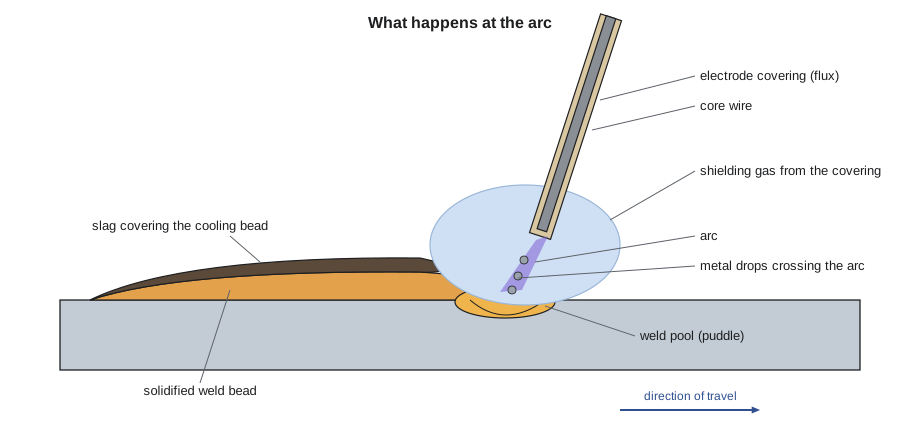
The heat melts three things at once: the tip of the core wire, the covering on the electrode, and a small pool of the base metal under the arc. Molten metal from the core wire crosses the arc in drops and mixes with the melted base metal to form the weld pool, which welders call the puddle. As the welder moves the electrode along the joint, the back of the puddle cools and freezes into the weld bead, joining the pieces. The electrode gets shorter as it melts, so the welder's hand must move steadily toward the work to keep the arc length constant while also moving along the joint. That double motion is the basic skill of SMAW.
What the covering does
The electrode is a solid steel wire, the core wire, coated with a covering of minerals, chemicals and binders pressed on and baked. The covering is often called the flux, and it does most of what makes SMAW work. Its jobs are:
- Shielding. Some ingredients, such as cellulose or carbonates, break down in the heat of the arc and give off gases, mostly carbon dioxide, carbon monoxide and hydrogen or water vapour depending on the type. The gas pushes air away from the arc and the puddle. Without it, oxygen and nitrogen from the air would dissolve in the molten metal and leave a porous, brittle weld.
- Slag. Other ingredients melt into a glassy liquid that is lighter than steel. It mixes with the molten metal, picks up impurities, floats to the top and freezes into a crust over the bead. The slag protects the hot metal from the air while it cools, slows the cooling, and shapes the bead. It is removed with a chipping hammer and wire brush after each pass.
- Arc stability. Ionizing compounds, such as potassium and sodium salts, make the arc easier to strike and keep it steady, especially on alternating current.
- Alloying and deoxidizing. Manganese and silicon in the covering remove oxygen from the weld metal and add alloy, so the weld reaches the strength the electrode is classified for. Some electrodes carry iron powder in the covering, which melts into the weld and increases the deposition rate.
- Shaping the arc. The covering melts a little more slowly than the core wire, so it forms a short cup at the tip that directs the arc, which is why a welder can drag the electrode with the covering touching the work for some electrode types.
Because the covering supplies the shielding, SMAW needs no gas cylinder and no wire feeder. The whole process is a power source, two leads, a holder and a box of electrodes. That simplicity is why it works on a farm, on a pipeline right-of-way in the wind, at the top of a tower or inside a tank, where a gas-shielded process would struggle.
Slag, spatter and fume
Every SMAW weld leaves slag to remove. If a welder lays a second pass over slag that has not been fully removed, the slag can be trapped in the weld as a slag inclusion, one of the most common defects in multi-pass work. Chipping, then brushing with a wire brush, and sometimes grinding at the toes, are part of every pass. Chipping slag is also a hazard to the eyes: hot slag pieces fly off, so safety glasses are worn under the helmet whenever slag is chipped, as the first course stressed.
Spatter is the small drops of molten metal thrown out of the arc that land beside the weld. Some is normal; a lot of spatter means the current is too high, the arc is too long, the electrode is damp, or arc blow is pulling the arc off line. Fume is the smoke made of tiny particles of metal oxides and covering compounds condensed from the vapour above the arc. SMAW produces more fume per kilogram of weld metal than most gas-shielded processes, so the ventilation and respiratory protection from the first course apply in every booth. Low-hydrogen and iron powder electrodes are not exempt; the fume composition varies with the covering, and the safety data sheet for each electrode lists it.
Strengths and limits of SMAW
SMAW is chosen when its strengths matter:
- Portability and simplicity. An engine-driven welder and a bundle of leads go anywhere a truck can, and the leads can run 30 to 60 m (100 to 200 ft) to the work.
- Tolerance of conditions. The process works outdoors in wind that would blow away a shielding gas, and it is less fussy than gas-shielded processes about mill scale and light rust, although clean steel always welds better.
- All positions. With the right electrode, SMAW welds flat, horizontal, vertical and overhead.
- Wide choice of filler metal. There are electrodes for mild steel, low-alloy and high-strength steels, stainless steels, cast iron, hardfacing and nickel alloys, all run on the same machine.
Its limits are just as real. Deposition is slow compared with wire processes, because the welder stops every electrode to change it, chips slag on every pass, and grinds at every start and stop. The operating factor, the share of a welder's time spent with the arc lit, is often only 20 to 35 percent. SMAW is not used on thin sheet metal, where the heat easily burns through, and it is rarely used on aluminium. In a production shop like Hartwell, long fillet welds on the Riverside girders go to flux-cored welding, covered in a later course, while stick welding handles tacking, short welds, repairs, field work and the qualification tests that every welder has to pass.
Arc power and heat input
Two numbers describe how hard the arc is working. Arc power is the product of arc voltage and current. Heat input is the energy delivered per unit length of weld, and it depends on travel speed as well. A welding procedure specification often limits heat input, because too much or too little affects the toughness and strength of the weld and the heat-affected zone, which the metallurgy course explains. The usual formula multiplies voltage and current by 60, divides by travel speed in length per minute, and divides by 1000 to give kilojoules per unit length. Some codes then multiply by an arc efficiency factor, about 0.8 for SMAW, to estimate the share of the heat that actually enters the work.
Here H is heat input in kilojoules per millimetre, E is arc voltage in volts, I is current in amperes, and S is travel speed in millimetres per minute.
# Arc power and heat input for a stringer bead
volts = 24          # arc voltage (V)
amps = 125          # welding current (A)
bead_len = 230      # length of the bead (mm)
seconds = 52        # time to run it, from a stopwatch (s)
speed = bead_len / seconds * 60           # travel speed (mm/min)
power_kw = volts * amps / 1000
heat = 60 * volts * amps / (1000 * speed)  # heat input (kJ/mm)
print(f"travel speed   {speed:6.1f} mm/min")
print(f"arc power      {power_kw:6.2f} kW")
print(f"heat input     {heat:6.2f} kJ/mm")
print(f"with arc efficiency 0.8: {0.8 * heat:.2f} kJ/mm into the work")travel speed 265.4 mm/min arc power 3.00 kW heat input 0.68 kJ/mm with arc efficiency 0.8: 0.54 kJ/mm into the work
Devon ran that bead with a 3.2 mm (1/8 in) E7018 electrode on a practice plate. The same settings at half the travel speed would double the heat input, which is one reason a slow, wide bead is not the same weld as a quick, narrow one, even with the machine untouched.
Worked problem
Comparing two beads
Two beads are run at 24 V and 125 A. Bead A travels 150 mm per minute and bead B travels 250 mm per minute. What is the heat input of each?
Show solution
- Bead A: 60 × 24 × 125 / (1000 × 150) = 1.20 kJ/mm.
- Bead B: 60 × 24 × 125 / (1000 × 250) = 0.72 kJ/mm.
Answer: Bead A puts in about two-thirds more heat per millimetre: 1.20 against 0.72 kJ/mm.
Where SMAW fits in the program
The welder program at Hartwell, like the provincial and national training standards behind it, builds stick welding in two steps. This course covers the equipment, the electrodes, the basic bead skills and fillet welds in the flat and horizontal positions, ending with the kind of visual inspection and fillet break test used to check a new welder's fillets. The metallurgy course that follows explains what the heat does to the steel, and the second SMAW course moves to groove welds in the vertical and overhead positions and to bend tests. Weld symbols and drawings have their own course. Marta's plan for Devon is simple: two weeks in the booth on practice plate, then tack welds and short fillets on real work under her eye, then a break test before Devon welds anything that leaves the shop.
At Hartwell, structural welding is done to CSA W59 under the company's CWB certification to CSA W47.1, and every welder who welds on that work holds a current CWB welder qualification for the process and position. Devon is not qualified yet; until then, Devon's welds on company work are tack welds and fillets that Marta or another qualified welder completes or inspects.
SMAW beside the other arc processes
Devon will learn three more arc processes in the program, and it helps to see where stick welding sits among them. Gas metal arc welding, GMAW or MIG, feeds a solid wire continuously through a gun with a shielding gas from a cylinder; it is fast and clean, with little slag, but the gas blows away in a draft. Flux-cored arc welding, FCAW, feeds a tubular wire filled with flux, with or without a shielding gas; it combines high deposition with SMAW's tolerance of outdoor conditions, and it does much of the heavy structural work at Hartwell. Gas tungsten arc welding, GTAW or TIG, uses a non-consumable tungsten electrode with filler added by hand; it is slow but gives the finest control, for thin material, stainless steel, aluminium and pipe roots. SMAW gives up speed to all of them except GTAW, and in return needs the least equipment and works almost anywhere.
The skills transfer in both directions. A welder who can hold a steady arc length, read a puddle and keep slag behind the arc with a stick electrode learns the wire processes quickly; the reverse is less true, which is one reason training programs still start with SMAW.
Common mistakes
MistakeThinking the electrode covering is just insulation.
InsteadThe covering makes the shielding gas and slag, stabilizes the arc and adds alloy; a damaged covering makes a defective weld.
MistakeLaying a new pass over slag that was only partly chipped.
InsteadChip and brush every pass clean; trapped slag becomes an inclusion.
MistakeAssuming SMAW makes little fume because there is no gas cylinder.
InsteadSMAW makes a lot of fume; use the ventilation and respirator the job requires.
MistakeJudging heat only by the amperage on the dial.
InsteadHeat input depends on voltage, current and travel speed together.
Summary and key terms
- SMAW melts a covered consumable electrode and the base metal with an arc of about 20 to 30 V and tens to hundreds of amperes.
- The covering supplies shielding gas, slag, arc stability and alloying; no separate gas is needed.
- Slag protects the cooling bead and must be removed completely between passes.
- SMAW is portable, works outdoors and in all positions, and suits repair, field and qualification work, but its operating factor is low.
- Heat input in kJ per unit length is 60 × volts × amps divided by 1000 × travel speed.
- SMAW
- Shielded metal arc welding, also called stick welding.
- Core wire
- The solid metal wire at the centre of a covered electrode.
- Covering (flux)
- The coating on the electrode that makes shielding gas and slag and adds alloy.
- Slag
- The glassy crust that forms over the weld from the melted covering.
- Puddle
- The weld pool of molten metal under the arc.
- Heat input
- Arc energy delivered per unit length of weld.
- Operating factor
- The share of working time spent with the arc lit.
Practice problems
Work each problem on paper first, then reveal the answer to check.
A bead is run at 22 V, 110 A and 180 mm per minute. What is the heat input?
Show answer
60 × 22 × 110 / (1000 × 180) = 0.81 kJ/mm.
Name three jobs of the electrode covering.
Show answer
Shielding gas, slag, arc stability (also alloying and deoxidizing).
Why is slag removed before the next pass?
Show answer
Slag left on the bead is trapped by the next pass as a slag inclusion.
Lesson quiz · 5 questions
Score 60% or more to complete this lesson.
Create a free account to save your progress, take quizzes and earn a certificate.