
WLD-120 · Lesson 7 of 12 · 18 min
Arc length, travel speed and electrode angles
Once Devon could strike an arc and keep it lit, the beads started to look like beads. They did not yet look like Marta's. Hers were the same width from end to end, the ripples evenly spaced, the edges blended into the plate without a line; Devon's were wide in one place and narrow in another, and one edge always seemed to sit up proud. The difference is control of five variables that welding instructors have long taught together, often under the memory aid CLAMS: current, length of arc, angle of the electrode, manipulation and speed of travel. Current was set in the last lesson and manipulation, weaving, comes in the next. This lesson is about the three the welder controls with every second of hand movement: arc length, travel speed and the angles of the electrode, and how to diagnose a bead by looking at it.
The five essentials
- Current: set on the machine within the electrode's range, then confirmed by the way the electrode runs.
- Length of arc: the distance from the tip of the core wire to the surface of the puddle.
- Angle: the tilt of the electrode in two directions, along the joint and across it.
- Manipulation: any motion of the electrode tip other than straight travel, such as weaving or whipping.
- Speed of travel: how fast the arc moves along the joint.
They interact. A longer arc raises the voltage and spreads the heat; slower travel adds heat to every millimetre; a steeper angle changes where the arc force pushes the puddle. A welder who changes two at once cannot tell which one fixed the problem, so Marta has Devon change one at a time and run a bead for each.
Arc length
For most carbon steel electrodes, the arc length should be about equal to the diameter of the core wire: about 3 mm (1/8 in) for a 3.2 mm (1/8 in) electrode. Low-hydrogen electrodes such as E7018 are run with a shorter arc still, almost touching, with the covering's cup nearly on the puddle, because a long arc lets air into the arc and the weld picks up nitrogen and oxygen and becomes porous. Cellulosic E6010 is often run with a short, tight arc for penetration as well, while E7024 is dragged with the covering in contact with the work.
Arc length shows in sound, light and bead shape:
- A correct arc has a steady, crisp crackle, like bacon frying, a stable cone of light, and a bead with good wetting at the edges and moderate spatter.
- A long arc hums or hisses with irregular cracks and pops, the light flares and wanders, spatter increases, the bead becomes wide, flat and irregular with poor penetration and possible undercut, and with low-hydrogen electrodes, porosity appears.
- A short arc sounds muffled and may stutter, the electrode tends to stick or short-circuit, and the bead is narrow and high with a lot of convexity, possibly with slag trapped along the edges.
Arc length also changes arc voltage, roughly one to two volts for each millimetre, which is why the voltage across a stick arc is not set on the machine but follows the welder's hand. Keeping arc length steady while the electrode burns off is the hardest part of early practice: the hand must feed down at the burn-off rate while it moves along. Bracing the wrist and forearm, and watching the gap between the covering cup and the puddle rather than the arc itself, both help.
Travel speed
Travel speed is set by watching the puddle. The electrode moves at the speed that keeps the puddle the right size and lets it wet into both edges of the joint or the plate. For a stringer bead, the width is usually about one-and-a-half to two-and-a-half times the core wire diameter, depending on the electrode and the job. Too slow and the puddle grows, the bead becomes wide and high, heat input rises, slag can run ahead of the arc and be trapped, and on thin material the plate overheats or burns through. Too fast and the bead is narrow and ropey with a pointed, V-shaped ripple pattern, the edges do not fuse fully, undercut appears along the toes, and slag can be trapped in the ripples.
The ripples in the bead surface are frozen records of the puddle's back edge. On a well-run stringer they are evenly spaced, gently curved arcs. Ripples drawn into sharp chevrons mean travel too fast; ripples that are nearly flat and widely spread with a bulging profile mean travel too slow. Uneven spacing means uneven travel, often a hand that speeds up as the electrode gets shorter.
Travel speed is easy to measure: run a bead of known length and time it with a stopwatch, or count seconds aloud. Procedure qualification records and welding procedures for code work state a travel speed range, and some procedures limit heat input, which depends on speed directly.
# Travel speed and heat input from timed practice beads
volts = 23                      # typical arc voltage for this electrode (V)
amps = 125                      # measured current (A)
low, high = 230, 350        # travel speed range in the practice procedure (mm/min)
beads = [(250, 61), (250, 47), (250, 34), (250, 52)]   # (length mm, seconds)
for n, (length, sec) in enumerate(beads, 1):
    speed = length / sec * 60
    heat = 60 * volts * amps / (1000 * speed)
    note = "OK" if low <= speed <= high else ("too slow" if speed < low else "too fast")
print(f"bead {n}: {speed:6.1f} mm/min, heat input {heat:5.2f} kJ/mm {note}")bead 1: 245.9 mm/min, heat input 0.70 kJ/mm OK bead 2: 319.1 mm/min, heat input 0.54 kJ/mm OK bead 3: 441.2 mm/min, heat input 0.39 kJ/mm too fast bead 4: 288.5 mm/min, heat input 0.60 kJ/mm OK
Devon's first bead sat at the slow end of the range, the third ran too fast and came out narrow and ropey, and the second and fourth were where Marta wanted them. The numbers matter less than the habit of linking what the bead looks like to a number that can be repeated.
Electrode angles
The electrode is tilted in two planes, and each has its own name and effect.
- Travel angle, also called lead or lag angle: the tilt along the line of the weld, measured from a line perpendicular to the work. With the electrode tip pointing back toward the finished bead, the electrode is said to drag, or use a backhand technique; with the tip pointing forward toward the unwelded joint, it pushes, a forehand technique. For SMAW in the flat and horizontal positions, a drag angle of about 10 to 20 degrees is standard, so that the arc force pushes molten slag back behind the puddle.
- Work angle: the tilt across the joint, measured from the plate surface or from the joint. On a bead on flat plate the work angle is 90 degrees, straight up; on a flat fillet weld between two plates at right angles it is about 45 degrees, splitting the angle so heat goes equally into both plates; on a horizontal fillet it is lowered a little, so the arc favours the bottom plate, because the top edge tends to undercut and the bottom tends to overlap.
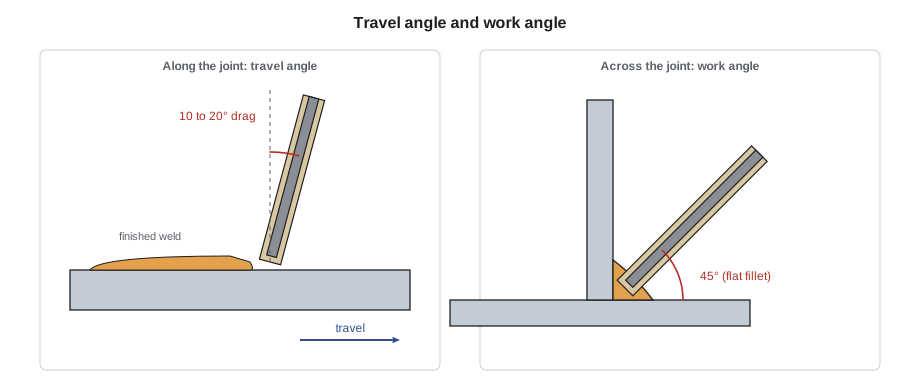
Too much drag angle, over about 30 degrees, points the arc back over the bead, reduces penetration and can produce a humped bead; too little, or a push angle, lets slag run ahead under the arc, which is the most common cause of slag inclusions in a beginner's flat beads. A work angle off to one side on a fillet puts more heat into one plate and can leave the other side unfused, with undercut on the hot side and overlap on the cold side.
Some electrodes have their own habits. E6010 root passes on pipe are run with a slight drag and a whipping motion. E7024 is dragged with the covering touching the work, at a steep travel angle of up to about 30 degrees. E7018 is run with a short arc and a small drag angle, and is not whipped, because whipping lengthens the arc and lets air into a low-hydrogen weld.
Diagnosing a bead
After each bead is cleaned, it can be read like a report card. The chart below collects the common signs. More than one cause can give the same sign, so the welder changes one variable at a time to find out which.
| What the bead shows | Likely causes |
|---|---|
| Wide, flat, irregular bead with spatter | Arc too long; current too high |
| Narrow, high, ropey bead | Current too low; travel too fast; arc too short |
| Undercut along one or both edges | Current too high; arc too long; travel too fast; wrong work angle |
| Overlap, metal rolled onto the plate unfused | Current too low; travel too slow; wrong work angle |
| Slag trapped in or along the bead | Travel angle too steep or pushing; travel too slow; poor cleaning |
| Porosity, especially at starts | Arc too long; damp electrodes; dirty plate; low-hydrogen start technique |
| Sharp V-shaped ripples | Travel too fast |
| Uneven width along the bead | Travel speed or arc length varying |
Worked problem
Fixing an undercut edge
Devon's flat fillet on a practice T-joint has undercut along the vertical plate and a slightly convex bead. The current is 135 A and the travel speed is in range. What should change first?
Show solution
- Undercut on one side only points to the work angle and the arc length rather than the current, which would undercut both edges.
- The electrode was probably pointed toward the vertical plate, putting too much heat there and too little on the bottom plate.
- Lower the work angle slightly toward the bottom plate and shorten the arc; then rerun before changing current.
Answer: Correct the work angle and arc length first; reduce current only if the undercut remains.
Practice routine
Marta's routine for Devon runs over a week. Each morning: a pad of parallel stringers on flat plate, each changed in one variable from the last, with the result written down. Then cut a strip from the pad, etch it, and compare the penetration with the notes. By the end of the week the notebook shows Devon's own ranges: the current at which each electrode starts to undercut, the travel speed at which the bead goes ropey, the arc length that starts the hiss. The exercise is less about reaching a perfect bead than about knowing what each change does, so that on a real joint Devon can correct in the middle of an electrode rather than after it.
Hartwell's practice procedure for E4918 (E7018) in the flat position, written for training, gives 110 to 140 A on DCEP for 3.2 mm (1/8 in) electrodes, an arc length of about 3 mm, a drag angle of 10 to 20 degrees and a travel speed of 230 to 350 mm per minute. It mirrors the format of a real welding procedure data sheet so that Devon learns to work inside the limits a procedure sets.
Building consistency
Most beginners can make one good bead; the skill is making the same good bead every time, at the start of an electrode and at its end, in the morning and late in the shift. Consistency comes from habits that do not depend on concentration: the same body position braced the same way, the same check of the electrode angle before each strike, the same count for travel, and a quick look at each finished bead before starting the next. Marta has Devon run beads in sets of five, all with the same settings, and lay the five slag-free beads side by side. If one differs, Devon must say why before running the next set, which teaches Devon to notice small drifts, such as an arc that lengthens as the hand tires, before they become defects.
Comfort matters too. A booth chair at the right height, a helmet that fits and does not slip, and a lens kept clean change bead quality more than most apprentices expect, because a welder who is straining to see or to reach cannot hold a steady arc.
Common mistakes
MistakeHolding a long arc with E7018 because it is easier to see the puddle.
InsteadKeep a short arc with low-hydrogen electrodes; a long arc causes porosity.
MistakeSpeeding up as the electrode gets shorter.
InsteadKeep travel speed steady from the start of the electrode to the stub.
MistakePushing the electrode in the flat position.
InsteadUse a 10 to 20 degree drag so slag stays behind the puddle.
MistakeChanging current, angle and speed all at once to fix a bead.
InsteadChange one variable at a time and rerun.
MistakeWhipping E7018 like E6010.
InsteadLow-hydrogen electrodes are run without whipping, at a steady short arc.
Summary and key terms
- CLAMS: current, length of arc, angle, manipulation and speed of travel all shape the bead.
- Arc length is about one core wire diameter, shorter for low-hydrogen electrodes; it shows in sound, spatter and bead shape.
- Travel speed sets bead width and ripple shape and directly affects heat input.
- Travel angle (drag about 10 to 20 degrees) keeps slag behind the puddle; work angle splits or favours the plates.
- Read the bead to diagnose the cause, and change one variable at a time.
- CLAMS
- Memory aid for current, length of arc, angle, manipulation and speed.
- Arc length
- The distance from the core wire tip to the puddle surface.
- Travel angle
- The tilt of the electrode along the weld line.
- Work angle
- The tilt of the electrode across the joint.
- Backhand (drag)
- Electrode tip pointing back toward the finished weld.
- Undercut
- A groove melted into the base metal at the weld toe and left unfilled.
- Overlap
- Weld metal that has flowed onto the base metal without fusing to it.
Practice problems
Work each problem on paper first, then reveal the answer to check.
A 250 mm bead takes 40 seconds. What is the travel speed?
Show answer
250 / 40 × 60 = 375 mm/min.
What is the usual work angle for a flat fillet weld?
Show answer
About 45 degrees, splitting the joint.
A bead shows sharp V-shaped ripples and undercut on both edges. What is the likely cause?
Show answer
Travel too fast, possibly with current high.
Lesson quiz · 5 questions
Score 60% or more to complete this lesson.
Create a free account to save your progress, take quizzes and earn a certificate.