
WLD-120 · Lesson 5 of 12 · 17 min
Electrode storage and low-hydrogen practice
An electrode is only as good as its covering, and coverings are sensitive to moisture and damage. A low-hydrogen electrode that has sat in damp air on a bench overnight can put enough hydrogen into a weld to crack it hours later, after the inspector has walked away. A cellulosic electrode that has been baked in an oven can lose the moisture it needs and run badly. A covering chipped off one side makes the arc blow sideways and leaves an unshielded weld. This lesson explains why hydrogen matters, how each family of electrodes is stored, the holding ovens, exposure limits and redrying rules for low-hydrogen electrodes, how to recognize damp or damaged electrodes, and how Hartwell controls its electrodes from the delivery truck to the stub bucket. It is a short subject on paper and one of the most frequent causes of rejected welds in practice.
Why hydrogen matters
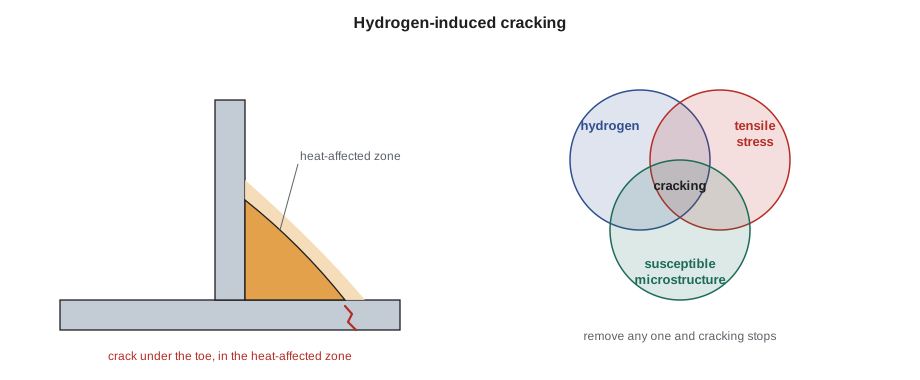
Water in the covering, and hydrogen-bearing compounds such as cellulose, break down in the arc and release hydrogen, which dissolves readily in the molten weld pool. As the weld cools, the steel can hold less hydrogen in solution, and the excess diffuses through the weld and into the heat-affected zone, collecting at defects and at hard microstructures. If three conditions come together, hydrogen plus a hard, susceptible microstructure plus tensile stress from shrinkage and restraint, the steel can crack. This is hydrogen-induced cracking, also called cold cracking or delayed cracking, because it happens at low temperature and can appear hours or even a day or two after welding.
Hydrogen cracks often start under the bead in the heat-affected zone and may not break the surface, so visual inspection can miss them. They are most likely in thick sections, in higher-strength and hardenable steels, in highly restrained joints and in cold weather. The welding metallurgy course explains how preheat and controlled cooling help. The first line of defence is simpler: keep hydrogen out of the weld by using low-hydrogen electrodes and keeping them dry, and by welding on clean, dry steel free of oil, grease, paint and condensation.
Storage by electrode family
Different coverings need different storage, and the manufacturer's data sheet is the authority for each product. The general practice is:
- Low-hydrogen electrodes, such as E7018. Kept in their sealed containers until needed. Once a container is opened, the electrodes go into a heated holding oven, not back on a shelf. Hermetically sealed and vacuum-packed containers keep them dry until opened; after that, the clock starts.
- Cellulosic electrodes, such as E6010 and E6011. The covering is designed to contain some moisture, which the arc needs. They are stored in a dry place at room temperature in closed containers, and are not put in hot ovens, which can dry them out and make them run poorly and burn the covering.
- Rutile and iron powder electrodes, such as E6013, E7014 and E7024. Stored dry at room temperature in closed containers. If they pick up moisture they can be dried at a moderate temperature as the manufacturer directs.
- All electrodes. Stored off the floor, away from water and condensation, in their labelled containers, with the oldest stock used first. Electrodes that have been wet, are contaminated with oil or grease, or have damaged coverings are discarded.
Holding ovens
A holding oven, called a rod oven, keeps opened low-hydrogen electrodes warm enough that they cannot absorb moisture from the air. Shop ovens hold several boxes; portable canister ovens hold a few dozen electrodes, plug into a machine's auxiliary outlet, and go to the work. The oven has a thermostat and often a thermometer, and it stays switched on, including overnight and over weekends. An oven that has been switched off and allowed to cool with electrodes inside has, in effect, been a cold, damp storage cupboard, and the electrodes in it may need redrying or scrapping depending on the rules in force.
CSA W59 and AWS D1.1, the codes behind most structural work in Canada, both require low-hydrogen electrodes to be kept in holding ovens at a minimum temperature after the container is opened, commonly 120 °C (250 °F), with limits on exposure to the atmosphere and rules for redrying. At Hartwell the shop ovens are set at about 150 °C (300 °F), and the oven temperature is logged at the start of each shift.
Ovens are for electrodes. Lunches, gloves and wet clothing do not go in them, because they bring moisture and contamination, and because a rod oven left open to dry wet gloves is not holding its temperature.
Exposure limits and redrying
Once a low-hydrogen electrode is taken out of the oven, it starts to absorb moisture from the air, faster in humid weather. Codes and specifications therefore limit the time an electrode may be out of the oven before it must be used, returned to the oven or redried. AWS D1.1 sets a limit of four hours for ordinary E70XX low-hydrogen electrodes, shorter limits for higher-strength electrodes, and allows longer exposure for moisture-resistant electrodes carrying the R designator when they have been tested for it. The welder takes out only what can be used in a short time, often a handful, and keeps them in a closed portable oven at the work.
Electrodes that have exceeded the exposure limit, or that have been in an oven that failed, can be redried in a separate drying oven at a much higher temperature than the holding oven, for a specified time, following the manufacturer's instructions and the code. Codes typically allow redrying only once. Electrodes that have been wet are not redried; they are scrapped. Hartwell does not redry in the shop at all: any electrode that has exceeded its exposure time, fallen on the floor, or come back from a job in an unheated container goes in the scrap bin. Glen's view is that a box of E7018 costs far less than one cut-out repair.
# Low-hydrogen electrode exposure tracker for one welder's shift
limit_h = 4.0          # allowed time out of the oven for E70XX low hydrogen (h)
# (electrode batch, time taken out of the oven, time used up or returned)
batches = [("3.2 mm E7018 H4, batch A", "07:10", "08:40"),
           ("3.2 mm E7018 H4, batch B", "08:45", "12:55"),
           ("3.2 mm E7018 H4, batch C", "13:30", "15:20")]

def hours(t1, t2):
    h1, m1 = map(int, t1.split(":")); h2, m2 = map(int, t2.split(":"))
    return (h2 * 60 + m2 - h1 * 60 - m1) / 60

for name, out, back in batches:
    h = hours(out, back)
    status = "OK" if h <= limit_h else "OVER LIMIT: scrap or redry per procedure"
    print(f"{name:26s} out {out}  back {back}  {h:4.2f} h  {status}")
oven_c = 150
print(f"holding oven setting {oven_c} C = {oven_c * 9 / 5 + 32:.0f} F (minimum 120 C = 250 F)")3.2 mm E7018 H4, batch A out 07:10 back 08:40 1.50 h OK 3.2 mm E7018 H4, batch B out 08:45 back 12:55 4.17 h OVER LIMIT: scrap or redry per procedure 3.2 mm E7018 H4, batch C out 13:30 back 15:20 1.83 h OK holding oven setting 150 C = 302 F (minimum 120 C = 250 F)
Batch B was out for 4 h 10 min while Devon waited for a crane to set the Coldwater base frame. The rule does not bend for crane delays, so the remaining electrodes from that batch went in the scrap bin. Marta's habit is to carry no more than about an hour's worth at a time, kept in the portable oven.
Recognizing damp and damaged electrodes
A welder learns to notice the signs:
- Damp low-hydrogen electrodes run with more spatter, a rougher arc, and sometimes a hissing or steaming sound; the weld shows porosity, often as wormholes or surface pores near the start, and the covering may blister or crack as it heats.
- Over-dried cellulosic electrodes give a weak, unstable arc with poor penetration and the covering may burn away unevenly.
- A chipped or cracked covering, or covering that has broken off one side near the tip, makes the arc blow toward the bare side and leaves part of the puddle unshielded. Electrodes are not bent, stepped on or used as levers, and a dropped electrode is checked before use.
- Rust on the core wire at the holder end, discoloured covering or a stuck-together bundle all mean the electrodes have been wet.
- Oil or grease on the covering, from dirty gloves or a contaminated bench, adds hydrogen and carbon and can cause porosity.
Electrode stubs are not run down to the holder jaws, which overheats the holder and wastes nothing worth saving. A stub of about 40 to 50 mm (1-1/2 to 2 in) is normal, and stubs go in a metal stub bucket, never on the floor where they become a slipping hazard and a fire risk in the hot stub's first minutes.
Clean and dry steel
Low-hydrogen practice applies to the steel too. Moisture on the joint, whether rain, frost or condensation on cold plate brought into a warm shop, is as much a source of hydrogen as a damp electrode. Oil, cutting fluid, grease, paint, marker crayon and heavy rust all add hydrogen or contaminants. Joints are cleaned bright for about 25 mm (1 in) either side of the weld, and steel brought in from the yard in winter is warmed above the dew point, or preheated as the procedure requires, before welding. Devon learns the reason for the shop habit of bringing the next day's plate inside the evening before.
Electrode control at Hartwell
Hartwell's quality program follows each electrode from receipt to use:
- Receiving: the delivery is checked against the purchase order; classification, size, lot or heat number and container condition are recorded; damaged containers are rejected.
- Storage: sealed containers go on racks in the heated store, oldest first; low-hydrogen containers go into the oven only when opened.
- Issue: welders draw electrodes from the oven in small quantities into portable ovens or closed containers, and the issue time is noted on the job's tracking sheet for code work.
- Return and scrap: electrodes past their exposure time, unidentified, dropped, wet or damaged are scrapped, not mixed back in the oven.
- Records: oven temperature logs and electrode lot numbers are kept with the job records for code work, so a weld can be traced to the electrode used.
For the Coldwater skid's pressure piping, which falls under ABSA's quality requirements in Alberta, electrode control is audited, and an auditor can ask any welder to show which lot of electrode is in the portable oven and when it came out of the main oven.
Weather and electrode condition
Humidity and temperature change how fast electrodes pick up moisture. On a humid summer day on a coast or near a cooling tower, an opened low-hydrogen electrode absorbs moisture much faster than on a dry winter day indoors, and moisture-resistant R types earn their extra cost. In winter, the problem is condensation: a cold electrode, or a cold box brought into a warm shop, can gather a film of moisture on its covering. Electrode containers brought in from a cold truck are allowed to warm to room temperature before they are opened, and portable ovens are kept plugged in on the truck where power allows.
Electrode control on field jobs
Field jobs have fewer walls and more ways to lose control. Hartwell's field kit includes a portable oven for each welder, a small logbook for oven times, and a sealed, labelled container for the day's supply in the truck's heated cabinet. Electrodes that come back from the field at the end of the day go into a separate oven tray marked for checking, not straight back into the main shop oven, so that a field problem cannot spread to shop stock. When the refinery's inspectors visit the Unit 4 turnaround, the first thing they ask Marta is to open her portable oven and show its thermometer.
Common mistakes
MistakeLeaving opened E7018 on the bench overnight and using it the next morning.
InsteadOpened low-hydrogen electrodes go into the holding oven; those left out past the limit are scrapped or redried per procedure.
MistakePutting E6010 in the hot rod oven.
InsteadCellulosic electrodes need their moisture; store them dry at room temperature.
MistakeSwitching the rod oven off for the weekend to save power.
InsteadLeave it on; a cold oven lets electrodes absorb moisture.
MistakeDrying wet gloves in the rod oven.
InsteadThe oven is for electrodes only.
MistakeWelding on frosty plate brought in from the yard.
InsteadWarm and dry the joint, or preheat as the procedure requires.
Summary and key terms
- Hydrogen plus a susceptible microstructure plus tensile stress causes hydrogen-induced cracking, which can appear hours after welding.
- Low-hydrogen electrodes go into a holding oven once opened, commonly at a minimum of 120 °C (250 °F).
- Exposure outside the oven is limited, for example four hours for E70XX under AWS D1.1; R types may be allowed longer.
- Redrying, when allowed, is done once, in a separate oven, to the manufacturer's instructions; wet electrodes are scrapped.
- Cellulosic electrodes are stored dry at room temperature, never baked.
- Damaged, contaminated or unidentified electrodes are discarded, and the joint itself must be clean and dry.
- Hydrogen-induced cracking
- Cracking caused by hydrogen in the weld, also called cold or delayed cracking.
- Holding oven
- A heated cabinet that keeps opened low-hydrogen electrodes dry.
- Exposure limit
- The maximum time a low-hydrogen electrode may be out of the oven.
- Redrying
- Baking electrodes at high temperature to drive out absorbed moisture.
- Hermetically sealed
- Packed in an airtight container that keeps out moisture.
- Lot number
- The manufacturer's identification of a production batch of electrodes.
Practice problems
Work each problem on paper first, then reveal the answer to check.
Name the three conditions needed for hydrogen-induced cracking.
Show answer
Hydrogen, a susceptible microstructure and tensile stress.
Why should E6010 not be stored in a hot rod oven?
Show answer
Its cellulosic covering needs some moisture to run properly.
An E7018 electrode was taken out at 09:15 and is still unused at 13:40. Can it be used under a four-hour limit?
Show answer
No: 4 h 25 min has passed; scrap or redry per procedure.
What signs suggest a low-hydrogen electrode is damp?
Show answer
Extra spatter, rough or hissing arc, porosity and blistering covering.
Lesson quiz · 5 questions
Score 60% or more to complete this lesson.
Create a free account to save your progress, take quizzes and earn a certificate.