
WLD-120 · Lesson 4 of 12 · 18 min
Electrode classifications
Walk into the Hartwell electrode store and there are a dozen kinds of electrode on the shelves, and the boxes all carry a code such as E7018, E4918-H4 or E6010. That code is the electrode classification, and it tells a trained welder most of what matters before the box is opened: how strong the deposited weld metal is, which positions the electrode can weld in, what kind of covering it has, and which current and polarity it runs on. Welding procedures and drawings call for electrodes by classification, inspectors check them by classification, and an apprentice who cannot read one cannot pick the right box. This lesson explains how the classifications for carbon steel covered electrodes are built, compares the main types used in this course, and introduces the low-alloy classifications that appear later in the program.
In Canada, carbon steel covered electrodes are classified to CSA W48, the national standard for filler metals, whose classifications use metric strength units, such as E4918. The same electrodes are also commonly marked with the AWS A5.1 classification, such as E7018, because most are made to both and are sold across North America. Welders in Canada therefore read both systems, and many boxes carry both codes.
How the classification is built
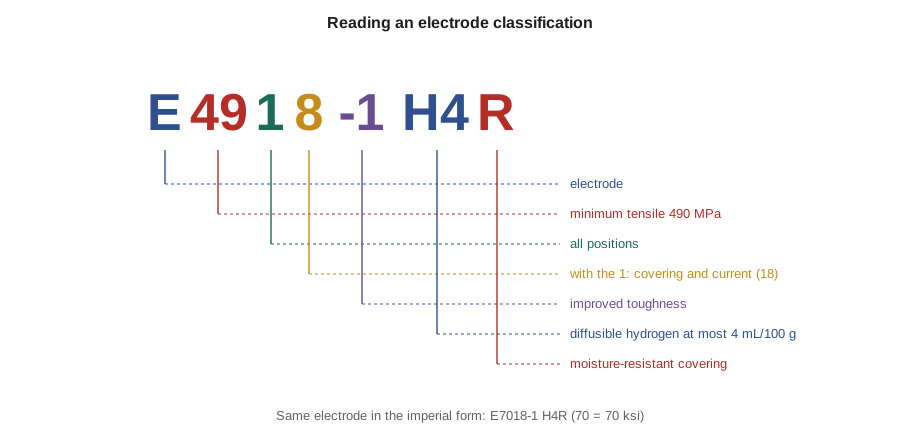
Every classification for carbon steel covered electrodes starts with E, for electrode, and is followed by four or five digits and sometimes a suffix. Taking E7018 as the example, read from the left:
- E: a covered electrode for arc welding.
- 70: the minimum tensile strength of the deposited weld metal, in thousands of pounds per square inch, so 70,000 psi. In the metric form, 49 means 490 MPa, which is about the same strength, so E7018 corresponds to E4918, and E6010 corresponds to E4310 (430 MPa, about 60,000 psi).
- 1: the third-from-last digit gives the welding positions. 1 means all positions; 2 means flat and horizontal fillet only; 4 means flat, horizontal, overhead and vertical down.
- 8: the last two digits together, here 18, describe the type of covering and the welding current and polarity it is designed for.
So E7018 is a 70 ksi electrode for all positions with a low-hydrogen potassium iron powder covering, run on AC or DCEP. E7024 is a 70 ksi electrode for flat and horizontal fillets with an iron powder titania covering. The classification standard also sets the chemical composition limits, mechanical property tests such as tensile and impact tests, and the soundness tests the electrode must pass, but the welder mostly needs the parts above.
Covering types and current
The last two digits group electrodes into families with very different running characteristics. The table lists the common carbon steel types; the welder learns to recognize each by its arc, its puddle and its slag as well as its number.
| AWS | Metric | Covering | Current | Positions |
|---|---|---|---|---|
| E6010 | E4310 | High cellulose, sodium | DCEP | All |
| E6011 | E4311 | High cellulose, potassium | AC or DCEP | All |
| E6013 | E4313 | High titania, potassium | AC, DCEP or DCEN | All |
| E7014 | E4914 | Iron powder, titania | AC, DCEP or DCEN | All |
| E7016 | E4916 | Low hydrogen, potassium | AC or DCEP | All |
| E7018 | E4918 | Low hydrogen, potassium, iron powder | AC or DCEP | All |
| E7024 | E4924 | Iron powder, titania | AC, DCEP or DCEN | Flat, horizontal fillet |
| E7028 | E4928 | Low hydrogen, potassium, iron powder | AC or DCEP | Flat, horizontal fillet |
In practice, four families cover most of a structural shop's stick welding:
- Cellulosic electrodes, E6010 and E6011. The covering is largely cellulose, which burns to give a strong, gas-rich, digging arc with deep penetration and a thin, easily removed slag. They are the classic choice for open root passes on pipe and for welding through light rust and paint on repair work. The arc is harsh and spattery, the bead surface is rough, and the weld metal carries a lot of hydrogen, so they are not used where low-hydrogen practice is required. E6010 needs DC; E6011 runs on AC, which suits farm transformer machines.
- Rutile electrodes, E6013 and E7014. The covering is mostly titanium dioxide, giving a soft, quiet arc, easy starts and restarts, little spatter, a smooth bead and slag that often peels off by itself. Penetration is shallow to medium. They are popular for light fabrication, sheet steel over a few millimetres, and general repair, and they are easy for beginners, but they are not low hydrogen.
- Low-hydrogen electrodes, E7016 and E7018. The covering is based on calcium carbonate and fluorides with almost no hydrogen-bearing compounds, so the weld metal contains very little hydrogen. These electrodes give sound, tough welds and are the standard for structural steel, pressure work and steels prone to cracking. They need careful storage, covered in the next lesson, a short arc, and a clean joint. E7018 with iron powder is the most widely used structural stick electrode in North America.
- Iron powder production electrodes, E7024 and E7028. Heavy coverings with a high iron powder content give a high deposition rate and a smooth, flat bead in the flat position and on horizontal fillets. They are run almost in contact with the work, dragging the covering, and they are used on long, downhand fillets. E7028 is the low-hydrogen version.
Devon runs one electrode of each on scrap plate in an afternoon, with Marta asking after each what the arc sounded like, how the slag came off, and how deep the bead dug in when the plate is cut and etched. The notebook page that comes out of it is one Devon keeps for years.
Suffixes and optional designators
Some electrodes carry extra characters after the classification. For carbon steel electrodes the common ones are:
- -1, as in E7018-1: improved impact toughness at a lower test temperature than the base classification, and for some types extra ductility. Used where the specification calls for notch toughness, such as bridges and low-temperature service.
- H4, H8 or H16: the maximum diffusible hydrogen in the weld metal, in millilitres per 100 grams of deposited metal, measured by a standard test. H4 is the lowest and is required on many structural and pressure jobs.
- R: a moisture-resistant covering that absorbs moisture more slowly after the box is opened, tested by exposure to a humid atmosphere.
- M: an electrode meeting a set of military-origin requirements for low moisture, toughness and composition, often specified for critical work.
Low-alloy steel electrodes, classified in AWS A5.5 and in the same CSA W48 family, add an alloy suffix after a hyphen. E8018-C1 has a nickel addition for toughness at low temperature; E8018-B2 has chromium and molybdenum for elevated-temperature service; E9018-M and E11018-M are high-strength military types. The strength digits rise with the alloy. These appear in later courses on pipe and pressure work; for now Devon only needs to know that a hyphen and a letter after the number mean an alloy electrode with its own uses, and that it is never substituted for an ordinary carbon steel electrode or the reverse without the procedure allowing it.
Stainless steel, nickel, cast iron and hardfacing electrodes have their own classification systems, based mostly on alloy type, for example E308L-16 for a low-carbon 308 stainless electrode with a rutile-type covering. They are covered with the processes and materials that use them.
# Decode a carbon steel covered electrode classification
import re
POS = {"1": "all positions", "2": "flat and horizontal fillet", "4": "flat, horizontal, overhead, vertical down"}
COVER = {"10": ("high cellulose sodium", "DCEP"), "11": ("high cellulose potassium", "AC or DCEP"),
         "13": ("high titania potassium", "AC, DCEP or DCEN"), "14": ("iron powder titania", "AC, DCEP or DCEN"),
         "16": ("low hydrogen potassium", "AC or DCEP"), "18": ("low hydrogen potassium iron powder", "AC or DCEP"),
         "24": ("iron powder titania", "AC, DCEP or DCEN"), "28": ("low hydrogen potassium iron powder", "AC or DCEP")}
STRENGTH = {"60": (430, 60), "70": (490, 70), "43": (430, 60), "49": (490, 70)}

def decode(code):
    m = re.match(r"E(\d\d)(\d)(\d)(-1)?\s*(H\d+)?(R)?\Z", code.replace(" ", ""))
    if not m:
        return code + ": not a carbon steel covered electrode code this decoder knows"
    s, p, last, tough, hyd, r = m.groups()
    mpa, ksi = STRENGTH[s]
    cover, current = COVER[p + last] if p + last in COVER else COVER.get("1" + last, ("?", "?"))
    out = [f"{code}: {mpa} MPa ({ksi} ksi) minimum tensile, {POS[p]}, {cover}, {current}"]
    if tough: out.append("  -1: improved impact toughness")
    if hyd: out.append(f"  {hyd}: at most {hyd[1:]} mL diffusible hydrogen per 100 g")
    if r: out.append("  R: moisture-resistant covering")
    return "\n".join(out)

for c in ["E4918-1 H4R", "E7018", "E6010", "E4924"]:
print(decode(c))E4918-1 H4R: 490 MPa (70 ksi) minimum tensile, all positions, low hydrogen potassium iron powder, AC or DCEP -1: improved impact toughness H4: at most 4 mL diffusible hydrogen per 100 g R: moisture-resistant covering E7018: 490 MPa (70 ksi) minimum tensile, all positions, low hydrogen potassium iron powder, AC or DCEP E6010: 430 MPa (60 ksi) minimum tensile, all positions, high cellulose sodium, DCEP E4924: 490 MPa (70 ksi) minimum tensile, flat and horizontal fillet, iron powder titania, AC, DCEP or DCEN
The decoder handles only the common carbon steel types in the table, and reads the covering from the last two digits. A real electrode is always checked against its box and data sheet; the code tells you the family, the manufacturer tells you the details.
Choosing an electrode for the job
On code work, the welding procedure specification names the electrode classification, and the welder uses that and nothing else. Where no procedure applies, such as a farm repair, the choice follows the same logic Marta teaches: the strength of the electrode should match or exceed the base metal; the positions must suit the job; the current must suit the machine; and the covering type must suit the conditions and the consequences of failure. A cracked grain auger frame of mild steel, welded in the flat and horizontal positions on a DC machine, gets E7018. A rusty fence post on an AC transformer welder gets E6011. A long horizontal fillet on clean plate in a production shop might get E7024, if the procedure allows it.
Electrodes must also be identifiable. CSA W59 and the shop's quality program require that electrodes be stored in labelled containers and that a welder can show which classification is in use. Loose, unmarked electrodes in a pocket or a bucket are scrapped.
Reading the box and the data sheet
The classification is the start of the information an electrode carries, not the end. The container label gives the classification, often in both the metric and the imperial form, the brand name, the diameter and length, the net weight, the lot or heat number, any optional designators such as H4 or R, and the standards it conforms to. Many labels also show the recommended current ranges and polarity by diameter, and some carry a hazard pictogram and a pointer to the safety data sheet. The manufacturer's data sheet adds typical mechanical properties and chemistry, approvals from classification societies and inspection bodies, storage and redrying instructions, and running notes for each position.
Before using a new box, the welder reads the label and compares it with the welding procedure: classification, diameter and any designator the procedure requires. Two boxes with the same classification from different makers can run differently, one with a smoother arc, another with stiffer slag, and the procedure may name a brand or allow any electrode of the classification. Welders also learn that the brand name alone tells nothing; the classification is what counts.
Substitutions need approval
On code work, substituting one electrode for another is a procedure change, not a welder's choice. An E7018 cannot be replaced with an E7024 because it runs faster, nor an E7018-1 H4 with plain E7018 because the box is closer, nor a 4.0 mm (5/32 in) electrode with a 4.8 mm (3/16 in) one if the procedure limits size. Some substitutions are allowed by the code or the procedure qualification, for example certain electrodes within the same group; others require a new or revised procedure and approval from the engineer or welding supervisor. When the specified electrode is not available, the welder stops and asks.
Electrodes for other jobs in the shop
Devon will meet other electrode families before long. Stainless steel electrodes such as E308L-16 and E309L-16 are used in the pressure bay for stainless spools and for joining stainless to carbon steel. Cast iron electrodes, often nickel-based, are used in the repair bay for cracked housings. Hardfacing electrodes build up wear-resistant surfaces on loader bucket edges and cultivator points. Each has its own classification system, storage rules and technique, and each is kept in its own labelled container well away from the carbon steel stock, because a mix-up is easy to make and hard to see in the finished weld.
Common mistakes
MistakeReading E7018 as 18 ksi or as an electrode for position 8.
Instead70 is strength; the third digit, 1, is position; the last two digits, 18, are covering and current.
MistakeUsing E6010 for a structural weld that calls for low hydrogen.
InsteadCellulosic electrodes put a lot of hydrogen in the weld; use the low-hydrogen classification specified.
MistakeTreating E7024 as an all-position electrode.
InsteadThe 2 means flat and horizontal fillet only.
MistakeAssuming E4918 and E7018 are different electrodes.
InsteadThey are the metric and imperial forms of the same strength and covering type.
MistakeSubstituting E8018-C1 for E7018 because it is stronger.
InsteadAlloy electrodes have specific uses; follow the procedure.
Summary and key terms
- Classifications start with E, then a strength number, a position digit and a covering and current digit.
- 70 means 70 ksi; 49 means 490 MPa; E7018 corresponds to E4918.
- Position digit: 1 all positions, 2 flat and horizontal fillet, 4 includes vertical down.
- Cellulosic (E6010), rutile (E6013), low-hydrogen (E7018) and iron powder (E7024) electrodes run very differently.
- Suffixes add toughness (-1), diffusible hydrogen limit (H4, H8, H16), moisture resistance (R) and alloy content (A5.5 types such as -C1).
- Electrode classification
- The standard code describing strength, positions, covering and current.
- Tensile strength
- The stress at which a test bar of weld metal breaks.
- Low-hydrogen electrode
- An electrode whose covering leaves very little hydrogen in the weld.
- Cellulosic electrode
- An electrode with a cellulose covering that gives a deep, digging arc.
- Rutile electrode
- An electrode with a titania covering that gives a soft arc and smooth bead.
- Diffusible hydrogen
- Hydrogen in the weld metal that can move and cause cracking.
Practice problems
Work each problem on paper first, then reveal the answer to check.
What does the 2 mean in E7024?
Show answer
Flat and horizontal fillet positions only.
What is the metric form of E6010?
Show answer
E4310.
What does H4 mean?
Show answer
At most 4 mL of diffusible hydrogen per 100 g of weld metal.
Which electrode family gives the deepest, most digging arc?
Show answer
Cellulosic, such as E6010 and E6011.
Lesson quiz · 5 questions
Score 60% or more to complete this lesson.
Create a free account to save your progress, take quizzes and earn a certificate.