
TRD-104 · Lesson 9 of 12 · 20 min
Fasteners: nails, screws, bolts and grades
Every building is held together by fasteners: millions of nails, screws, bolts and pins. On Kingsway Tower, the structural steel was bolted with high-strength bolts, the steel studs are screwed together, the plywood backing is nailed and screwed, and Maya's pipe hangers hang from threaded rod held by nuts. Choosing the wrong fastener is one of the quiet ways work fails: a drywall screw used to hang a heavy cabinet, a plain steel bolt where a high-strength one was specified, or an ordinary nail in treated lumber that corrodes away in a few years. This lesson covers the main types of fasteners, how they are sized and graded, and how to choose them.
The most important rule comes first. Where the drawings, the specifications or a manufacturer's instructions name a fastener, use exactly that fastener. Structural connections are designed by engineers for a particular fastener size, grade, length and spacing, and substituting something that looks similar can halve the strength of a connection.
Nails
Nails are the simplest fasteners: a shank with a head and a point, driven by impact. They hold by friction against the wood fibres and resist sideways (shear) loads well, but pull out more easily than screws.
- Common nails have thick shanks and large heads for framing. Box nails are thinner, to reduce splitting.
- Finishing and brad nails have small heads that can be set below the surface and filled.
- Ring-shank and spiral-shank nails have deformed shanks that grip the wood much better, used for subfloors, sheathing and siding.
- Roofing nails have large flat heads to hold shingles and membranes. Masonry nails are hardened for concrete and block, and shatter if struck badly.
- Collated nails, joined in strips or coils, are made for nail guns, which must be matched to the collation angle and type.
In Canada, nails are usually sold by length in inches or millimetres and by gauge, for example a 3 1/4 inch or 82 mm common nail for framing. The old penny system, written with the letter d, is still heard on site: a 10d nail is 3 inches long. The building code's nailing tables give the size and spacing of nails for each connection in wood-frame construction.
Screws
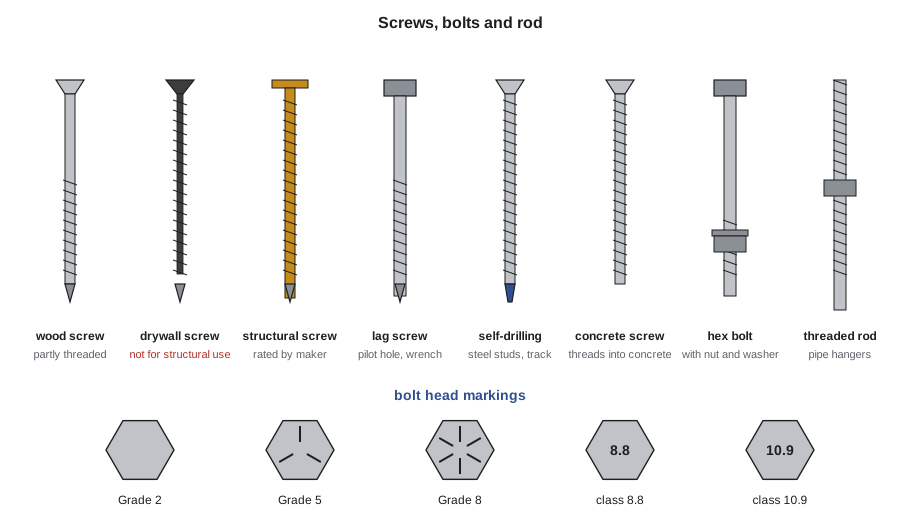
Screws hold by their threads, which grip the material and resist pulling out much better than nails. They come in a huge range of types, and each is made for a material:
- Wood screws have coarse threads for wood. Many are now partly threaded so the upper shank pulls the top piece tight.
- Drywall screws are thin, hardened and brittle. They are designed to hold gypsum board to studs and nothing else. They snap under sideways load and must never be used for structural connections, hanging heavy items or deck framing.
- Structural screws, or engineered wood screws, are tested and rated for structural loads and often replace lag screws and through-bolts in wood framing. Their size and spacing come from the manufacturer's tables or the engineer.
- Lag screws are large wood screws with hex heads, driven with a wrench or impact driver into a pilot hole.
- Sheet metal screws and self-drilling screws, with a drill-point tip, fasten steel studs, track, duct and light metal. The drill point must be long enough to drill through all the layers before the threads engage, or the screw will jam.
- Concrete screws, or screw anchors, thread directly into a drilled hole in concrete or masonry. They are covered with anchors in Lesson 10.
Screw heads have different drives, which Lesson 1 described: square, Phillips, star and hex. Choose a drive that suits the screw and use the matching bit in good condition.
Bolts, nuts and washers
A bolt passes through a hole in the parts it joins and is tightened with a nut. Bolts are described by diameter, thread pitch, length and grade or property class.
In imperial sizes, a bolt might be described as 1/2-13 x 3, meaning 1/2 inch diameter, 13 threads per inch (the coarse thread for that size, called UNC) and 3 inches long. Fine threads (UNF) have more threads per inch. In metric sizes, a bolt might be M12 x 1.75 x 80, meaning 12 mm diameter, 1.75 mm between threads (the coarse pitch for M12) and 80 mm long. Metric and imperial threads are not interchangeable, even when the sizes look close: an M12 nut will start on a 1/2 inch bolt and then jam or strip. Many Canadian sites use both systems, so check the markings.
Grades and markings
The strength of a bolt depends on its steel and heat treatment, shown by marks on the head. Using a weak bolt where a strong one is required is a serious error, and so is mixing nuts and bolts of different strengths.
| Marking on head | Grade or class | Approximate minimum tensile strength | Typical use |
|---|---|---|---|
| No marks | SAE Grade 2 | about 60 to 74 ksi (414 to 510 MPa) | Light, non-structural use |
| 3 radial lines | SAE Grade 5 | about 120 ksi (830 MPa) for sizes to 1 in | Machinery, general medium strength |
| 6 radial lines | SAE Grade 8 | about 150 ksi (1030 MPa) | High strength machinery |
| 8.8 | Metric class 8.8 | 800 MPa | General medium strength, similar to Grade 5 |
| 10.9 | Metric class 10.9 | 1040 MPa | High strength, similar to Grade 8 |
| A325 or A490 (now F3125) | ASTM structural bolt | 120 or 150 ksi | Structural steel connections |
Structural steel connections, like those on Kingsway Tower's steel-framed roof structure, use structural bolts to specific ASTM standards, installed by trained ironworkers to a specified tightness, often with direct tension indicator washers or twist-off bolts that show when the bolt is properly tensioned. Apprentices from other trades never loosen, remove or reuse structural bolts, or drill and bolt into structural steel, without approval.
Nuts are graded too and must be at least as strong as the bolt. Washers spread the load under the head and nut and protect the surface; hardened washers are used with high-strength bolts. Lock washers, locking nuts with nylon inserts, and thread-locking compounds help resist loosening from vibration.
Threaded rod and hanger rod
Maya uses a lot of threaded rod, which is threaded along its whole length, to hang pipe from inserts and anchors in the slabs. Common sizes for pipe hangers are 3/8 in and 1/2 in, or 10 mm and 12 mm in metric. Each hanger and rod size has a maximum load from the manufacturer, and the specifications set the rod size for each pipe size. Cut threaded rod with a rod cutter or band saw and clean the threads so the nut starts easily; a damaged thread can strip under load.
Corrosion and coatings
Fasteners corrode, and a corroded fastener loses strength. The coating must suit the location:
- Plain steel or bright fasteners are for dry interior use only.
- Zinc-plated (electro-galvanized) fasteners have a thin coating for mild exposure.
- Hot-dip galvanized fasteners have a thick zinc coating for exterior use and for pressure-treated lumber, whose copper-based preservatives corrode plain and lightly coated steel quickly.
- Stainless steel fasteners resist corrosion in wet, coastal and chemical environments.
Galvanic corrosion happens when two different metals touch in the presence of moisture: the less noble metal corrodes faster. Aluminum flashing fastened with copper nails, or galvanized steel hangers in contact with copper pipe, will corrode at the contact. Plumbers use dielectric unions and isolators between copper and steel, and copper-plated or plastic-coated hangers on copper pipe. Match the fastener metal to the material, or isolate them.
Tightening and torque
Tightening a bolt stretches it slightly, like a spring, and the stretch produces the clamping force that holds the joint together. Too little tension and the joint loosens or slips; too much and the bolt yields, strips or snaps. For critical bolts, the manufacturer or engineer specifies a torque, measured with a torque wrench, or a tensioning method. Torque values assume clean threads and specified lubrication; dirty, rusty or oiled threads change the tension produced by the same torque. Never guess at torque on critical bolts, and never use an impact wrench to final-tighten bolts that need a specified torque unless the method allows it.
Choosing a fastener
When the drawings do not specify a fastener, choose by asking these questions, in order:
- What materials am I joining, and what is the base material: wood, steel stud, concrete, masonry, drywall?
- What load does it carry, and in which direction: shear (sideways), tension (pull-out) or both? Is anyone's safety depending on it?
- Is it inside or outside, wet or dry, in treated lumber or in contact with another metal?
- Is there a manufacturer's instruction for the item being installed? Many products, such as hangers, brackets and fixtures, specify their fasteners.
- When in doubt about anything that carries a load, ask the foreman or the engineer.
Worked example: bolt strength
Worked problem
Comparing bolt grades
A support bracket for a pump at Kingsway Tower calls for M12 class 8.8 bolts. The gang box has M12 class 8.8 and some unmarked bolts of the same size. How much tensile force will an M12 class 8.8 bolt carry before it breaks, compared with an unmarked bolt assumed to be about 400 MPa? The tensile stress area of an M12 coarse bolt is about 84.3 mm².
Show solution
- Breaking force = tensile strength x tensile stress area.
- Class 8.8: 800 N/mm² x 84.3 mm² = 67 440 N, about 67 kN.
- Unmarked at about 400 N/mm²: 400 x 84.3 = 33 720 N, about 34 kN.
- The unmarked bolt breaks at about half the load. It must not be substituted. The working load is much less than the breaking force; the engineer's design includes safety factors.
Answer: About 67 kN for class 8.8 against about 34 kN for an unmarked bolt. Use the specified grade.
Here d is the nominal diameter in millimetres and p is the thread pitch in millimetres. The program uses this to compute the tensile stress area and the breaking force for several sizes and classes.
import math
sizes = [('M10', 10, 1.5), ('M12', 12, 1.75), ('M16', 16, 2.0), ('M20', 20, 2.5)]                 # (name, diameter mm, pitch mm)
grades = {'4.6': 400, '8.8': 800, '10.9': 1040}               # minimum tensile strength, MPa
for name, d, t in sizes:
    As = math.pi / 4 * (d - 0.9382 * t) ** 2
    row = f"{name:8} As = {As:6.1f} mm2 |"
    for g, s in grades.items():
        row += f" {g}: {s * As / 1000:7.1f} kN |"
print(row)M10 As = 58.0 mm2 | 4.6: 23.2 kN | 8.8: 46.4 kN | 10.9: 60.3 kN | M12 As = 84.3 mm2 | 4.6: 33.7 kN | 8.8: 67.4 kN | 10.9: 87.6 kN | M16 As = 156.7 mm2 | 4.6: 62.7 kN | 8.8: 125.3 kN | 10.9: 162.9 kN | M20 As = 244.8 mm2 | 4.6: 97.9 kN | 8.8: 195.8 kN | 10.9: 254.6 kN |
These are breaking forces for a straight pull, not safe working loads. Hangers, anchors and connections are designed with large safety factors, and their allowable loads come from manufacturers' tables and the engineer, never from a calculation like this on site.
Common mistakes
MistakeUsing drywall screws to hang heavy items or in structural connections.
InsteadUse rated structural screws, lag screws or bolts as specified.
MistakeSubstituting an unmarked bolt for a graded one.
InsteadUse the specified grade or class; check the head markings.
MistakeStarting a metric nut on an imperial bolt.
InsteadCheck the thread system; metric and imperial threads are not interchangeable.
MistakeUsing plain or zinc-plated fasteners in pressure-treated lumber.
InsteadUse hot-dip galvanized or stainless fasteners as required.
MistakePutting galvanized steel hangers directly on copper pipe.
InsteadUse copper-plated or isolated hangers to prevent galvanic corrosion.
MistakeLoosening or drilling structural steel bolts and members without approval.
InsteadNever alter structural connections without the engineer's approval.
Summary and key terms
- Use exactly the fastener the drawings, specifications or manufacturer require.
- Nails resist shear well; screws hold better against pull-out; each type is made for a material.
- Drywall screws are brittle and never structural; structural screws are rated by the manufacturer.
- Bolts are described by diameter, thread, length and grade; head markings show strength.
- Choose coatings for the exposure; prevent galvanic corrosion between different metals.
- Critical bolts are tightened to a specified torque or tension; never guess.
- Shear load
- A force acting sideways across a fastener.
- Tension load
- A force pulling a fastener out or along its length.
- Penny (d)
- A traditional nail size; for example a 16d common nail is 3 1/2 inches long.
- Thread pitch
- The distance between threads; in imperial sizes, threads per inch is used instead.
- Property class
- The metric strength rating of a bolt, such as 8.8 or 10.9.
- Tensile stress area
- The effective cross-sectional area of a threaded fastener used in strength calculations.
- Galvanic corrosion
- Faster corrosion of one metal in contact with a different metal in moisture.
- Hot-dip galvanized
- Coated with a thick layer of zinc by dipping in molten zinc.
Practice problems
Work each problem on paper first, then reveal the answer to check.
What do three radial lines on a bolt head mean?
Show answer
SAE Grade 5.
What does M16 x 2.0 x 100 mean?
Show answer
16 mm diameter, 2.0 mm thread pitch, 100 mm long.
Why must drywall screws not be used to hang a cabinet?
Show answer
They are brittle and snap under sideways load.
Which fasteners suit pressure-treated lumber?
Show answer
Hot-dip galvanized or stainless steel.
What is the tensile stress area of an M16 x 2.0 bolt?
Show answer
pi/4 x (16 - 0.9382 x 2)^2 = about 157 mm².
Why are plumbers careful about steel hangers on copper pipe?
Show answer
Contact between the metals in moisture causes galvanic corrosion.
Lesson quiz · 5 questions
Score 60% or more to complete this lesson.
Create a free account to save your progress, take quizzes and earn a certificate.