
TRD-104 · Lesson 8 of 12 · 22 min
Powder-actuated and pneumatic fastening tools
Some fastening tools drive a pin or nail with a single burst of energy: a cartridge of powder, a fuel cell or a blast of compressed air. They are fast, and they let one worker fasten track to concrete or sheathing to studs at a rate no hammer could match. They also fire fasteners at speeds that can go straight through a hand, a wall or a person on the other side. This lesson covers powder-actuated tools, gas-actuated tools and pneumatic nailers and staplers, and the compressed-air systems that drive them.
On Kingsway Tower, the steel stud crew uses powder-actuated tools to fasten floor track to the slabs, and the electricians use them to fix clips for conduit. Maya's crew uses them occasionally to fasten pipe clips to concrete walls. Only trained and authorized workers may use them, and Luis has made sure Maya is trained before she touches one.
How powder-actuated tools work
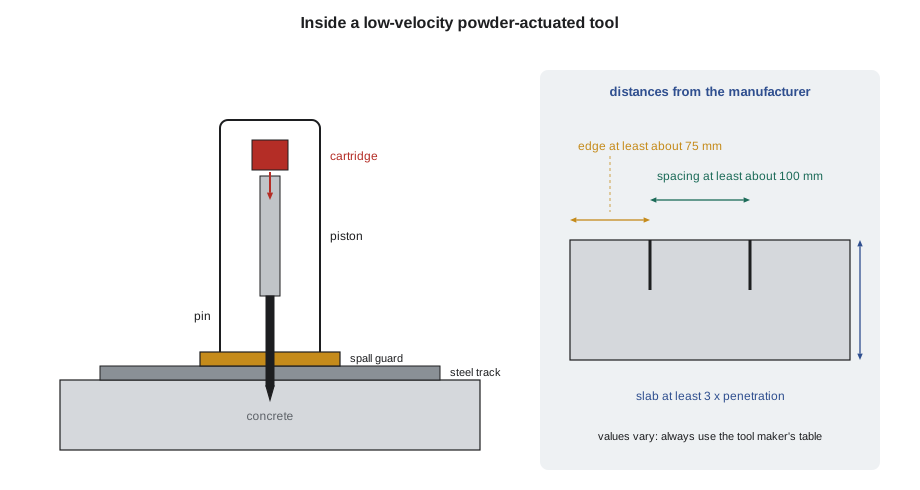
A powder-actuated tool, often called a PAT or a powder gun, uses a small explosive cartridge, similar to a blank firearm round, to drive a hardened steel pin into concrete, steel or masonry. Modern construction tools are almost all low-velocity, indirect-acting tools: the expanding gas pushes a piston, and the piston drives the fastener. The piston stops inside the tool, so the fastener travels only as far as the piston pushes it, and its speed is far lower than a bullet's. Older high-velocity tools, in which the gas pushed the fastener directly, are rarely seen today because a fastener that misses or passes through the material can travel a long way at lethal speed.
Low-velocity does not mean safe. A pin from a powder-actuated tool can pass through a hand, ricochet off hard steel or a stone in the concrete, shatter brittle material, or blow out the far side of a thin slab or wall and injure someone there.
Cartridges
Cartridges, also called loads or boosters, come in several power levels. Each level is identified by a number and by a colour code on the cartridge, and the colour code and numbering vary somewhat between manufacturers, so always check the chart for the tool you are using. The rule is to start with the weakest load that might work and increase one step at a time until the fastener seats properly. Too strong a load drives the pin too deep, overdrives the head through the fixture or causes a ricochet; too weak, and the pin stands proud.
- Use only cartridges made for the tool, of the type and calibre listed in its instructions.
- Keep cartridges in their original container, separated by power level, and locked away when not in use.
- Never carry loose cartridges in a pocket, and never leave them where untrained people could get them.
The rules for powder-actuated tools
In Ontario, the Construction Projects regulation (O. Reg. 213/91, sections 117 to 121) sets the rules for explosive-actuated fastening tools. Only a worker who has been adequately trained may use one, and the worker must carry proof of that training. The tool must be inspected before use, must have a protective guard at the muzzle unless it is a low-velocity type that meets the regulation's speed limit, must not fire unless pressed firmly against the surface and squared to it, and must need two separate actions to fire. When it is not in use it is stored unloaded in a locked container, loaded only immediately before use and never pointed at anyone. Misfired cartridges are placed in a container of water until they are removed from the project.
Whatever the jurisdiction, the practical rules are the same, and Maya's training covered them all:
- Inspect the tool before use: clean, moving parts free, barrel clear, guard and safety interlocks working. A tool that fails any check is tagged out and returned.
- Know what you are fastening into. Never fire into soft or brittle materials such as drywall, glass, tile, glazed brick, cast iron or hardened steel, or into anything the fastener could pass through. Never fire into spalled, cracked or previously damaged concrete.
- Keep the required distances from edges and other fasteners, and make sure the base material is thick enough: the manufacturer's tables give these, and typical values for concrete are about 75 mm, or 3 in, from an edge and a base at least three times as thick as the pin's penetration.
- Never fire into an existing hole or close to a previous fastener that failed; the new pin can follow the old path or deflect.
- Press the tool firmly and squarely against the work. The tool is designed not to fire unless the muzzle is pushed in and held nearly perpendicular to the surface; do not try to defeat that.
- Wear safety glasses, hearing protection and, where needed, a face shield. Everyone nearby needs eye and hearing protection too.
- Make sure nobody is on the other side of a wall or below a thin slab, and that the area beyond is clear.
- Never use a powder-actuated tool in an explosive or flammable atmosphere, such as near fuel vapours or in an area with gas present.
Misfires
Sometimes the tool clicks but does not fire. A misfired cartridge can still go off late, a delay called hang fire. The standard procedure, which matches the manufacturers' instructions, is to hold the tool firmly against the work for at least 30 seconds, then try to fire again. If it still does not fire, hold it another 30 seconds, then carefully unload it, keeping it pointed at a safe surface, and put the cartridge in a container of water. Never try to pry a stuck cartridge out with a knife or screwdriver, and never throw misfires in the garbage.
Gas-actuated tools
Gas-actuated fastening tools use a small fuel cell and a battery-powered spark to drive pins into concrete and steel or nails into wood. They are lighter to handle and do not use explosive cartridges, but they are still fastening tools that fire hardened pins at high energy, and they carry most of the same hazards. Follow the manufacturer's training and instructions, store fuel cells away from heat, and never use them in flammable atmospheres.
Pneumatic nailers and staplers
Pneumatic nail guns drive nails and staples with compressed air. They are standard for framing, sheathing, roofing and finishing. Research by NIOSH and the Center to Protect Workers' Rights (now CPWR) found nail guns to be a leading cause of hand injuries among residential carpenters, and that apprentices and less experienced workers are injured much more often. Most of those injuries are linked to the trigger type.
Trigger types
Nail guns have two controls: the trigger, and a contact element or safety tip at the nose that must be pressed against the work. How the two work together determines the risk:
- Full sequential trigger: the contact element must be pressed first, then the trigger pulled. To fire again, both must be released and the sequence repeated. This is the safest type.
- Single sequential trigger: like full sequential for the first nail, but the trigger can be held and the contact released and pressed again for the next nail. Slightly faster, slightly more risk.
- Contact trigger: the gun fires whenever the contact and trigger are both activated, in either order. Holding the trigger and bumping the nose along the work fires nails rapidly, called bump firing. It is fast, and it causes most unintended firings: a double fire when the gun recoils, or a nail fired when the user bumps a leg while carrying the gun with the trigger held.
- Single actuation trigger: fires one nail each time the trigger is pulled with the contact pressed, then requires both to be released.
Safety agencies, including NIOSH in the United States, recommend full sequential triggers, especially for apprentices, and many contractors require them. On Kingsway Tower, Stonebridge requires full sequential triggers on all nailers.
Nail gun rules
- Keep your finger off the trigger unless the nose is on the work and you are ready to fire.
- Keep your hand at least 300 mm or 12 in away from the point of firing. Nails can pass through thin material, follow the grain or deflect off knots and metal.
- Disconnect the air hose before clearing jams, adjusting, leaving the tool or passing it to someone.
- Never point the gun at anyone, and never carry it with a finger on the trigger.
- Avoid nailing near the edge of a board or into knots and hardware, and never nail toward yourself.
- Use the lowest air pressure that drives the nails properly, within the tool's rating.
Compressed air systems
Compressors, hoses and fittings carry their own hazards. Compressed air can enter the bloodstream through a cut or even through intact skin and cause an embolism; it can blow particles into the eyes or ears; and a hose that comes loose under pressure whips violently.
- Inspect hoses and fittings before use. Replace damaged hoses rather than taping them.
- Use safety devices on large hoses, such as whip checks across couplings and excess-flow valves at the supply, so that a hose that separates cannot whip.
- Never point compressed air at a person, and never use it to clean dust off clothing or skin.
Where compressed air is used for cleaning, it is reduced to a low pressure with chip guarding and protective equipment, following the manufacturer and site rules. Compressed air must not be used to clean up silica dust.
- Drain the compressor tank regularly and check that its pressure relief valve works.
- Shut off the air and bleed the pressure before disconnecting a hose.
Worked example: checking fastener layout
Worked problem
Edge distance and spacing
The steel stud foreman marks fasteners for a length of floor track along the edge of a balcony slab at Kingsway Tower. The manufacturer's table for the pins being used requires at least 75 mm from any concrete edge, at least 100 mm between fasteners and a slab at least three times the 25 mm pin penetration. The slab is 200 mm thick. The track runs 60 mm from the slab edge. Can it be fastened there?
Show solution
- Base thickness: 3 x 25 = 75 mm needed; the slab is 200 mm. OK.
- Spacing: fasteners can be placed at 100 mm or more apart. OK.
- Edge distance: the track centre is 60 mm from the edge, less than the 75 mm required. Not OK.
- The foreman must move the track back, use a different fastener such as a screw anchor approved for that edge distance, or ask the engineer. Firing a pin 60 mm from the edge risks blowing out the concrete edge.
Answer: The edge distance fails. Do not fire powder-actuated pins closer to the edge than the manufacturer allows.
The program below checks a list of planned pin locations against the edge, spacing and thickness limits and flags any that fail.
import math
edge_min, space_min, factor = 75, 100, 3        # mm
penetration, slab = 25, 200                       # mm
slab_edges_y = 0                                        # slab edge along y = 0
pins = [(0, 60), (600, 80), (1200, 80), (1260, 80), (1800, 120)]                                           # (x, y) in mm
print("base thickness OK" if slab >= factor * penetration else "slab too thin for this pin")
for i, (x, y) in enumerate(pins):
    problems = []
    if y - slab_edges_y < edge_min:
        problems.append(f"edge {y - slab_edges_y} < {edge_min}")
    for j, (x2, y2) in enumerate(pins):
        if j != i and math.dist((x, y), (x2, y2)) < space_min:
            problems.append(f"too close to pin {j}")
print(f"pin {i} at ({x}, {y}): " + ("OK" if not problems else "; ".join(problems)))base thickness OK pin 0 at (0, 60): edge 60 < 75 pin 1 at (600, 80): OK pin 2 at (1200, 80): too close to pin 3 pin 3 at (1260, 80): too close to pin 2 pin 4 at (1800, 120): OK
The manufacturer's published values govern; they vary with the pin type, the concrete strength and the load. When in doubt, ask before firing.
Common mistakes
MistakeUsing a powder-actuated tool without being trained and authorized.
InsteadGet trained on the specific tool and carry proof of training.
MistakeStarting with a strong cartridge to make sure the pin seats.
InsteadStart with the weakest load and increase one step at a time.
MistakeFiring into tile, drywall, cast iron or spalled concrete.
InsteadFire only into suitable base materials, away from edges and damaged areas.
MistakeThrowing a misfired cartridge in the garbage.
InsteadFollow the misfire procedure and put it in a container of water.
MistakeBump firing a contact-trigger nailer while carrying it with a finger on the trigger.
InsteadUse full sequential triggers and keep your finger off the trigger until ready.
MistakeBlowing dust off clothing with compressed air.
InsteadNever point compressed air at people; use a vacuum or brush.
Summary and key terms
- Low-velocity powder-actuated tools drive pins with a piston, but pins can still pass through, ricochet or blow out edges.
- Only trained, authorized workers may use them; the regulations require training, inspection and safe storage.
- Start with the weakest load; respect edge, spacing and thickness limits; never fire into unsuitable materials.
- Handle misfires with the waiting procedure and a water container.
- Full sequential triggers greatly reduce nail gun injuries; keep hands well clear of the firing point.
- Compressed air can injure: use whip checks, never point it at people, and disconnect before servicing tools.
- Powder-actuated tool
- A tool that uses an explosive cartridge to drive pins into concrete, steel or masonry.
- Low-velocity tool
- A powder-actuated tool in which a piston, not the gas directly, drives the fastener.
- Cartridge (load)
- The explosive charge that powers a powder-actuated tool, made in several strengths.
- Hang fire
- A delayed firing of a cartridge after the trigger is pulled.
- Spall
- A chip or flake broken off the surface of concrete.
- Full sequential trigger
- A nail gun trigger that fires only when the contact is pressed first and the trigger pulled second, for each nail.
- Bump firing
- Firing a contact-trigger nailer by holding the trigger and bumping the nose on the work.
- Whip check
- A cable restraint across an air hose coupling that stops the hose whipping if it separates.
Practice problems
Work each problem on paper first, then reveal the answer to check.
Why are low-velocity tools safer than high-velocity ones?
Show answer
The piston drives the fastener and stops in the tool, so the fastener's speed is much lower.
A pin stands above the surface. What do you do?
Show answer
Try the next stronger load, one step at a time, after checking the base material.
Name three materials you must never fire into.
Show answer
Any of: drywall, glass, tile, glazed brick, cast iron, hardened steel, spalled concrete.
The tool clicks but does not fire. What is the first step?
Show answer
Hold it firmly against the work for at least 30 seconds before trying again.
Which nail gun trigger type is safest?
Show answer
The full sequential trigger.
What must you do before clearing a jam in a pneumatic nailer?
Show answer
Disconnect the air hose.
Lesson quiz · 5 questions
Score 60% or more to complete this lesson.
Create a free account to save your progress, take quizzes and earn a certificate.