
TRD-104 · Lesson 12 of 12 · 20 min
Inspection, maintenance, tagging and your own kit
Every lesson in this course has said to inspect the tool before using it. This final lesson pulls those checks together into a routine, explains what happens to a tool that fails, and covers the care, storage and security of tools on a busy site. It ends where Lesson 1 began, with Maya's own kit: how a first-year apprentice chooses tools, looks after them and builds a set that will last a career.
Who is responsible for tools
Under Ontario's Occupational Health and Safety Act, the employer must make sure that the equipment, materials and protective devices it provides are maintained in good condition, and supervisors must make sure workers use them properly. Workers must use equipment as they were trained, report any defect they know of to the supervisor, and must not use equipment in a way that endangers anyone. Those duties apply to the tools a worker owns and brings to site as well as to company tools, since they are used in the employer's workplace.
In practice, on Kingsway Tower, Northbridge Mechanical owns the larger tools (rotary hammers, saws, threading machines, press tools, powder-actuated tools) and keeps them in its gang boxes and a tool crib, and each apprentice and journeyperson owns their hand tools and some cordless tools. Everyone inspects what they use, every time.
The pre-use inspection
A pre-use inspection takes less than a minute for most tools. Luis taught Maya to do it the same way every time, so nothing gets skipped:
- General condition: housing, handle and body free of cracks, missing screws and damage; tool clean enough to inspect.
- Power: cords and plugs intact, ground pin present, strain relief in place; or battery free of cracks, swelling and damage; or air hose and fittings in good condition.
- Controls: trigger and switch work and return to off; lock-on button works only where allowed; clutch and speed settings work.
- Guards and safety devices: present, undamaged and moving freely; lower saw guards snap back; grinder guards correctly positioned; powder-actuated tool interlocks function.
- Accessories: correct type for the job and material, sharp, undamaged, rated for the tool's speed, and properly secured.
- Labels: nameplate and safety labels legible; inspection tag or colour code current where the site uses one.
For hand tools the check is simpler: heads tight, handles sound, no mushrooming, jaws and tips not worn, blades sharp, insulated tools' insulation intact.
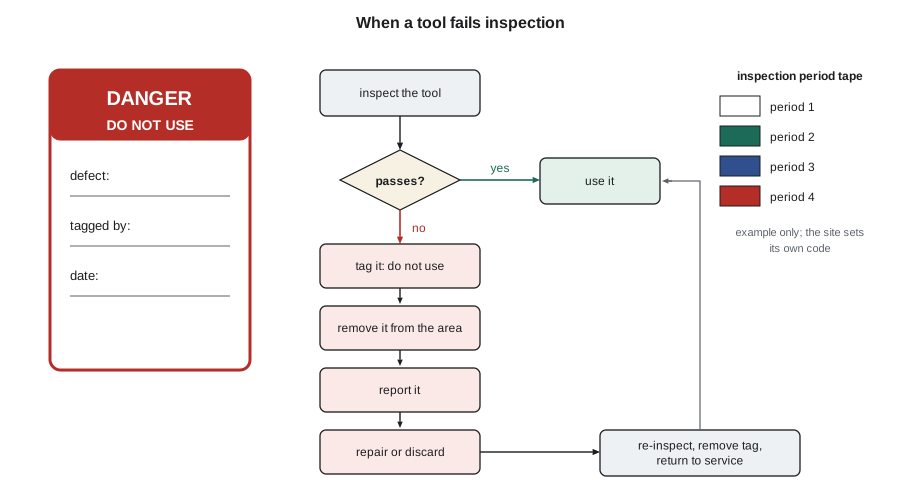
When a tool fails: tag it out
A tool that fails inspection, or that breaks or behaves strangely in use, is taken out of service immediately. On Kingsway Tower the procedure is the same for every trade:
- Stop using it and, for a powered tool, disconnect it or remove the battery.
- Attach a do not use tag (also called a danger tag or defective tool tag) stating the problem, your name and the date.
- Remove it from the work area so nobody picks it up by mistake. Put it in the designated place for defective tools, often a marked bin or shelf in the gang box or crib.
- Report it to your foreman or supervisor.
- Do not try to repair it yourself unless repairing tools is your job and you are qualified. Electrical repairs to tools and cords are done by qualified people; many tools must go back to an authorized service centre to keep their certification.
A tagged tool is not used until it has been repaired, inspected and the tag removed by an authorized person, or until it is disposed of. Damaged tools that are not worth repairing should be destroyed or made unusable before disposal, especially cords and abrasive wheels, so that nobody fishes them out of the bin.
Tagging a defective tool is different from lockout. Lockout, covered in TRD-101, isolates the energy to machinery or systems so that people can work on them safely, using personal locks. A do not use tag on a hand tool marks it as defective; it is not an energy isolation procedure.
Periodic inspection programs
Besides the pre-use checks, many tools and items need regular formal inspections, recorded in a log:
Cords and portable electrical tools on many Ontario sites are inspected on a regular schedule set by the employer, with a coloured tape or tag showing the current period. Fall protection equipment, ladders, rigging and fire extinguishers each have their own inspection requirements.
Powder-actuated tools are serviced on the manufacturer's schedule and after a set number of shots. Torque wrenches, gas detectors and laser levels are calibrated on schedules set by their manufacturers. Press tools for copper and PEX fittings are serviced after a set number of cycles. A tool's inspection record is part of its history, and an expired calibration or service date is as good as a failed inspection.
Maintenance
Good maintenance makes tools last, work better and stay safe:
- Keep cutting tools sharp. Sharpen chisels and knives, replace dull blades and bits. A sharp tool is a safe tool.
- Clean tools after use: blow or brush out dust from vents with the tool unplugged, wipe off concrete, solder flux, sealant and moisture.
- Lubricate as the manufacturer directs; oil pneumatic tools daily if required, and keep moving parts of hand tools free of rust.
- Store tools dry. Rust attacks blades, measuring tapes and mechanisms.
- Look after batteries: store them partly charged in moderate temperatures, keep terminals clean, and recycle damaged or worn-out packs.
- Replace worn parts: worn chucks, frayed hoses, cracked handles, faded labels.
Storage and security
Tool theft is a serious problem on construction sites. Gang boxes are locked when not attended and at the end of each shift; powder-actuated tools and cartridges are kept in locked containers as the regulations require; and many contractors mark their tools with engraving, paint or tracking tags. Personal tools should be marked with your name or an identifying mark and kept in a lockable box. Keep an inventory with serial numbers and photos; insurance and police reports need them.
Storage is also a safety issue. Tools left on the floor are trip hazards; tools left on ledges, beams and scaffolds can fall. Store sharp tools with their blades covered, coil cords and hoses neatly, and keep walkways clear.
Tools at height
Dropped tools are a leading cause of struck-by injuries on high-rise sites. A small wrench dropped from the eighth floor of Kingsway Tower hits the ground with enough energy to cause a serious head injury, even through a hard hat. Workers on scaffolds, mast climbers, aerial platforms and open floor edges use tool lanyards attached to a wrist strap or a tool belt anchor, holsters and buckets with closures, and toe boards and debris netting on platforms. Lanyards must be rated for the tool's weight and attached only to points that can hold it; never attach a heavy tool lanyard to your fall arrest harness unless the harness manufacturer allows it. A dropped-object prevention standard published by ANSI and the International Safety Equipment Association gives requirements for tool tethering systems, and many contractors, including Stonebridge, follow it.
Vibration and noise over a career
Some tool hazards build up slowly. Long-term use of vibrating tools such as rotary hammers, grinders, impact wrenches and breakers can cause hand-arm vibration syndrome, which damages the blood vessels, nerves and joints of the hands and fingers: fingers that go white and numb in the cold, lost grip and lost dexterity. The damage is permanent. Choose low-vibration tools where possible, keep tools maintained (worn bits and unbalanced wheels vibrate more), take breaks, keep hands warm, and let the tool do the work instead of gripping it hard. Noise-induced hearing loss also builds up silently over years; wear hearing protection whenever tools are loud enough that you must raise your voice to be heard by someone an arm's length away.
Building your own kit
Every trade has a list of tools apprentices are expected to supply, often set out in a collective agreement or by the employer, with the employer supplying the larger and specialized tools. Maya's first-year list from Northbridge Mechanical included:
- A tool bag or box, and a lockable box for site storage.
- Tape measures, a torpedo level and a longer level, a combination square and pencils, markers and a scribe.
- A self-retracting utility knife, a hacksaw and blades, tubing cutters for small copper, and a plastic pipe cutter.
- Screwdrivers and a multi-bit driver, adjustable wrenches, two pipe wrenches, tongue-and-groove pliers, locking pliers and side cutters.
- A ball-peen hammer, a cold chisel and a set of files and a deburring tool.
- Her own personal protective equipment, as required by the site, though much of it is supplied.
Luis's advice for building a kit:
- Buy the best quality you can afford for the tools you use every day: knives, tapes, levels, wrenches, pliers. Cheap versions wear out, slip and injure.
- Buy as you need. Do not buy a specialized tool until you know you will use it.
- Choose for fit and comfort, and try tools before buying where you can.
- Stay with one cordless battery platform so batteries and chargers are shared.
- Keep tools clean, sharp and organized. A journeyperson can tell a lot about an apprentice from the state of their tool bag.
Capstone: an inspection round
At the end of her first month, Luis gave Maya a test. He set out eight tools on the tailgate and asked her to inspect each and decide whether it could be used. Her findings:
| Tool | What Maya found | Decision |
|---|---|---|
| Utility knife | Self-retracting, blade dull | Change the blade, then use |
| Cold chisel | Head mushroomed | Tag it; dress the head or retire it |
| Corded hammer drill | Ground pin missing | Tag it; remove from service for repair |
| Cordless impact driver | Battery swollen | Remove battery from service; recycle it; tool OK with a good battery |
| Circular saw | Lower guard returns slowly | Tag it; repair before use |
| Angle grinder | Wheel rated above tool speed, guard in place | OK to use with face shield and glasses |
| Extension cord | Cut jacket taped over | Tag it; remove from service |
| Adjustable wrench | Jaw worn and loose | Retire it |
Luis agreed with every decision. "Most of the tools that hurt people were already broken before they picked them up," he said. "Your job is to notice."
Tracking inspections in code
Many contractors keep their tool inspection records in software. The program below shows the idea: it reads a list of tools with their last inspection dates and inspection intervals and reports which ones are due or overdue.
from datetime import date, timedelta
today = date(2026, 11, 2)
tools = [  # (tool, last inspection, interval in days)
    ("extension cord EC-07", date(2026, 7, 28), 90),
    ("rotary hammer RH-02", date(2026, 10, 1), 90),
    ("powder-actuated tool P-01", date(2026, 5, 15), 180),
    ("laser level LL-03", date(2025, 11, 20), 365),
    ("torque wrench TW-01", date(2026, 3, 1), 365),
    ("harness H-14", date(2026, 10, 30), 7),
]
for name, last, days in tools:
    due = last + timedelta(days=days)
    left = (due - today).days
    if left < 0:
        status = f"OVERDUE by {-left} days - tag out until inspected"
    elif left <= 14:
        status = f"due in {left} days"
    else:
        status = "current"
print(f"{name:26} last {last} due {due} {status}")extension cord EC-07 last 2026-07-28 due 2026-10-26 OVERDUE by 7 days - tag out until inspected rotary hammer RH-02 last 2026-10-01 due 2026-12-30 current powder-actuated tool P-01 last 2026-05-15 due 2026-11-11 due in 9 days laser level LL-03 last 2025-11-20 due 2026-11-20 current torque wrench TW-01 last 2026-03-01 due 2027-03-01 current harness H-14 last 2026-10-30 due 2026-11-06 due in 4 days
A tool that is overdue for inspection is treated the same as a tool that has failed: it is tagged and not used until it has been checked.
Common mistakes
MistakeUsing a tool with an expired inspection tag or calibration.
InsteadTreat it as defective: tag it and have it inspected before use.
MistakeRepairing a damaged cord or tool yourself.
InsteadTag it and send it to a qualified person or service centre.
MistakeLeaving a tagged tool in the work area.
InsteadRemove it to the designated defective-tool location so no one uses it.
MistakeConfusing a do not use tag with lockout.
InsteadTags mark defective tools; lockout isolates energy with personal locks.
MistakeWorking at height with untethered tools.
InsteadUse rated lanyards, holsters and closed buckets, attached to suitable points.
MistakeBuying the cheapest tools for daily use.
InsteadBuy quality for the tools you use every day; buy specialized tools only when needed.
Summary and key terms
- Employers and workers share responsibility for tool condition, including worker-owned tools.
- Inspect every tool before use: condition, power, controls, guards, accessories and labels.
- Tag, remove and report defective tools; only qualified people repair them.
- Periodic inspections, calibrations and service intervals are recorded and must be current.
- Maintain, store and secure tools; tether tools at height.
- Protect yourself from vibration and noise over a career, and build a quality personal kit.
- Pre-use inspection
- A quick check of a tool before each use.
- Do not use tag
- A tag that marks a defective tool and removes it from service.
- Tool crib
- A secure store where an employer keeps and issues tools.
- Calibration
- Checking and adjusting a measuring or testing instrument against a standard.
- Tool lanyard
- A tether that attaches a tool to the worker or structure to prevent drops.
- Hand-arm vibration syndrome
- Permanent damage to the hands from long-term use of vibrating tools.
- Gang box
- A lockable steel job-site box for storing tools.
- Inspection log
- A record of inspections, findings and dates for tools and equipment.
Practice problems
Work each problem on paper first, then reveal the answer to check.
What are the five steps when a tool fails inspection?
Show answer
Stop and disconnect it, tag it, remove it from the work area, report it, and have it repaired or disposed of by a qualified person.
Is a do not use tag the same as a lockout?
Show answer
No. The tag marks a defective tool; lockout isolates energy sources with personal locks.
A cord was last inspected 100 days ago on a 90-day schedule. Can it be used?
Show answer
No. It is overdue and must be inspected first.
Why should damaged cords be cut or made unusable before disposal?
Show answer
So nobody takes them from the bin and uses them.
Name two ways to prevent dropped tools at height.
Show answer
Any two of: tool lanyards, holsters, closed buckets, toe boards, debris netting.
What is hand-arm vibration syndrome?
Show answer
Permanent damage to blood vessels, nerves and joints of the hands from vibrating tools.
Lesson quiz · 5 questions
Score 60% or more to complete this lesson.
Create a free account to save your progress, take quizzes and earn a certificate.