
SMW-310 · Lesson 6 of 12 · 19 min
Lifting duct and working at heights
Nearly all duct installation happens above head height, with heavy, awkward pieces that have sharp edges and catch the wind. The work is done from ladders, scaffolds and mobile elevating work platforms, and the duct is raised with material lifts, hoists and sometimes cranes. Falls from height and struck-by injuries from dropped materials are among the leading causes of serious injury in construction, and sheet metal workers are exposed to both every day. This lesson covers how the crew gets the duct up, how it works safely at height, and what the rules require in each country.
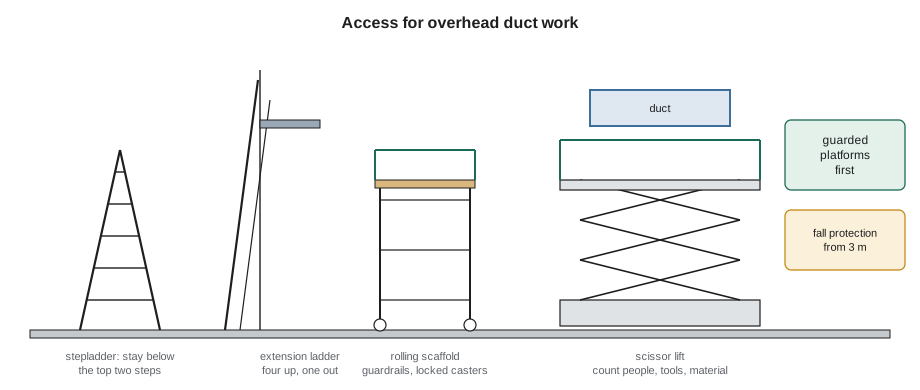
Sean's crews follow a simple order of thinking for any task at height: first, can the work be done from the floor, for example by assembling duct sections on the floor and raising them together? If not, use a platform with guardrails, such as a scaffold or scissor lift. Only when a guarded platform is not practical does the crew rely on personal fall protection, and a ladder is for short, light tasks, not for hanging a main.
Getting the duct up
Duct is light per metre but large, and a two-section length of trunk T1 with its flanges weighed over 50 kg (110 lb): too heavy and too bulky to carry up a ladder. The usual tool is a duct lift, a portable material lift with a winch and forks or a cradle that raises the duct to ceiling height so the crew can join and hang it from a platform. Duct lifts have a rated capacity and a maximum height and must stand on a firm, level floor. They are not personnel lifts: nobody rides them.
Long runs are often assembled on the floor into sections of two or three pieces, sealed, and raised together on two lifts, which cuts the number of joints made overhead. That is faster and safer, but the assembled section has to be supported at its quarter points while it is raised so it does not bend at a joint. On the Ashgrove corridor mains, Aggie assembled three-piece sections on sawhorses, sealed and inspected the joints, and raised them on two lifts while Kai and the second apprentice steadied the ends from scissor lifts.
Heavy items such as fans, coils, large dampers and the rooftop unit are rigged with chain hoists, come-alongs or cranes. A chain hoist must hang from a rigging point able to take the load; hanging one from a beam or a slab anchor needs the engineer's or the general contractor's approval, and from a pipe or duct never. The Ashgrove rooftop unit came up by mobile crane, run by the crane company with a qualified rigger and signal person; Keelson's crew only guided it onto the curb with tag lines, standing clear of the load.
Ladders
Ladders are the most familiar access equipment and the cause of many falls. The rules are simple and the same everywhere: use the right ladder for the job, inspect it before use, set it on firm footing, keep three points of contact while climbing, face the ladder, and never carry duct up a ladder. Extension ladders are set at about four units up to one unit out, tied or held at the top, and extend about 1 m (3 ft) past a landing. Stepladders are used fully open and locked, and nobody stands on the top cap or the step below it.
Ladders suit short tasks such as fastening a strap, setting a diffuser or checking a joint. Work that needs two hands for long, or force such as drilling overhead or lifting, is done from a platform. Keelson does not allow drilling concrete overhead from a stepladder, because the reaction of a hammer drill catching rebar can throw the worker off.
Scaffolds
Rolling scaffolds and frame scaffolds give a stable, guarded platform for long tasks in one area. They must be erected by competent workers, with base plates or locked casters, bracing, a full platform and guardrails, and inspected before use. Rolling scaffolds are moved only with nobody on them and with the casters unlocked and relocked. Many sites tag scaffolds green for safe to use and red for do not use, after daily inspection.
In Nova Scotia, the Fall Protection and Scaffolding Regulations set the rules for scaffolds and for fall protection. Guardrails or other fall protection are required where a worker could fall 3 metres or more, or into machinery or a hazard, and scaffolds must be erected, used and inspected according to the regulations and the manufacturer's instructions.
Mobile elevating work platforms
Scissor lifts and boom lifts, known as mobile elevating work platforms or aerial work platforms, are the main access tool for duct crews. A scissor lift raises a guarded platform straight up and suits most ceiling work on a flat floor. A boom lift reaches up and out over obstacles and suits atriums, high bays and outside work.
In Canada, MEWPs are covered by the CSA B354 series: B354.6 for design, B354.7 for safety principles, inspection, maintenance and operation, and B354.8 for operator training. Operators must be trained and familiarized on the model they use, the employer must have a rescue plan, and occupants of boom lifts wear a full-body harness and lanyard attached to the platform's anchor point.
MEWP hazards include tipping on slopes, soft ground or holes, crushing against overhead structure, overloading, and falls from the platform when workers climb on the rails. Before use, the operator inspects the machine and the work area, checking for floor openings, ramps and overhead obstructions. On the platform, workers stand on the deck, not the rails or a bucket, and keep the load within the rated capacity, counting people, tools and materials.
Loading the platform
Platform capacity is easy to exceed with duct work. Two workers with tool belts, a box of fittings, a coil of strap, sealant, a drill and a section of duct can add up quickly, and duct is often longer than the platform, which shifts its weight to one side and adds wind load outdoors. Keelson's rule is to put the duct on the duct lift, not the scissor lift, and to carry only what the job at hand needs.
Before the library work, Kai checked the planned load on the crew's scissor lift for the T1 joints, and the duct lift's load for a two-piece section, against the nameplate capacities.
# Platform and duct lift loads (illustrative values, kg)
scissor_capacity = 320
on_platform = [('two workers with harness and belts', 190), ('drill, driver, batteries', 12), ('TDC clips, cleats, screws', 8), ('sealant and gun', 6), ('angle trapeze pieces', 14)]     # (item, weight)
total = 0
for item, w in on_platform:
    total += w
    print(f"  {item:<26} {w:>5} kg")
print(f"scissor lift: {total} of {scissor_capacity} kg ({100 * total / scissor_capacity:.0f} percent)")
lift_capacity = 295
section = 57         # two-piece duct section with flanges and wrap
print(f"duct lift: {section} of {lift_capacity} kg ({100 * section / lift_capacity:.0f} percent)")
if total > scissor_capacity or section > lift_capacity:
print("over capacity: change the plan")two workers with harness and belts 190 kg drill, driver, batteries 12 kg TDC clips, cleats, screws 8 kg sealant and gun 6 kg angle trapeze pieces 14 kg scissor lift: 230 of 320 kg (72 percent) duct lift: 57 of 295 kg (19 percent)
Both were within capacity, with the scissor lift at about three quarters of its rating. Sean pointed out that adding a third worker or the duct section to the scissor platform would push it close to the limit, which is why the duct rode the duct lift.
Falling objects and the area below
Overhead work puts everyone below at risk. A dropped drill, a falling offcut or a sheet sliding off a platform can kill. The crew barricades and signs the area under the work, keeps people out of the drop zone, keeps tools and parts in bins on the platform, uses tool lanyards for tools used at the edge of a platform or near openings, and never throws material down. On a school or hospital retrofit, where other people may walk into the area, the barricade is part of the daily setup, checked before the first lift goes up.
Rescue, inspection and training
Fall protection works only with a plan to get a fallen worker down quickly, because hanging in a harness can quickly become a medical emergency. MEWPs have ground controls that let a trained person lower the platform; the crew knows where they are and how to use them. Harnesses and lanyards are inspected before each use and removed from service after a fall. Training is required for MEWP operators, for fall protection users and for anyone erecting scaffolds, and Keelson keeps the records with each worker's file.
The work area itself needs attention. Floors in old buildings like Ashgrove may have trench covers, ramps or weak spots; the general contractor marked the library's old floor trench before the lifts came in. On new floors at Eastgate, openings for shafts and stairs were covered or guarded, and slab edges had guardrails. A lift driven into an unmarked opening is one of the classic fatal accidents.
Worked problem
Ladder setup
Kai needs to reach a landing 3.6 m above the floor with an extension ladder. Where should the foot of the ladder be, and how long a ladder does he need?
Show solution
- At four up to one out, the foot is 3.6 ÷ 4 = 0.9 m from the wall.
- Ladder length to the landing = √(3.6² + 0.9²) = 3.71 m.
- Add about 1 m extension above the landing: at least 4.7 m of working length, so a ladder that extends to about 5 m.
Answer: Foot 0.9 m out, a ladder extended to about 5 m, tied at the top.
A day on the lifts
A typical lifting day on the Ashgrove corridor showed how the rules fit together. The crew's day started with the toolbox talk at 7 a.m.: the day's lifts, the drop zones, who was working above whom and the weather for the roof crew. Each operator did a pre-use inspection of their scissor lift with the checklist on the machine: controls, emergency lowering, guardrails, tires, battery and any leaks. Kai checked the floor along the travel route for open trenches and covers. The corridor below the work was barricaded with tape and signs, and the custodial staff were told which doors to use.
Sections were assembled on sawhorses in the gym and rolled to the corridor on a cart. The duct lifts were set under the hanger points, the section was raised to just below its final height, and the two workers on scissor lifts joined it to the hung section, set the trapeze nuts and checked level. Nobody stood under a raised section, and nobody reached past the guardrails; when a joint was out of reach, the lift was lowered and moved. At breaks, platforms were lowered and the lifts parked out of the corridor so the custodians could pass.
At the end of the day, the lifts went back on charge, harnesses were hung up and inspected, the area was cleaned, and the open duct ends were capped. Kai recorded the day's installed lengths against the labour units from lesson 1, so the next day's plan started from real numbers.
The roof work was different. On the day the new rooftop unit's curb adapter went in, the roof crew worked inside a warning-line area set back from the roof edge, with a guardrail at the open hatch and personal fall arrest where they worked near the edge, under the general contractor's roof safety plan. Materials were hoisted with the crane and kept away from the edge, and the work stopped when the wind picked up, because a sheet of metal on a roof can act as a sail.
Common mistakes
MistakeRiding a duct lift or standing on its forks.
InsteadDuct lifts carry material only; use a platform for people.
MistakeStanding on the rails or a bucket in a scissor lift.
InsteadStay on the deck; reposition the lift instead.
MistakeCarrying duct up a ladder.
InsteadRaise duct with a lift or hoist.
MistakeLeaving the area under overhead work open.
InsteadBarricade and sign the drop zone.
MistakeHanging a chain hoist from a pipe or duct.
InsteadUse an approved rigging point on the structure.
Summary and key terms
- Plan to work from the floor first, then from guarded platforms; ladders are for short, light tasks.
- Duct lifts raise material; assembled sections are raised on two lifts and supported at their quarter points.
- Nova Scotia requires fall protection at 3 m; MEWPs follow the CSA B354 series.
- Count people, tools and materials against the platform's rated capacity.
- Barricade the drop zone and use tool lanyards near platform edges.
- Have a rescue plan and train everyone who uses lifts, scaffolds and harnesses.
- MEWP
- Mobile elevating work platform: a scissor lift, boom lift or similar machine that raises people.
- Duct lift
- A portable material lift that raises duct to ceiling height.
- Rated capacity
- The maximum load a platform or lift may carry, including people.
- Drop zone
- The area below overhead work where falling objects could land.
- Competent person
- Someone trained and experienced enough to recognize hazards and correct them.
- Tag line
- A rope used to steady a suspended load from a safe distance.
Practice problems
Work each problem on paper first, then reveal the answer to check.
A scissor lift is rated 320 kg. Two workers weigh 200 kg with gear and tools weigh 30 kg. How much material may go on the platform?
Show answer
320 − 230 = 90 kg, and less is better.
At what height does Nova Scotia require fall protection?
Show answer
Generally where a worker could fall 3 m or more, or into a hazard.
How far should an extension ladder's foot be from the wall for a 4.8 m height?
Show answer
4.8 ÷ 4 = 1.2 m.
Why is a long section raised on two lifts supported at its quarter points?
Show answer
So it does not bend at the joints while it is raised.
Lesson quiz · 5 questions
Score 60% or more to complete this lesson.
Create a free account to save your progress, take quizzes and earn a certificate.