
SMW-220 · Lesson 8 of 12 · 19 min
Volume dampers and backdraft dampers
A duct system is designed to deliver a certain flow to each room, but no designer can predict every resistance exactly, and no installation matches the drawings perfectly. The balancing contractor at the end of the job measures the flow at each outlet and adjusts the system until each room gets its share, and the tools for that adjustment are the volume dampers the sheet metal shop builds or installs. Other dampers stop air flowing the wrong way when a fan is off. This lesson covers manual volume dampers, their blades, frames and quadrants, where they go, how they are sized, and backdraft dampers. Fire dampers and smoke dampers, which protect the building in a fire, are installed under strict rules covered in SMW-310 with the field work; motorized control dampers are usually supplied by the controls contractor, though the sheet metal crew mounts them.
What a volume damper does
A volume damper is an adjustable blade or set of blades in a duct that adds resistance when partly closed. Closing it a little raises the pressure drop through it and reduces the flow through its branch, which pushes more air to the other branches. The balancer sets each damper to the position that gives the design flow, then locks it. Volume dampers are not shut-off devices: they are meant to be set once and left, and they are not tight when closed.
Because every damper adds resistance and noise when it is throttled, good design puts them where they can do the most with the least throttling: in each branch, close to where it leaves the trunk but far enough downstream for the air to straighten, and not right behind a diffuser, where the noise of the throttled air would go straight into the room. A damper close to an outlet that has to be nearly shut to balance the system will whistle. Some outlets have their own small dampers behind the face, but the standard and most specifications want the main balancing done at the branch.
Single-blade dampers
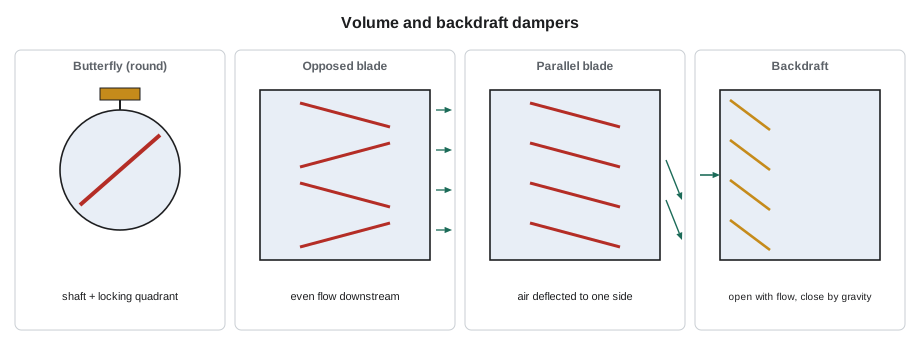
The simplest damper is a single blade on a shaft across the duct, turned by a handle outside. In round duct it is a round blade, a butterfly damper; in small rectangular duct it is a rectangular blade. The blade is stiffened with a bead or a fold so it does not flutter, the shaft runs through bearings in the duct wall on both sides, and the handle outside carries a locking quadrant: a small plate with a slot and a wing nut or a locking lever that holds the blade at any position and shows where it is set.
Single-blade dampers are cheap and simple, but a single blade gives poor control: most of the change in flow happens in the last part of its travel, and a large single blade can flutter and rattle. The standard limits single-blade dampers to small sizes, with a largest blade width and length, and requires multi-blade dampers above them.
Multi-blade dampers
Larger rectangular ducts use multi-blade dampers: several narrow blades in a frame, linked so they move together. There are two linkages.
- Opposed-blade dampers have adjacent blades turning in opposite directions, like a row of hands clapping. As they close, they squeeze the air evenly across the duct, giving smooth control of flow and an even velocity downstream. They are the usual choice for balancing.
- Parallel-blade dampers have all blades turning the same way, like venetian blinds. They deflect the air to one side as they close, which can be useful for mixing two air streams but is poor for balancing, because the downstream flow is uneven.
A multi-blade damper is usually bought as a manufactured unit with its own frame, blades, linkage and bearings, often with blade and jamb seals for tighter shut-off, and slid into a sleeve or mounted between flanges in the duct. Keelson also made simple opposed-blade dampers in the shop for low-pressure work, with sheet blades and a strap linkage, but bought manufactured dampers where the specification called for rated leakage or performance.
Quadrants, shafts and access
Every manual damper needs a way to set it and to see where it is set. The locking quadrant does both. On insulated duct, the quadrant is mounted on a standoff bracket so it sits outside the insulation, where the balancer can reach it without cutting the wrap; the standard and most specifications require this, and forgetting it is a common source of field complaints. The quadrant's handle should point along the blade, so its position shows the blade's position at a glance.
Dampers above ceilings need access. Where a damper is above a lay-in ceiling, the balancer can lift a tile. Where it is above a hard ceiling, an access panel in the ceiling is needed, or a remote cable operator that brings the adjustment down to a ceiling plate. The fabricator's part is to put the quadrant on the side of the duct the drawing shows, usually the side facing the access, and to mark the damper's location on the shop drawing so the ceiling contractor knows where access is needed.
Sizing a damper
A volume damper is normally the size of the duct it sits in, but the face velocity through it matters for noise. A damper in a high-velocity branch must be throttled hard to balance, and the sound it makes rises steeply with velocity. Keelson used an illustrative limit for quiet balancing dampers in schools and offices, and checked each damper on the Ashgrove library drawing against it with the script below.
# Sizing volume dampers by face velocity
import math
dampers = [('VD-1', 600, (600, 450)), ('VD-2', 250, (250,)), ('VD-3', 600, (300,)), ('VD-4', 1400, (900, 450))]            # (tag, flow L/s, duct size)
limit = 7.5               # Keelson face-velocity limit for quiet volume dampers, m/s
for tag, q, s in dampers:
    a = (math.pi * s[0] ** 2 / 4 if len(s) == 1 else s[0] * s[1]) / 1e6
    v = q / a / 1000
    ok = "ok" if v <= limit else "too fast: enlarge or move upstream"
    blades = 1 if len(s) == 1 or max(s) <= 300 else math.ceil(min(s) / 200)
    kind = "single blade" if blades == 1 else f"opposed blade, {blades} blades"
print(f"{tag}: {v:.1f} m/s ({ok}); {kind}")VD-1: 2.2 m/s (ok); opposed blade, 3 blades VD-2: 5.1 m/s (ok); single blade VD-3: 8.5 m/s (too fast: enlarge or move upstream); single blade VD-4: 3.5 m/s (ok); opposed blade, 3 blades
The trunk and large branch dampers ran at low face velocities, well inside the limit, and the large ones needed opposed blades. VD-3, a 300 mm round branch carrying 600 L/s, came out at about 8.5 m/s, faster than the shop's limit. Kai flagged it, and Lin found that the branch had been drawn one size too small; it was changed to 350 mm round, which brought the velocity down to about 6.2 m/s.
Backdraft dampers
A backdraft damper, also called a gravity damper or relief damper, lets air flow one way and closes when it stops or tries to reverse. Its light blades are hinged at the top and hang closed under their own weight, or under a light spring or counterweight; air flowing in the right direction pushes them open, and when the fan stops they fall closed. Backdraft dampers are used on exhaust fans, so cold outdoor air does not blow back in when the fan is off; on the discharge of each of several fans sharing a duct, so a stopped fan does not let air recirculate through it; and on relief openings.
Backdraft dampers need to be mounted the right way round and level, so the blades hang freely, and they need enough pressure to open fully. A backdraft damper on a small exhaust fan that barely opens costs the fan most of its flow. They are not tight shut-off dampers either: where a building needs tight closure against outdoor air, as in cold climates on large openings, a motorized damper with seals is used instead.
At Ashgrove, the new washroom exhaust fans each had a backdraft damper at the roof outlet, and the gym's relief opening had a counterweighted relief damper set to open at a small positive pressure. Halifax winters made the difference between a damper that closed tight and one that stuck open obvious to the school's staff within a week.
Control dampers
Motorized control dampers open and close, or modulate, under the building's control system: outdoor air dampers, return and relief dampers in the air handler's mixing box, zone dampers and isolation dampers. They are usually opposed or parallel blade dampers with tight blade and jamb seals and an actuator, specified for a rated leakage at a given pressure tested by an industry test method. The controls contractor usually supplies them and their actuators; the sheet metal shop builds the duct connections and sleeves they mount in and installs them, which needs coordination of sizes, sleeve lengths and the side the actuator goes on. Lin's shop drawings showed each control damper with a reference to the controls submittal, so the sleeves could be made before the dampers arrived.
Worked problem
Face velocity
A damper in a 400 by 300 mm branch carries 650 L/s. What is the face velocity, and is it under a 7.5 m/s limit?
Show solution
- Area = 0.400 × 0.300 = 0.120 m².
- Velocity = 0.650 ÷ 0.120 = 5.4 m/s.
Answer: About 5.4 m/s, under the limit.
Building and installing dampers well
A shop-made damper must be stiff, square in its duct and free to turn. The shaft bearings must be aligned so the blade does not bind, the blade must clear the duct walls by a small even gap all round, and the quadrant must hold the blade firmly at any setting without slipping. Where the duct is sealed to seal class A, the shaft penetrations are sealed with gasketed bearings or sealant that does not bind the shaft. The damper section is labelled with its tag, VD-1, VD-2 and so on, matching the drawing, so the balancer can find it.
In the field, the crew installs dampers where the drawings show them, with the quadrant toward the access, and leaves them fully open. The balancer, not the installer, sets them. A damper that the crew partly closes to make a noisy outlet quieter only moves the problem and makes the balancer's job harder.
Remote operators and balancing access
Where a damper sits above a hard ceiling or in a place no one can reach, it can be fitted with a remote operator: a cable or rod that runs from the damper's shaft to a small plate in the ceiling or wall, where a key or screwdriver turns it. Some remote operators show the blade position on the plate. They cost more than a quadrant, but they save an access panel and let the balancer adjust the damper without a ladder. The shop's part is to fit the operator's bracket to the damper section and to label the cable's route on the shop drawing, so the ceiling contractor knows where the plate goes.
Some specifications also call for balancing dampers to be marked after balancing, with the set position scribed on the quadrant or painted on the shaft, so that a damper knocked out of position later can be reset. That marking is done by the balancer, but it only works if the quadrant is visible and the blade position readable, which is the fabricator's responsibility.
Damper noise and placement
The sound a damper makes depends on how hard it is throttled, how fast the air goes through it and what lies downstream. A damper set nearly closed in a fast branch is the noisiest case, and a lined section or a length of round duct between it and the diffuser lets some of that noise die away before the room. Designers sometimes move dampers to the trunk end of a branch for exactly that reason. When the shop sees a damper drawn right behind a diffuser, it is worth asking whether it should move upstream.
Common mistakes
MistakeUsing a volume damper as a shut-off.
InsteadVolume dampers are for balancing; use a sealed control or isolation damper for shut-off.
MistakeBurying a quadrant under insulation.
InsteadMount quadrants on standoffs so they sit outside the insulation.
MistakePutting a balancing damper right behind a diffuser.
InsteadBalance at the branch, far enough downstream of the takeoff, away from the outlet.
MistakeUsing parallel blades for balancing.
InsteadUse opposed blades for even downstream flow.
MistakeMounting a backdraft damper upside down or out of level.
InsteadMount it so the blades hang freely and close by gravity.
Summary and key terms
- Volume dampers add resistance when throttled, letting the balancer share the air among the branches.
- Single-blade dampers suit small ducts; multi-blade dampers are used above the standard's limits.
- Opposed-blade dampers give even downstream flow and are used for balancing; parallel blades deflect air.
- Quadrants lock and show the blade position; on insulated duct they go on standoffs.
- Face velocity through a damper should be kept moderate to avoid noise.
- Backdraft dampers let air flow one way and close by gravity; control dampers are motorized and usually supplied by the controls contractor.
- Volume damper
- An adjustable blade or set of blades used to balance air flow.
- Locking quadrant
- A device on a damper shaft that locks and shows the blade position.
- Opposed-blade damper
- A multi-blade damper whose adjacent blades turn in opposite directions.
- Parallel-blade damper
- A multi-blade damper whose blades all turn the same way.
- Backdraft damper
- A damper that opens with air flow and closes by gravity when flow stops or reverses.
- Face velocity
- The air velocity through a damper or grille, flow divided by face area.
Practice problems
Work each problem on paper first, then reveal the answer to check.
What is the face velocity of a 250 mm round damper carrying 300 L/s?
Show answer
Area 0.049 m², so about 6.1 m/s.
Why are quadrants mounted on standoffs on insulated duct?
Show answer
So the balancer can reach them without cutting the insulation.
Which damper type gives even flow downstream when partly closed?
Show answer
Opposed-blade.
Who sets the volume dampers?
Show answer
The balancing contractor; the installer leaves them open.
Lesson quiz · 5 questions
Score 60% or more to complete this lesson.
Create a free account to save your progress, take quizzes and earn a certificate.