
SMW-220 · Lesson 7 of 12 · 20 min
Elbows, turning vanes, takeoffs and transitions
Straight duct is the easy part of a system. Every change of direction, size or shape is a fitting, and fittings take most of the fabricator's time and most of the system's pressure. A good fitting turns or divides the air smoothly, with little turbulence and noise; a poor one costs the fan energy for the life of the building and can make a room whistle. SMW-120 and SMW-210 taught how to lay out elbows, tees and transitions. This lesson is about building them to the duct standard: the radius rules for elbows, turning vanes for square elbows, the right kind of branch takeoff, and the slope limits on transitions. Kai worked through the Ashgrove library fittings as Lin issued them.
Why fittings matter
Air does not like to turn. When it flows round a bend, it crowds toward the outside of the turn and separates from the inside, leaving a region of eddies near the throat that wastes energy and makes noise. The sharper the bend, the bigger that region and the larger the loss. A fitting's loss is expressed as a loss coefficient, a fraction of the velocity pressure lost each time the air passes through it. A smooth long-radius elbow may lose a small fraction of a velocity pressure; a sharp square elbow without vanes may lose more than one whole velocity pressure. In a system with dozens of fittings, the difference adds up to a large part of the fan's work.
Fittings also cause noise. Turbulence in a sharp fitting, a branch taken off at a right angle, or a damper just downstream of an elbow generates sound that travels along the duct. The standard and the designer's specification set rules for fittings mainly to keep losses and noise down, and the fabricator's job is to build them the way they are drawn and to recognise when one is not drawn the way the standard intends.
Radius elbows
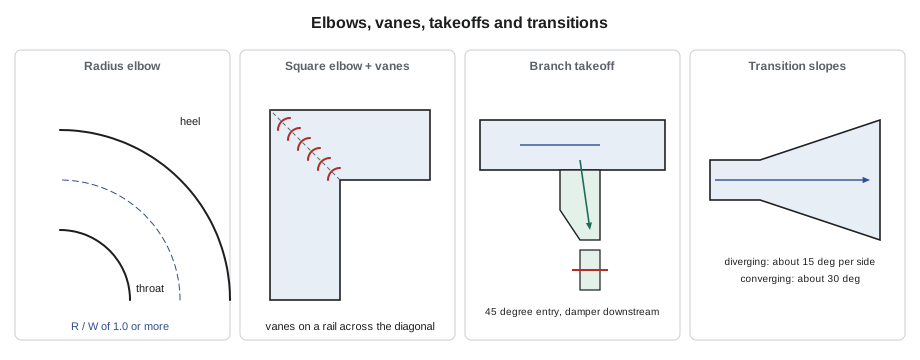
A rectangular radius elbow has a curved throat, the inside of the turn, and a curved heel, the outside, joined by flat cheeks. Its key number is the ratio of the centreline radius to the duct width in the plane of the turn. A ratio of about 1.0 or more gives a smooth elbow with a small loss; the standard's usual full-radius elbow has a centreline radius equal to the width, with a throat radius of half the width. Ratios below about 1.0 lose more, and ratios below about 0.5 are no better than a square elbow. Where space allows, longer radii are better still. Elbows with too short a radius can be improved with splitter vanes, curved sheets running parallel to the throat and heel that divide the elbow into several narrow elbows.
The fabricator's check is simple: the throat must have a real radius. A throat drawn as a sharp corner, with the heel curved, is called a square-throat elbow and is one of the worst fittings there is. Keelson's rule, from the standard, was that any rectangular elbow with a square throat must have turning vanes, or be questioned.
# Turning vanes for a square elbow and the throat check for a radius elbow
import math
w, h = 600, 450                 # duct width (in the plane of the turn) and depth, mm
spacing = 83              # vane spacing for the vane size used, mm
diag = math.hypot(w, w)     # the vane rail runs along the diagonal of a square elbow
vanes = math.ceil(diag / spacing) - 1
print(f"{w} x {h} square elbow: diagonal {diag:.0f} mm, {vanes} vanes at about {spacing} mm, rail {diag:.0f} mm")
print(f"vane blade length {h} mm each, total {vanes * h / 1000:.2f} m")
for ratio in (0.5, 1.0, 1.5):
    r = ratio * w
print(f"radius elbow, mid-line radius / width {ratio:.1f}: mid-line radius {r:.0f} mm, throat radius {r - w / 2:.0f} mm, heel {r + w / 2:.0f} mm")600 x 450 square elbow: diagonal 849 mm, 10 vanes at about 83 mm, rail 849 mm vane blade length 450 mm each, total 4.50 m radius elbow, mid-line radius / width 0.5: mid-line radius 300 mm, throat radius 0 mm, heel 600 mm radius elbow, mid-line radius / width 1.0: mid-line radius 600 mm, throat radius 300 mm, heel 900 mm radius elbow, mid-line radius / width 1.5: mid-line radius 900 mm, throat radius 600 mm, heel 1200 mm
For a 600 mm wide elbow, a mid-line radius ratio of 1.0 gives a 600 mm centreline radius, with a 300 mm throat and a 900 mm heel. A ratio of 0.5 gives no throat radius at all, which is why it performs like a square elbow. A ratio of 1.5 needs a 1200 mm heel, which is often too big for the space and is why the designer settles on 1.0 or uses vanes. The first part of the script, for a square elbow, is covered next.
Square elbows and turning vanes
Where there is no room for a radius elbow, a square elbow is used with turning vanes: a row of short curved blades fixed across the diagonal of the elbow on rails, each turning a thin slice of the air smoothly. A well-vaned square elbow loses little more than a good radius elbow and takes much less space. Vanes come in a few standard types: single-thickness vanes, curved sheet, used for most work; and double-thickness or airfoil vanes, with a rounded nose, which are stiffer and quieter and used on higher velocities and larger elbows. Each type has a standard radius and spacing, and the standard gives the largest duct size each can be used in without extra support.
Vanes are mounted on rails, strips of sheet with tabs or slots that hold each vane at the right angle and spacing, fixed to the elbow's cheeks along the diagonal. The vanes span from one cheek to the other, so their length equals the duct's depth. On deep elbows, longer than the standard allows for the vane type, a middle rail or tie supports the vanes so they do not flutter.
For the Ashgrove library, a 600 by 450 mm square elbow turned the trunk under a beam. The diagonal across a 600 mm wide square elbow is about 849 mm. Using single-thickness vanes at a spacing of about 83 mm, the script found 10 vanes, each 450 mm long, 4.5 m of vane in all. Kai cut the rail to the diagonal, set the vanes in it on the bench and riveted the rails to the cheeks before closing the elbow.
The vane count depends on the rail's spacing and on how the rail is laid out, so Keelson always counted vanes from the rail manufacturer's pattern rather than from the formula alone; the script's number was a check.
Branch takeoffs
A branch takes air off a trunk, and the way it leaves the trunk decides how much air it takes and how much noise it makes. The worst branch is a plain straight collar cut square into the side of the trunk: the air must turn ninety degrees sharply, it separates at the upstream edge of the opening, and the branch takes less than its share. Better takeoffs shape the entry.
- A 45-degree entry takeoff, or shoe tap, has its upstream side sloped at 45 degrees, giving the air a ramp into the branch. It is the standard's usual rectangular-to-rectangular and rectangular-to-round branch fitting.
- A bellmouth or conical entry fitting, used for round branches off rectangular or round trunks, has a flared entry that guides air in smoothly.
- A boot tap or angled branch, taking off the trunk at an angle in the direction of flow, is used on round mains.
- A spin-in collar, a short round collar spun or snapped into a round hole in the trunk, is a quick, cheap takeoff for small branches; spin-ins with a built-in damper and a conical or bellmouth entry are common for diffuser branches.
Where the branch is large compared with the trunk, the designer may use a split, a full-width division of the trunk into two ducts, or a tee with a radius on the branch side, instead of a tap. Where a damper is needed in the branch, the standard and good practice put it a few diameters downstream of the takeoff, not right at the opening, so the air has straightened before it reaches the blade; Lesson 8 returns to this.
Ashgrove's library branches were 250 mm round, taken off the rectangular trunk with conical-entry spin-in fittings with built-in dampers, bought from a supplier. Kai's job was to cut and flange the holes in the trunk sections in the shop, at the positions on the shop drawing, so the field crew only had to snap the fittings in and seal them.
Transitions and offsets
A transition changes the size or shape of a duct; an offset moves it sideways or up and down. Both can be made smoothly or badly, and the difference is in the slope of their sides. Air speeding up in a converging transition behaves well, so converging sides can be fairly steep. Air slowing down in a diverging transition tends to separate from the sides and lose pressure, so diverging sides must be gentler. The standard and common practice limit the slope of each side to about 15 degrees from the duct's axis for diverging transitions and about 30 degrees for converging ones, with steeper slopes needing vanes or splitters. These limits are rules of thumb that the designer may tighten.
Offsets follow the same principle: a gentle offset made with two shallow angles, or with two radius elbows, loses much less than a sharp one made with two square turns. Where space forces a sharp offset, vanes in each turn help. The fabricator who receives a drawing with a transition steeper than the limits should check with the detailer; often the length can be increased, or the transition can be split between two fittings.
Transitions from rectangular to round, such as the square-to-round of SMW-210, follow the same slope rules on their steepest side. At Ashgrove, the air handler's square-to-round had sides sloping well inside the limits, because Lin had been given enough height for it.
Worked problem
Checking a transition slope
A transition widens a duct from 400 mm to 600 mm on one side only, over a length of 500 mm. Is the diverging side within 15 degrees?
Show solution
- The side moves out by 600 − 400 = 200 mm over 500 mm.
- Angle = arctan(200 ÷ 500) = arctan(0.4) = about 21.8 degrees.
Answer: About 22 degrees, steeper than the 15 degree limit: lengthen it to at least about 750 mm, or split the change between both sides.
Building fittings to the standard
A fitting is built from the same gauge as the largest duct it connects to, with seams and joints suited to its pressure class, reinforcement where its flat sides exceed the standard's spans, and sealing to the seal class. The heel and cheeks of a radius elbow are joined with Pittsburgh locks or other seams the standard allows, the throat and heel curves are formed on the roll or brake, and the cheeks are crossbroken or beaded if they are wide. Vane rails are fixed with rivets or screws through both cheeks. Takeoffs are fixed to the trunk with screws or rivets at the spacing the standard sets and sealed.
Every fitting is labelled with its piece number and checked against the shop drawing before it leaves the bench: its sizes at each end, its angle, its length along its centreline and the position of any taps. Walt's check of fittings was always the same three questions: does it fit the duct at each end, does it turn or change the way the drawing says, and does it meet the standard's rules for its radius, vanes or slopes.
Fittings and the balancer
The fittings the shop builds affect the balancer's job directly. A branch taken off with a good entry delivers close to its design flow before any damper is touched; a poor one starves its branch and forces the balancer to throttle the others hard to push air into it, which makes noise everywhere. Smooth elbows and gentle transitions keep the static pressure the designer expected, so the fan delivers its design flow. When the balancer finds a system short of air, the first things checked are the fittings near the fan, and a square elbow without vanes or a steep transition is a common culprit.
Common mistakes
MistakeBuilding a square-throat elbow without vanes.
InsteadSquare elbows need turning vanes; otherwise use a radius elbow with a real throat radius.
MistakeCounting vanes by formula alone.
InsteadCount from the rail pattern; use the formula as a check.
MistakeCutting a plain square collar for a branch.
InsteadUse a 45-degree entry, bellmouth or conical takeoff.
MistakePutting a damper right at a takeoff opening.
InsteadPlace it downstream, where the air has straightened.
MistakeMaking a diverging transition steeper than about 15 degrees.
InsteadLengthen it, split it between sides or add vanes.
Summary and key terms
- Fittings take much of a system's pressure; their loss is a fraction of the velocity pressure each time air passes.
- Radius elbows need a centreline radius about equal to the duct width or more; a square throat is a poor fitting.
- Square elbows use turning vanes on rails across the diagonal; vane length equals the duct depth.
- Branches should be taken off with shaped entries: 45-degree taps, bellmouths or conical fittings.
- Diverging transitions are limited to about 15 degrees per side and converging ones to about 30.
- Fittings are built to the gauge, seams, reinforcement and sealing of the largest duct they connect to.
- Loss coefficient
- The fraction of velocity pressure a fitting loses.
- Throat
- The inside curve of an elbow.
- Heel
- The outside curve of an elbow.
- Turning vane
- A curved blade in a square elbow that turns a slice of the air smoothly.
- Takeoff
- A fitting that connects a branch to a trunk.
- Divergence
- The widening of a transition in the direction of flow.
Practice problems
Work each problem on paper first, then reveal the answer to check.
What centreline radius does a 500 mm wide elbow need for a ratio of 1.0?
Show answer
500 mm, with a 250 mm throat and a 750 mm heel.
How long is each turning vane in a 600 by 300 mm square elbow?
Show answer
300 mm, the duct depth.
Why is a plain square branch collar poor?
Show answer
The air separates at the upstream edge, so the branch takes less air and makes noise.
A transition narrows one side by 150 mm over 300 mm. Is it within 30 degrees?
Show answer
arctan(150 ÷ 300) is about 26.6 degrees, so yes.
Lesson quiz · 5 questions
Score 60% or more to complete this lesson.
Create a free account to save your progress, take quizzes and earn a certificate.