
SMW-220 · Lesson 5 of 12 · 19 min
Round and spiral duct
Every branch to every diffuser at Ashgrove was round, and so were the long mains in the new gym. Round duct is the most efficient shape there is for carrying air: it uses the least metal for a given area, its wall is evenly loaded, it has the least friction and the fewest seams to leak. Most of it in commercial work is spiral duct, made continuously from a narrow strip on a spiral machine. This lesson covers why round duct works so well, how spiral and longitudinal-seam round duct are made, the gauges the standard requires, the joints and couplings that connect it, and the fittings made for it.
Why round duct is efficient
Pressure inside a round duct pushes evenly on every part of the wall, and the wall resists by stretching like the skin of a balloon, in what engineers call hoop tension. Thin sheet is very strong in tension, so a round duct can carry a pressure that would bulge a flat-sided duct of the same thickness badly. That is why round duct needs no intermediate reinforcement under positive pressure and why its gauges can be lighter than rectangular duct of the same area.
A circle also encloses the most area for its perimeter. A round duct needs less sheet than a square duct of the same area, and much less than a flat rectangular one. Less perimeter also means less wall for the air to rub against, so friction losses are lower, and fewer seams and joints for the air to leak through. The only real disadvantage of round duct is its depth: a round duct is as deep as it is wide, and in a shallow ceiling space a rectangular or flat oval duct carrying the same air fits where a round would not.
Spiral duct
Spiral duct is made on a spiral pipe machine from a coil of narrow strip. The machine forms both edges of the strip into a lock profile and winds the strip around a forming head at an angle, so that each turn's edge interlocks with the previous turn's edge. A seaming roller then closes the lock, and the duct comes off the machine as a continuous tube with a spiral lockseam running around it, cut to length by a saw or a slitter that travels with the pipe. One machine with a change of forming head makes a whole range of diameters from the same strip.
The spiral lockseam stiffens the wall, acting like a continuous spiral rib, so spiral duct is stiffer than longitudinal-seam round duct of the same gauge. Some machines also roll small ribs between the seams for extra stiffness. Because the seam is mechanically locked under pressure, spiral duct is tight; its main leakage paths are the joints between lengths and fittings, not the seam itself.
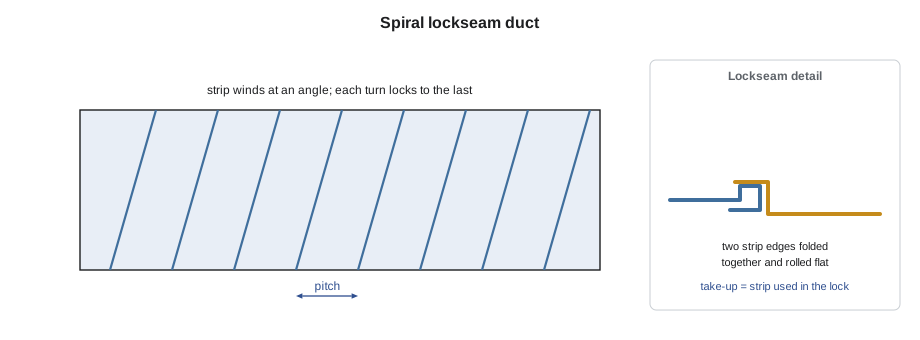
The amount of strip in a length of spiral duct depends on the strip width, the width used up in the lock, and the diameter. Each turn advances the duct by the pitch, the strip width less the take-up. Each turn uses a strip length equal to the hypotenuse of a triangle whose sides are the circumference and the pitch. Kai worked through one Ashgrove gym main length with the script below, using a common strip width and a typical take-up, both illustrative.
# Spiral duct: strip length, number of turns and weight for one length of pipe
import math
d, length = 400, 3000             # diameter and pipe length, mm
strip = 137              # strip width, mm
take_up = 16               # width used up in the lockseam, mm
pitch = strip - take_up      # advance per turn
turns = length / pitch
helix = math.hypot(math.pi * d, pitch)        # strip used per turn
strip_len = turns * helix
print(f"pitch {pitch:.1f} mm, turns {turns:.1f}, strip per turn {helix:.1f} mm")
print(f"strip needed {strip_len / 1000:.2f} m for one {length} mm length")
area = strip_len * strip / 1e6
print(f"strip area {area:.2f} m² against a plain surface of {math.pi * d * length / 1e6:.2f} m² (seam overlap {100 * (area / (math.pi * d * length / 1e6) - 1):.1f} percent)")
print(f"weight at {4.6} kg per m²: {area * 4.6:.1f} kg")pitch 121.0 mm, turns 24.8, strip per turn 1262.4 mm strip needed 31.30 m for one 3000 mm length strip area 4.29 m² against a plain surface of 3.77 m² (seam overlap 13.7 percent) weight at 4.6 kg per m²: 19.7 kg
A 3 m length of 400 mm spiral duct used about 31 m of strip in about 25 turns. The strip area came out about 14 percent more than the plain cylinder, the extra being the metal folded into the lock. That overlap is why spiral duct weighs a little more per metre than plain round duct of the same gauge, and why estimators use the manufacturer's weight tables instead of the simple area.
Longitudinal-seam round duct
Round duct can also be made from flat sheet rolled on the slip roll and closed with a longitudinal seam: a grooved seam, a snap lock or, for some work, a welded seam. This is how most fittings are made, and how small shops make straight round duct when they have no spiral machine. Snap-lock round pipe, made with a male and female lock that pushes together, is common in light commercial and residential work. Longitudinal-seam pipe is less stiff than spiral of the same gauge and has more seam length to seal, so the standard's tables treat it separately.
Keelson bought much of its small-diameter straight spiral from a local spiral manufacturer and made its own larger spiral and most round fittings in the shop. For Ashgrove, the 250 mm, or 10 in, branches came in as purchased spiral, and the shop made the round takeoffs, elbows and reducers that connected them.
Gauges for round duct
The standard's round duct tables give the minimum gauge for each diameter and pressure class, separately for spiral and longitudinal-seam duct, and separately for positive and negative pressure. Gauges rise with diameter, because a larger duct carries more hoop load for the same pressure, and they rise steeply for negative pressure on large diameters, because thin round duct can collapse under suction. For the low and medium pressure classes in ordinary buildings, small and medium spiral duct is often made from the lightest gauge the machine runs, and the gauge only steps up at large diameters.
Negative pressure also brings in stiffening rings. A large round exhaust main under suction may need angle rings or formed rings around it at intervals to keep it round, much as rectangular duct needs reinforcement. Eastgate's large exhaust risers, in Lin's estimate, were spiral with stiffening rings at the spacing the standard's negative tables required.
Joints and couplings
Round duct lengths and fittings are joined in a few common ways.
- The slip joint: a fitting's end is made slightly smaller, or crimped, and slips inside the next piece by a set overlap, then is fixed with screws or rivets and sealed. The male end points in the direction of air flow so the edge does not catch the air. It is the cheapest joint and is used on low-pressure work.
- The coupling: a short band, often beaded and sometimes with a factory gasket, slips over the two ends and is screwed or riveted to each. Gasketed couplings make tight, fast joints and are common on medium-pressure spiral duct.
- Flanged joints: rolled angle rings or manufactured flanges on each end are bolted together with a gasket. They are used on large diameters, high pressures and exhaust duct that may be taken apart.
- Proprietary gasketed fittings: fittings with a rubber gasket on each end that push into spiral duct and seal without added sealant. They save field sealing time and are common in modern commercial work.
Whatever the joint, the standard sets minimum overlaps and minimum numbers of fasteners: model codes and the standard typically require at least three screws or rivets equally spaced around a round joint, more on larger diameters. In seal class A or B work each joint is sealed, either with sealant and tape or by the gasket.
Round fittings
Round duct has its own family of fittings. Gore elbows, which SMW-120 laid out, turn the duct, with the number of gores set by the angle and the diameter. Stamped and die-formed elbows, made in one or two pieces on a press, are common in small diameters. Reducers, concentric and eccentric, change diameter, as SMW-210 showed. Tees, laterals and conical tees take branches off a main. Takeoffs connect round branches to rectangular trunks: a spin-in collar, often with a damper and a bellmouth or conical entry, which Lesson 7 covers. Saddle taps and boot taps connect a smaller round to the side of a larger one.
Each fitting must match the gauge and joint system of the duct it connects to. A fitting made from lighter sheet than the duct around it becomes the weak point of the system, and a fitting whose ends do not match the coupling or flange system cannot be joined properly in the field.
Worked problem
Equivalent round size
A rectangular duct 600 by 300 mm is to be replaced with round duct of the same area. What diameter is needed?
Show solution
- Area = 0.600 × 0.300 = 0.180 m².
- Diameter = √(4 × area ÷ π) = √(4 × 0.180 ÷ π) = 0.479 m.
Answer: About 480 mm by area. Designers use an equal-friction equivalent instead, which is somewhat smaller for the same flow and friction, from the design tables.
Handling and storing round duct
Round duct is easy to dent and hard to make round again. Keelson stored spiral duct on racks with cradles, never stacked loose, and nested smaller sizes inside larger ones for shipping only when the pieces were the right sizes to fit without rubbing. Ends were capped with film when the job required clean duct. Out-of-round ends were checked on two diameters at right angles before shipping, because a coupling or gasketed fitting will not seal on an oval end.
Fittings for spiral systems
Spiral duct systems are usually built around a family of manufactured fittings that match the spiral pipe exactly: die-formed or gored elbows, tees, laterals, reducers and end caps, each made to slip into the pipe or to take a coupling. Fittings for spiral pipe are made slightly smaller in diameter than the pipe at their ends, so they slip inside it, while couplings are made slightly larger, so they slip over two pipe ends. Mixing the two up, or ordering a fitting for the wrong system, is a common shop error. Keelson kept a simple rule: pipe joins pipe with a coupling, and fittings slip into pipe. Every order was checked against that rule before it went to the supplier.
Where a spiral main is long, its lengths are joined with couplings and fixed with screws or rivets at the spacing the standard sets, then sealed. Long straight runs also expand and contract with temperature, especially on outdoor or hot exhaust duct, and the designer may call for slip joints or expansion fittings at intervals so the duct does not buckle or pull its joints apart. On indoor supply duct at room temperature, the movement is small and ordinary joints take it.
Testing roundness and fit
Before a round fitting leaves the bench, Kai checked its ends with a diameter tape or a ring gauge, at two diameters at right angles, and test-fitted it into a short offcut of the pipe it would join. A fitting that went in too easily would leak; one that would not go in at all would be forced in the field and probably dented. The test took a minute and saved a call from the site.
Common mistakes
MistakeReinforcing round positive-pressure duct as if it were rectangular.
InsteadRound duct's wall is in tension and needs no intermediate reinforcement under positive pressure.
MistakeForgetting that large round duct can collapse under suction.
InsteadUse the standard's negative tables and stiffening rings where required.
MistakeEstimating spiral duct weight from the plain cylinder area.
InsteadAllow for the metal in the lockseam, about 10 to 15 percent; use the manufacturer's tables.
MistakePointing slip joints against the air flow.
InsteadThe male end points in the direction of flow.
MistakeUsing too few fasteners at round joints.
InsteadUse at least the standard's minimum, typically three equally spaced, more on larger sizes.
Summary and key terms
- Round duct's wall is in hoop tension, so it is strong and needs no reinforcement under positive pressure.
- A circle encloses the most area for its perimeter, so round duct uses the least metal and has the least friction.
- Spiral duct is wound from narrow strip with a spiral lockseam that stiffens the wall.
- Each spiral turn advances the duct by the strip width less the take-up; the strip used per turn is the hypotenuse of the circumference and the pitch.
- Gauges rise with diameter and pressure, steeply for large negative duct, which may need stiffening rings.
- Joints include slip joints, couplings, flanges and gasketed fittings, with minimum overlaps and fasteners.
- Hoop tension
- The tension in the wall of a round duct carrying internal pressure.
- Spiral duct
- Round duct wound from strip with a continuous spiral lockseam.
- Pitch
- The advance of spiral duct per turn of strip.
- Take-up
- The width of strip used in forming the lockseam.
- Coupling
- A band slipped over two duct ends and fixed to both.
- Stiffening ring
- A ring around large round duct to keep it round under suction.
Practice problems
Work each problem on paper first, then reveal the answer to check.
What is the pitch of spiral duct made from 137 mm strip with a 16 mm take-up?
Show answer
121 mm per turn.
Why does round duct use less metal than rectangular of the same area?
Show answer
A circle has the smallest perimeter for its area.
Which way does the male end of a slip joint point?
Show answer
In the direction of air flow.
What equal-area diameter replaces a 400 by 400 mm duct?
Show answer
√(4 × 0.16 ÷ π), about 451 mm.
Lesson quiz · 5 questions
Score 60% or more to complete this lesson.
Create a free account to save your progress, take quizzes and earn a certificate.