
SMW-120 · Lesson 7 of 12 · 13 min
Multi-piece gore elbows
Most round elbows in an air system are not two-piece but multi-piece: three, four or five short pieces of pipe joined on several mitres, so the duct turns gradually around a curve instead of all at once. These are called gored elbows or segmented elbows, and each short wedge of pipe between two mitres is built from gores. A gore elbow with a centreline radius of one and a half times the diameter loses far less pressure than a sharp two-piece elbow, and it is the standard fitting for supply and return duct. This lesson covers how the gores are counted, how big each one is, how one gore pattern makes every piece, and how the pieces nest on a sheet with almost no waste. The Ashgrove retrofit needed forty-two of them.
Gores, pieces and the elbow rule
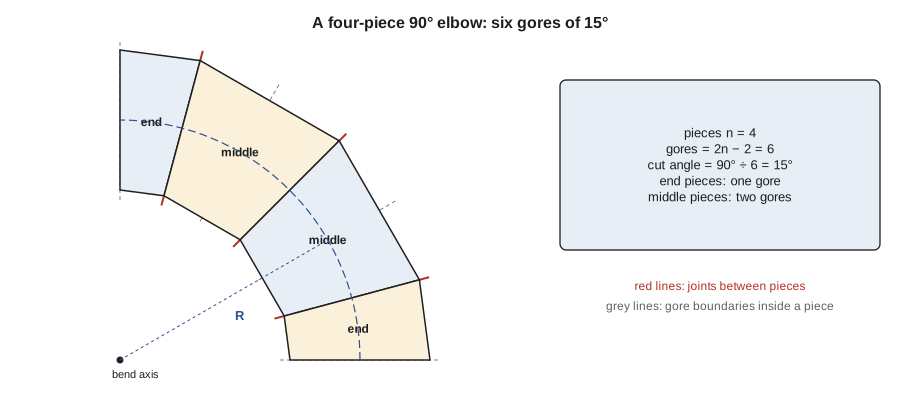
Think of a smooth bend in a pipe, a quarter of a torus for a 90, and imagine slicing it into wedges with planes that all pass through the centre of the bend. Each plane is a mitre. Pattern makers divide the turn into equal half-wedges called gores. Each end piece of the elbow, the piece that connects to straight duct, contains one gore: it is square at one end and cut on a mitre at the other. Each middle piece contains two gores back to back: it is cut on a mitre at both ends, like a wedge. Because of that, an elbow of n pieces always has two end pieces and n minus 2 middle pieces, and the number of gores is twice the number of pieces minus two.
The mitre angle α, the angle each cut is tilted from square, is the turn angle divided by the number of gores. This is the elbow rule, and every pattern maker knows it by heart. For a 90-degree elbow, it gives the following.
| Pieces | Gores | Mitre angle per gore | Middle pieces |
|---|---|---|---|
| 2 | 2 | 45° | 0 |
| 3 | 4 | 22.5° | 1 |
| 4 | 6 | 15° | 2 |
| 5 | 8 | 11.25° | 3 |
| 6 | 10 | 9° | 4 |
For other angles the rule is the same. A four-piece 45-degree elbow has six gores of 7.5 degrees; a three-piece 60-degree elbow has four gores of 15 degrees. How many pieces to use is set by the specification, and duct construction standards tie the minimum number of pieces to the diameter and the turn angle, with larger ducts needing more pieces. Lin's fitting schedule for Ashgrove gave each elbow's number of pieces; the 250 mm branches were four-piece 90s with a centreline radius of 1.5 times the diameter.
Sizes of the pieces
A gore elbow is defined by its diameter, its turn, its number of pieces and its centreline radius R, the radius of the bend measured to the centre line of the pipe. From those, the lengths of every piece follow from simple trigonometry, because each mitre plane passes through the centre of the bend.
Along the centre line, a single gore is R times the tangent of α long. So an end piece, which holds one gore, is R tan α along its centre line, plus any straight collar added for the connection. A middle piece, which holds two gores, is 2R tan α along its centre line. At the throat, the inside of the bend, the radius is R minus the mean radius of the pipe r, so the lengths are shorter; at the heel, the outside, the radius is R plus r and they are longer.
Those few numbers are enough to draw the whole elbow. A pattern maker who knows them can check a drawn layout at a glance: if the heel of a middle piece on the layout does not match 2(R + r) tan α, something has slipped.
The script works out every size for a gore elbow: the number of gores, the mitre angle, the throat, centre line and heel lengths of the end and middle pieces, and the ordinates of one gore, which is all the pattern needs.
# Gore elbow: elbow rule, piece sizes and the ordinates of one gore
import math
d_out, t = 250, 0.70
turn, pieces = 90, 4
R = 375          # mm, 1.5 x diameter                          # centreline radius
collar = 50           # mm                   # straight extension on each end piece
gores = 2 * pieces - 2
alpha = turn / gores
r = (d_out - t) / 2
tan_a = math.tan(math.radians(alpha))
print(f"{pieces} pieces, {gores} gores of {alpha:.3g} deg")
print(f"end piece:    throat {(R - r) * tan_a + collar:.1f}, centre {R * tan_a + collar:.1f}, heel {(R + r) * tan_a + collar:.1f} mm")
print(f"middle piece: throat {2 * (R - r) * tan_a:.1f}, centre {2 * R * tan_a:.1f}, heel {2 * (R + r) * tan_a:.1f} mm")
stretch = 2 * math.pi * r
print(f"stretchout {stretch:.1f} mm in 12 spaces of {stretch / 12:.1f} mm")
print(f"nested blank {stretch:.1f} x {gores * R * tan_a + 2 * collar:.1f} mm for the whole elbow")
print("ordinates of one gore, measured from the gore's centre line, throat (line 1) to heel (line 7):")
for k in range(7):
    phi = math.pi * k / 6
print(f" line {k + 1}: {(R - r * math.cos(phi)) * tan_a:.1f} mm")4 pieces, 6 gores of 15 deg end piece: throat 117.1, centre 150.5, heel 183.9 mm middle piece: throat 134.2, centre 201.0, heel 267.8 mm stretchout 783.2 mm in 12 spaces of 65.3 mm nested blank 783.2 x 702.9 mm for the whole elbow ordinates of one gore, measured from the gore's centre line, throat (line 1) to heel (line 7): line 1: 67.1 mm line 2: 71.6 mm line 3: 83.8 mm line 4: 100.5 mm line 5: 117.2 mm line 6: 129.4 mm line 7: 133.9 mm
For the Ashgrove four-piece elbow, each gore is only 67.1 mm deep at the throat and 133.9 mm at the heel; a middle piece is 134.2 mm at the throat and 267.8 mm at the heel. Kai's first reaction was that the pieces were very short. They are: a gore elbow is a stack of thin wedges, and its accuracy depends on every wedge being right.
One gore pattern makes every piece
Every gore of a gore elbow is the same shape, so only one gore pattern is developed. It is laid out like the pipe of Lesson 5, cut at the mitre angle α, with one difference: its heights are measured not from a square end but from the gore's own centre plane, the plane square to the pipe through the middle of the piece. In the elevation, that plane is a line from the centre of the bend through the middle of the piece; for an end piece it is the square end itself. The ordinates of a gore run from (R − r) tan α at the throat to (R + r) tan α at the heel.
An end piece is one gore plus its collar: the pattern is the gore drawn on top of a rectangle the height of the collar. A middle piece is two gores placed back to back on a common stretchout, one above and one mirrored below, so its pattern is shaped like a barrel, narrow at the throat ends and wide at the heel in the middle. Pattern makers often make a hard pattern of a single gore and trace it twice for each middle piece, flipping it over the stretchout line for the second gore.
Nesting the pieces
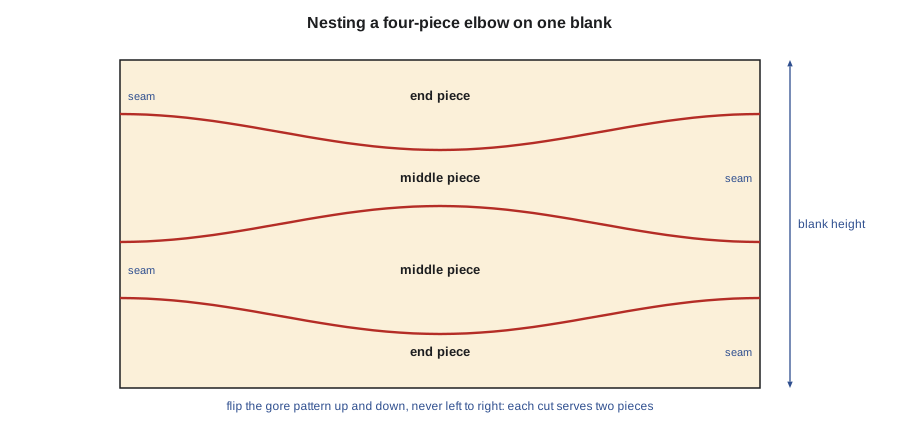
The real economy of the gore elbow comes from nesting. All the pieces of one elbow can be cut from one rectangular blank, the width of the stretchout and as tall as the elbow measured along its centre line, with every curved cut shared by two neighbouring pieces. The trick is to trace the gore pattern up and down the blank, flipping it over each time about the stretchout direction but never turning it left to right. Each flip puts the heel of one piece against the throat of the next. The seams then alternate between the throat side and the heel side of neighbouring pieces, which is exactly what is wanted for strength and for easy assembly.
The height of the nested blank is the centre line depth of one gore, R tan α, multiplied by the number of gores, plus the two collars, because along any element line the throats and heels of alternate pieces average out to the centre line. For the Ashgrove elbow, that gave a blank about 783 by 703 mm (31 3/8 by 28 1/8 in) for each four-piece elbow, about a third of a standard sheet. Lin's nesting sheet put three elbows side by side on each 1,220 by 2,440 mm sheet, with the strip left along the top saved for collars. Pattern makers call the result a fish pattern, from the shape of the alternating curves, and warn about the one way to ruin it: turning the pattern left to right, which puts the throat against the throat and leaves a lens-shaped gap of wasted metal at every cut.
Nesting also works only if the joints between pieces need no allowance at the cut edges, as with welded elbows, or if the allowances are the same on both sides of the cut. Where each piece needs a lap or lock along its mitre, Lesson 11 shows how the blank is made taller to provide it.
Assembly and checking
The pieces of a gore elbow are rolled one at a time, closed at their longitudinal seams, and joined at the mitres. In Keelson's shop, low-pressure gore elbows were joined with a standing seam formed on an elbow machine, a rotary machine that turns an edge on one piece and seats it into the next, while grease duct and exhaust elbows were welded. Each piece is rotated so that its seam is on the opposite side from its neighbour's, which the nesting has already arranged.
The finished elbow is checked three ways. The ends should be square to each other at the turn angle; a framing square or a protractor across the two collars shows a 90 at a glance. The centreline radius should be right, which is checked by measuring the throat and heel lengths of the whole elbow against the calculated arcs. And the elbow should not twist out of its plane, which shows as one end rotated relative to the other when the elbow lies on a flat bench. A twisted elbow usually means a piece was rotated wrongly before its mitre was joined, and the cure is to open the joint, turn the piece and rejoin it.
Kai's first four-piece elbow lay flat and turned 90 degrees, but its centreline radius was 10 mm (3/8 in) tight. One middle piece had been rolled with its seam on the wrong side, and Aggie showed him how that shortens the heel when the seam is closed. His second was right.
Elbow machines and adjustable elbows
Many shops do not lay out gore elbows by hand for common sizes. Adjustable elbows, made on a machine that forms gored pieces joined by rotating seams, can be twisted on site to any angle from 0 to 90 degrees, and spiral duct manufacturers supply die-formed or gored elbows in standard sizes. The pattern maker's work is then the odd sizes, odd angles and special materials that the standard products do not cover, which are exactly the fittings where an error is most expensive. Keelson made its own gore elbows for stainless, for large diameters and for any angle not in the supplier's catalogue.
Even where elbows are bought, the elbow rule is used constantly in the field to check what has arrived and to work out where a bought elbow's centre lines fall, because duct runs are laid out to centre lines. A fitter who knows that a four-piece elbow of centreline radius R puts its ends a distance R from the corner of its centre lines, plus the collars, can set hangers before the elbow arrives.
Common mistakes
MistakeCounting gores as the number of pieces.
InsteadGores = 2 × pieces − 2; end pieces hold one, middle pieces two.
MistakeMeasuring gore heights from the end of a middle piece.
InsteadMeasure from the gore's own centre plane, square to the pipe.
MistakeTurning the gore pattern left to right when nesting.
InsteadFlip it up and down only, so each cut is shared and seams alternate.
MistakeUsing R for the throat and heel lengths.
InsteadUse R − r at the throat and R + r at the heel.
MistakeJoining pieces without checking the seam position.
InsteadRotate each piece so its seam is opposite its neighbour's, then join.
Summary and key terms
- A gore elbow is a stack of short pipe wedges joined on mitres through the centre of the bend.
- Gores = 2n − 2, and each mitre is cut at the turn angle divided by the number of gores.
- End pieces hold one gore; middle pieces hold two.
- Piece lengths are (R − r), R and (R + r) times tan α per gore at the throat, centre and heel.
- One gore pattern, flipped up and down, nests every piece of an elbow on one blank.
- Check the turn, the centreline radius and twist on the finished elbow.
- Gore
- A half-wedge of a segmented elbow, cut square at its centre plane and on a mitre at one side.
- Gore elbow
- A round elbow built from several short pieces joined on mitres.
- Elbow rule
- Number of gores = 2 × pieces − 2; mitre angle = turn ÷ gores.
- Centreline radius
- The radius of an elbow measured to the centre line of the pipe.
- Nesting
- Arranging patterns on a sheet so they share cuts and waste little material.
- Elbow machine
- A rotary machine that forms standing seams between the pieces of a round elbow.
Lesson quiz · 5 questions
Score 60% or more to complete this lesson.
Create a free account to save your progress, take quizzes and earn a certificate.