
SLS-250 · Lesson 9 of 12 · 19 min
Closing at the counter
▶ Video coming soon A video version of this lesson is on the way.
On Saturday, October 31, after the Morenos had chosen their mattress, Aiden walked them to the sales desk. He was nervous about this part. In décor, closing meant scanning a lamp. Here it meant writing an order with a model number, a size, a base, a protector, a delivery window, a haul-away, a financing question and a mattress policy that had conditions. Bev had given him the store's counter checklist the week before. He followed it line by line, read the order back to the couple, and caught one mistake before it became a problem: he had keyed the queen size, but they had said king. Hannah laughed. "That would have been a short night."
Closing is the step where the customer commits to the purchase and the associate turns that decision into an accurate order. In retail, it has two parts that are both easy to get wrong. The first is helping the customer reach the decision without pressure. The second is writing the sale so that what arrives at the customer's home is exactly what they chose, when and how they expect it. Many problems that look like delivery or service failures, as SLS-130 showed, begin with mistakes at the counter.
Recognizing buying signals
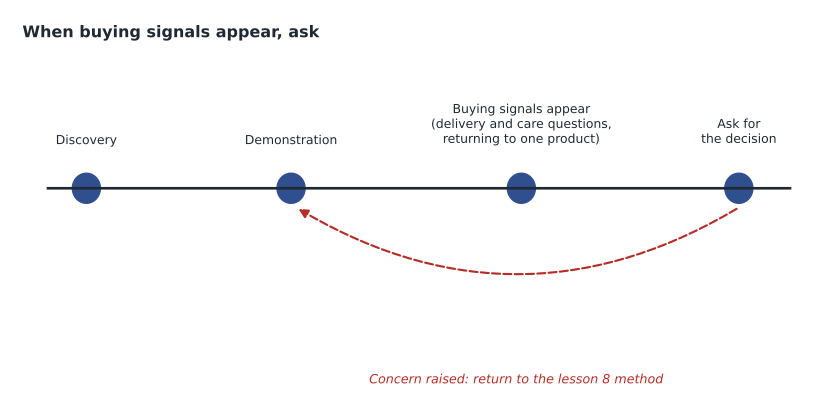
Customers usually show that they are ready to decide before they say so. Common buying signals include questions about delivery ("how soon could it come?"), about care ("how do you clean it?"), about ownership ("what's the warranty?") or about payment ("do you take financing?"); returning to one product after looking at others; a partner nodding or saying "I like this one"; and talking about the product as if they already own it ("this would look great by the window"). When associates notice these signals, they can stop presenting and help the customer move to a decision.
| Buying signal | A helpful response |
|---|---|
| "How soon could you deliver it?" | "This colour is in stock, so we could deliver as early as Thursday. Would that work for you?" |
| Returning to the same sofa for the third time | "It looks like this one keeps winning. What do you think?" |
| "How would we clean it?" | Explain the cleaning code, then: "Is there anything else you'd want to know before deciding?" |
| One partner says to the other, "I really like this one." | Turn to the other partner: "How about you? Does it work for you?" |
Asking for the decision
Asking is the step many associates avoid, fearing it will seem pushy. In practice, customers who are ready usually appreciate a clear, simple question. Juniper & Pine trains associates to ask directly and kindly: "Would you like to go ahead with this one?" or "Shall we set up delivery?" If the customer is not ready, the answer will reveal a remaining concern, and the associate returns to the objection method from lesson 8.
Several traditional "closing techniques" are taught in sales books, and some deserve caution. An assumptive close ("I'll book Thursday for the delivery, then") can feel natural when the customer has clearly decided, but it is manipulative when used to rush someone who has not. A choice close ("would you like the grey or the blue?") is helpful when the customer genuinely is choosing between two, and manipulative when it hides the option of choosing neither. Urgency closes ("the sale ends tonight") are honest only when true; false urgency is a misleading representation, as SLS-150 explained. Researchers who study sales generally find that customer-focused behaviours such as listening and adapting predict results better than any particular closing line.
The counter checklist
Once the customer has decided, accuracy matters more than speed. Juniper & Pine's counter checklist covers the details that most often cause problems later.
| Item | What to confirm |
|---|---|
| Product | Exact model number, size, configuration (for example, left-arm or right-arm chaise), fabric or finish code |
| Fit | Measurements noted, narrowest point on the way in, any legs to remove, fit checklist completed for appliances |
| Add-ons | Each add-on the customer agreed to, and none they did not |
| Delivery | Date and two-hour window, address, access notes (stairs, elevator, parking), who will be home |
| Removal and installation | Haul-away of old items, installation, parts needed such as cords, hoses or water lines |
| Policies | Return window, mattress comfort exchange conditions, what is final sale, warranty basics |
| Payment | Price, taxes, deposit if any, payment method, financing application if chosen |
| Contact | Phone and email for delivery updates, consent for texts, and the customer profile |
The order is then read back to the customer item by item. Reading back catches errors such as the queen-for-king mix-up, a left-arm chaise entered as right-arm, or a wrong delivery address. It also gives the customer a final chance to ask questions, which reduces surprises later.
Price, taxes and the total
Customers deserve a clear total before they pay. Associates explain the price of each item, any delivery or service charges, the taxes and the final amount. They point out any charges that are optional, such as haul-away, so the customer can decline them.
Worked problem
Working out the total at the counter
The Morenos' order is a king hybrid mattress at 1,599 dollars, an adjustable base at 1,249 dollars, a mattress protector at 129 dollars, delivery at 79 dollars and haul-away of the old mattress at 39 dollars. In Saskatchewan, the 5 in 100 GST and the 6 in 100 PST both apply to these items and services. What is the subtotal, the tax and the total?
Show solution
- Subtotal of items and services.
- \[1599 + 1249 + 129 + 79 + 39 = 3095\ \text{dollars}\]
- GST at 5 in 100.
- \[0.05 \times 3095 = 154.75\ \text{dollars}\]
- PST at 6 in 100.
- \[0.06 \times 3095 = 185.70\ \text{dollars}\]
- Total.
- \[3095 + 154.75 + 185.70 = 3435.45\ \text{dollars}\]
Answer: The subtotal is 3,095 dollars, taxes are 340.45 dollars and the total is 3,435.45 dollars. Aiden showed the Morenos the breakdown on the screen and pointed out that the haul-away was optional.
Policies the customer must understand
Customers should leave the counter knowing what they can and cannot do after the sale. This is both good service and a legal safeguard.
In Canada there is no general right to cancel a purchase made in a store; a store's return or exchange policy is a voluntary promise and must be honoured as stated. Cooling-off periods in Saskatchewan's consumer protection law apply mainly to door-to-door and some other sales made away from the store, and to certain remote contracts, not to ordinary in-store purchases. Associates therefore explain Juniper & Pine's 30-day return window on most furniture, the 90-night mattress comfort exchange and its conditions, and any final-sale items such as custom orders and floor models, before payment, and the same terms are printed on the receipt.
Custom orders deserve special care. A sofa made to order in the customer's chosen fabric usually cannot be returned, takes several weeks and requires a deposit. Associates confirm the fabric code against the swatch the customer chose and have the customer initial the fabric and configuration on the order.
Payment and financing at the counter
Most customers pay by card. Some use the store's partner financing, which SLS-256 covers in depth because it carries its own disclosure rules. At the counter, the associate's role is to explain that financing is available, describe the main terms in plain words, help the customer complete the lender's application if they choose it, and make sure the customer receives the lender's disclosure documents. Associates do not describe financing as "free" unless it truly has no interest or fees in every scenario, and they do not pressure customers who prefer to pay another way.
After the payment
The close is not finished when the payment goes through. The associate thanks the customer, explains what will happen next (a confirmation email, a text the evening before delivery, the delivery window), gives them a business card or the store's contact details, and asks permission for a follow-up, as lesson 10 describes. Then the associate adds notes to the customer's profile while the details are fresh. Carl's rule is to finish the notes before greeting the next customer, because "if you wait until closing, you'll forget the stairs".
Deposits, special orders and lead times
Not every order can be delivered from stock. Special orders, such as a sofa in a fabric the store does not carry in its warehouse or an appliance in an unusual finish, may take several weeks. Associates explain the expected lead time honestly, based on the supplier's current estimate, and say that it is an estimate. Juniper & Pine takes a deposit on special orders, usually a set fraction of the price, and explains what happens to the deposit if the customer cancels before the order is placed with the supplier and after it has been placed. The terms are printed on the order and the customer initials them.
When a lead time changes, the customer should hear it from the store before they have to ask. The associate who wrote the order is responsible for watching its status in the system and calling the customer with any change, offering options such as a floor model, a different fabric or a revised date.
Closing with a hold instead of a sale
Sometimes the right close is not a sale today. A customer who needs to measure, consult a partner or wait for payday may welcome an offer to hold an in-stock item for a short time. Holds should follow the store's rules: Juniper & Pine holds items for 48 hours without a deposit, records the hold in the system with the customer's contact details, and releases it automatically if the customer does not return. A hold is a kind of close, because it records the decision the customer is close to making and gives a natural reason to follow up.
Closing well when the answer is no
Not every conversation ends in a sale, and the way an associate closes a conversation without one matters. The customer should leave with useful information, such as a written model number, a price and the associate's card, and with the feeling that they are welcome back. A brief "Thanks for coming in; if you want to see it again or have questions, ask for me" is often the beginning of a sale weeks later.
What a complete order looks like
Bev's test for a finished order is that anyone in the store could read it and deliver the right product to the right place without calling the associate. That means the model number, size and fabric code; the delivery address, date and window; access notes such as stairs, a narrow door or a parking restriction; any parts the installers need; what is to be removed; the customer's phone number and consent for texts; the policies explained; and the payment details. Orders that fail this test are returned to the associate before the end of the shift.
An order that passes the test also protects the associate. If something goes wrong at delivery, a complete order shows exactly what was agreed and makes the fix quick, instead of turning into a dispute about who said what at the counter.
Last, associates should never let the counter become a place of pressure. Customers who feel rushed at the end of a good conversation remember the rush, not the conversation. Bev keeps a chair for each customer at the sales desk and asks associates to sit down with them, explain each line at an unhurried pace and invite questions before the payment terminal comes out.
Common mistakes
MistakeAsking for the sale is pushy.
InsteadCustomers who are ready usually appreciate a clear, simple question.
MistakeUse a closing technique on every customer.
InsteadAsk directly when buying signals appear; avoid assumptive or urgency closes that rush or mislead.
MistakeSpeed matters most at the counter.
InsteadAccuracy matters most: follow the checklist and read the order back.
MistakeCustomers have a few days to cancel any purchase.
InsteadIn-store purchases have no general cancellation right; explain the store's policy before payment.
MistakeThe sale ends with the payment.
InsteadExplain next steps, ask permission to follow up, and record notes before the next customer.
Summary and key terms
- Closing turns a customer's decision into an accurate order, without pressure.
- Buying signals include delivery, care and warranty questions, returning to one product and ownership language.
- Ask for the decision directly; be cautious with assumptive, choice and urgency closes.
- Use the counter checklist and read the order back to catch errors.
- Show the subtotal, taxes and total clearly and point out optional charges.
- Explain return, exchange and final-sale terms before payment, handle financing honestly, and finish notes before the next customer.
- Buying signal
- A question or behaviour suggesting a customer is ready to decide.
- Close
- The step where the customer commits to the purchase.
- Assumptive close
- Proceeding as if the customer has decided, such as booking delivery without asking.
- Read-back
- Reading the order to the customer item by item to confirm it is correct.
- Final sale
- An item that cannot be returned, such as a custom order or some floor models.
Practice problems
Work each problem on paper first, then reveal the answer to check.
Name three buying signals.
Show answer
Any three of: questions about delivery, care, warranty or payment; returning to one product; a partner approving; talking as if they own it.
Why does Juniper & Pine require a read-back of every order?
Show answer
It catches errors such as wrong sizes, configurations or addresses and gives the customer a last chance to ask questions.
A customer's subtotal is 2,000 dollars. What would the total be with taxes of 11 in 100?
Show answer
2,000 times 1.11 is 2,220 dollars.
When is "the sale ends tonight" an acceptable thing to say?
Show answer
Only when it is true.
Lesson quiz · 5 questions
Score 60% or more to complete this lesson.
Create a free account to save your progress, take quizzes and earn a certificate.