
SLS-250 · Lesson 5 of 12 · 19 min
Demonstrating and letting customers try
▶ Video coming soon A video version of this lesson is on the way.
Hannah and Luis Moreno, the couple who had bought a sectional from Carl in September, came back on Saturday, October 31, for a mattress. Aiden greeted them, and after a few discovery questions he learned that Luis slept on his side, Hannah slept on her back and ran warm, and their old mattress rolled them into the middle. He suggested three mattresses. Then, instead of describing them, he said: "The best way to choose is to lie on them the way you actually sleep. Take your shoes off, use one of these pillows, and give each one at least five minutes. I'll be right here." Twenty minutes later they had chosen a hybrid with a pocket-coil base and a cooling cover. Hannah said it was the first time a salesperson had told them to take their time.
Demonstration is the step where the customer experiences the product: sits on it, lies on it, opens it, hears it, touches it, sees it working. For furniture, mattresses and appliances, a good demonstration often does more than any description. It lets customers test the associate's claims for themselves, picture the product in their own home, and feel confident about a decision they will live with for years. This lesson covers how to plan a demonstration, how to involve the customer, how to demonstrate safely, and how to demonstrate when the product is not on the floor.
Why trying matters
SLS-110 described how people judge products through their senses and how touching a product can increase the sense of owning it, an effect researchers have linked to feelings of psychological ownership. Physical testing also reduces risk: customers buying something expensive that they cannot easily return want to be sure. For a sofa, the seat depth, height and firmness matter far more than any photo can show. For a mattress, comfort and support are personal and cannot be judged by reading. For a range or a washer, the controls, the noise and the way the doors open all affect whether the customer will be happy with it every day.
Testing is also the main reason many customers come to a store at all, as lesson 1 noted. A store that does not invite them to try is wasting its strongest advantage over online sellers.
Planning a demonstration
A demonstration is planned around what discovery revealed. The associate chooses which products to show, which features to demonstrate and in what order. Showing two or three well-chosen options is better than walking a customer through ten. Showing the feature that matters most first, while attention is highest, is better than saving it for the end.
| What discovery revealed | What to demonstrate |
|---|---|
| "The old sofa's cushions went flat in two years." | Unzip a cushion to show the core; let the customer sit, stand and sit again to feel the recovery |
| "We have a dog that sheds." | Show the performance fabric; pour a little water on a swatch to show how it beads; show the lint roller test |
| "I sleep hot." | Let the customer feel the cooling cover compared with a standard one; explain what is underneath |
| "My mother finds it hard to get out of low chairs." | Compare seat heights on two chairs; let the customer, or the mother if present, try standing up from each |
| "Our kitchen is open-plan, so noise matters." | Run the dishwasher's demonstration mode, if available, or play the manufacturer's noise comparison; show the decibel ratings |
| "I've never cooked on induction." | Use the induction demonstration unit to boil water; show how the surface stays cooler than a gas or electric burner |
Involve the customer
The most effective demonstrations put the customer in control. Instead of saying "this recliner is very smooth", the associate says "try the button on the right side" and lets the customer feel it. Instead of saying "this fridge has a lot of space", the associate opens the door and asks "where would you put the milk and the big platters?" Customers remember what they did far better than what they were told.
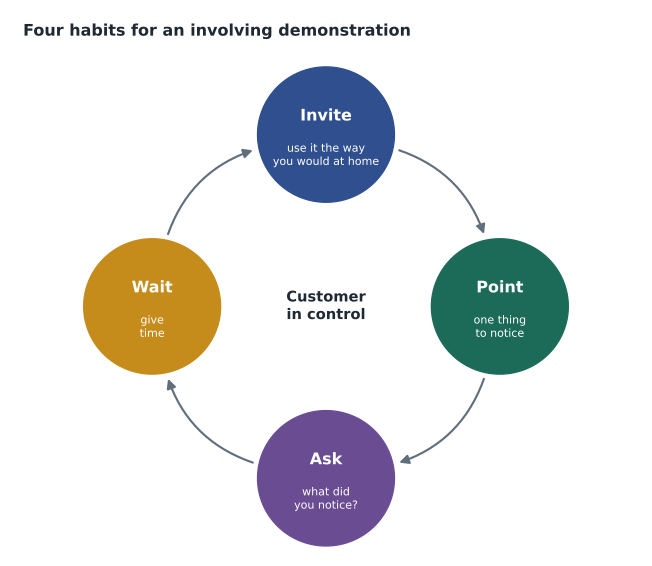
Bev's floor school teaches four habits for involving customers. Invite them to use the product in the way they would at home. Give them a specific thing to notice ("feel how the seat edge supports the back of your knees"). Ask what they noticed, and listen. And give them time, especially on mattresses, where a brief sit on the edge tells almost nothing.
Demonstrating mattresses
Mattresses are the product where demonstration matters most and where customers are most often rushed. Many shoppers lie down for a few seconds, fully dressed with shoes on, feel self-conscious and get up. Juniper & Pine's mattress routine is designed to make testing comfortable and useful.
| Step | What the associate does |
|---|---|
| 1. Prepare | Offer a clean pillow protector and the store's guest pillow; invite the customer to remove shoes |
| 2. Position | Ask the customer to lie in their usual sleeping position, not on their back by default |
| 3. Time | Suggest at least five minutes on each finalist; step back a short distance to give privacy |
| 4. Partner test | For couples, have both lie down and one roll over, to feel how much motion transfers |
| 5. Compare | Test no more than three finalists, then go back to the favourite |
| 6. Explain the comfort exchange | Explain the 90-night comfort exchange and its conditions honestly, so customers know their options |
The routine shows respect: it treats the mattress decision as important and the customer's comfort as the point. It also reduces exchanges later, because customers who test properly choose better.
Worked problem
Does a longer test reduce exchanges?
Over the summer, Juniper & Pine tracked mattress exchanges under the 90-night comfort exchange. Of 180 mattresses bought by customers who tested each finalist for less than two minutes, 27 were exchanged. Of 220 bought by customers who followed the full routine, 11 were exchanged. Each exchange costs the store about 160 dollars in pickup, handling and the markdown on the returned mattress. What are the two exchange rates, and how much did exchanges cost for each group?
Show solution
- Exchange rate for quick testers.
- \[27 \div 180 = 0.15\]
- Exchange rate for customers who followed the routine.
- \[11 \div 220 = 0.05\]
- Exchange cost for quick testers.
- \[27 \times 160 = 4320\ \text{dollars}\]
- Exchange cost for routine testers.
- \[11 \times 160 = 1760\ \text{dollars}\]
Answer: Quick testers exchanged 15 in 100 mattresses and routine testers 5 in 100. Exchanges cost the store 4,320 dollars for the first group and 1,760 dollars for the larger second group. Customers who test longer may also be more careful shoppers in general, so the routine is not the only cause, but the gap persuaded Bev to make it standard.
Demonstrating safely
Demonstrations involve heavy, moving and electrical products, and safety comes first. Associates check that recliners and lift chairs are clear of feet and children before operating them, that power cords are not across walkways, and that appliance doors are not left open where someone could trip. They lift and move furniture only with help and proper technique, as the store's health and safety training requires. Children in the store are welcome, but associates keep an eye out for climbing on displays.
Tip-overs of dressers, bookcases and televisions injure children every year. Health Canada advises anchoring tall and heavy furniture to the wall, and Juniper & Pine includes an anchoring kit with every dresser and explains it at the sale. Associates should demonstrate drawers on floor models only when the unit is properly anchored or stable.
When the product is not on the floor
Many products are sold from samples, catalogues or the website: other colours and fabrics, custom configurations, appliances in finishes the store does not display. Associates still demonstrate, using what is available. They show the same frame in a different fabric, bring the fabric swatch to the window to see it in daylight, let customers borrow swatches overnight, use the room planner on the store tablet to show a custom sectional in the customer's room dimensions, or show manufacturer videos of features that cannot be shown on the floor.
Since 2025, Juniper & Pine has also offered virtual consultations by video, as SLS-120 mentioned. On a video call, demonstration means showing the product slowly and close up, describing what the camera cannot show (how a fabric feels, how firm a cushion is), comparing with something the customer knows ("about as firm as the sofa in our front window, if you've visited"), and offering swatches by mail. Customers on video calls often decide to visit the store to test before buying, which is a good outcome, not a failure.
Common demonstration traps
Several mistakes recur on any sales floor. Associates talk through the whole demonstration, so the customer cannot concentrate on what they feel. They demonstrate features the customer did not ask about. They show the most expensive product first and every other product feels like a downgrade. They stand too close, which makes testing, especially of mattresses, uncomfortable. And they forget to ask what the customer noticed, losing the chance to learn which features matter.
Aiden's own trap, which Carl pointed out, was filling silence. When a customer sat quietly on a sofa, Aiden would start explaining the frame. Carl's advice was to count to ten in his head. "If they're quiet, they're deciding. Don't interrupt."
Letting customers take their time
Many associates feel uncomfortable when a customer spends a long time testing a product, especially on a busy day. Yet the time spent in testing is rarely wasted. Customers who test thoroughly are more confident, less likely to exchange and more likely to recommend the store. When the floor is busy, associates can still give time by giving the customer a clear task ("try each of these three for five minutes, starting with the one on the left") and checking back at a set time, as lesson 11 describes.
Demonstrating to couples and families
When two or more people will use a product, the demonstration should include all of them. For sofas, that means both partners sitting together in their usual positions, and children trying it too if they will use it. For mattresses, the partner test described above is essential. For appliances, the person who does most of the cooking or laundry should operate the controls. Associates watch for differences: one partner may love a deep seat that the other finds hard to get out of. Naming the difference openly ("it sounds like you like the deep seat and Luis prefers something firmer; let's try the one in between") helps the couple decide together rather than leaving one of them quietly unhappy.
Recording what the customer tried
After a demonstration, a short note in the client book saves time later: which models the customer tested, which they liked and why, and which they ruled out. A customer who returns next week to decide should not have to start the testing again from the beginning. Aiden's note for the Morenos read: "Tested three hybrids; liked the cooling cover on model B; A too soft for Luis; ruled out all-foam (sleeps hot)."
Demonstration also gives the associate information. Watching where a customer's hand goes first, which cushion they return to and what makes them smile tells the associate more about what matters to them than many questions would. Associates who watch closely during demonstrations often find that the right product is obvious to both of them before anyone mentions price.
Common mistakes
MistakeDescribe the product thoroughly before letting the customer try it.
InsteadInvite the customer to try early, point out one thing to notice, and let the product speak.
MistakeShow the customer as many products as possible.
InsteadShow two or three well-chosen options based on discovery.
MistakeA few seconds on a mattress is enough.
InsteadCustomers should lie in their usual position for several minutes on each finalist.
MistakeSilence during a demonstration is awkward and should be filled.
InsteadSilence often means the customer is deciding. Give them time.
MistakeDemonstrations are only possible with floor stock.
InsteadUse swatches, the same frame in another fabric, the room planner, videos and virtual consultations.
Summary and key terms
- Demonstration lets customers experience the product, test claims, picture it at home and feel confident.
- Plan demonstrations from discovery: choose a few products and show the features that matter most first.
- Put the customer in control: invite, point out one thing to notice, ask what they noticed, and wait.
- Mattress testing needs time, the usual sleeping position and a partner test; proper testing reduces exchanges.
- Demonstrate safely, with attention to moving parts, children and tip-over risks.
- When the product is not on the floor, use swatches, similar models, room planners, videos and virtual consultations.
- Demonstration
- The step where the customer experiences the product directly, guided by the associate.
- Psychological ownership
- The feeling that something is "mine", which touching and using a product can strengthen.
- Partner test
- Having two people lie on a mattress together to judge how much motion transfers between them.
- Comfort exchange
- Juniper & Pine's policy allowing a mattress to be exchanged within 90 nights, with conditions.
- Virtual consultation
- A sales conversation by video in which the associate shows products remotely.
Practice problems
Work each problem on paper first, then reveal the answer to check.
A customer says, "We host family dinners for twelve." What would you demonstrate on a dining set?
Show answer
The table extension mechanism, how many chairs fit at full length, and the durability of the tabletop finish.
Of 150 quick-test mattress sales, 21 were exchanged. What is the exchange rate?
Show answer
21 divided by 150 is 0.14, or 14 in 100.
Why should an associate step away while a customer tests a mattress?
Show answer
To give privacy so the customer can relax and test properly.
Name two ways to demonstrate a fabric that is not on the floor.
Show answer
Any two of: show it on a swatch in daylight, lend swatches overnight, show the same frame in another fabric, use the room planner.
Lesson quiz · 5 questions
Score 60% or more to complete this lesson.
Create a free account to save your progress, take quizzes and earn a certificate.