
SLS-250 · Lesson 8 of 12 · 19 min
Handling objections on the floor
▶ Video coming soon A video version of this lesson is on the way.
On Sunday, November 1, a woman in her thirties had narrowed her choice to a grey sectional and was ready to talk about delivery. Then she took out her phone. "I found this exact one online for 1,890," she said. "You've got it at 2,199." Aiden felt his stomach drop. Two weeks earlier he would have either offered to "see what he could do", which he was not allowed to do, or said nothing and let her leave. Instead he asked to see the listing, read it with her, and noticed three things: the online price did not include delivery, the listing was for the fabric in a different grade, and the retailer charged a restocking fee on returns. He then explained Juniper & Pine's price-match policy, checked the identical model on the manufacturer's site, and walked her through a total-cost comparison. She bought from Juniper & Pine, at the store's price, with delivery on Thursday.
An objection is a concern or hesitation that stands between the customer and a decision. On the retail floor, objections are normal and usually healthy: they show the customer is seriously considering the purchase. The associate's job is not to "overcome" objections in the sense of winning an argument, but to understand them and help the customer resolve them, which sometimes means agreeing that the product is not right. This lesson applies the general approach from SLS-101 to the most common retail objections. Negotiation of price and terms in more depth is the subject of SLS-213.
A method for any objection
Juniper & Pine teaches a five-step method that works for most objections: listen, acknowledge, clarify, respond and check. It is the same idea SLS-101 introduced, slowed down for the floor.
| Step | What it means | What it sounds like |
|---|---|---|
| Listen | Let the customer finish without interrupting or defending | (Silence, eye contact, a nod) |
| Acknowledge | Show that the concern is reasonable and heard | "That's a fair thing to check on a purchase this size." |
| Clarify | Find out what is really behind it | "Is it mainly the price, or is it the total with delivery?" |
| Respond | Answer the real concern with facts, options or a demonstration | "Let's compare the two side by side, including delivery and returns." |
| Check | Confirm the concern is resolved before moving on | "Does that take care of it, or is anything else on your mind?" |
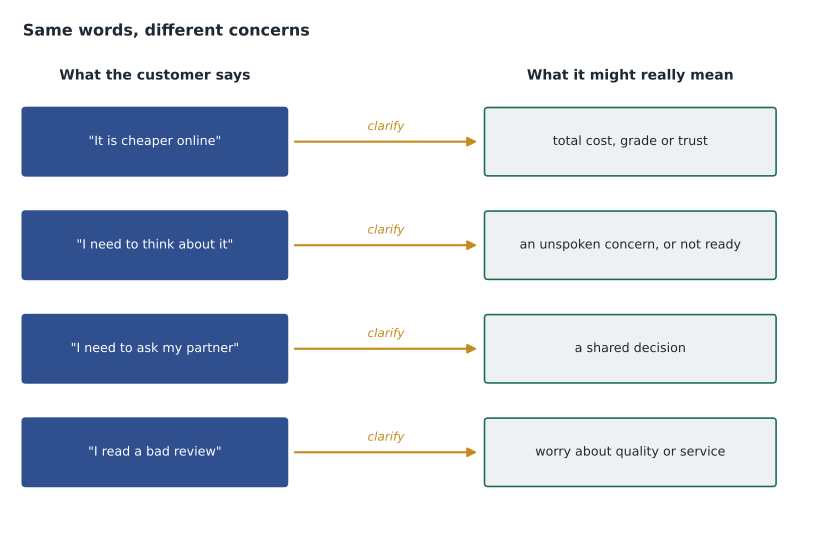
Clarifying is the step new associates skip. An objection that sounds like price may really be about uncertainty ("is it worth it?"), about timing ("I wasn't planning to spend this month"), about a partner ("I don't want to decide without him") or about trust ("will it really last?"). Answering the stated objection when the real one is different wastes the customer's time and the associate's credibility.
"I can get it cheaper online"
Price comparisons with online sellers are the most common objection on any furniture or appliance floor. They are best handled openly. Customers have every right to compare, and an associate who looks at the listing with them shows confidence and respect.
Comparisons are often less simple than they look. Online prices may exclude delivery, assembly, haul-away or returns, may be for a different grade, colour or model number, or may come from a marketplace seller the customer knows nothing about. Juniper & Pine's policy is to match the price of an identical model, in stock, from a local or national retailer, including delivery charges in the comparison, but not marketplace or clearance listings. Associates explain the policy as written, apply it fairly and do not invent exceptions.
Worked problem
Comparing the total cost
The customer's online listing shows the sectional at 1,890 dollars. Delivery from the online retailer is 149 dollars, returns carry a restocking fee of 15 in 100 of the price, and the listing is for the standard fabric grade, not the performance grade she chose. Juniper & Pine's price is 2,199 dollars for the performance grade, with delivery at 79 dollars. The standard grade at Juniper & Pine is 1,949 dollars. Compare the delivered totals for the standard grade, and the cost of returning the online sectional if it did not suit.
Show solution
- Online delivered total, standard grade.
- \[1890 + 149 = 2039\ \text{dollars}\]
- Juniper & Pine delivered total, standard grade.
- \[1949 + 79 = 2028\ \text{dollars}\]
- Restocking fee if the online sectional were returned.
- \[0.15 \times 1890 = 283.50\ \text{dollars}\]
- Juniper & Pine delivered total, performance grade.
- \[2199 + 79 = 2278\ \text{dollars}\]
Answer: For the same standard grade, Juniper & Pine is 11 dollars less delivered, and the online seller would charge about 284 dollars to return it. The performance fabric she wanted costs 250 dollars more than the standard grade at Juniper & Pine. The real choice was between fabric grades, not between stores.
The example shows why clarifying matters. The customer's objection was "it's cheaper online", but the real question, once the facts were on the table, was whether the performance fabric was worth 250 dollars to her. Because she had mentioned a young child and a cat, she decided it was.
"I need to think about it"
"I need to think about it" is often a polite way of ending a conversation. It may mean the customer genuinely needs time, wants to compare elsewhere, needs to talk to someone else, has an unspoken concern, or simply is not interested. The associate's aim is to find out which, respectfully, and to make the customer's next step easy whatever it is.
A useful response is to agree and ask one gentle question: "Of course, it's a big decision. Just so I can help, is there anything about this one you're unsure about, or is it more that you want to sleep on it?" If the customer names a concern, the associate addresses it. If they simply want time, the associate offers to hold the item if possible, writes down the model and price, asks whether they would like a follow-up text (with consent, as lesson 10 covers), and thanks them. Pressure at this point, such as "this price is only good today" when it is not true, is both unethical and, if false, misleading under the law described below.
"I need to ask my partner"
Many furniture decisions are shared, and this objection is often completely genuine. Associates can help by making the conversation at home easier: photos of the product and fabric, a swatch to take home, a written quote with dimensions and delivery options, and an invitation to come back together or join a video call. If the partner is reachable, some customers will call or video-chat from the floor; the associate should offer this without pushing it.
Concerns about fit, quality or reviews
Concerns about whether the product will fit, last or look right are best answered with evidence rather than reassurance. For fit, re-check measurements and offer a hold while the customer measures at home. For quality, show the construction, as lesson 4 described, and explain the warranty in plain words. For colour, lend a swatch. For a negative review the customer has read, look at it together: is it about this model? Is it about delivery rather than the product? Was the problem resolved? Associates should never dismiss reviews or suggest they are fake without evidence.
Advertised items and stock problems
A special kind of objection arises when a customer comes in for an advertised item that is not available. Associates must handle this carefully, because the law sets clear rules.
In Canada, the Competition Act's bait-and-switch provision makes it a reviewable practice to advertise a product at a bargain price that the store does not supply in reasonable quantities, unless the store had reasonable grounds to expect it would and, when it runs out, offers a rain check. A separate provision prohibits selling a product above its advertised price. Juniper & Pine's practice is to offer a rain check at the advertised price for any advertised item that sells out, and associates must never steer customers away from an advertised item they want.
Offering a different product is fine when the customer wants alternatives, but the advertised product must be shown honestly and sold at the advertised price if the customer wants it.
When not to overcome an objection
Some objections are correct. If the sofa really is too deep for the customer's room, or the customer's budget genuinely does not stretch to the fridge they like, the right response is to agree and help them find something that works, or to let them leave with good information. Carl says some of his best long-term customers are people he told not to buy something. "They remember you didn't sell them the wrong thing."
Objections after the sale
Some objections arrive after the customer has bought: a call the next day saying "I think we paid too much", or doubts when the sofa arrives and looks different at home. These are often a form of what psychologists call post-purchase dissonance, the discomfort people feel after a significant decision. The same five steps apply. Listen fully, acknowledge the feeling, clarify what has prompted it (a lower price seen elsewhere, a comment from a friend, a real problem with the product), respond with facts and the store's policies, and check that the concern is settled. If the customer is within the return window and wants to return the product, associates explain the process without pressure. A customer who is helped kindly at this moment often keeps the product and returns to the store; one who is argued with rarely does.
Learning from objections
Objections are also information for the store. If many customers raise the same concern, such as delivery times, a fabric that looks different in daylight or a price gap with a competitor, managers need to know. Juniper & Pine asks associates to note recurring objections in the weekly floor huddle. In October, three associates reported customers asking for delivery within a week; Marcus Dube used those reports to argue for the two-hour delivery windows and faster scheduling that SLS-130 described.
Objections from the quieter partner
When a couple shops together, an objection often comes from the partner who has said least. It may be a sigh, a glance at the price tag or a "hmm" rather than words. Associates who notice it can invite the concern gently: "You've been quiet. What do you think of it?" Bringing the concern into the open early is far better than having the couple leave, talk at home and decide against the purchase for a reason the associate never heard. The five steps then apply as usual, with the associate careful not to take sides between partners.
Throughout, the associate's tone matters as much as the words. Objections handled with curiosity sound like help; the same words delivered defensively sound like an argument. Bev's advice is to treat every objection as a question the customer has not quite asked yet, and to answer that question as helpfully as possible. Customers can usually tell whether an associate is trying to understand them or trying to win.
Common mistakes
MistakeObjections are a sign the sale is lost.
InsteadObjections usually show the customer is seriously considering the purchase.
MistakeAnswer the objection as stated, immediately.
InsteadListen, acknowledge and clarify first; the real concern may be different.
MistakeAvoid looking at online listings the customer shows you.
InsteadLook together and compare the total delivered cost and the exact model honestly.
MistakeCreate urgency to stop "I need to think about it".
InsteadAsk gently whether there is a concern, then make the next step easy. False urgency is misleading.
MistakeSteer customers away from an advertised item that is in short supply.
InsteadShow it honestly, sell it at the advertised price, and offer a rain check if it is sold out.
Summary and key terms
- Objections are concerns standing between the customer and a decision; they are normal and often a good sign.
- Use the five steps: listen, acknowledge, clarify, respond and check.
- Handle online price comparisons openly: compare the exact model and the total delivered cost, and apply the price-match policy fairly.
- For "I need to think about it" and "I need to ask my partner", find out what is behind it and make the next step easy.
- Answer concerns about fit, quality and reviews with evidence rather than reassurance.
- Follow bait-and-switch and advertised-price rules, offer rain checks, and accept that some objections are correct.
- Objection
- A concern or hesitation that stands between a customer and a decision.
- Clarifying question
- A question that finds out what is really behind an objection.
- Price-match policy
- A store's written rule for matching a competitor's price on an identical product.
- Rain check
- A written promise to sell an advertised item at the advertised price when it is back in stock.
- Bait and switch
- Advertising a product at an attractive price without intending or being able to supply it, to steer customers to something else.
Practice problems
Work each problem on paper first, then reveal the answer to check.
A customer says, "That's too expensive." Write a clarifying question.
Show answer
For example: "Is it more than you planned to spend overall, or are you comparing it with something you've seen elsewhere?"
An online sofa is 1,650 dollars plus 120 delivery. The store's identical sofa is 1,749 with 79 delivery. Which is cheaper delivered, and by how much?
Show answer
Online: 1,770 dollars. Store: 1,828 dollars. Online is 58 dollars cheaper delivered.
What three things help a customer who needs to ask their partner?
Show answer
Any three of: photos, a swatch, a written quote with dimensions and delivery, an invitation to come back together or to a video call.
An advertised recliner is sold out. What should the associate offer?
Show answer
A rain check at the advertised price, and alternatives only if the customer wants them.
Lesson quiz · 5 questions
Score 60% or more to complete this lesson.
Create a free account to save your progress, take quizzes and earn a certificate.