
SLS-250 · Lesson 10 of 12 · 19 min
Clienteling and the client book
▶ Video coming soon A video version of this lesson is on the way.
Carl Jensen's binder is famous at Juniper & Pine. It is a thick black ring binder with tabbed dividers for each letter of the alphabet and about 900 handwritten pages, one per customer household, going back nine years. Each page lists what the household bought, when, the room it went in, family names, pets, measurements, colours they liked and hated, and notes from every follow-up call. On a slow Tuesday in early November, Aiden watched Carl flip to a page, dial a number and say: "Mrs. Beaulieu, it's Carl from Juniper & Pine. It's been about three years since we did your living room, and you mentioned you wanted to do the bedroom once your son moved out. Did that happen?" It had. She came in that Saturday.
Clienteling is the practice of building lasting, personal relationships with individual customers so that they come back and refer others. The client book is the record that makes it possible. Carl's binder is the traditional version; most stores now use a clienteling app linked to the point-of-sale system, as SLS-140 described. This lesson covers what clienteling is for, what to record, how to follow up, how to do it with consent and within privacy law, and why Bev asked Carl, gently, to move his binder into the app.
Why clienteling matters in furniture and appliances
Furniture and appliances are bought rarely, so a single household may buy from a store only once every few years. That makes each relationship more valuable, not less. A household that furnishes a living room today may need a bedroom, a dining room, a mattress, a fridge and a washer over the next decade, and may refer friends, children and neighbours. SLS-130 showed how retention drives profit. In commission retail, it also drives the associate's income: Carl estimates that more than half of his sales each year come from people already in his binder or referred by them.
Clienteling also improves the customer's experience. A customer who is recognized, whose preferences are remembered and who is contacted at helpful moments feels valued. Done badly, though, clienteling becomes intrusive: too many messages, irrelevant offers, or notes that reveal more than the customer expected the store to remember.
What to record
A good client record holds what will help serve the customer next time, and nothing that would embarrass anyone if the customer read it. Juniper & Pine's guidance groups useful notes into four kinds.
| Kind of note | Examples | Why it helps |
|---|---|---|
| Purchases and service | What was bought, when, which room, delivery notes, any service issues and how they were resolved | Context for the next visit and for warranty or care questions |
| Home and fit | Room sizes, door and stair measurements, "stairwell turn, 81 cm clear" | Prevents repeat measuring and fit failures |
| Preferences | Colours and styles they like or dislike, comfort preferences, brands they trust | Lets the associate suggest the right things quickly |
| Plans and timing | "Planning bedroom once son moves out, maybe next summer"; "fridge is 14 years old" | Gives a reason and a time to follow up |
Notes must be factual, respectful and based on what the customer chose to share. "Recovering from hip surgery; prefers higher seats" is appropriate if the customer mentioned it in the context of choosing a chair and agreed to have a profile. Guesses about income, marital status, health or anything else the customer did not volunteer have no place in the record. A useful test is to imagine the customer reading the page over the associate's shoulder.
Following up
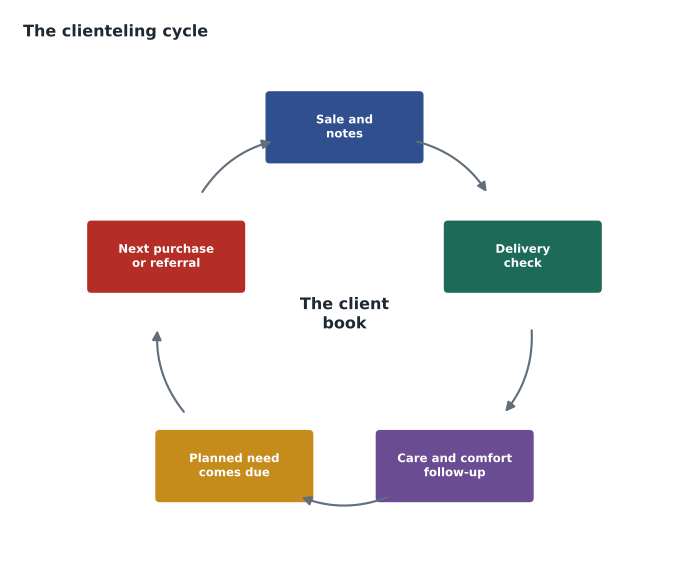
A client book is only valuable if it is used. Follow-up has three main purposes: to make sure the customer is happy with what they bought, to be available when their next need arises, and to thank them for referrals. Juniper & Pine sets a basic follow-up rhythm for main-floor sales, and associates add personal contacts where the record suggests a reason.
| When | Contact | Purpose |
|---|---|---|
| Day after delivery | Short text or call | Check that delivery went well and the product is as expected |
| About three weeks after a mattress sale | Call | Check comfort, remind them of the comfort exchange window if needed |
| About two months after a sale | Text or email | Care tips, and an invitation to ask questions |
| When a planned need comes due | Personal call or message | Ask whether the plan has happened ("Did your son move out?") |
| After a referral | Thank-you note or call | Thank the customer, without making it feel transactional |
Each contact should be useful to the customer. Carl's rule is that every call has a reason the customer would recognize. "Just checking in" is not a reason. "You mentioned the fridge was 14 years old and starting to make noises" is.
Measuring a client book
Worked problem
What is Carl's binder worth?
Last year Carl made 610 sales. Of these, 220 were to households already in his binder and 120 were to people referred by binder customers. His average sale to returning and referred customers was 1,480 dollars, compared with 1,150 dollars for new walk-in customers. What share of his sales came from the binder, and how much did those sales total?
Show solution
- Sales from returning or referred customers.
- \[220 + 120 = 340\]
- Share of all sales.
- \[340 \div 610 \approx 0.56\]
- Total value of those sales.
- \[340 \times 1480 = 503\,200\ \text{dollars}\]
- Value of the remaining walk-in sales, for comparison.
- \[(610 - 340) \times 1150 = 270 \times 1150 = 310\,500\ \text{dollars}\]
Answer: About 56 in 100 of Carl's sales, worth about 503,200 dollars, came from returning or referred customers, compared with about 310,500 dollars from new walk-ins. His binder was the biggest single source of his business.
Consent for messages
Following up by text and email is convenient, but commercial messages are regulated, as SLS-140 and SLS-150 explained. At Juniper & Pine, consent for texts is captured at the point of sale, and the texting tool, managed by Tessa Yellowbird, records it. Associates must not text customers from personal phones or add numbers to the tool without consent.
In Canada, CASL requires consent for commercial electronic messages. A purchase creates implied consent for two years from the purchase, and an inquiry creates implied consent for six months, but express consent, given knowingly and recorded, lasts until withdrawn and is the store's preferred basis. Every message must identify the store and include an unsubscribe method that works, and unsubscribe requests must be honoured within 10 business days. Messages that are purely about the transaction itself, such as delivery confirmations and warranty information, are treated differently from promotional messages.
Privacy and the client book
Customer notes are personal information. In Saskatchewan, as in most provinces, the federal Personal Information Protection and Electronic Documents Act (PIPEDA) applies to retailers. It requires the store to collect only what it needs for identified purposes, with the customer's knowledge and consent, to keep it accurate, protect it with security safeguards appropriate to its sensitivity, keep it only as long as needed and let customers see what is held about them. A notable breach of security safeguards that creates a real risk of significant harm must be reported to the Privacy Commissioner and to the affected customers.
This is why Bev asked Carl to move his binder into the clienteling app. The binder sits on a shelf behind the sales desk, unlocked; if it were lost or taken, 900 households' details would go with it, and the store would have no record of what was in it. In the app, records are protected by sign-in, backed up, visible to colleagues who need them when Carl is away, and linked to consent records. Carl agreed, on one condition: that he could keep writing the notes in his own words. Aiden spent three slow Tuesday mornings helping him enter the most recent 200 pages, and the binder was then shredded under the store's retention procedure.
Personal touches that stay professional
Clienteling at its best feels personal: remembering a child's name, asking how the new kitchen turned out, sending a handwritten thank-you after a large purchase. It stays professional when the contact is about the customer's home and purchases, uses the channels the customer agreed to, and respects the customer's time. Birthday and holiday messages are common in some retail sectors, but Juniper & Pine leaves them to the store's marketing team rather than individual associates, to keep consent and frequency under control. Lesson 7's rule applies here too: record declined offers so customers are not asked again.
Moving from one associate to another
Associates change roles, go on leave and move to other stores, and their customers should not lose the relationship when that happens. Because Juniper & Pine's client records live in the app rather than in personal binders or phones, a colleague can pick up the record, read the history and continue. Good practice is a short handover: the departing associate introduces the colleague by phone or message to their most active customers, and notes any open promises in the records. Customers are told who will look after them, and they remain free to ask for someone else.
Clienteling at scale
A busy associate may have several hundred customers in their book, too many to remember. The clienteling app helps by surfacing the right contacts at the right time: deliveries completed yesterday, mattress sales due for the three-week call, plans that come due this month, customers who have browsed the website recently and agreed to be contacted. Associates still decide who to contact and what to say. Carl's advice to Aiden was to spend the first 30 minutes of every quiet morning on the app's list, and to write each message as if it were the only one he was sending that day.
Stores also measure clienteling. Useful measures include the share of sales with a complete customer profile, the share of follow-ups completed on time and the share of sales from returning and referred customers. Bev watches the last of these most closely, because it shows whether the relationships associates build are lasting.
When customers ask what the store knows
Customers sometimes ask what information the store holds about them, or ask to have it corrected or deleted. Associates should respond politely and pass the request to the person the store names for privacy questions, rather than handling it informally. They should never refuse, argue or delete records on the spot without following the store's procedure, because some information, such as purchase and warranty records, may need to be kept for a period for legal or service reasons.
Done well, clienteling also makes the job more satisfying. Associates who know their customers well enjoy the conversations more, see the results of their earlier work and build a reputation that brings people to the store asking for them by name. Carl says that after nine years, most of his Saturdays feel less like selling to strangers and more like helping friends of friends furnish their homes. That reputation is built one useful contact at a time, and it begins with the first note in the record.
Common mistakes
MistakeA client book is a list of phone numbers.
InsteadIt is a record of purchases, home details, preferences and plans that makes each contact useful.
MistakeRecord everything you can find out about a customer.
InsteadRecord only what helps serve them and what they chose to share, in words they could read without embarrassment.
Mistake"Just checking in" is a good reason to call.
InsteadEvery contact should have a reason the customer would recognize as useful.
MistakeTexting from a personal phone is fine for regular customers.
InsteadUse the store's tool with recorded consent, so messages follow the law and the store's records.
MistakeA paper binder is private because only one person uses it.
InsteadPaper records can be lost or taken and have no backup or access control; they need the same protection as digital records.
Summary and key terms
- Clienteling builds lasting relationships so customers return and refer others; the client book is its record.
- In furniture and appliances, each relationship spans years and many purchases, and repeat and referred customers often provide most of a seller's business.
- Record purchases, home and fit details, preferences and plans; keep notes factual, respectful and based on what the customer shared.
- Follow a rhythm of useful contacts after each sale, and contact customers when a planned need comes due.
- Commercial texts and emails need consent and working opt-outs under CASL.
- Client records are personal information: collect only what is needed, protect it, keep it accurate and delete it when no longer needed.
- Clienteling
- Building lasting, personal relationships with individual customers so they return and refer others.
- Client book
- The record of each customer's purchases, preferences and plans used for clienteling.
- Follow-up rhythm
- A planned schedule of useful contacts after a sale.
- Express consent
- Permission the customer gives knowingly and clearly, recorded by the store.
- Retention procedure
- The store's rules for how long records are kept and how they are destroyed.
Practice problems
Work each problem on paper first, then reveal the answer to check.
Write a useful note for a customer who bought a sofa and mentioned planning a new dining set next spring.
Show answer
For example: "Bought grey sectional, Oct 2026, living room. Planning dining set spring 2027, seats 8, likes oak, dislikes glass tops."
Why should a follow-up call have a reason the customer would recognize?
Show answer
So the contact feels useful rather than intrusive or purely sales-driven.
An associate made 400 sales, 180 to returning or referred customers. What share is that?
Show answer
180 divided by 400 is 0.45, or 45 in 100.
Give two reasons a clienteling app is safer than a paper binder.
Show answer
Any two of: sign-in protection, backups, access for colleagues who need it, linked consent records, controlled deletion.
Lesson quiz · 5 questions
Score 60% or more to complete this lesson.
Create a free account to save your progress, take quizzes and earn a certificate.