
SLS-222 · Lesson 7 of 12 · 27 min
Margins, discounts and profitability
▶ Video coming soon A video version of this lesson is on the way.
Late in October, Grace Liu circulated a short report to the sales team. Across the fiscal year, Ridgeline's average discount off list had been 7.4 in 100, and deals discounted by more than 10 in 100 had closed, on average, only two days faster than the rest. At the value desk on October 27, Rob put the report on the table. "Everyone in this room has given a discount this year to close a deal," he said. "Today we work out what those discounts actually cost."
The first half of this course has been about the customer's numbers. This lesson turns to the seller's. A seller who understands the customer's finances but not their own employer's will win deals that make no money.
Margin and markup
Two terms describe the profit on a sale, and they are easy to confuse. Gross margin is gross profit as a share of the selling price. Markup is gross profit as a share of cost. The same sale has a smaller margin than markup, because the selling price is larger than the cost.
Worked problem
Margin and markup on a desk
Ridgeline buys a desk for 680 dollars and sells it for 1,000 dollars. What are the gross profit, the gross margin and the markup?
Show solution
- Gross profit: 1,000 − 680 = 320 dollars.
- \[\text{Margin} = \frac{320}{1{,}000} = 0.32 \qquad \text{Markup} = \frac{320}{680} \approx 0.47\]
Answer: Gross profit of 320 dollars: a gross margin of 32 in 100 and a markup of about 47 in 100. Confusing the two is a common way to misjudge how much room there is for a discount.
Margins differ widely between product lines. Ridgeline's illustrative gross margins in fiscal 2026 were about 32 in 100 on furniture, about 30 in 100 on video and display hardware, about 38 in 100 on managed print contracts and about 78 in 100 on RoomFlow subscriptions, where most of the cost of developing the software had already been paid. Those differences explain why Ridgeline was willing to bend on hardware prices to win a subscription, and why its 2027 commission plan would pay on gross profit rather than revenue for managed print and RoomFlow.
A discount comes out of profit
When a seller cuts a price, the cost of the product does not change. Every dollar of discount comes straight off the gross profit. That is why a discount that looks small as a share of the price is large as a share of the profit.
Worked problem
What the Keystone hardware discount cost
In the Keystone room deal described in SLS-213, Ridgeline gave 4 in 100 off 17,600 dollars of hardware with a gross margin of 30 in 100. How much gross profit did the discount cost, and what share of the hardware's gross profit was that?
Show solution
- Gross profit at list: 17,600 × 0.30 = 5,280 dollars.
- Discount: 17,600 × 0.04 = 704 dollars, all of which comes off gross profit.
- Gross profit after the discount: 5,280 − 704 = 4,576 dollars.
- \[\frac{704}{5{,}280} \approx 0.133\]
Answer: The 4 in 100 discount cost 704 dollars, about 13 in 100 of the hardware's gross profit. Ridgeline accepted it because it secured a three-year RoomFlow subscription at a far higher margin.
How much more you must sell
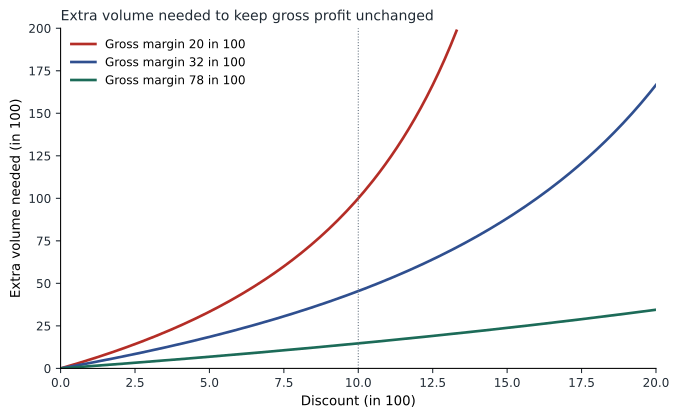
If a discount is supposed to pay for itself through higher volume, the seller has to sell more units to earn the same gross profit. With a gross margin m and a discount d, both written as decimals, the increase in volume needed to keep gross profit unchanged is:
Worked problem
The volume needed to make up a 10 in 100 discount
Ridgeline's furniture has a gross margin of 32 in 100. If a seller gives a 10 in 100 discount, how much more furniture must be sold to earn the same gross profit? What if the discount is 5 in 100?
Show solution
- \[\frac{0.10}{0.32 - 0.10} = \frac{0.10}{0.22} \approx 0.455\]
- \[\frac{0.05}{0.32 - 0.05} = \frac{0.05}{0.27} \approx 0.185\]
Answer: A 10 in 100 discount requires about 45 in 100 more volume just to stand still; a 5 in 100 discount requires about 19 in 100 more. Halving the discount cuts the extra volume needed by more than half.
| Gross margin | Discount 5 in 100 | Discount 10 in 100 | Discount 15 in 100 |
|---|---|---|---|
| 20 in 100 | 33 in 100 more | 100 in 100 more | 300 in 100 more |
| 30 in 100 | 20 in 100 more | 50 in 100 more | 100 in 100 more |
| 40 in 100 | 14 in 100 more | 33 in 100 more | 60 in 100 more |
| 78 in 100 | 7 in 100 more | 15 in 100 more | 24 in 100 more |
The table explains a pattern in Grace's report. On low-margin products, even modest discounts need very large volume increases to pay for themselves, and those increases rarely happen in business-to-business sales, where a customer buys what it needs, not more because the price is lower. On high-margin products like RoomFlow, a discount costs less in proportion, which is why software sellers discount more readily. Neither makes a discount free.
The pocket price
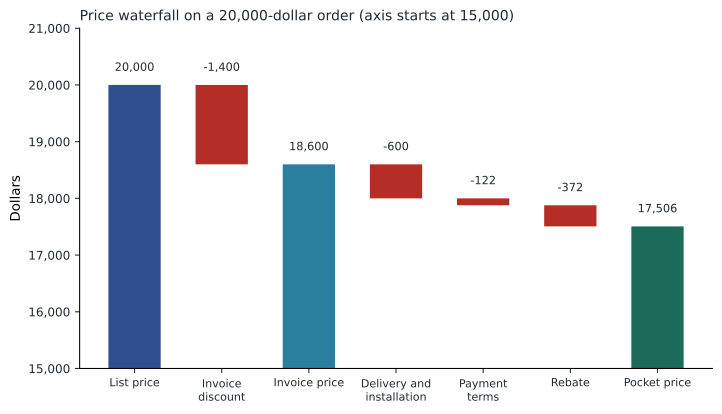
The list price and even the invoice price often overstate what a seller actually keeps. Michael Marn and Robert Rosiello of McKinsey, in a 1992 Harvard Business Review article, "Managing Price, Gaining Profit", described the price waterfall: the series of discounts and costs between the list price and the pocket price, the amount the seller really pockets from a sale. Some reductions appear on the invoice, such as negotiated discounts. Others do not: free delivery and installation, extended payment terms, rebates, special training and the cost of rush orders. Their case studies found that these off-invoice items were often large and poorly tracked.
Worked problem
A price waterfall on a furniture order
A 20,000-dollar furniture order at list is sold with a 7 in 100 invoice discount. Ridgeline also agrees to free delivery and installation worth 600 dollars, 60-day payment terms instead of 30 (Ridgeline's cost of money is 8 in 100 a year), and a 2 in 100 year-end volume rebate on the invoice amount. What is the pocket price, and what share of list is it?
Show solution
- Invoice price: 20,000 × 0.93 = 18,600 dollars.
- Free delivery and installation: − 600 dollars.
- \[\text{Extra 30 days of credit} = 18{,}600 \times 0.08 \times \frac{30}{365} \approx 122\]
- Volume rebate: 18,600 × 0.02 = 372 dollars.
- \[\text{Pocket price} = 18{,}600 - 600 - 122 - 372 = 17{,}506\]
Answer: The pocket price is about 17,506 dollars, about 87.5 in 100 of list. The invoice showed a 7 in 100 discount; the real reduction was about 12.5 in 100.
Why price matters so much to profit
Marn and Rosiello also popularized a striking calculation: for the large companies they studied, a 1 in 100 price increase with no loss of volume would have raised operating profit by about 11 in 100, far more than a 1 in 100 cut in costs or increase in volume. The exact figure depends on each company's margins, but the logic applies everywhere, because a price increase falls straight to profit.
Worked problem
What 1 in 100 on price is worth to Ridgeline
Ridgeline's revenue in fiscal 2026 was about 16.8 million dollars. Suppose its operating margin was 7 in 100 (an illustrative figure). If Ridgeline had achieved prices 1 in 100 higher on the same volume, by how much would operating profit have risen?
Show solution
- Operating profit: 16,800,000 × 0.07 = 1,176,000 dollars.
- Extra revenue at the same volume, all of it profit: 16,800,000 × 0.01 = 168,000 dollars.
- \[\frac{168{,}000}{1{,}176{,}000} \approx 0.143\]
Answer: Operating profit would have risen by about 168,000 dollars, or about 14 in 100. In reverse, an average discount 1 in 100 deeper costs about the same.
Rob used the result to explain why he cared about the difference between a 7.4 and a 6.4 in 100 average discount. "That one point is most of a sales rep's salary," he said. "I'm not asking you never to discount. I'm asking you to get something for it."
Discounting with discipline
Ridgeline's discount bands, which SLS-213 covered, let an account executive give up to 5 in 100, up to 10 with Darnell's approval and more only with Rob's. From 2027, any discount above 5 in 100 had to be linked in the CRM to something the customer gave in return: a longer term, a larger order, a reference, faster payment or a scheduled installation in a quiet month. The principle behind both rules is the same one negotiators teach: never give a concession without getting one, and know what each concession costs before offering it.
Why Ridgeline is paying commission on gross profit
For most of its history, Ridgeline paid account executives a commission on revenue. Grace's analysis showed why that was changing for managed print and RoomFlow in 2027. A commission on revenue rewards a seller equally for a dollar of high-margin business and a dollar of low-margin business, and it barely notices discounts. A commission on gross profit makes the seller's pay move with the company's profit.
Worked problem
Two deals under two commission plans
Deal A is 40,000 dollars of furniture at a 32 in 100 margin after a 10 in 100 discount from a 44,444-dollar list (rounded). Deal B is 30,000 dollars of managed print at a 38 in 100 margin with no discount. Compare the seller's commission under a plan paying 5 in 100 of revenue and a plan paying 15 in 100 of gross profit. Assume the 32 in 100 margin is measured on the list price, so the discounted margin must be recalculated.
Show solution
- Deal A cost: 44,444 × (1 − 0.32) ≈ 30,222 dollars. Gross profit at 40,000: 40,000 − 30,222 = 9,778 dollars.
- Deal B gross profit: 30,000 × 0.38 = 11,400 dollars.
- Revenue plan: A earns 40,000 × 0.05 = 2,000; B earns 30,000 × 0.05 = 1,500.
- Gross-profit plan: A earns 9,778 × 0.15 ≈ 1,467; B earns 11,400 × 0.15 = 1,710.
Answer: On revenue, the discounted furniture deal pays the seller more. On gross profit, the smaller managed print deal pays more, matching the fact that it earns Ridgeline more profit.
Neither plan is perfect. Gross-profit commissions are harder for sellers to calculate and can make them reluctant to sell strategically important products with thin margins. Ridgeline kept revenue-based commission on furniture for 2027 and added the gross-profit plan for the two recurring lines, where the effect of discounts on profit was largest.
Five questions before giving a discount
Rob asked the team to run through five questions, out loud if necessary, before offering any discount. None of them forbids a discount. Together they make sure a discount is a decision rather than a reflex.
- What is the customer actually asking for: a lower price, or a lower payment, a smaller budget line or a reason to say yes internally? Lesson 6 showed that a different structure can solve some of these without a discount.
- What will this discount cost in gross profit, in dollars, not just in per cent off the price?
- What will the customer give in return: a longer term, a larger order, a reference, faster payment or flexibility on timing?
- Is the discount within my band, and if not, have I asked the right person before mentioning it to the customer?
- Will this price become the customer's expectation next time, or set a precedent for other customers?
Maya tested the questions on her own deals that week. Two of the discounts she had planned to offer turned out to answer the wrong problem. At Westgate & Rowe, Priya needed the partners to see a total within their moving budget, which a three-year RoomFlow term solved better than a lower furniture price. At Halverson Law, the firm's concern was the installation date during a busy period, not price at all.
Common mistakes
MistakeA 10 in 100 margin and a 10 in 100 markup are the same thing.
InsteadMargin divides profit by price; markup divides it by cost. The same sale has a lower margin than markup.
MistakeA small discount on the price is a small cut in profit.
InsteadThe whole discount comes off gross profit; on a 30 in 100 margin, 4 in 100 off the price removes about 13 in 100 of the profit.
MistakeA discount pays for itself if it helps the customer buy more.
InsteadAt a 32 in 100 margin, a 10 in 100 discount needs about 45 in 100 more volume to break even.
MistakeThe invoice price is what the seller keeps.
InsteadOff-invoice items such as free services, payment terms and rebates reduce the pocket price further.
Summary and key terms
- Gross margin is gross profit divided by price; markup is gross profit divided by cost.
- Margins vary widely by product line, which shapes where a seller can be flexible.
- Every dollar of discount comes off gross profit, so a small price cut can be a large profit cut.
- To keep gross profit unchanged after a discount d at margin m, volume must rise by d ÷ (m − d), which is very large on low-margin products.
- The price waterfall runs from list to pocket price through invoice discounts and off-invoice costs.
- Because a price change falls straight to profit, 1 in 100 on price can change operating profit by 10 in 100 or more.
- Discounts should be traded for something of value and kept within approved bands.
- Gross margin
- Gross profit divided by the selling price.
- Markup
- Gross profit divided by cost.
- Price waterfall
- The sequence of discounts and costs from list price to pocket price.
- Invoice price
- The price shown on the invoice after on-invoice discounts.
- Pocket price
- What the seller actually keeps from a sale after all on-invoice and off-invoice reductions.
- Off-invoice cost
- A reduction in what the seller keeps that does not appear on the invoice, such as free services or rebates.
Practice problems
Work each problem on paper first, then reveal the answer to check.
A product costs 600 dollars and sells for 800. What are the margin and markup?
Show answer
Profit 200; margin 200 ÷ 800 = 25 in 100; markup 200 ÷ 600 ≈ 33 in 100.
At a 25 in 100 gross margin, how much extra volume does a 5 in 100 discount need to keep gross profit unchanged?
Show answer
0.05 ÷ 0.20 = 0.25, so 25 in 100 more volume.
Name three off-invoice items that can lower the pocket price.
Show answer
For example: free delivery or installation, extended payment terms, rebates, free training or rush-order costs.
Lesson quiz · 5 questions
Score 60% or more to complete this lesson.
Create a free account to save your progress, take quizzes and earn a certificate.