
SLS-222 · Lesson 4 of 12 · 22 min
ROI and payback
▶ Video coming soon A video version of this lesson is on the way.
Marlene Toews had told Maya, in a fifteen-minute call in early October, exactly how Keystone would judge the training centre: mainly on payback, with a target of three years or less, and with the owners' board approving anything over 20,000 dollars. At the value desk on October 13, Maya brought the numbers she had gathered since then and asked Rob to help her turn them into the two figures Marlene would look for first.
"Payback and return on investment are the two numbers every finance director knows," Rob said. "They're simple, which is their strength and their weakness. Get them right, show the working, and then show you understand what they leave out."
The training-centre investment
Keystone's dealer training had grown. In 2025 it ran 16 days of training for dealers' sales and service staff in rented hotel meeting rooms, at about 1,100 dollars a day for the room and audiovisual equipment, and its two trainers made about 12 trips a year to dealers for sessions that could have been run by video, at about 850 dollars a trip in travel and accommodation. Maya's proposal would turn six unused rooms at Keystone's plant into a training centre: video equipment and displays in every room, RoomFlow booking panels, installation and setup, for 48,000 dollars. RoomFlow itself would cost 45 dollars per room per month.
Maya had checked each figure with the person who knew it. Linda Sorensen had the training calendar and the hotel invoices; Marlene had confirmed the travel claims. Maya had not counted anything she could not trace, such as the trainers' time spent travelling or any extra dealer sales from better training, though she noted both as possible further benefits.
| Item | Basis | Per year (dollars) |
|---|---|---|
| Hotel meeting rooms no longer rented | 16 days × 1,100 dollars | 17,600 |
| Trainer trips replaced by video sessions | 12 trips × 850 dollars | 10,200 |
| Total annual benefit | 27,800 | |
| RoomFlow subscription | 6 rooms × 45 dollars × 12 months | 3,240 |
| Net annual benefit | 27,800 − 3,240 | 24,560 |
Payback
The payback period is how long it takes for the cumulative net benefits of an investment to equal its cost. It answers a question every owner asks: "How soon do I get my money back?" When the benefit is roughly the same each year, the calculation is a single division.
Worked problem
Payback on the training centre
The training centre costs 48,000 dollars to install and produces a net benefit of 24,560 dollars a year. What is the payback period in years and in months?
Show solution
- \[\text{Payback} = \frac{48{,}000}{24{,}560} \approx 1.95 \text{ years}\]
- \[1.954 \times 12 \approx 23.5 \text{ months}\]
Answer: About 1.95 years, or roughly 23 and a half months, comfortably inside Keystone's three-year target.
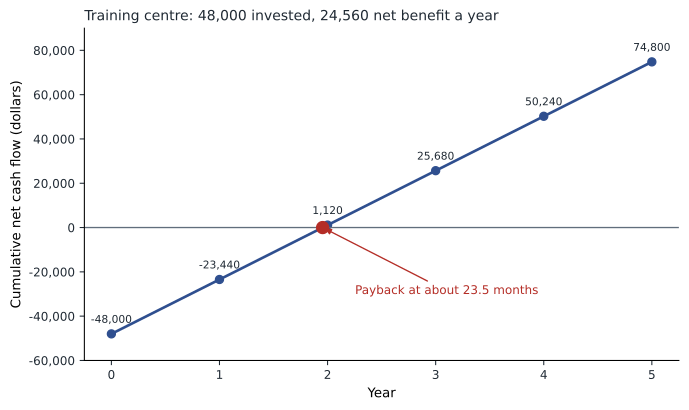
Payback is easy to understand and easy to check, and it favours projects that return cash quickly, which matters to a business like Keystone whose cash is tight in the spring. Its weakness is that it ignores everything after the payback date. A project that pays back in two years and then stops producing benefits looks the same as one that pays back in two years and keeps paying for ten.
Return on investment
Return on investment (ROI) compares the net gain from an investment with its cost, over a stated period. Because ROI depends heavily on the period chosen, a seller should always say what period it covers. A five-year ROI will always look better than a one-year ROI for the same project.
Worked problem
Three-year ROI on the training centre
Over three years, the training centre produces net benefits of 24,560 dollars a year. It costs 48,000 dollars. What is the three-year ROI?
Show solution
- Total net benefits over three years: 24,560 × 3 = 73,680 dollars.
- \[\text{ROI} = \frac{73{,}680 - 48{,}000}{48{,}000} = \frac{25{,}680}{48{,}000} = 0.535\]
Answer: A three-year ROI of about 53.5 in 100: over three years Keystone gets back its 48,000 dollars plus 25,680 dollars more.
Maya chose three years because that was the period Marlene used for payback and because it was well within the equipment's expected life of five to seven years. A five-year ROI would have been much larger, but it would also have depended on benefits further in the future, which a careful buyer trusts less.
When ROI does not fit
Not every purchase is an investment with an up-front cost and later benefits. Eastgate Physiotherapy's managed print proposal had no initial investment at all; it replaced one monthly cost with a lower one. Calculating an ROI for it would mean dividing savings by a cost that was itself the source of the savings, which produces an impressive-looking but confusing number. For purchases like this, Rob preferred a simple comparison of totals over the same period: the status quo against the proposal, which is how the Eastgate business case in lesson 2 was built. The general rule is to use the measure the customer actually uses, and not to force a formula onto a decision it does not fit.
The time value of money
Payback and simple ROI both treat a dollar received in year five as worth the same as a dollar today. A finance director knows it is not. Money available now can be invested, or used to pay down the operating line and save interest, and future benefits carry more risk. This is the time value of money: a dollar today is worth more than a dollar in the future.
To compare money received at different times, finance uses present value: what a future amount is worth today at a chosen discount rate, which reflects the customer's cost of money and the risk of the project. The present value of an amount received in n years at a discount rate r is:
Many companies set a hurdle rate, a minimum return a project must earn. Marlene told Maya that Keystone used 8 in 100 for equipment projects, slightly above the rate it paid on its bank line.
Net present value
Net present value (NPV) adds up the present values of all a project's future net benefits and subtracts the initial investment. A positive NPV means the project earns more than the discount rate; a negative NPV means it earns less. NPV is the measure most finance textbooks recommend, because it accounts for both the size and the timing of every cash flow.
| Year | Net benefit | Discount factor 1 ÷ 1.08ⁿ | Present value |
|---|---|---|---|
| 1 | 24,560 | 0.9259 | 22,741 |
| 2 | 24,560 | 0.8573 | 21,056 |
| 3 | 24,560 | 0.7938 | 19,497 |
| 4 | 24,560 | 0.7350 | 18,052 |
| 5 | 24,560 | 0.6806 | 16,715 |
| Total | 122,800 | 3.9927 | 98,061 |
Worked problem
NPV of the training centre over five years at 8 in 100
The training centre costs 48,000 dollars and produces net benefits of 24,560 dollars at the end of each of the next five years. Keystone's hurdle rate is 8 in 100. What is the NPV?
Show solution
- The table above gives the present value of each year's net benefit; together they come to 98,061 dollars.
- \[\text{NPV} = 98{,}061 - 48{,}000 = 50{,}061\]
Answer: The NPV is about 50,000 dollars. Even after allowing for the time value of money at Keystone's own rate, the project is worth about 50,000 dollars more than it costs.
The NPV of about 50,000 dollars was noticeably smaller than the undiscounted five-year total of 122,800 dollars minus 48,000, or 74,800 dollars. That difference is exactly what a finance director expects a seller to understand. Maya decided to show payback first, because Marlene had asked for it, then the three-year ROI, and then the NPV at Keystone's own rate as a note, so that Marlene would see that the case survived the stricter test.
Some finance teams also calculate a discounted payback period: the time until the present values of the benefits add up to the investment. For the training centre, the first two years' present values add up to 43,797 dollars, and the third year's adds 19,497 dollars, so discounted payback falls a little over two years in, later than the simple payback but still well inside three years.
What these numbers do not say
Every one of these measures depends on the benefit figures, and every benefit figure is an estimate. The training centre's numbers were based on 2025, a normal year; if Keystone ran fewer training days, the benefits would be smaller. Lesson 10 shows how a value case tests a range of assumptions rather than a single figure. None of the measures captures benefits that are hard to price, such as better-trained dealer staff, or risks such as a supplier failing to deliver. A good seller presents the numbers as the customer's numbers, built from the customer's data, and is the first to say what they leave out.
Internal rate of return
Some finance teams prefer a fourth measure, the internal rate of return (IRR): the discount rate at which a project's NPV would be exactly zero. It expresses the project's return as an annual rate, which can be compared directly with the customer's hurdle rate or its borrowing cost. If the IRR is higher than the hurdle rate, the NPV at the hurdle rate is positive.
IRR cannot be found with a single division; spreadsheets calculate it by trial and error with a function such as IRR. For the training centre, with 48,000 dollars invested and 24,560 dollars a year for five years, the IRR is roughly 42 in 100 a year, far above Keystone's 8. Maya did not put the IRR in the proposal, because Marlene had not asked for it and a very high rate can look too good to be true. She kept it in her notes in case Marlene's accountant asked.
IRR has known weaknesses. It can give misleading answers when cash flows change sign more than once, and it says nothing about the size of the gain: a tiny project and a large one can have the same IRR. Most finance textbooks treat NPV as the more reliable guide and IRR as a useful summary.
Presenting the numbers
A finance director reads a business case looking for reasons to doubt it. The way the numbers are presented can make that easier or harder. Rob gave Maya five rules for the page that would go to Marlene.
| Rule | Why it matters | In the Keystone case |
|---|---|---|
| Lead with the measure the customer uses | It answers their first question before they look for it | Payback first, because Marlene asked for it |
| Show the working, not just the result | A buyer can check and correct it | Each benefit shown as days or trips times a cost |
| Name every source | Traceable numbers are trusted numbers | "Linda Sorensen, 2025 training calendar and hotel invoices" |
| Separate what is counted from what is not | Shows the case is conservative | Trainer time and extra dealer sales listed as not counted |
| Round sensibly | False precision invites suspicion | "About 23 months", not "23.45 months" |
Maya also learned to avoid a habit common in sellers' business cases: adding up every possible benefit, however speculative, to produce the largest possible number. A business case claiming that a 48,000-dollar room would earn Keystone a million dollars in extra dealer sales might be technically arguable, but it would destroy her credibility with Marlene in a single sentence. A modest, well-sourced case that clears the customer's own test is almost always more persuasive than a dramatic one.
Finally, Rob reminded her that the numbers belong to the customer. "Don't say 'our ROI'," he said. "Say 'the return on your investment, based on your figures'. If she can see her own data in it, she'll defend it to her board."
Common mistakes
MistakeROI means the same thing whatever period it covers.
InsteadROI depends on the period; always state it, and choose one the customer uses.
MistakePayback tells you whether a project is worth doing.
InsteadPayback says how soon the cost is recovered, but ignores benefits after that date and the time value of money.
MistakeFuture benefits are worth the same as money today.
InsteadDiscount future benefits at the customer's rate; NPV does this.
MistakeEvery purchase should be shown with an ROI.
InsteadWhere a purchase replaces one cost with another, compare totals over the same period instead.
Summary and key terms
- Payback is the time it takes cumulative net benefits to equal the investment; with level benefits it is the investment divided by the annual net benefit.
- ROI compares net gain with cost over a stated period, and should always state the period.
- Some purchases, such as replacing one monthly cost with another, are better shown as a comparison of totals.
- The time value of money means future benefits are worth less than money today.
- Present value discounts a future amount at a chosen rate, and NPV adds the present values of all future net benefits and subtracts the investment.
- A positive NPV at the customer's hurdle rate means the project earns more than that rate.
- All these measures rest on estimates and leave out benefits that are hard to price.
- Payback period
- The time for cumulative net benefits to equal the initial investment.
- Return on investment (ROI)
- Total net benefits minus the investment, divided by the investment, over a stated period.
- Time value of money
- The principle that a dollar today is worth more than a dollar in the future.
- Discount rate
- The rate used to convert future amounts into present values.
- Hurdle rate
- The minimum return an organization requires before approving a project.
- Net present value (NPV)
- The sum of the present values of future net benefits minus the initial investment.
- Discounted payback
- The time until the present values of benefits add up to the investment.
Practice problems
Work each problem on paper first, then reveal the answer to check.
An investment of 30,000 dollars saves 12,000 dollars a year. What is the payback period?
Show answer
30,000 ÷ 12,000 = 2.5 years.
The same investment over four years: what is the ROI?
Show answer
Net benefits 48,000; (48,000 − 30,000) ÷ 30,000 = 0.6, or 60 in 100.
What is the present value of 10,000 dollars received in two years at 8 in 100?
Show answer
10,000 ÷ 1.08² ≈ 8,573 dollars.
Lesson quiz · 5 questions
Score 60% or more to complete this lesson.
Create a free account to save your progress, take quizzes and earn a certificate.