
SLS-221 · Lesson 8 of 12 · 20 min
Content and social selling
▶ Video coming soon A video version of this lesson is on the way.
On November 2, Owen showed Maya a post that had appeared that morning in her LinkedIn feed. The practice manager of a veterinary clinic, Sandra Kim, had written about the clinic's new second surgery suite and the scramble to schedule staff across two rooms. Several people had left congratulations. "You know Sandra," Owen said. "Lakeview is one of your deals. What would you do with this?" Maya's first thought was to send a message about RoomFlow. Owen shook his head. "Comment like a person first. Congratulate her, ask a real question about the scheduling. The sale comes later, if it comes at all."
Social selling means using social networks to find, understand and build relationships with prospects and customers, mainly by listening, engaging and sharing useful content, rather than by broadcasting sales messages. The term became popular in the early 2010s, partly through LinkedIn's own marketing of the idea. Underneath the label is an old principle: people prefer to buy from sellers they know, trust and find useful. Social networks make it possible to build that familiarity with many people at once, but only if the seller behaves like a useful person rather than an advertisement.
Listen, engage, share
Owen described social selling as three activities, done in roughly that order.
| Activity | What it involves | Example at Ridgeline |
|---|---|---|
| Listen | Follow prospects, customers and their organizations; notice news, job changes and problems they mention | Sandra's post about the second surgery suite |
| Engage | Comment thoughtfully, congratulate, answer questions, make introductions | Maya's comment asking how they were handling scheduling across two rooms |
| Share | Post useful content: your own observations, guides, short lessons from your work | Maya's post on three signs a clinic has outgrown its front-desk printer |
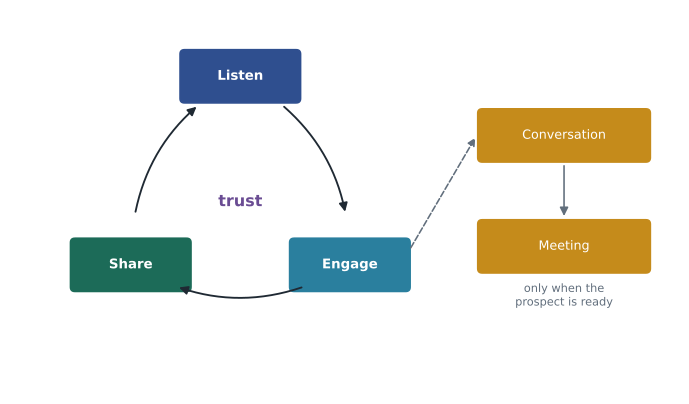
Listening comes first because it gives the seller something worth saying. A job change, an expansion, a new regulation or a complaint about an existing supplier are all triggers, events that can create a need. Sales Navigator's alerts, covered in lesson 7, make listening easier at scale, but even without paid tools a seller can follow target accounts and check their feed for ten minutes a day.
Engagement turns listening into a relationship. The best comments add something: a question, a relevant observation, a short answer to someone else's question. Comments that say only "Great post!" add nothing, and comments that pitch a product in someone else's thread annoy both the author and everyone reading. Maya's comment on Sandra's post read: "Congratulations on the second suite. Two rooms and one schedule is a real puzzle; are you booking the rooms or the staff first?" Sandra replied that afternoon, and the exchange became part of the conversation Maya had already started about Lakeview's printing needs.
What to share
Sharing is the part most sellers find hardest, because it feels like self-promotion. The way past that is to share what is useful to customers rather than what is flattering to the seller. Good B2B sales content is usually short, practical and based on real experience: what the seller sees customers struggle with, a simple checklist, an explanation of a rule or a trend, or a short story from a project, with customer permission if anyone could be identified.
| Kind of content | Example for Ridgeline's customers | Strength |
|---|---|---|
| Practical tip | "Three signs your front-desk printer is costing more than a new one" | Easy to read and save |
| Explainer | "What a managed print agreement actually includes, in plain language" | Answers questions buyers hesitate to ask |
| Observation from the field | "What I learned watching ten clinic receptionists book rooms" | Shows real experience |
| Company material with a personal comment | Ridgeline's clinic printing guide, with one line on why it matters | Uses approved material; adds the seller's voice |
| Customer story (with permission) | How a law firm cut printer jams before tax season | Shows results others can relate to |
Ridgeline's marketing team ran a light employee advocacy program: each week it shared two or three approved posts that sellers could repost with their own comment. Owen encouraged the team to use them, but to always add a sentence in their own words, because a feed full of identical reposts from one company's employees looks like advertising. He also encouraged each rep to write one original post a fortnight about something they had seen in their own work.
A simple routine
Social selling works through regular, small efforts rather than occasional bursts. Owen suggested a routine of about 20 minutes a day, split into listening and engaging, plus about an hour a fortnight to write an original post. That added up to roughly two hours a week.
Worked problem
The weekly time budget
Maya plans 20 minutes a day, five days a week, for listening and engaging on LinkedIn, plus one original post a fortnight that takes about 60 minutes to write. How many minutes a week does that average, and what share is it of a 40-hour week?
Show solution
- Daily listening and engaging per week.
- \[20 \times 5 = 100 \text{ minutes}\]
- Posting, averaged over a fortnight.
- \[\frac{60}{2} = 30 \text{ minutes a week}\]
- Total.
- \[100 + 30 = 130 \text{ minutes} \approx 2.2 \text{ hours}\]
- Share of a 40-hour week (2,400 minutes).
- \[\frac{130}{2{,}400} = 0.054 \approx 5 \text{ in } 100\]
Answer: The routine takes about 130 minutes, a little over 2 hours a week, about 5 in 100 of her working time. Owen's view was that it was worth it only if it produced conversations, which Grace could check in the CRM after a quarter.
Measuring whether it works
Social platforms give sellers numbers such as impressions (how often a post was shown), reactions, comments and reposts. These measure attention, not business. A useful summary is the engagement rate: reactions, comments and reposts divided by impressions. But the measures that matter to a sales team are the ones in the CRM: conversations, meetings and opportunities that began with social activity.
Worked problem
Engagement on two posts
Maya's first post, about clinic printers, had 1,240 impressions, 38 reactions, 9 comments and 3 reposts. Her second, a repost of a Ridgeline guide with one line of comment, had 860 impressions, 11 reactions, 1 comment and no reposts. What was each post's engagement rate, and which did more for her selling?
Show solution
- First post engagement.
- \[\frac{38 + 9 + 3}{1{,}240} = \frac{50}{1{,}240} = 0.040 \approx 4.0 \text{ in } 100\]
- Second post engagement.
- \[\frac{11 + 1 + 0}{860} = \frac{12}{860} = 0.014 \approx 1.4 \text{ in } 100\]
- Check what happened next in the CRM: two of the nine commenters on the first post were office managers in her territory, and one agreed to a short call. The second post led to no conversations.
Answer: The original post had an engagement rate of about 4.0 in 100, almost three times the repost's 1.4, and it produced a conversation. Engagement rates are useful for comparing posts, but the call it led to is what made it worth writing.
Grace also warned about dark social: sharing that platforms cannot see, such as a prospect forwarding a seller's post to a colleague by email or mentioning it in a meeting. Some of the most valuable effects of social selling never show up in any count. That is one reason to ask new prospects, "How did you hear about us?" and to record the answer.
Messaging on social networks
Direct messages on LinkedIn and similar platforms are often the bridge from social activity to a sales conversation. The rules for good messages are the same as for email: be specific, be brief and ask for something small. A connection request with no note is fine; a connection request followed immediately by a sales pitch is not. Owen's rule was to never pitch in the first message to someone who had just accepted a connection, and to wait until there was a real reason to talk, such as a question they had asked or a trigger in their news.
Canada's anti-spam law applies to more than email. CASL's definition of an electronic address includes email, instant messaging and telephone accounts and "any similar account," and the regulators have treated messages sent to social media accounts as electronic messages. So a commercial message sent through LinkedIn needs the same basis as an email: express or implied consent or an exemption, identification of the sender and a way to unsubscribe. A LinkedIn connection alone is not consent to receive sales messages. Ridgeline's practice was to send commercial messages on social platforms only to people with whom the seller had an existing conversation or business relationship, or who had published a business contact address without objecting to messages, and to keep them relevant to the person's role.
Mistakes that damage trust
Social selling goes wrong when sellers use the tools without the attitude. Common problems include automated connection requests followed by template pitches, commenting only to draw attention to oneself, arguing with prospects or competitors in public, posting confidential information, and sharing content without reading it. Each makes the seller look less trustworthy, and because social activity is public, the damage is seen by many people at once.
Building a network deliberately
Social selling depends on having the right people in the seller's network. A new seller usually starts with friends, former colleagues and classmates, few of whom are prospects. Owen suggested Maya build her network deliberately over her first quarter, aiming for quality rather than numbers. Each week she connected with a handful of people in her territory: contacts at existing Ridgeline customers, people she had met at the October office-managers' conference, and prospects she had spoken to by phone. Every connection request after a conversation included a short note referring to it, such as "Thanks for the time on Tuesday; good luck with the branch opening."
| Who to connect with | Why | Note to include |
|---|---|---|
| Contacts at existing customers | Stay visible between renewals; hear about changes early | Thank them for their business; mention their account manager |
| People met at events | Turn a brief meeting into an ongoing link | Mention the event and something you discussed |
| Prospects after a call or meeting | Make it easy for them to find you later | Refer to the conversation; no pitch |
| Colleagues at Ridgeline and partners | Share content and introductions | None needed |
| Others in the industry | Learn and be seen in the field | Explain the shared interest |
She avoided sending connection requests to large numbers of strangers in her territory with no note. Those requests are often ignored, can annoy people and, if many go unanswered, can lead the platform to limit an account.
Social selling with existing customers
Social selling is often described as a prospecting technique, but some of its most valuable uses are with existing customers. Farida Haddad, Ridgeline's senior account manager, followed the key contacts at all her accounts and paid attention to what they posted. When a contact at Keystone Grain Equipment announced a new training centre, Farida congratulated him the same day; the conversation that followed became part of the training-centre opportunity Maya later worked on. When a long-time contact at a law firm changed jobs, Farida noticed within a week and made sure the firm knew who would look after its account, and she congratulated the contact on the new role, which later led to an introduction at the new employer.
Job changes are among the most useful triggers social networks reveal. When a champion leaves a customer, the account is at risk because the new person may not know why Ridgeline was chosen. When that champion joins another organization, they may bring the same need with them. Owen encouraged the team to set alerts for job changes at key accounts and to treat each one as a reason for two conversations: one with the account the person left, and one with the person in their new job.
Common mistakes
MistakePitching in the comments on a prospect's post.
InsteadComment like a person: congratulate, ask a real question or add something useful.
MistakeReposting company content with no comment.
InsteadAdd a sentence in your own words about why it matters to customers.
MistakeMeasuring success by impressions and likes.
InsteadTrack conversations, meetings and opportunities that began with social activity.
MistakeSending a sales pitch as soon as someone accepts a connection.
InsteadWait for a real reason to talk, and follow the messaging rules for your country.
MistakeDoing social selling in occasional bursts.
InsteadKeep a small daily routine of listening and engaging, with a regular original post.
Summary and key terms
- Social selling means using social networks to find, understand and build relationships with prospects through listening, engaging and sharing, not broadcasting pitches.
- Listening finds triggers; thoughtful comments build relationships; useful, practical content earns trust.
- Employee advocacy works best when sellers add their own words.
- A routine of about 20 minutes a day plus a fortnightly post takes about 130 minutes a week.
- Engagement rate compares posts, but the measures that matter are conversations and opportunities in the CRM; much sharing happens out of sight.
- Direct messages need the same care as email, and anti-spam rules can apply to them too.
- Social selling
- Using social networks to find, understand and build relationships with prospects and customers.
- Trigger
- An event, such as an expansion or job change, that can create a need.
- Employee advocacy
- A program in which employees share approved company content on their own accounts.
- Impressions
- The number of times a post was shown to people.
- Engagement rate
- Reactions, comments and reposts divided by impressions.
- Dark social
- Sharing that platforms cannot track, such as forwarding a post by email.
Practice problems
Work each problem on paper first, then reveal the answer to check.
A post had 900 impressions, 24 reactions, 4 comments and 2 reposts. What is its engagement rate?
Show answer
30 ÷ 900 ≈ 0.033, about 3.3 in 100.
What is a better comment than "Great post!"?
Show answer
One that adds a question, observation or answer related to what the person wrote.
Why ask new prospects how they heard about you?
Show answer
Because much social influence is invisible to the platforms, so asking captures it.
Lesson quiz · 5 questions
Score 60% or more to complete this lesson.
Create a free account to save your progress, take quizzes and earn a certificate.