
SLS-221 · Lesson 5 of 12 · 19 min
Phone skills for inside sales
▶ Video coming soon A video version of this lesson is on the way.
On Tuesday, October 13, the day after Thanksgiving, Maya spent her session with a second headset plugged into Jordan Reyes's phone, listening to his outbound calls with the sound of her own microphone muted. In fifty minutes Jordan dialled 23 numbers, reached 3 people, had two real conversations and booked one meeting, with the operations manager of an accounting firm whose printer lease ended in the spring. "Three out of twenty-three sounds terrible," Jordan said afterward. "It's actually normal. The skill isn't getting everyone to answer. It's being worth listening to in the thirty seconds after someone does."
Maya had covered basic telephone skills in SLS-120. This lesson builds on that for the inside seller, who may make dozens of calls a day: how to plan a calling block, open a call to someone who did not expect it, handle the first objection, leave a voicemail worth returning, deal with gatekeepers, record the outcome and stay within the law. The examples use the calls she listened to.
Planning a calling block
Inside reps rarely make calls one at a time between other tasks. They work in calling blocks: set periods, often 45 to 90 minutes, reserved for calls, with research done beforehand and notes written immediately after each call. A block keeps the rep in a calling frame of mind and makes it easier to measure what happens. Jordan's typical day had two blocks, one from 8:30 to 9:45 a.m., when office managers and owners were often at their desks before the day got busy, and one from 3:30 to 4:30 p.m., when meetings were winding down.
Before each block, Jordan prepared a list in the CRM with, for each contact, the reason for calling in one line, the trigger that put them on the list and what the cadence had already sent. He did not write scripts word for word. Instead he kept a short talk track, a few phrases for the opening and for the most common objections, that he could adapt to each person.
The opening
The first few seconds of a call to someone who did not expect it decide whether there will be a conversation at all. The person is busy and probably doing something else. A good opening tells them who is calling and why, quickly and honestly, and gives them an easy way to say whether now is a good time. Several approaches are common; the table compares them.
| Opening approach | Example | Strengths and risks |
|---|---|---|
| "How are you today?" | "Hi Deb, how are you today?" | Polite, but strangers hear it as a sales signal and it delays the reason for the call |
| Permission-based | "Hi Deb, it's Jordan from Ridgeline. This is a cold call; can I have thirty seconds to tell you why, and then you can decide?" | Honest and disarming; some people find it scripted |
| Reason-first | "Hi Deb, it's Jordan at Ridgeline. I'm calling because your printer lease with us ended in 2023 and your new one probably ends next spring." | Gets to relevance fast; needs a real, specific reason |
| Referral | "Hi Sandra, it's Maya Chen. Dr. Anand at Northfield suggested I call." | Strongest when genuine; never invent or stretch a referral |
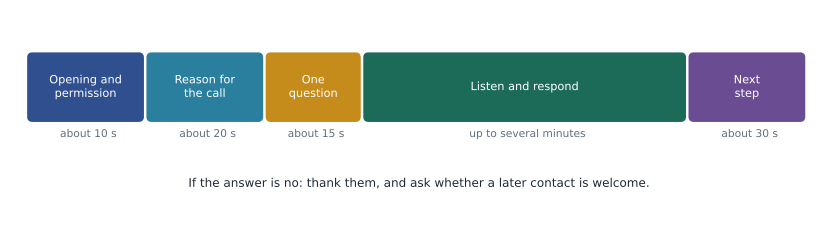
Jordan usually combined the permission and reason-first approaches: his name and company, a plain statement that he was calling them out of the blue, and a specific reason in one sentence. Then he stopped and let the person respond. Sales trainers often say the most common mistake on cold calls is talking too much in the first minute; vendors of call-recording software have published analyses of millions of recorded calls suggesting that successful cold calls tend to have shorter seller monologues. Those analyses come from companies selling the software, so their exact figures should be read cautiously, but the general advice matches experience: say why you called, then ask, then listen.
The first objection
Most people's first reaction to an unexpected call is some form of brush-off: "we're all set," "send me an email," "not interested," "I'm busy." These are rarely considered decisions; they are reflexes. SLS-213 covered objection handling in negotiation, where the buyer knows the offer. On a cold call, the aim is narrower: not to argue, but to find out whether there is any reason to keep talking.
Jordan's approach was to acknowledge the reaction, offer one piece of relevant information or one question, and accept the answer. For example, when the operations manager at Sandstone Accounting said, "We're all set with printers," he replied: "That makes sense; most firms are. The reason I called is that leases like yours usually end in the spring, and the firms I talk to find it easier to compare options before tax season than during it. Is your lease ending this year, or am I early?" If she had said, "We signed a new one last year," he would have thanked her, noted the date and moved on.
| Brush-off | Response that keeps the door open | When to stop |
|---|---|---|
| "We're all set." | "That makes sense. When does your current agreement end, so I can check back at a better time?" | If they have just signed a long agreement |
| "Send me an email." | "Happy to. So I send something useful, is it the cost, the service or the timing you'd want to compare?" | If they repeat it; send the email and stop |
| "Not interested." | "Fair enough. Can I ask whether it's the timing or that this just isn't something you handle?" | If they say no again |
| "I'm busy." | "Understood. Would Thursday morning be better for five minutes, or should I leave it?" | If they decline a later time |
Respect matters more than technique. If the person says no twice, or asks not to be called, the rep says thank you, ends the call and records the request so nobody calls them again. Pushing past a clear no costs more in reputation than it ever gains in meetings, and as the rules below explain, ignoring a do-not-call request can break the law.
Voicemail
Most outbound calls end in voicemail. A good voicemail is short, about 20 to 30 seconds, gives the caller's name and company, one specific reason and a clear way to respond, and refers to an email the person will see. Jordan's voicemails rarely asked for a call back directly; instead they pointed to the email. "Hi Deb, it's Jordan Reyes at Ridgeline. I'm calling about your printer lease, which I think ends in the spring. I've sent you a short email with two dates for a ten-minute call. Again, Jordan Reyes, Ridgeline," followed by his number said slowly, twice.
Return rates on cold voicemails are low, but voicemails make the next email more likely to be read, because the name is familiar. Grace's data showed that contacts who received a voicemail on day 3 of the tier B cadence were somewhat more likely to reply to the day 5 email than those who did not, although the difference was small enough that she treated it as a hint rather than proof.
Gatekeepers
In many offices, the first person to answer is not the person the rep wants to reach. Receptionists, assistants and office managers are often called gatekeepers, though the term can be disrespectful: they are often influential people who know how decisions are made. Jordan treated them as allies. He was honest about who he was and why he was calling, asked for help rather than trying to trick his way past, and often learned more from the receptionist than from the decision-maker, such as when the lease ended, who handled the printers and when the managing partner was usually in.
Tactics that rely on deception, such as pretending to know the decision-maker, implying an existing relationship that does not exist or calling the decision-maker's personal mobile without permission, damage the company's reputation and can break the rules on misleading representations covered in SLS-150. They also tend to backfire in small communities where receptionists talk to each other.
Recording the outcome
Every call attempt gets a disposition in the CRM: a short code for what happened, such as no answer, voicemail left, wrong number, reached gatekeeper, conversation with no next step, meeting booked or asked not to be called. Dispositions let Grace calculate the team's calling numbers and spot problems, such as a list full of wrong numbers. Jordan also wrote a one-line note after any conversation, because the details he remembered at 9:46 a.m. would be gone by the afternoon.
Worked problem
How many dials does a meeting take?
Over September 2026, Jordan made 610 outbound dials. He reached a person 61 times, had a real conversation (more than a brief brush-off) 38 times and booked 12 meetings. What are his connect rate, conversation rate and meeting rate, and how many dials did each meeting take?
Show solution
- Connect rate: people reached divided by dials.
- \[\frac{61}{610} = 0.10 = 10 \text{ in } 100\]
- Conversation rate: conversations divided by connects.
- \[\frac{38}{61} = 0.623 \approx 62 \text{ in } 100\]
- Meeting rate: meetings divided by conversations.
- \[\frac{12}{38} = 0.316 \approx 32 \text{ in } 100\]
- Dials per meeting.
- \[\frac{610}{12} \approx 50.8\]
Answer: About 10 in 100 dials reached a person, about 62 in 100 of those became real conversations, and about 32 in 100 of conversations became meetings. Each meeting took about 51 dials. At roughly 2 minutes per dial including notes, that is about 100 minutes of calling per meeting, before counting the research and emails that also supported it.
These rates help in two ways. They show where a rep can improve: Jordan's low connect rate was typical, but his meeting rate was high, so his time was best spent getting more connects, for example by calling at better times. And they make targets realistic. If a rep is asked to book 15 meetings a month, the arithmetic says that means about 760 dials at Jordan's rates, which is roughly 36 a working day.
Caller ID and spam labels
Many phone networks now label incoming calls as "spam likely" or "scam risk" based on patterns such as many short calls from one number. Both Canada and the United States require phone companies to use a caller ID authentication framework known as STIR/SHAKEN, which helps networks check that a call really comes from the number shown. For a legitimate inside team, the practical points are to call from numbers registered to the business, to keep a stable local number for each rep rather than rotating numbers, to avoid very high volumes from a single line and to answer when prospects call back.
The law on sales calls
In Canada, the CRTC's Unsolicited Telecommunications Rules apply to telemarketing calls. Calls made to businesses are exempt from the National Do Not Call List rules, so Ridgeline does not have to check business numbers against the national list, but they are not exempt from everything: callers must identify themselves and the company they represent, provide contact information on request, and keep an internal do-not-call list, adding a number within 14 days of a request and keeping it there for 3 years and 14 days. Calls to people at home or on personal mobiles are consumer telemarketing and must follow the full rules, including the national list and calling hours of 9:00 a.m. to 9:30 p.m. on weekdays and 10:00 a.m. to 6:00 p.m. on weekends.
Automated and artificial-voice calls face stricter rules. Under the CRTC's rules, an automatic dialing-announcing device (ADAD), a system that plays a pre-recorded or synthesized message, may not be used for unsolicited calls that sell or promote something unless the person has given express consent. In June 2026, the CRTC opened a public consultation (Compliance and Enforcement Notice of Consultation CRTC 2026-132) on updating these rules, including whether the ADAD definition clearly covers AI-generated voices and whether callers should have to say at the start that no live person is speaking. Until the rules change, Ridgeline's policy treated any AI-generated voice as a synthesized message: no automated voice calls for selling, and no AI voice agents placing outbound sales calls.
Call recording is covered in SLS-120 and SLS-150. Ridgeline recorded inside-team calls for coaching, so every recorded call began with a short notice that the call might be recorded, as privacy law requires when a business collects personal information this way, and recordings were deleted after 12 months.
Common mistakes
MistakeOpening with a long introduction before the reason for calling.
InsteadGive your name, company and a specific reason in a sentence or two, then ask and listen.
MistakeArguing with a brush-off.
InsteadAcknowledge it, offer one relevant point or question, and accept a second no.
MistakeLeaving long voicemails asking for a call back.
InsteadKeep voicemails to 20 to 30 seconds and point to an email with a clear next step.
MistakeTrying to trick gatekeepers.
InsteadBe honest and ask for help; receptionists often know how decisions are made.
MistakeUsing an AI voice or prerecorded message for sales calls.
InsteadFollow the consent rules for artificial voices; at Ridgeline, do not use them for selling at all.
Summary and key terms
- Inside reps call in planned blocks with a short talk track rather than a script.
- A good opening gives the caller's name, company and a specific reason quickly and then listens.
- Brush-offs are reflexes: acknowledge, offer one point or question, and accept a second no.
- Voicemails should be short and point to an email.
- Gatekeepers are allies.
- Every call gets a disposition.
- Jordan's September numbers, 610 dials, 61 connects, 38 conversations and 12 meetings, mean about 51 dials per meeting.
- Calls must follow telemarketing rules on identification, do-not-call lists and calling hours, and artificial or AI-generated voices face strict consent rules in both countries.
- Calling block
- A set period reserved for making calls, with research done beforehand.
- Talk track
- A few flexible phrases for the opening and common objections, rather than a word-for-word script.
- Connect rate
- The share of dials that reach a person.
- Disposition
- A code recorded in the CRM for the outcome of a call attempt.
- Gatekeeper
- A receptionist, assistant or office manager who answers before the decision-maker.
- Internal do-not-call list
- A company's own list of people who have asked not to be called.
- Artificial voice
- A prerecorded, synthesized or AI-generated voice used in a call.
Practice problems
Work each problem on paper first, then reveal the answer to check.
A rep made 480 dials, reached 52 people, had 30 conversations and booked 9 meetings. How many dials per meeting?
Show answer
480 ÷ 9 ≈ 53 dials per meeting.
A prospect says "send me an email." What is a good response?
Show answer
Agree, and ask one question about what would make the email useful, such as whether cost, service or timing matters most.
What should a rep do when a prospect asks not to be called again?
Show answer
Thank them, end the call and add them to the internal do-not-call list straight away.
Lesson quiz · 5 questions
Score 60% or more to complete this lesson.
Create a free account to save your progress, take quizzes and earn a certificate.