
SLS-221 · Lesson 4 of 12 · 20 min
Outbound cadences
▶ Video coming soon A video version of this lesson is on the way.
On October 5, Tyler Greyeyes turned his second screen toward Maya. It showed a calendar grid with one row for each of twenty contacts at clinics in Maya's territory, and coloured squares across fifteen working days: blue for emails, green for calls, orange for LinkedIn steps. "This is a cadence," he said. "SLS-210 showed you the basic idea. Today I'll show you how we actually build them, why each step is where it is, and how we tell whether one works."
A cadence (also called a sequence) is a planned series of contacts, spread over a set period and across more than one channel, used to start a conversation with a prospect who has not asked to hear from the company. Cadences exist because one message rarely gets a reply. People are busy, miss emails and do not pick up calls from unknown numbers. A cadence makes persistence systematic and polite: each contact adds something, the gaps give the prospect room, and the sequence ends at a planned point rather than continuing until the prospect complains.
Ridgeline's standard cadence
SLS-210 introduced Ridgeline's standard tier B cadence: eight touches over fifteen business days, on days 1, 1, 3, 5, 8, 10, 12 and 15. Tyler showed Maya what each touch was and why it sat where it did.
| Day | Channel | What it does |
|---|---|---|
| 1 | Short, specific opener tied to a trigger, such as a lease ending or a new location | |
| 1 | View the profile and send a connection request without a sales pitch | |
| 3 | Phone | Call; if no answer, leave a 20-second voicemail that refers to the email |
| 5 | Reply in the same thread with one useful idea or a short example from a similar clinic | |
| 8 | Phone | Call at a different time of day from day 3 |
| 10 | LinkedIn or video | A comment on something the person posted, or a short personal video (lesson 6) |
| 12 | Phone and email | Call; follow with a short email offering two specific times |
| 15 | A polite closing message: last note for now, how to reach Ridgeline, permission to say no |
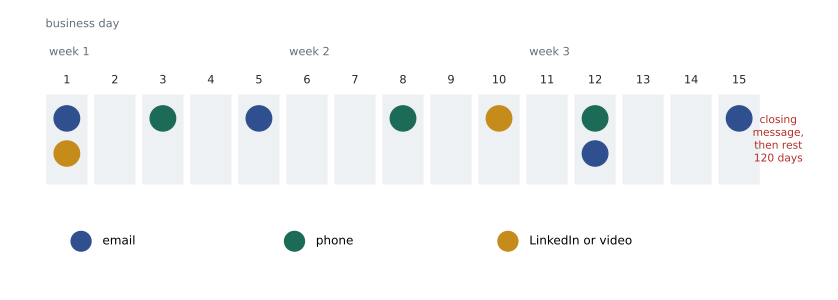
Several design choices are worth noticing. Touches cluster early, when the trigger is most relevant, and spread out later. Channels alternate, so that a prospect who never answers the phone still sees emails and a prospect who ignores email still hears a voice. Calls fall at different times of day, because the same person may be at their desk at 8:15 a.m. but never at 2:00 p.m. And the cadence ends. After the closing message, the account rests for 120 days before anyone on the team contacts it again, unless the prospect replies or something new happens, such as a new office opening.
Matching the cadence to the account
One cadence does not fit every account. Ridgeline used three levels of effort, matching the account tiers from SLS-210. Tier A accounts, the 63 largest and best-fit organizations in Maya's territory, got a high-touch cadence: fewer contacts in the sequence, but each one heavily researched and personal, often involving several people at the same organization and sometimes a mailed letter or a visit. Tier B accounts got the standard cadence, with a personal first line and a personal reason in each email but otherwise reused templates. Tier C accounts got a light cadence of four touches, mostly email, with templates personalized only by name, industry and the trigger that put them on the list.
| Tier | Touches | Research per contact | Personalization | Typical use |
|---|---|---|---|---|
| A | 6 to 8, over about four weeks | 20 to 30 minutes | Every message written for the person | Large clinics, school divisions, multi-site firms |
| B | 8, over 15 business days | 5 to 10 minutes | Personal opening and reason; reused body | Mid-sized offices with a known trigger |
| C | 4, over 10 business days | 1 to 2 minutes | Name, industry and trigger only | Small offices on a broad list |
Tyler stressed that "personalized" did not mean mentioning the prospect's alma mater or favourite sports team. It meant showing that Ridgeline understood something specific about their situation that made a conversation worth their time. "I don't care that you both like hockey," he said. "I care that you know their lease ends in March and that they just added three dentists."
Capacity: how many people one rep can work
Cadences are limited by time. Each touch takes a few minutes, and research takes more. A rep can only start so many new contacts each day before the follow-up touches for earlier contacts fill the calendar. Grace Liu taught the inside team to plan capacity with simple arithmetic.
Worked problem
How many new contacts can a rep start each day?
Tyler works the standard tier B cadence. Research for each contact takes about 8 minutes. The eight touches take, on average, 3 minutes for each email, 2 minutes for each LinkedIn step and 4 minutes for each call attempt including a voicemail and notes. Day 12 has both a call and an email. Tyler spends about 4.5 hours a day on outbound work. Once the cadence is running steadily, how many new contacts can he start each working day?
Show solution
- Count the touches by type: emails on days 1, 5, 12 and 15 (4); LinkedIn on days 1 and 10 (2); calls on days 3, 8 and 12 (3).
- Minutes per contact over the whole cadence.
- \[8 + 4 \times 3 + 2 \times 2 + 3 \times 4 = 8 + 12 + 4 + 12 = 36 \text{ minutes}\]
- In a steady state, each day Tyler does the full 36 minutes of work for every contact he starts that day (spread across the next three weeks). Outbound minutes per day:
- \[4.5 \times 60 = 270 \text{ minutes}\]
- New contacts per day.
- \[\frac{270}{36} = 7.5\]
Answer: Tyler can start about 7 or 8 new contacts a day, about 37 a week, and keep up with all their follow-ups. If he tried to start 15 a day, by the second week his follow-up touches would crowd out new contacts, and the later steps of each cadence, which often produce the replies, would be skipped.
This arithmetic explains a common failure. A rep who starts a large batch of new contacts on Monday has an easy first day and an impossible second week, when every one of those contacts is due for a call and an email at once. Steady daily starts keep the workload even.
Which touches produce replies
A cadence is a small experiment that runs again and again, so it produces data. Grace tracked, for each cadence, how many contacts replied or booked a meeting at each step. The results for Ridgeline's tier B cadence over the summer of 2026 showed a pattern common in outbound work: the first email and the later calls did a lot of the work, and the closing message produced a surprising number of replies.
Worked problem
Replies by touch
Over June to August 2026, the inside team started the tier B cadence with 360 contacts. Replies by step (positive or negative, excluding automatic out-of-office messages) were: day 1 email, 11; day 1 LinkedIn, 3; day 3 call, 5; day 5 email, 7; day 8 call, 6; day 10 LinkedIn or video, 4; day 12 call and email, 8; day 15 closing email, 10. What was the overall reply rate, and what share of replies came after the first two touches?
Show solution
- Total replies.
- \[11 + 3 + 5 + 7 + 6 + 4 + 8 + 10 = 54\]
- Overall reply rate.
- \[\frac{54}{360} = 0.15 = 15 \text{ in } 100\]
- Replies after the first two touches (day 3 onward).
- \[54 - (11 + 3) = 40\]
- \[\frac{40}{54} = 0.741 \approx 74 \text{ in } 100\]
Answer: About 15 in 100 of contacts replied at some point, and about 74 in 100 of those replies came from the third touch onward. A rep who gave up after one email and one connection request would have missed three-quarters of the conversations. The closing message alone produced 10 replies, almost as many as the first email.
Not every reply was good news. Of the 54 replies, 19 were positive (interest or a meeting), 23 were "not now" with a reason, and 12 asked to be removed or were clearly annoyed. Grace watched the third group closely. If removal requests rose, it usually meant a list included the wrong people, or a template had become too pushy.
Testing and improving cadences
Teams often test changes to a cadence, for example two different subject lines or a call before the first email rather than after. These A/B tests are useful, but sample sizes in B2B outbound are small, so results need care. If one subject line gets 6 replies from 50 contacts and another gets 4 from 50, the difference could easily be chance. Grace's rule was to run a test until each version had at least 150 to 200 contacts, to change only one thing at a time, and to judge on meetings held rather than opens or clicks, which email privacy features now make unreliable.
SLS-140 described Owen's September experiment comparing a purchased list with a targeted one. That was not a small A/B test but a stark contrast: 400 purchased contacts produced 3 meetings and 9 unsubscribe requests, while 60 targeted contacts produced 11 meetings. The difference was too large to be chance, and Ridgeline stopped buying lists for email outreach.
Rules every cadence must follow
Every outbound cadence must follow the law and the company's own rules. In Canada, CASL applies to every commercial email, text and social media direct message. Messages to people at other organizations can rely on the business-to-business exemption only where the two organizations already have a relationship and the message concerns the recipient's business, or on implied consent where the person has conspicuously published their business email address without saying they do not want unsolicited messages, and the message relates to their role, as SLS-210 explained. Every message must identify the sender and include an unsubscribe method that works for at least 60 days, and unsubscribes must be honoured within 10 business days. Calls are covered by the CRTC's telemarketing rules (lesson 5): calls to businesses are exempt from the National Do Not Call List rules but not from the identification rules or the requirement to keep an internal do-not-call list.
Mailbox providers set rules too. In 2024, Google and Yahoo began enforcing requirements for organizations that send large volumes of email, including authenticating their domains and keeping spam complaint rates low. Ridgeline's outbound volume was far below the bulk-sender thresholds, but the same practices protected its emails from landing in spam folders: send from a properly authenticated domain, keep each rep's daily volume modest, remove bounced addresses quickly and stop emailing anyone who asks.
Ridgeline's own rules went further than the law in two places. Reps could not add anyone to a cadence who had asked to be removed in the past two years, even under a new campaign, and reps could not run more than one cadence at the same person at the same time. Both rules came from complaints in 2024, when two reps had emailed the same office manager about two different products in the same week.
Contacting more than one person at an account
For larger accounts, a cadence aimed at one person is fragile. If that person is on leave, has just changed jobs or simply never reads unsolicited email, the whole effort is wasted. Tyler's tier A cadences therefore usually ran in parallel to two or three people at the same organization, a practice often called multithreading. At a clinic, that might mean the office manager, the managing physician and the person who handled the clinic's IT. Each person received messages written for their role: the office manager heard about jams and service calls, the physician about cost and patient-facing reliability, the IT contact about security and support.
Multithreading needs coordination. The messages to different people must be consistent, must not pretend the others have not been contacted and must not overwhelm a small office. Tyler's rule was that if one person replied, the cadences to everyone else at that account paused until he had spoken to the person who replied and asked whom else he should involve. He also kept the number of people contacted at small organizations to two at most, because in a ten-person office three people receiving messages from the same company in one week feels like pressure, not attention.
Common mistakes
MistakeStarting a big batch of new contacts on Monday.
InsteadStart a steady number each day so follow-up touches do not pile up in week two.
MistakeGiving up after one or two touches.
InsteadMost replies come from the third touch onward; finish the cadence.
MistakePersonalizing with trivia about the prospect.
InsteadPersonalize with something specific about their situation that makes a conversation worth their time.
MistakeJudging an A/B test on 50 contacts per version.
InsteadWait for at least 150 to 200 per version, change one thing, and judge on meetings held.
MistakeRunning two cadences at the same person.
InsteadCoordinate so each contact receives one sequence at a time, and honour removal requests promptly.
Summary and key terms
- A cadence is a planned series of contacts across several channels, ending at a set point.
- Ridgeline's tier B cadence has eight touches over fifteen business days, alternating email, phone and LinkedIn, and ends with a closing message; the account then rests for 120 days.
- Effort matches the account tier: high-touch for A, standard for B, light for C.
- Capacity arithmetic shows a rep can start about 7 or 8 new contacts a day on the standard cadence.
- Over the summer, 54 of 360 contacts replied, and about 74 in 100 of replies came from the third touch onward.
- Tests need large samples, and every cadence must follow anti-spam and telemarketing law and company rules.
- Cadence
- A planned series of contacts over a set period and across several channels, used to start a conversation.
- Touch
- One contact in a cadence, such as an email, call or LinkedIn step.
- High-touch cadence
- A cadence with fewer, heavily researched and personal contacts, used for the most important accounts.
- Closing message
- The last touch in a cadence, telling the prospect it is the last message for now and how to get in touch.
- A/B test
- A comparison of two versions of a message or step, each sent to a similar group.
- Reply rate
- The share of contacts in a cadence who reply at any step.
Practice problems
Work each problem on paper first, then reveal the answer to check.
A cadence takes 40 minutes per contact over its full length and a rep has 4 hours a day for outbound work. How many new contacts can the rep start each day?
Show answer
240 ÷ 40 = 6 new contacts a day.
Out of 200 contacts, 28 replied. What is the reply rate?
Show answer
28 ÷ 200 = 0.14, or 14 in 100.
Why does Ridgeline rest an account for 120 days after a cadence?
Show answer
To avoid wearing out the prospect, and so that the next contact comes with something new to say.
Lesson quiz · 5 questions
Score 60% or more to complete this lesson.
Create a free account to save your progress, take quizzes and earn a certificate.